

A compliant ingredient list doesn’t, by itself, make a cosmetic halal. Halal compliance for cosmetics also depends on ingredient provenance, processing aids and controls that prevent cross-contamination during manufacturing. These distinctions matter when comparing halal and vegan claims or considering how halal certification sits alongside cosmetic quality management.
Requirements can be difficult to assess because raw-material documentation may be incomplete, and frameworks associated with JAKIM, MUI and GAC may differ across markets. This guide gives manufacturers a practical way to review ingredient eligibility, strengthen supply-chain controls and prepare for an audit.
You’ll learn how halal requirements differ from vegan standards and cosmetic quality management, which records can support an assessment, and how to plan for regional certification needs. International Associates Limited provides independent Halal certification and auditing globally, with a head office in Glasgow and regional offices across Europe, Asia and the Middle East. Its audit process includes a technical review of documentation and verification of management system implementation.
Key Takeaways
- Halal compliance for cosmetics depends on more than ingredient declarations. Traceability and manufacturing controls are central to a credible certification case.
- Review the origin and processing of animal-derived ingredients such as collagen, keratin and glycerin before they enter a formulation.
- Vegan claims and halal certification address different requirements, so assess ingredients and production processes against the relevant standard.
- Prepare for certification by organising technical records and reviewing internal controls before submitting an application.
- Independent auditing can assess whether documented controls are implemented in practice and support a clear certification process.
Halal Compliance for Cosmetics: Strategic Market Entry in 2026
Halal market entry depends on more than removing prohibited ingredients. Halal compliance for cosmetics requires manufacturers to consider ingredient origins, manufacturing controls and product handling against the requirements relevant to their target markets. The principles of Islamic law provide the foundation, while independent certification gives buyers and consumers an externally assessed basis for confidence.
The commercial opportunity is substantial, although market estimates vary widely: 2026 projections range from approximately USD 51 billion to more than USD 125 billion, reflecting differences in research methodology. Treat these figures as indicators of market potential rather than a single settled valuation. For manufacturers, the practical decision is whether target markets and distribution plans justify building documented Halal controls into product development and production.
Halal certification complements, but does not replace, ISO 22716, the cosmetics Good Manufacturing Practices (GMP) standard. ISO 22716 addresses cosmetic manufacturing practices; Halal assessment additionally considers religiously compliant sourcing and controls to prevent prohibited materials from entering products or processes. Used together, Halal certification and quality management standards such as ISO 9001 can support a structured approach to product and process assurance.
The Concept of ‘Tayyib’ in Modern Cosmetic Manufacturing
For manufacturers, tayyib extends consideration beyond permissibility to qualities associated with purity and good practice. In operational terms, examine how materials are sourced, handled and controlled throughout production, rather than relying on finished-product claims alone. Ethical sourcing can also connect with social accountability: documented supplier expectations and responsible workplace practices strengthen supply-chain governance. International Associates Limited provides Social Accountability Audits as a related area of independent assessment.
Global Regulatory Frameworks for 2026
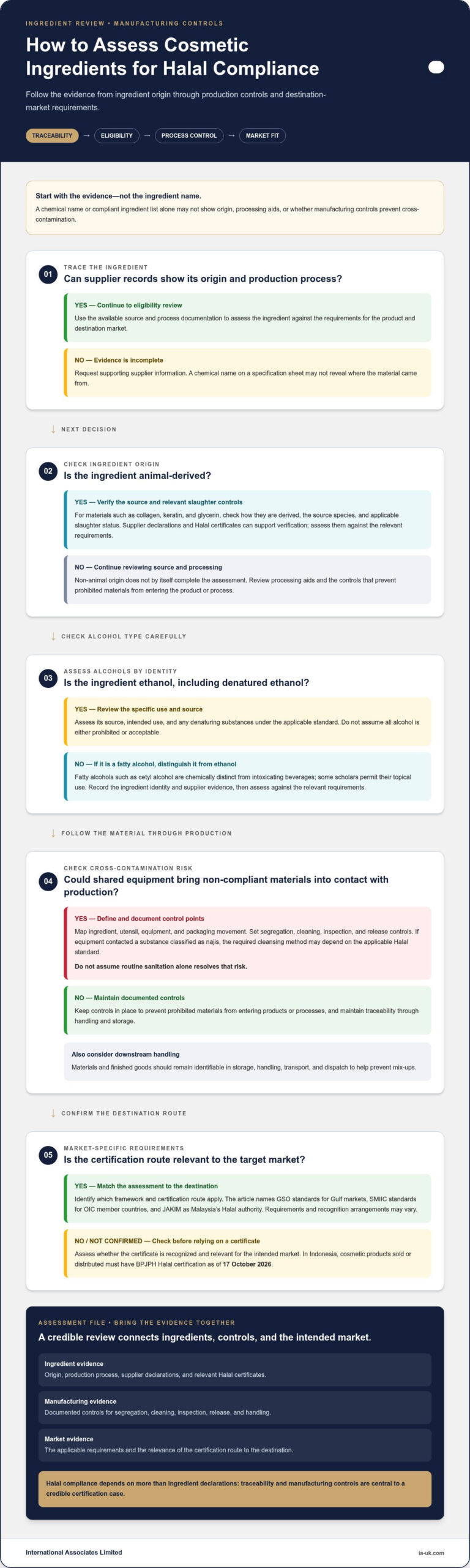
Manufacturers serving multiple regions should identify which framework and certification route apply to each destination. GSO standards are relevant across Gulf markets, SMIIC develops standards for OIC member countries, and JAKIM is Malaysia’s Halal authority. Requirements and recognition arrangements may vary, so assess a certificate’s relevance against the intended market. In Indonesia, cosmetic products sold or distributed must have BPJPH Halal certification as of 17 October 2026.
The Halal Assurance System (HAS) is the documented set of policies, controls and records used to maintain Halal integrity from ingredient sourcing through manufacturing. An independent certification body can assess this system and the supporting documentation, giving manufacturers a structured way to demonstrate how controls are applied. International Associates Limited provides independent Halal certification globally, with a Glasgow head office and regional offices across Europe, Asia and the Middle East.
Navigating Najis: Ingredient Sourcing and Critical Control Points
Ingredient review must look beyond the name printed on a specification sheet. Najis refers to substances considered impure under Islamic requirements; potential concerns include pig-derived materials, blood, carrion and animal ingredients whose sourcing or slaughter status does not meet the applicable criteria. An ingredient’s chemical name alone may not reveal its origin, so manufacturers need documented evidence connecting each material to its source and production process.
Collagen, keratin and glycerin illustrate the challenge. Their compliance status depends on how they are derived and, for animal-based materials, the source species and relevant slaughter controls. Supplier declarations and Halal certificates can support verification, but assess evidence against the certification requirements that apply to the product and destination market. The American Halal Foundation’s overview of Halal certification requirements also highlights the importance of reviewing ingredients alongside manufacturing and supply-chain controls.
Alcohol requires similarly careful assessment, not a blanket assumption that every alcohol is prohibited or acceptable. Ethanol, including denatured ethanol, should be evaluated for its source, intended use and denaturing substances under the relevant standard. Fatty alcohols such as cetyl alcohol are chemically distinct from intoxicating beverages, and some scholars permit their topical use. Record the ingredient identity and supplier evidence so they can be assessed against the appropriate requirements.
Critical Control Points in the Factory
Shared equipment creates a cross-contamination risk if non-compliant materials can contact Halal production. Map where ingredients, utensils, equipment and packaging move, then define segregation, cleaning, inspection and release controls. Chemical sanitisation addresses hygiene, but where equipment has contacted a substance classified as najis, the required cleansing method may depend on the applicable Halal standard. Document the approved procedure rather than assuming routine sanitation alone resolves the risk.
Integrity must continue beyond the production line. Keep materials and finished goods identifiable in storage, and maintain controls during handling, transport and dispatch to prevent mix-ups or contact with non-compliant goods. Make these controls proportionate to the risks identified in the operation.
Technical Documentation and Traceability
A strong audit file connects formulation records to supplier evidence, process controls, cleaning records and batch traceability. Each raw material needs sufficient, current evidence to substantiate its status. A certificate may be appropriate, while other documentation may be needed depending on the material and applicable scheme. Digital systems can support this work when they link approved materials and suppliers to production batches and preserve relevant changes and records.
During certification, International Associates Limited’s independent audit process includes a technical review of documentation and verification of management system implementation. Manufacturers can prepare by organising records so that each ingredient, supplier and production batch can be traced through the relevant evidence.
Halal vs. Vegan Cosmetics: Why Compliance Requires More
A vegan claim and a Halal certificate communicate different things. Vegan standards exclude animal-derived ingredients such as beeswax, honey and lanolin, while Halal assessment applies Islamic requirements to ingredients and how products are manufactured. Some animal-derived ingredients may be acceptable under Halal requirements if their source and processing meet the applicable criteria. Conversely, a vegan formula may still raise questions about alcohol, enzymes or contamination controls.
Alcohol is a common point of confusion. Vegan status doesn’t determine whether an alcohol-based solvent meets Halal requirements: the source, type and use of the substance matter, and assessments can vary by applicable standard and interpretation. Manufacturers should document the solvent’s identity and origin rather than treating all alcohols as either automatically prohibited or acceptable.
Tayyib encourages attention to purity and ethical conduct, but it shouldn’t be used to imply that every Halal scheme applies identical animal-testing rules. Brands should identify the specific requirements of their certification programme and target markets, then keep claims aligned with verified controls. In OIC markets, Halal certification signals that a product has undergone assessment against religious compliance criteria; a vegan claim alone doesn’t provide that assurance. For US exporters, the International Trade Administration’s guidance on cosmetics and trade requirements provides separate market context.
Decision Matrix: Halal, Vegan and Organic
Halal: Assesses ingredient permissibility, sourcing and manufacturing controls, including measures to protect product integrity.
Vegan: Excludes animal-derived ingredients, but doesn’t by itself assess religious compliance, alcohol or facility cross-contamination.
Organic: Refers to compliance with a particular organic scheme; its input and production criteria are distinct from both Halal and vegan requirements.
Multi-certification can support brands serving consumers with different priorities, but each claim needs its own applicable evidence. For a vegan brand moving towards Halal certification, start by mapping solvents, enzymes, processing aids, supplier documentation and shared-line controls. Address evidence gaps before submitting the technical file for audit.
Addressing the Plant-Based Misconception
Plant-based does not automatically mean Halal if an ingredient has been processed with non-compliant enzymes or other materials.
For genetically modified ingredients, the presence of genetic modification alone shouldn’t be treated as a universal Halal ruling. Assess the source material, processing inputs and applicable certification standard. Keep supplier evidence traceable to the ingredient and its production process. For a broader overview of certification decisions, read the Halal certification and regulatory guidance from International Associates Limited, which provides independent Halal certification and auditing globally.
The 2026 Halal Certification Roadmap for Cosmetic Manufacturers
A clear certification plan helps teams organise evidence, assign responsibilities and address gaps before an independent assessment. The precise process, surveillance frequency and certificate validity depend on the applicable certification scheme and target market, so use the chosen scheme’s requirements rather than assume one universal timetable. This roadmap outlines the main stages of Halal compliance for cosmetics.
- 1. Gap analysis: Compare current ingredient controls, supplier evidence, production processes and records with the relevant Halal requirements. An internal review can identify missing documentation and cross-contamination risks before application.
- 2. Application and technical file: Submit the application and organise formulation details, raw-material evidence, supplier information and procedures for review. Keep documents current and traceable to the products being assessed.
- 3. Audit and verification: The certification body assesses the relevant operations and verifies that the Halal Assurance System is implemented. Be prepared to demonstrate how controls work in practice, not only how they are described in procedures.
- 4. Technical review and decision: Audit findings and technical evidence are reviewed before a certification decision is made. Address any identified non-conformities through the applicable process.
- 5. Ongoing compliance: Maintain records, controls and supplier oversight after certification. Surveillance and renewal arrangements follow the scheme’s stated cycle.
Preparing Your Team for the Halal Audit
Assign a responsible internal lead who can coordinate records, answer questions and track corrective actions. A formally titled “Halal Lead Internal Auditor” isn’t a universal requirement across all schemes, but staff with relevant audit competence can help maintain oversight. Professional training can strengthen internal audit capability and help teams identify evidence gaps before external assessment.
Documentation reviews commonly encounter incomplete supplier certificates, mismatches between formulation records and production documents, or procedures that don’t reflect actual practice. Reconcile ingredient lists, batch records and approved supplier information before submission. Control changes so the file remains aligned with production.
Surveillance and Recertification Cycles
Don’t assume every certificate follows a three-year lifecycle or requires annual surveillance. Validity periods, surveillance intervals and renewal steps are set by the applicable scheme, so record the dates and obligations stated for your certification. Report proposed changes to raw materials, suppliers or processes through the required change-control route, and retain the resulting assessment records. This keeps certification records aligned with the scheme’s requirements.
International Associates Limited provides independent Halal certification and auditing globally. To understand how certification fits with applicable regulatory requirements, explore the Halal regulatory compliance information.
Choosing a Global Halal Certification Body: The IA-UK Advantage
For cosmetic manufacturers, the certification body affects how technical evidence is assessed and how well the audit fits target-market plans. International Associates Limited provides independent Halal certification and auditing globally, with a Glasgow head office and regional offices across Europe, Asia and the Middle East. Its audit process includes a technical review of documentation and verification of management system implementation.
International Associates Limited uses advanced IT infrastructure to support an efficient audit process and quick certificate turnaround. Independent third-party assessment also gives retailers, distributors and other stakeholders evidence that Halal controls have been reviewed beyond the manufacturer’s own claims. Recognition depends on the relevant certification scope and destination-market arrangements, so it shouldn’t be assumed to be automatic across every country.
Cosmetic brands can also align Halal assurance with broader quality objectives. Halal certification can sit alongside ISO 9001 quality management, while ISO 22716 provides a cosmetics GMP framework. These approaches address related but distinct aspects of assurance, including quality systems, manufacturing practice and Halal integrity.
Accreditations and Recognition
Before selecting a certification route, manufacturers should understand the body’s accreditation and membership status and how its scope relates to the markets they intend to serve. A certificate’s acceptance can depend on destination requirements and recognition arrangements, so market-specific scope matters as much as the issuing body’s international footprint. Review the applicable scheme requirements and confirm that the certification scope covers the products and operations included in the application.
Next Steps for Your Cosmetic Brand
Prepare a concise scope for a formal quotation: identify the products and manufacturing sites involved, the target markets, and the status of ingredient and process documentation. A preliminary gap assessment can highlight evidence or control issues to address before the audit, helping the team plan the certification process and reduce avoidable delays.
For manufacturers pursuing Halal compliance for cosmetics, International Associates Limited provides independent certification and auditing, supported by a global network of offices. To explore how certification can fit within a wider management-system approach, visit the Management System Certification page.
Build a Clear Path to Global Halal Certification
Halal compliance for cosmetics depends on verified ingredient sourcing, effective controls against cross-contamination and traceable documentation. Vegan claims alone don’t establish Halal status, and manufacturers should assess requirements against the certification scheme and markets they intend to serve. A structured audit roadmap can help teams identify gaps, prepare technical files and maintain controls after certification.
Independent assessment provides stakeholders with assurance beyond product claims. International Associates Limited combines a global auditing network, regional offices across Europe, Asia and the Middle East, and experience in independent certification. Its advanced IT infrastructure supports an efficient audit process and quick certificate turnaround.
Take the next step towards a well-documented certification programme. Start your Halal certification journey with International Associates Limited.
Frequently Asked Questions
Is alcohol allowed in Halal-certified cosmetics?
Some alcohols may be acceptable, but the answer depends on the substance, its source, intended use and the applicable certification standard. Intoxicating beverages and cosmetic ingredients such as cetyl alcohol are not the same category, and interpretations can differ. Don’t assume that all alcohol is prohibited or that denatured ethanol is automatically acceptable. Record the ingredient identity and supplier information so they can be assessed against the relevant Halal requirements.
Do Halal cosmetics have to be vegan?
No. Halal cosmetics don’t have to be vegan: some animal-derived ingredients, including beeswax or honey, may be acceptable when they meet the applicable requirements. Vegan products exclude animal-derived ingredients, but that alone doesn’t establish Halal compliance. Alcohol, enzymes, processing aids and manufacturing controls may still need assessment. For a Halal claim, manufacturers need evidence about both the formulation and relevant production processes, rather than relying on a vegan label.
How long does it take to achieve Halal compliance for a cosmetic factory?
There isn’t one reliable timeframe for every factory. The process depends on factors such as the completeness of supplier and product records, the controls already in place, the audit scope and the certification scheme’s review process. A manufacturer with organised technical files and traceable ingredient evidence may be better prepared than one with unresolved documentation gaps. A preliminary gap review can help identify work required, but it shouldn’t be treated as a guaranteed completion date.
Can a non-Muslim-owned business achieve Halal certification?
Yes. Halal certification assesses whether products and relevant processes meet the applicable certification requirements; the owner’s religion isn’t the measure of product compliance. A non-Muslim-owned cosmetic business can prepare by documenting ingredient sources, manufacturing controls, cleaning procedures and traceability. The certification body evaluates the evidence and operations within the defined scope. Requirements can vary by scheme and market, so align the application with the certification route the business intends to pursue.
What is the difference between Halal and Cruelty-Free cosmetics?
Halal certification assesses religious requirements relating to ingredients, sourcing and production controls. “Cruelty-free” generally refers to claims about animal testing, but the claim’s meaning can depend on the standard or scheme used. Neither label automatically establishes the other: a cruelty-free product may still contain ingredients or use processes that require Halal assessment, while Halal certification should not be assumed to verify a separate cruelty-free claim. Brands should substantiate each claim independently.
Does Halal certification require a specific factory layout?
Not necessarily a single prescribed floor plan. The key issue is whether the facility can maintain the controls required by the applicable scheme, including preventing cross-contamination, identifying materials and batches, and applying suitable cleaning and storage procedures. Shared production lines may require documented segregation and cleaning controls. During assessment, manufacturers should be ready to explain how materials move through receiving, production and storage, and show records demonstrating that controls are implemented.
How often are Halal surveillance audits conducted?
Surveillance frequency is determined by the certification scheme and the terms of the certificate, so there isn’t one interval that applies to every cosmetic manufacturer. Check the certification documents for audit timing, renewal obligations and change-reporting requirements. Maintain evidence between assessments, including current supplier records and batch traceability. If a raw material, supplier or process changes, follow the scheme’s change-control requirements rather than waiting for the next scheduled surveillance audit.
Are GMO ingredients permitted in Halal cosmetics in 2026?
There isn’t a universal answer based on GMO status alone. In 2026, manufacturers should assess the ingredient’s source, production inputs and processing aids against the applicable certification standard and target-market requirements. A plant-derived or genetically modified ingredient may still need review if enzymes or other materials used in production raise compliance questions. Keep supplier documentation traceable to the ingredient and process, and include relevant details in the technical file for assessment.