

In 2026, a self-published sustainability report isn’t a badge of honor; it’s a potential legal liability. As the EU’s Corporate Sustainability Reporting Directive (CSRD) and California’s SB 253 set rigorous new benchmarks for transparency, the era of voluntary, unverified claims has ended. Organizations now face the daunting task of demonstrating corporate social responsibility through frameworks that satisfy both rigorous regulatory scrutiny and cynical global stakeholders. You’re likely struggling to differentiate between overlapping standards like SA8000, SEDEX, and WRAP while the risk of non-compliance grows.
We understand that selecting the right assurance pathway is complex, particularly when regional mandates conflict with global operational goals. This guide provides a professional roadmap for selecting and implementing independent verification frameworks that provide objective proof of your CSR performance. You’ll learn how to navigate the technical nuances of social accountability audits and ISO certifications to mitigate risk. We’ll examine the specific decision factors that align your corporate governance with international standards, ensuring your brand maintains its status as a reliable, ethical entity in a highly regulated global market.
Key Takeaways
- Evaluate the critical transition from voluntary reporting to mandatory legal compliance under the 2026 CSRD and state-level disclosure mandates.
- Identify the most appropriate methodology for demonstrating corporate social responsibility to satisfy global institutional stakeholders and eliminate greenwashing risks.
- Compare specialized international frameworks including SA8000, SEDEX, and WRAP to select the precise assurance standard required for your industrial sector.
- Implement a structured five-step approach to execute internal gap analyses and compile verifiable technical files prior to independent third-party audits.
- Leverage an independent auditing network with local operational presence to ensure uniform compliance across diverse international jurisdictions.
Beyond the Report: Why Demonstrating Corporate Social Responsibility is Mandatory in 2026
The paradigm for Corporate Social Responsibility (CSR) has fundamentally shifted. For decades, it was viewed as a voluntary strategic choice. In 2026, it’s a legal obligation. Organizations can’t rely on glossy marketing brochures to satisfy global stakeholders anymore. Regulatory bodies and institutional investors now demand objective, third-party verification of all sustainability claims. The trust gap between corporate promises and operational reality has widened, leaving unverified reports largely ignored by the market.
The financial impact of proven versus claimed accountability is now quantifiable. Companies that successfully achieve independent certification often secure lower insurance premiums and better credit terms. Conversely, those relying on self-reporting face increased scrutiny and the growing threat of greenwashing litigation. In this environment, demonstrating corporate social responsibility isn’t a branding exercise. It’s a critical risk management strategy that protects an organization’s legal and financial standing.
The Rise of Mandatory ESG Disclosure
Global regulations in 2026 have codified CSR requirements for exporters across all major sectors. The EU’s Corporate Sustainability Reporting Directive (CSRD) now requires large entities to publish detailed, audited reports on their social and environmental impact. Coupled with the Corporate Sustainability Due Diligence Directive (CSDDD), these mandates force companies to account for their entire supply chain. For any business operating internationally, regulatory compliance is the new baseline. It’s no longer enough to claim ethical practices; you must provide a verifiable audit trail that stands up to regulatory inspection.
Investor and Stakeholder Expectations
Institutional investors have largely abandoned unverified ESG scores in favor of data backed by independent assurance. They recognize that self-reported data often masks significant operational risks, such as labor violations or environmental hazards. To secure Preferred Supplier status with multinational corporations, businesses must prove their adherence to international standards. Demonstrating corporate social responsibility through third-party audits provides the radical transparency that modern consumers and investors demand. It bridges the gap between corporate claims and stakeholder trust, ensuring that your organization is recognized as a stable, reliable partner in the global marketplace.
Core Frameworks for Quantifiable CSR Demonstration
Moving from theoretical intent to operational reality requires a structured approach to data collection and verification. While academic discussions often categorize the four main types of CSR, industrial entities require technical tools to measure performance accurately. Selecting a framework isn’t just about branding; it’s about aligning with specific corporate risks, whether they reside in labor practices, carbon footprints, or supply chain transparency. Internationally recognized standards provide a common language for global operations, ensuring that a facility in Southeast Asia meets the same rigorous benchmarks as one in Western Europe.
Management systems serve as the permanent architecture for demonstrating corporate social responsibility. They move ethics out of the boardroom and into daily workflows. By integrating social, environmental, and safety standards, organizations create a holistic demonstration of their corporate character that withstands the scrutiny of professional auditors.
Social Accountability via SA8000 and Collaborative Platforms
Proving fair labor practices is a primary concern for stakeholders in 2026. SA8000 social accountability audits offer a rigorous, certifiable framework based on International Labour Organization (ILO) conventions. This standard is distinct from collaborative supplier networks, which act as shared platforms for exchanging ethical supply chain data. While SA8000 provides a formal certification of compliance, collaborative databases facilitate transparency by allowing companies to share audit results with multiple customers simultaneously. Choosing between them depends on whether your goal is individual facility certification or broad supply chain visibility. Both methods are essential for mitigating risks related to forced labor and workplace discrimination, with International Associates Limited helping organizations navigate these compliance pathways.
Environmental and Safety Management Systems
Environmental stewardship and worker protection are no longer optional “add-ons” to corporate strategy. ISO 14001 certification allows organizations to demonstrate a systematic approach to reducing their environmental impact through improved resource efficiency and waste reduction. Similarly, ISO 45001 proves a commitment to occupational health and safety, reducing workplace injuries and enhancing employee retention. The strategic value of management system certification lies in its ability to operationalize CSR goals. It transforms abstract promises into auditable processes that can be verified by independent bodies. For businesses aiming to secure international contracts, these certifications act as a steady hand, providing the necessary proof of institutional reliability. Organizations should consider how independent assessment can validate these internal systems against global benchmarks.
How to Choose the Right CSR Standard for Your Industry
Selecting a framework requires a precise assessment of where your organization’s greatest risks reside. A technology firm’s primary concern might be data security (ISO 27001), whereas a textile manufacturer must prioritize labor rights. Demonstrating corporate social responsibility effectively means matching the verification method to the specific expectations of your largest customers and the regulatory environment of your target markets. Cost-benefit analyses often reveal that integrating multiple standards into a single audit cycle reduces operational friction and lowers long-term compliance costs.
Risk profiles aren’t uniform. A heavy industrial site faces environmental challenges that a service provider doesn’t, making ISO 14001 a higher priority than social data sharing platforms. Organizations shouldn’t adopt every available standard. Instead, they should target the certifications that provide the highest level of assurance to their specific stakeholder group.
Sector-Specific Demonstration: Apparel, Medical, and Food
In the apparel sector, ethical labor practices are the primary metric for brand reputation. Manufacturers often choose between WRAP certification or the SLCP framework to satisfy retail procurement requirements. The medical device industry operates under different pressures. Here, ISO 13485 serves as the ethical baseline; patient safety is the ultimate form of social responsibility. For food producers, the integration of Halal certification with ISO 22000 food safety management provides a dual assurance of religious compliance and technical safety. This combination proves to global markets that products are both ethically sourced and safe for consumption.
Global vs. Regional Certification Strategies
Organizations operating across multiple borders must decide between a unified global standard and a patchwork of regional certifications. Global standards like SA8000 provide a consistent benchmark that simplifies reporting for multinational headquarters. However, regional mandates can’t be ignored. For businesses entering the British or European markets, adhering to UKCA or Medical Device Regulation (MDR) requirements is a technical prerequisite for demonstrating corporate social responsibility.
Navigating these overlapping mandates requires a certification body with global reach. Local auditors understand regional nuances, while a central administrative base ensures that global standards are applied uniformly. Choosing a partner with international offices allows you to bridge the gap between local operational realities and the high-level assurance required by global stakeholders. This duality is essential for maintaining a resilient supply chain in an increasingly fragmented regulatory landscape.
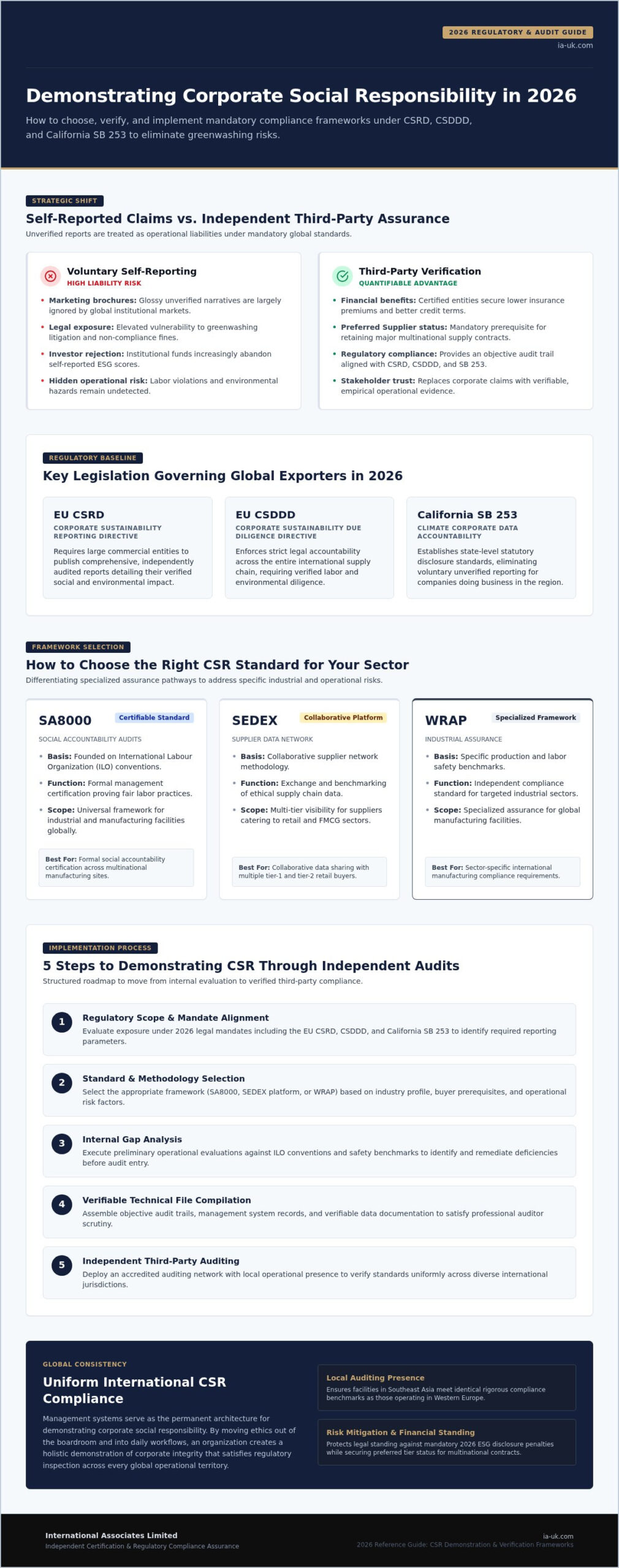
5 Steps to Successfully Demonstrating CSR Through Independent Audits
Successful verification isn’t a single event. It’s a methodical process that requires institutional discipline. Organizations must move beyond intent and focus on the technical execution of their social accountability goals. The path to demonstrating corporate social responsibility involves five critical phases: internal gap analysis, documentation construction, partner selection, the two-stage audit process, and ongoing surveillance.
First, an internal gap analysis identifies where current management systems fall short of international benchmarks. This is followed by the creation of a technical file, which serves as the primary evidence base for auditors. Selecting an accredited partner is the third step; only bodies with verified credentials can provide the necessary legal weight to a claim. The audit itself is divided into Stage 1, a documentation review, and Stage 2, an on-site or remote verification of implementation. Finally, continuous improvement is maintained through annual surveillance audits.
Preparing for the Social Accountability Audit
Internal teams must be technically proficient before an external assessment begins. Investing in Lead Auditor Training ensures that your staff understands the rigorous criteria of standards like SA8000. Conducting an internal pre-assessment allows for the identification of non-conformities in a controlled environment. This phase also requires active engagement with workers and community stakeholders to ensure that representation is authentic and not merely a reflection of management’s perspective.
Navigating the On-Site and Remote Audit Process
Modern auditing has evolved to include hybrid models. Advanced IT infrastructure now facilitates efficient remote verification of documents and digital records. This reduces operational friction while maintaining the integrity of the technical review. During the audit, management must be prepared to handle non-conformities objectively. A non-conformity isn’t a failure; it’s a documented area for improvement that, once addressed, strengthens the organization’s compliance posture. Successful certification is achieved when all critical gaps are closed through verified corrective actions. Demonstrating corporate social responsibility requires this level of forensic detail to satisfy global regulatory bodies.
If your organization is ready to move toward verified compliance, you can request a social accountability audit to begin the formal assessment process.
Scaling Your Impact: Global CSR Verification with International Associates
Achieving international market access isn’t a matter of self-declaration; it requires an independent partner capable of validating compliance without bias. International Associates Limited operates as an impartial auditing body, providing the objective assurance required to build stakeholder trust globally. Through advanced IT infrastructure, verification processes are streamlined, allowing for quick turnaround times for certificates. This efficiency provides a distinct advantage in competitive markets where delayed entry carries financial penalties. Demonstrating corporate social responsibility through this structured approach ensures that compliance data is both accurate and actionable.
Long-term validity is maintained through a structured program of annual surveillance audits and recertification cycles. This methodical approach ensures that internal systems adapt to evolving regulatory requirements without operational friction. By maintaining continuous oversight, organizations can assure future compliance and prevent the degradation of operational standards over time.
The Glasgow Advantage: Global Reach with UK Oversight
Headquartered in Glasgow, International Associates Limited combines Scottish institutional reliability with an expansive network of international offices across Europe, Asia, and the Middle East. This global-local duality ensures that facility audits are executed by local professionals who understand regional regulatory nuances, while all operations remain subject to centralized UK oversight. Rigorous standards of impartiality are maintained throughout the assessment process, ensuring that certifications carry the necessary weight. Centralized independence remains the core requirement for demonstrating corporate social responsibility, eliminating conflicts of interest and providing global stakeholders with clear proof of compliance.
Integrated Auditing Solutions for Complex Businesses
Complex international supply chains require a streamlined approach to assessment rather than a fragmented series of isolated inspections. International Associates Limited provides integrated verification solutions, allowing organizations to manage multiple certifications, including ISO 14001, ISO 45001, SA8000, and Halal certification, through a single independent partner. This integration minimizes operational disruption and ensures a unified approach to corporate governance. To support long-term performance, technical proficiency must be maintained across all operational levels. Organizations can leverage professional auditor training to equip internal teams with the skills necessary to sustain compliance between formal assessment cycles.
To establish a verified compliance framework that satisfies global institutional requirements, you can Contact International Associates Limited to begin your CSR verification journey and secure independent assurance for your operations.
Securing Global Market Access through Verified Compliance
The transition to mandatory ESG reporting in 2026 indicates that unverified claims have become high-risk liabilities. Organizations must prioritize technical assurance over marketing narratives to maintain international market access. By selecting frameworks like SA8000 or ISO 14001 that align with specific industrial risks, you ensure your compliance posture is both defensible and transparent. Demonstrating corporate social responsibility requires a meticulous approach to data verification that satisfies institutional investors and global regulators alike.
International Associates provides the steady hand needed to navigate these complex requirements. With our global network of expert auditors and specialized technical review for MDR and UKCA compliance, we bridge the gap between regional operations and international standards. Our accredited social accountability audits offer the impartial proof your stakeholders demand. You can Book a Social Accountability Audit with International Associates to secure your brand’s future as an ethical leader. We’re here to support your international growth with procedural integrity and global reliability.
Frequently Asked Questions
What is the most credible way of demonstrating corporate social responsibility?
The most credible method for demonstrating corporate social responsibility is through independent third-party verification by an accredited certification body. Unlike internal reports, an external audit provides an objective evaluation against international benchmarks like SA8000 or ISO standards. This process ensures that claims are backed by verifiable evidence rather than marketing intent. In 2026, global stakeholders prioritize these independent assessments to mitigate risks associated with greenwashing and regulatory non-compliance.
How do social accountability audits differ from standard financial audits?
Social accountability audits evaluate an organization’s ethical performance, focusing on labor rights, workplace safety, and supply chain ethics. While financial audits verify fiscal accuracy and accounting integrity, social audits examine qualitative factors such as child labor prevention and fair wage adherence. These assessments involve worker interviews and site inspections to ensure operational reality aligns with corporate policy. Both are essential for holistic risk management, but they serve distinct regulatory functions.
Can a small business realistically achieve SA8000 certification?
Small businesses can realistically achieve SA8000 certification by implementing management systems that scale with their operational size. The standard is designed for organizations of any size, provided they can demonstrate adherence to its nine core requirements. While initial implementation requires a structured internal gap analysis, the long-term benefits include improved worker retention and enhanced status as a preferred supplier for multinational corporations. Success depends on commitment to procedural integrity rather than company revenue.
How often must CSR certifications be renewed to remain valid?
Most CSR certifications, including SA8000 and ISO standards, operate on a three-year cycle. To remain valid, organizations must undergo annual surveillance audits to ensure continued adherence to the framework. A full recertification audit is required at the end of the third year to verify the entire management system. This recurring process ensures that demonstrating corporate social responsibility remains a continuous commitment rather than a one-time achievement, adapting to changing regulatory landscapes.
What is the difference between a CSR report and a CSR certification?
A CSR report is a self-disclosed document where a company describes its sustainability initiatives and goals. In contrast, a CSR certification is a formal recognition from an independent body that the organization meets specific, auditable standards. While reports are often used for stakeholder communication, certifications provide the objective proof required for legal compliance and investor assurance. Certifications carry significantly more weight in 2026 because they involve forensic verification of claims by external experts.
How does ISO 14001 help in demonstrating environmental responsibility?
ISO 14001 provides a systematic framework for organizations to manage their environmental impact through improved resource efficiency and waste reduction. By achieving this certification, a business proves it has established auditable processes to identify and mitigate environmental risks. It moves environmental responsibility from vague promises to a verifiable management system. This standard is a primary tool for companies seeking to demonstrate environmental stewardship to global partners and regulatory authorities.
Why is independent verification preferred over self-reporting in 2026?
Independent verification is preferred because it eliminates the inherent bias found in self-reporting. In 2026, mandatory regulations like the EU’s CSRD require audited data to prevent greenwashing litigation. Self-reports often lack the forensic detail needed to satisfy institutional investors who demand objective proof of ethical performance. Third-party assurance bridges the trust gap by providing a reliable, impartial assessment of an organization’s social and environmental claims across global supply chains.
What are the common non-conformities found during social audits?
Common non-conformities identified during social audits include excessive overtime hours, inadequate health and safety documentation, and insufficient worker grievance mechanisms. Auditors also frequently find gaps in supply chain monitoring where primary contractors fail to verify the practices of their own sub-suppliers. Identifying these non-conformities is a vital part of the audit process, allowing organizations to implement corrective actions that strengthen their ethical posture and ensure long-term regulatory compliance.