

Management buy-in comes from clarity, not volume. Presenting internal audit findings to management works best when you lead with the conclusion, explain each issue’s business impact, and set out practical actions with clear ownership. Evidence should support the message, not obscure it.
It is understandable to want every detail included, especially when a finding involves technical requirements or complex processes. But decision-makers need to know what matters, why it matters, and what response is needed before they can assess the supporting detail.
This guide explains how to structure findings around clear conclusions, tailor the message to management’s priorities, and translate technical issues into plain business language. It also covers discussing findings early, building trust through evidence and balanced delivery, and turning recommendations into actions that address root causes. The result is a focused conversation, less room for surprise, and a clearer path from audit observation to management response.
Key Takeaways
- Open with the audit conclusion, then use relevant observations and evidence to explain its significance.
- Shape the message around what each audience needs to understand, including risks, responses, and outcomes.
- Translate technical issues into clear business language so decision-makers can assess their implications.
- Build trust by discussing findings early, supporting them with evidence, and inviting constructive dialogue.
- Turn recommendations into practical actions that address root causes, with clear ownership and target dates.
Recommendations and implementation planning
Turn each finding into a prioritized action with an owner, target date, and measure of completion. The final communication should connect the evidence to the business impact and management response.
1. Define Issue Rating Scales
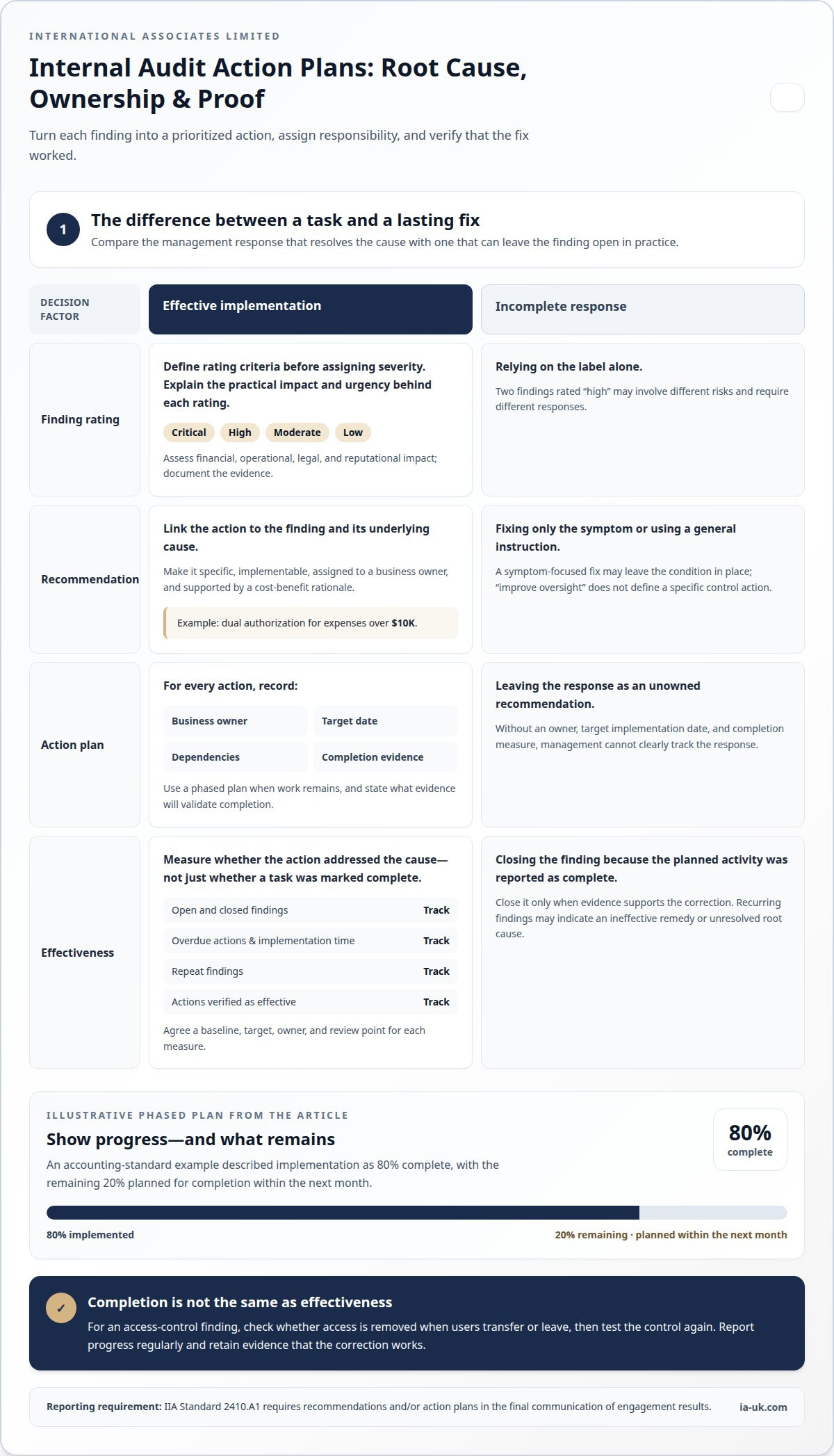
Set rating definitions before assigning severity to findings. Common scales use labels such as critical, high, moderate, and low, with each level linked to potential impact and urgency. For example, a critical issue may pose an immediate threat to a key objective, while a low-rated issue may call for routine corrective action. Explain the criteria so leaders can compare severity consistently.
When presenting internal audit findings to management, explain the reason for each rating and its practical consequences. Assess financial, operational, legal, and reputational impact, then document the supporting evidence. Do not rely on labels alone: two “high” findings may involve different risks and call for different responses. A brief definition beside each rating makes comparisons clearer and helps managers prioritize action.
2. Develop Recommendations and Implementation Plans
Link every recommendation directly to its finding and underlying cause. A symptom-focused fix may leave the condition in place, so identify why the control failed before proposing corrective action. Make each recommendation specific, implementable, assigned to a business owner, and supported by a cost-benefit rationale. For example, dual authorization for expenses over $10K is a defined control action, not a general instruction to improve oversight.
Translate the recommendation into a management action plan with an owner and target implementation date for each action. IIA Standard 2410.A1 requires recommendations and/or action plans in the final communication of engagement results. Use a phased plan when work remains: an illustrative accounting-standard example described implementation as 80% complete, with the remaining 20% planned for completion within the next month. Record dependencies and evidence needed to validate completion.
3. Measure Finding and Remediation Effectiveness
Choose measures that show whether an action addressed the cause, not merely whether someone marked a task complete. Track open and closed findings, overdue actions, time to implementation, repeat findings, and the share of actions verified as effective. These measures reveal different problems: overdue actions point to delays, while recurring findings may signal an ineffective remedy or unresolved root cause.
Agree on a baseline, target, owner, and review point for each measure. For an access-control finding, for example, track whether access is removed for users who transfer or leave, then test the control again. Report progress regularly so management can see outstanding work and verified results. Close a finding only when evidence supports the correction, not simply when someone reports that the planned activity is complete.
Structuring reports with conclusions first
Organize the report so decision-makers see the conclusion first, followed by observations and evidence. Then confirm that every finding meets reporting standards and answers management’s practical questions.
-
Assemble Finding Information
Build each finding from five connected elements: criteria, condition, cause, consequence, and corrective action. Criteria describe the expected requirement; condition records what the audit found. Explain the cause and consequence, then identify the corrective action. Support the account with specific evidence, such as a transaction sample or control record, rather than an unsupported conclusion.
Include the engagement objectives, scope, and results. IIA Standard 2410 requires these elements in internal audit communications. Standard 2400 requires internal auditors to communicate engagement results, while Standard 2440 requires the chief audit executive to communicate results to appropriate parties. Align the report’s objectives and scope with the approved engagement plan, so findings remain within the work performed.
Choose a format that suits the decision and evidence. Findings may be communicated in a written report, memorandum, slide presentation, or video; there is no single prescribed format. Put detailed data in an appendix or supplementary handout when it would obscure the finding in the main report.
-
Present Conclusions in the Executive Summary
Write the executive summary for readers who need the overall conclusion before the details. State the main result, the most consequential observations, and the management response or action required. Include two or three key observations, then direct readers to the report sections containing the supporting evidence and analysis.
For example, if an audit identifies weak access controls, summarize the exposure and operational consequence first. Follow with the relevant observation, cause, and evidence. Do not open with testing procedures or technical terms that delay the decision. The summary should reflect the full report accurately, without introducing findings that the detailed sections do not support.
Apply IIA Standard 2420 when reviewing the communication: it must be accurate, objective, clear, concise, constructive, complete, and timely. The chief audit executive reviews and approves the final engagement communication before issuance. Confirm that the executive summary and detailed findings agree, and that the conclusion reflects the evidence gathered within scope.
Use Lead Auditor Training to strengthen audit skills, including the disciplined assessment and communication that support clear findings.
To maintain this sequence, state the conclusion clearly, then connect each observation to its root cause and supporting evidence. Keep these elements distinct: the conclusion explains what the work means, observations show what was found, root causes explain why it happened, and evidence lets readers assess the report’s basis. This keeps the report focused on the decision while preserving its reasoning. Check that every observation supports the conclusion and that the evidence is relevant to the issue. For multiple observations, use the same progression each time, helping readers follow the overall result through its explanation and support. Lead with the conclusion, but keep the evidence visible.
Tailoring the key message to the audience
Identify who must act, approve, or oversee each finding before preparing the message. Then select the risks and decisions relevant to their responsibilities.
- Start with the audience’s decision. An audit committee needs to understand organisational risks, management’s response, remediation plans, and the results of those actions. Frame each finding around those points: what exposure exists, what response is planned, and how progress will be assessed. A finance executive may focus on reporting reliability, while an operations leader may need to understand service disruption. Keep the evidence consistent, but adjust the emphasis to the decision each group needs to make.
- Separate oversight messages from operational instructions. For senior leaders, explain how a finding affects business objectives, risk exposure, or resource priorities. For a process owner, specify the affected procedure, control gap, and next action. For example, an audit committee may need to know that a control weakness reduces confidence in reporting; the responsible manager needs to know which workflow missed approvals. This distinction keeps governance discussions focused while giving action owners usable detail.
- Translate the same evidence into language that suits each audience. If an audit finds incomplete access reviews, explain to executives the risk of inappropriate system access. Tell the system owner which review step failed and what evidence demonstrates the failure. Keep the finding’s meaning consistent across versions. Use the same criteria, facts, and conclusions, while adapting terminology and detail to the reader’s role and familiarity with the process.
- Prepare the meeting around the decisions expected from each group. For senior management, identify where approval, resources, or coordination across teams may be needed. For operational managers, clarify which action belongs to their team and what evidence will demonstrate completion. If a finding affects several departments, state each dependency rather than assigning responsibility vaguely. Anticipate questions about business impact, ownership, and progress, and have relevant records ready for discussion.
- End each audience-specific message with a clear next step. An executive briefing might seek agreement on response priority, while a process meeting may confirm the action owner and implementation sequence. Distinguish decisions already made from those still required. After the discussion, record management’s response accurately and share relevant actions with responsible teams. This connects audit committee oversight to operational follow-through without burdening either audience with unrelated detail.
Translating technical findings into accessible language
Prioritize findings according to their financial, operational, legal, or reputational impact. Explain each issue in plain business language, then show how the evidence supports its assigned severity.
- Replace specialist terminology with a description of the business effect. Instead of saying a control has a “configuration deficiency,” explain which task can proceed without the required review. For example, describe an approval gap as an expense processed without the intended authorization. Keep the technical term in supporting material when readers need it to trace the control.
- Separate the observed condition from its consequence. State what the audit examined, what the evidence showed, and what could happen if the issue remains. For example, “access records were not updated after role changes” describes a condition; “former permissions may remain active” explains a possible consequence. This distinction makes the finding clear without overstating what the audit established.
- Use a specific data point to make scale clear. An illustrative audit finding may report that 30% of account balances are more than 365 days old. Pair that result with a plain explanation of why aged balances matter, such as delayed collection or reduced confidence in account records. Keep the underlying sample and calculation available for readers who need technical detail.
- Define abbreviations and control terms the first time you use them. If a presentation refers to “segregation of duties,” explain that different people perform incompatible steps, such as initiating and approving a payment. Avoid unexplained acronyms in slide titles. Managers should be able to understand the risk without decoding technical shorthand or consulting a separate glossary.
- Match severity language to the evidence and impact. Rank an issue higher when its financial, operational, legal, or reputational consequences are more serious, not because its description sounds technical. For example, explain whether a process gap affects one record, a recurring workflow, or a key business objective. State the basis for the rating so managers can compare findings consistently.
- Design each slide around one finding and one decision. Use a concise headline, a brief explanation, and a chart or excerpt only when it clarifies the evidence. Keep detailed testing results in an appendix rather than crowding the main slide. During the discussion, explain the visual rather than reading it aloud, and pause before answering questions so your responses stay accurate and direct.
Keep the discussion focused on the decision at hand. Communicate audit findings in practical business language, not technical jargon. Choose familiar words that explain what readers need to understand, and clarify any unavoidable technical term in context. Be direct: identify the business concern, explain why it matters, and make the issue understandable without requiring readers to decode specialist language. This keeps attention on the finding and its implications.
Building management buy-in and trust
Build trust through early discussion, fair use of evidence, and visible follow-through. Treat disagreement as an opportunity to clarify facts, not as a reason to dilute a substantiated finding.
- Discuss emerging findings during fieldwork, before drafting the final report. Share the condition, evidence, and relevant criteria with the responsible manager, then invite them to explain the process. For example, a manager may identify a system change that affects how an approval record should be interpreted. Assess relevant evidence objectively, document its effect, and avoid raising an issue for the first time at the closing meeting.
- Handle disagreement by separating factual disputes from differences in risk judgment. Ask management to identify the specific record, process detail, or criterion in dispute, then compare it with the audit evidence. Correct factual errors when the evidence supports a change; retain a substantiated conclusion when the disagreement concerns its significance. Record management’s response and reasoning clearly, so decision-makers can see both positions without confusing agreement with audit independence.
- Communicate the final results to people able to give them due consideration. IIA Standard 2440.A1 assigns the chief audit executive responsibility for communicating final results to parties able to ensure they receive due consideration. Identify the responsible decision-makers before issuing the report. For a cross-functional issue, include the leaders who can address the affected process and those responsible for oversight, rather than relying on a single recipient to coordinate every action.
- Make the meeting a two-way discussion, not a reading of the report. Present the finding, pause, and invite questions about its evidence, impact, and proposed response. If an audit committee member raises a complex point, take a moment to organize your answer. Distinguish verified facts from interpretation, and commit only to follow-up actions that can be completed and documented. This helps prevent an inaccurate answer from undermining confidence.
- Keep follow-through visible after the meeting. Send the audit committee a written summary of key presentation points within 24-48 hours after the presentation, and track agreed management actions. Provide regular implementation updates that identify progress, delays, and evidence still needed. Afterward, seek constructive delivery feedback from senior colleagues or attendees. Use specific comments, such as a request for clearer risk explanations, to improve the next presentation while preserving balanced reporting.
International Associates Limited: Social Accountability Audits
International Associates Limited provides Social Accountability Audits for organisations assessing workplace practices and social accountability. This can be a relevant next step when audit findings point to concerns requiring independent assessment, or when your organisation needs a clearer view of its social accountability performance.
A structured audit can help establish evidence about practices and identify areas requiring attention. Use clear criteria, documented findings, and practical follow-up planning to support meaningful management decisions. Learn more about Social Accountability Audits and how they relate to your organisation’s needs.
Contact International Associates Limited to discuss Social Accountability Audits for your organisation.
Put clear audit communication into practice
Use your next audit discussion to establish a shared understanding of the issue, the decision required, and the evidence that will guide follow-up. Presenting internal audit findings to management is most effective when the conversation leads to accountable action while preserving the audit function’s independence.
Where an organisation is also strengthening assurance through recognised standards, International Associates Limited offers Social Accountability Audits, ISO 9001 Quality Management System Certification, and ISO 14001 Environmental Management System Certification. These services address distinct assessment and certification needs, providing a relevant next step when workplace practices, quality systems, or environmental management are in focus.
To discuss which service aligns with your organisation’s needs, contact International Associates Limited. A considered conversation can help clarify the appropriate next step and keep your assurance priorities moving forward.
Frequently Asked Questions
How should internal audit findings be structured and presented to management?
Use a consistent identifier for each finding and cross-reference it wherever the issue appears, including appendices and management responses. This helps readers connect supporting schedules to the relevant discussion without searching the full report. When evidence shows a recurring pattern, distinguish a process-wide weakness from an isolated exception. For example, compare affected business units or workflow stages, and make clear which evidence supports each conclusion.
How can internal auditors present findings constructively without damaging relationships?
Use neutral wording that describes observable actions and outcomes, not presumed motives. Before the discussion, check for language that implies negligence or intent without evidence. “The approval record was absent” is more precise than “the manager ignored the control.” Also acknowledge controls that worked as intended. Balanced language keeps the discussion focused on the process and evidence.
What should management responses and action plans include?
Alongside planned actions, management should state whether it accepts the finding’s risk assessment or proposes a different view. If management accepts the risk rather than implementing the recommendation, document its rationale, the residual exposure, and the person or governance body accepting it. If management proposes an alternative control, explain how it addresses the same exposure. This record clarifies the response even when management’s approach differs from the audit recommendation.
How should internal audit recommendations be documented and tracked to closure?
Use a consistent reference for each recommendation and maintain a clear record of status changes, revised plans, and management decisions. Group related items by underlying risk or process so recurring issues across departments can be identified without combining distinct responsibilities. If an action is superseded, record what replaced it and why. This history helps identify patterns over time and prevents repeat findings from being treated as unrelated events.
What are best practices for presenting audit findings in a management meeting?
Confirm that the right decision-makers will attend each agenda item, especially when the discussion may require resources or agreement across departments. Distinguish items requiring approval from those shared for awareness, so attendees understand their role. If the responsible manager cannot authorize a proposed response, identify the appropriate escalation route and record the referral. This prevents an unresolved decision from being mistaken for an agreed action.