

A report can document every test and still leave decision-makers unsure what needs to change. Knowing how to write an internal audit report means turning evidence into a clear account of the issue, its significance, and the action required.
Clarity matters, but a useful report must also be balanced and evidence-based. Readers need to understand how each finding relates to the audit’s objectives and scope. This guide explains how to present observations, evidence, findings, conclusions, and recommendations so that each point is clear and actionable. It also covers report structure, evidence references, and review practices that help keep the final communication concise, objective, and relevant. The aim is to support informed decisions, not leave important findings buried in detail.
Key Takeaways
- Make recommendations specific enough to guide remediation, and connect each action plan to a responsible owner and a clear completion point.
- Build each observation around criteria, condition, cause, risk, and recommendation so readers can follow the reasoning from evidence to action.
- Define the audit’s objectives and scope, then present findings and conclusions in a way that shows their relevance and relative priority.
- Use traceable evidence references and supporting annexures, and review the report for accuracy, clarity, and consistency before issue.
- Structure the executive summary around the conclusions and key issues decision-makers need to understand first.
How to Make an Internal Audit Report Actionable
A finding becomes useful when its recommendation addresses the cause, not just the visible error. For example, if purchase orders remain open without review, asking staff to “improve monitoring” leaves the response unclear. Specify the control change, the responsible role, and the evidence that will show it is complete. Separate immediate correction of affected records from remediation to prevent recurrence. Anyone asking how to write an internal audit report should make this link between the finding and the proposed action explicit.
In the United States, the IIA’s Global Internal Audit Standards provide a professional framework; applicable laws, regulations, and organizational policies also shape reporting. Standard 11.2 requires communications to be accurate, objective, clear, concise, constructive, complete, and timely. Standard 2410.A1 requires recommendations and/or action plans in the final communication of engagement results. These criteria give report authors a practical basis for reviewing whether a draft is both sound and usable.
Common mistakes include vague actions, unsupported claims, unnecessary personal information, and findings presented without enough context. Confidentiality risks arise when sensitive results are shared beyond appropriate recipients. Standard 2440.A2 requires the chief audit executive, before releasing results outside the organization when no legal, statutory, or regulatory requirement mandates release, to assess organizational risk, consult senior management and/or legal counsel as appropriate, and restrict use.
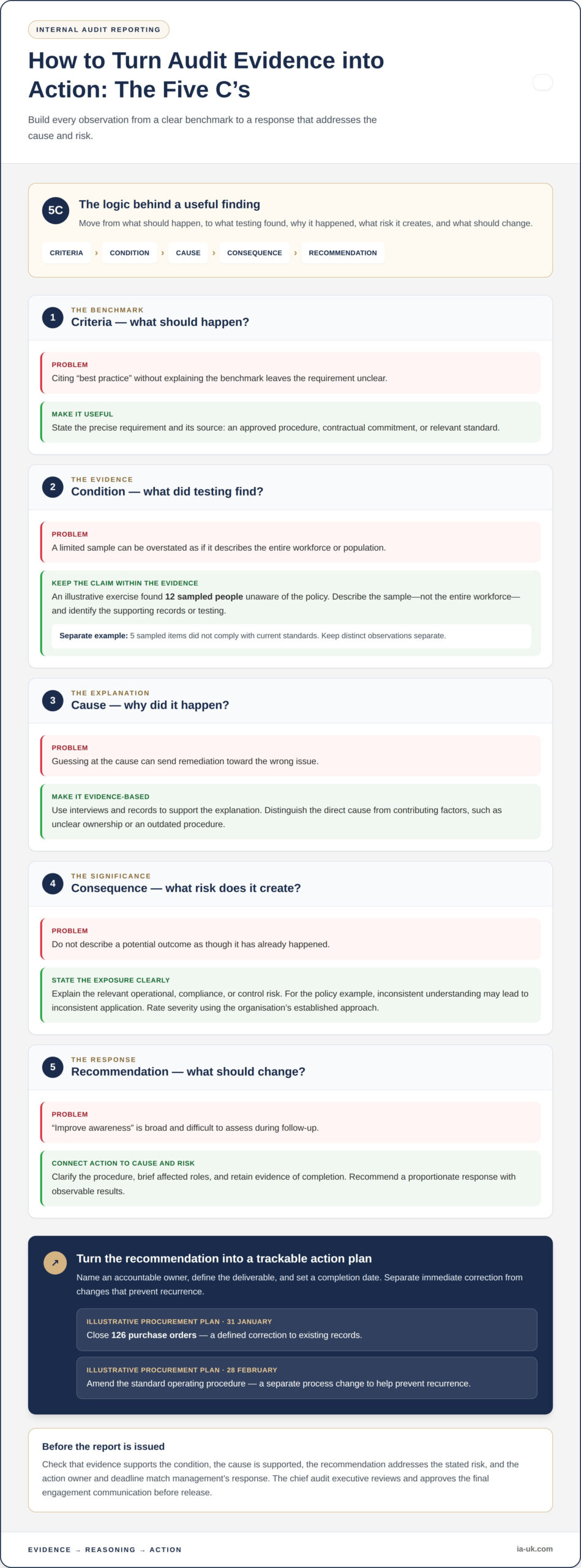
Translate each recommendation into a management action plan with an accountable owner, a defined deliverable, and a completion date. Make the action specific, measurable, achievable, relevant, and time-bound, and connect it to the finding’s risk. “Review open orders” is difficult to assess; “reconcile open orders against receipts and document exceptions” defines both the task and its evidence. The manager’s response should state whether the recommendation is accepted, what action will follow, and how progress will be reported.
For example, an illustrative procurement plan sets 31 January to close 126 purchase orders and 28 February to amend the standard operating procedure. The two deadlines distinguish correcting existing records from changing the process. Record any management disagreement, its rationale, and the associated risk rather than presenting agreement as automatic. For those learning how to write an internal audit report, this example shows why remediation actions need distinct deliverables and deadlines.
Before issuing the report, link every action to a documented finding and supporting evidence. Confirm that owners and deadlines match management’s response and that each recommendation addresses the stated cause. The chief audit executive reviews and approves the final engagement communication before release. This review helps ensure the report accurately states agreed actions and gives decision-makers a clear basis for monitoring remediation.
Audit Observation Criteria, Condition, Cause, Risk, and Recommendation
Use the five C’s to connect each audit observation to a practical response. Criteria identify the benchmark; condition records what testing found. IIA Standard 2210.A3 provides guidance on selecting suitable criteria for an engagement. In a policy audit, the approved procedure, contractual commitment, or relevant standard may supply that benchmark. State the precise requirement and its source, rather than citing “best practice” without explanation.
Describe the condition with verifiable details, including the process, records, and sample reviewed. An illustrative audit exercise found that 12 sampled people were unaware of the policy. That statement describes the sample, not the entire workforce. A separate example found 5 sampled items that did not comply with current standards. Keep each observation distinct, and identify the evidence supporting its condition.
Cause explains why the condition occurred; it should not be a guess. If interviews and records show that staff missed a policy briefing, describe this as a possible cause only when the evidence supports it. Distinguish the direct cause from contributing factors, such as unclear ownership or an outdated procedure. This helps readers choose remediation that addresses the process weakness, rather than merely correcting individual records.
Consequence describes the risk created by the condition. In the policy-awareness example, the report could explain that inconsistent understanding may lead to inconsistent application. Do not present a potential outcome as an event that has already happened. Explain the relevant operational, compliance, or control exposure, then rate its severity using the organisation’s established approach. The stated risk should follow logically from the evidence and condition.
A recommendation completes the chain by identifying a proportionate response. For the policy example, an action might be to clarify the procedure, brief affected roles, and retain evidence of completion. Tie each step to the identified cause and risk. Avoid broad wording such as “improve awareness,” which gives management little direction and makes follow-up difficult. A specific recommendation lets readers assess progress against observable results.
Before finalising an observation, check its five elements in sequence: benchmark, evidence-based condition, supported cause, plausible consequence, and responsive recommendation. Confirm that the evidence proves the stated gap and that the proposed action addresses it. If the evidence supports only a limited finding, keep the conclusion equally narrow. This disciplined structure makes the reasoning transparent and helps readers distinguish verified facts from analysis and proposed action.
Audit Report Objectives, Scope, Findings, and Conclusions
According to the Board of Governors of the Federal Reserve System, an internal audit report presents purpose, scope, results, findings, conclusions, and recommendations. State the objective first: what process, control, or requirement did the engagement assess? Then define the boundaries, including locations, activities, records, and period examined. Clear boundaries help readers understand what the report can establish and what falls outside its review.
IIA Standard 2400 requires internal auditors to communicate engagement results. IIA Standard 2410 requires communications to include objectives, scope, and results. Standard 15.1 expects a final report to cover objectives and scope, conclusions, findings, and recommendations or action plans. Under Global Internal Audit Standards Domain V, final communications also include recommendations or action plans and, when applicable, an overall conclusion or opinion.
Present each finding with enough context for readers to assess its significance. An illustrative treasury audit found that 9 of 43 users with bank account access had transferred or terminated status without access adjustments. The report can state the numerator and denominator, explain the access issue, and identify the relevant evidence. Avoid implying that the same condition applies beyond the reviewed population.
Risk ratings help prioritise findings, but the rating method should be explained. Internal audit functions commonly use three-tier or four-tier severity models. Define each level using clear criteria, then order findings from highest to lowest severity. This helps decision-makers distinguish an urgent control exposure from a lower-priority process weakness, rather than relying on labels without supporting rationale.
Keep the overall conclusion proportionate to the evidence and engagement scope. IIA Standard 2450 requires an overall opinion to be supported by sufficient, reliable, relevant, and useful information, while accounting for stakeholder expectations. A conclusion should synthesise the findings and explain their combined effect on the audited area. It shouldn’t claim assurance over processes or locations the engagement didn’t examine.
Before issuing the report, compare its objective, scope, findings, ratings, and conclusion for consistency. IIA Standard 2431 addresses engagement disclosure of nonconformance. Where relevant, explain the nature and impact of nonconformance in the engagement communication. For example, a conclusion about access controls should align with the tested accounts and observed exceptions. This final alignment makes the report’s boundaries and reasoning clear to its intended readers.
Evidence References and Report Quality Assurance
Give each item of evidence a stable identifier that connects the report finding to its workpaper. A reference such as “WP-04, access review” is more useful when the workpaper records the system, data owner, extraction date, and test performed. Keep the identifier consistent in the finding, supporting schedule, and annexure. A reviewer can then trace a stated exception back to its underlying record without relying on a general file name.
For quantified results, preserve the calculation behind each reported figure. Record the population, selection method, sample examined, exceptions identified, and any exclusions. If a schedule reports exceptions as a proportion, retain the underlying numerator and denominator in the workpaper. This makes it possible to reproduce the calculation and distinguish the tested sample from the wider population. Label estimates separately from confirmed counts, and record the source for every reported value.
Annexures should provide supporting detail that readers may need to examine without interrupting the main report. Give each attachment a descriptive title, such as “Sample selection and test results,” and assign it a stable letter or identifier. Reference that label beside the relevant finding. Include only relevant records, remove unrelated personal details, and apply the organisation’s access controls to sensitive files.
Use a traceability review before finalising the document. Start with each material statement in the report and follow its reference to the workpaper, source record, and any annexure. Confirm that the referenced file opens, matches the stated version, and supports the wording. Then reverse the process: select supporting records and confirm that each is cited wherever the report relies on it. This two-way check can reveal missing links and unreferenced attachments.
Separate technical review from editorial review. A reviewer with suitable audit knowledge can challenge the test logic, evidence sufficiency, and calculation method; a document reviewer can check numbering, cross-references, tables, and annexure labels. For teams reviewing complex IT systems and compliance documentation, consulting specialists such as butholezweprospermhlanga.co.za can help ensure that technical evidence is rigorously evaluated to produce clear findings for management decisions. IIA Standard 2420 addresses the quality of internal-audit communications. Record review comments and their resolution so the final file shows how substantive challenges were handled.
Complete a final version-control check before issuing the report. Confirm that the report and annexures carry matching identifiers, that changed figures have been updated in every referenced location, and that obsolete drafts are excluded from the release package. A controlled evidence index can list each workpaper, its related finding, and its annexure reference. This gives reviewers a practical route through the audit trail and preserves the link between reported conclusions and supporting records.
Executive Summaries and Report Structure
An internal audit report contains the complete engagement record, while its executive summary gives senior readers a concise view of the main messages. A management letter is a separate communication that may address issues or actions for management; its purpose and format depend on organisational practice. The Board of Governors of the Federal Reserve System says an executive summary should cover the auditable area, conclusions, rationale, and key issues.
Build the report around the reader’s route through the information. Use a clear title page, contents list, summary, and logically ordered sections, with appendices for supporting detail. Consistent labels help readers move between a summary statement and the corresponding discussion. This structure helps decision-makers navigate the report without searching through unrelated material.
Keep the executive summary concise and focused on decisions. A practical target is one or two pages, with three to five takeaways identifying the auditable area, principal conclusion, rationale, and key issues. Put the most consequential message first, then direct readers to the relevant report section for context. Do not introduce claims in the summary that are absent from the report body.
Draft the summary after completing the report. First, establish a working structure that reflects the engagement’s intended audience. Next, write and organise the detailed content, then distil its most important messages into the summary. This sequence helps keep the summary faithful to the finished document and gives readers an efficient way to find key information.
Use a consistent template for headings, page numbering, tables, and annexure labels. Formatting should make the document readable on screen and in print, with descriptive headings that help readers locate sections. Follow the organisation’s established review and approval workflow, and record the final version and issue date. These controls distinguish the approved report from working drafts and later revisions.
Make distribution controlled and traceable. Maintain a record of the intended recipients, the version issued, and the date it was shared, following the organisation’s document-handling procedures. If you issue a revised report, clearly identify it as the replacement and preserve the earlier version according to internal retention practices. A consistent release record helps readers identify the current report and supports orderly follow-up without confusing drafts with final communications.
International Associates Limited: Social Accountability Audits
International Associates Limited provides Social Accountability Audits for organisations seeking an independent assessment of their social accountability practices. This may be a relevant next step when internal reviews identify concerns requiring external assessment, or when an organisation needs independent assurance. The audit scope should reflect the organisation’s needs and the areas to be assessed.
A useful internal audit report can clarify why an external assessment may be appropriate. For example, findings about inconsistent workplace procedures may prompt management to seek a broader review of relevant practices. An independent audit is a separate assessment, not a replacement for internal audit reporting. Define its purpose and boundaries so decision-makers understand what the engagement is intended to assess.
Organisations building internal audit capability may also consider Lead Auditor Training. It can suit people developing the skills to plan and conduct audits, or teams seeking structured training alongside their audit work. Training and an audit engagement meet different needs: one develops capability, while the other provides an assessment. Choose between them based on whether the priority is workforce development or independent review.
For management systems, International Associates Limited offers ISO 9001 Quality Management System Certification and ISO 14001 Environmental Management System Certification. These options are relevant when an organisation seeks certification against the respective management system standard. Certification is distinct from writing an internal audit report: the report documents an engagement’s results, while certification involves an assessment against a defined standard. The appropriate route depends on the organisation’s objective.
Before proceeding, identify the purpose of the next step: an independent social accountability assessment, auditor training, or management system certification. This helps align the engagement with the issue raised by internal findings, rather than treating different services as interchangeable. A report may clarify the risks and actions that matter; the resulting business need determines whether an audit, training, or certification is the suitable path.
Frequently Asked Questions
What makes an audit report effective?
An effective report helps its intended readers make a clear decision based on supported audit results. Before issuing it, consider whether a manager can identify the affected process, understand the practical consequence, and see what decision or follow-up is needed. For example, a finding about delayed approvals should distinguish the delay from its operational impact. Clear ownership, consistent terminology, and evidence references also help readers use the report without relying on verbal explanations.
What are the standard sections of an internal audit report?
A practical report commonly includes a title and distribution details, an executive summary, engagement objectives and scope, methodology, findings, conclusions, and management responses or action plans. Put supporting schedules in annexures when readers need transaction-level detail. The layout can follow the organisation’s reporting framework, provided readers can locate the engagement’s boundaries, results, and follow-up information. Use consistent labels so references remain clear across the report and its attachments.
How do you write clear audit findings using criteria, condition, cause, effect, and recommendations?
Connect each element through a single evidence-based example. If a procedure requires approval before a system change, cite that procedure as the criterion and describe the change made without approval as the condition. Use interview and system records to establish why the approval step was missed. Explain the resulting exposure without implying that a loss occurred, then recommend a control that records approval before changes proceed.
How should internal audit reports rate risks and prioritize findings?
Apply the organisation’s documented rating definitions consistently, considering the potential impact and likelihood of each issue. A recurring access-control weakness may warrant more attention than an isolated documentation omission, depending on the information affected and the safeguards in place. Explain the rationale beside each rating, and order findings so decision-makers see higher-priority exposures first. If two findings share a rating, distinguish their urgency through their consequences, affected processes, or dependencies.
How do you write practical recommendations and assign corrective-action owners and deadlines?
Translate each recommendation into an observable deliverable, then assign it to a role with authority over the work. For example, an operations manager might update a workflow, while a system administrator implements an approval control. Set a completion date that accounts for dependencies, and define the evidence that will demonstrate closure. If implementation has several stages, record milestones so progress can be monitored before the final action is complete.
How should you validate findings and obtain management responses before issuing an audit report?
Before finalising a finding, reconcile its supporting records with the stated facts and give the responsible manager an opportunity to clarify process details. For example, compare a system timestamp with the relevant approval record before describing a delay. Request a response that states management’s position, planned action, accountable role, and target date. If management disputes a conclusion, document the differing view and its supporting evidence for appropriate review.