

Combining standards is not automatically the best starting point for integrated management system certification. First identify which management systems fit your organisation and share processes, then decide whether to integrate them now or add them over time.
A coordinated approach to policies, procedures and audits can avoid duplicated effort. Integration works best when the selected standards suit your organisation’s activities and shared requirements can be aligned without losing the controls each standard requires.
This guide explains how to identify compatible ISO standards, what an integrated management system can bring together, and how certification fits into the process. It also outlines how a certification provider can help clarify the certification scope, assess the management system against the selected standards, and coordinate the audit approach. You’ll see how organisations can build on an existing system, align shared processes and documentation, and decide whether to pursue certification for multiple standards together or in stages.
Key Takeaways
- Choose standards that fit your organisation’s activities and share processes, rather than combining them simply to pursue more certificates.
- Use common management-system requirements to align policies, procedures, documentation and reporting while retaining each standard’s specific controls.
- Quality, environmental and occupational health and safety management can be assessed within an integrated certification approach.
- Consider how audit scope, auditor coverage and certificate arrangements affect whether combined or separate certification best fits your needs.
- A certification body can assess your management system against the selected standards and explain the audit stages involved.
Benefits of integrating management systems
Organisations can combine management systems to coordinate controls that support different business objectives. For example, quality and occupational health and safety systems may share document control, training records and review processes. This gives teams a clearer view of how operational decisions affect product quality and workplace safety, while preserving each standard’s distinct requirements.
Integration can reduce duplicated effort when separate systems rely on similar procedures. A single document-control process, for example, can manage revisions to quality and environmental procedures instead of maintaining parallel workflows. Shared training and coordinated audits can also reduce repeated disruption for employees. The potential efficiency depends on how much the systems genuinely overlap.
The International Organization for Standardization notes that there are more than 80 MSS. That breadth allows organizations to develop a framework around their actual activities, rather than treating each management system as an isolated project. A manufacturer might align quality, environmental and occupational health and safety processes; a food business could connect quality management with food safety controls.
- Clearer accountability: Shared responsibilities make it easier to identify who maintains a procedure or follows up an audit finding.
- More connected decisions: Reviewing quality and safety information together can show how a production change affects both product consistency and worker protection.
- More coherent evidence: Common records can demonstrate how policies are applied across relevant business processes.
Integrated certification provides independent evidence that a coordinated system has been assessed against its selected standards. It can help organisations explain their management approach to customers and other stakeholders, while a combined assessment may align audit activity across standards. The scope must still reflect the organisation’s activities and each standard’s requirements.
Benefits are strongest when integration improves how work is managed, not just how documents are stored. A practical starting point is to map shared processes, such as competence, internal communication and corrective action, then identify where standard-specific controls remain necessary. Organizations considering management system certification can use this process to clarify which systems belong in a coordinated framework. Better visibility across processes can support timely improvements to products and services, while regular performance review helps keep the framework useful as operations change.
High Level Structure and shared management-system processes
ISO management system standards share structural features that can support coordinated implementation. This gives organisations a practical basis for aligning processes without treating every requirement as identical.
Common ISO Standard Structure
A common structure arranges management-system requirements in a consistent sequence. This helps organisations see how planning, operational controls and performance reviews relate across standards. For example, a business with quality and environmental management systems can map responsibilities and document controls using comparable frameworks. Each system still addresses its own subject matter, so shared structure supports coordination rather than replacing standard-specific controls.
Harmonized Management-System Requirements
Harmonized requirements are elements aligned across multiple standards, making shared processes easier to develop. An organisation can use one approach to manage documented information, assign responsibilities or review performance, then add controls specific to each standard. For example, a common corrective-action process can record and address quality or environmental findings while retaining their distinct causes and evidence.
Annex SL Structure
Annex SL provides the common high-level structure used by ISO 9001, ISO 14001, ISO 45001 and ISO 27001. Its shared framework helps organizations align clauses, terminology and requirements across quality, environmental, safety and information security systems. This can make it easier to coordinate planning and review activities, while each standard continues to set requirements relevant to its own management discipline.
For example, an organization pursuing ISO 9001 and ISO 45001 can coordinate leadership reviews and internal communication. A common process can make responsibilities clearer across departments, while quality controls and safety controls remain distinct where their purposes differ. This helps management see connections between operational performance and workplace protection.
Harmonization does not mean one procedure automatically satisfies every standard. The organisation must still address the scope and requirements of each system. A shared document-control process, for instance, can manage revisions consistently, while records show how relevant quality, environmental or information-security controls are maintained. This creates practical consistency without obscuring standard-specific obligations.
During implementation, map each shared process to the relevant requirements, then identify gaps that need separate controls. This comparison supports a coherent management-system framework and connects operational performance reviews. It also helps ensure duplicated processes do not obscure who owns a decision or corrective action.
Integrated certification for quality, environmental, and occupational health and safety management
An organisation can integrate quality, environmental, and occupational health and safety management when these disciplines affect the same operations. For example, a manufacturer may coordinate product inspection, waste controls and worker safety within one production process. This gives leaders a joined-up view of operational objectives without treating every control as interchangeable.
According to the International Organization for Standardization, ISO 9001 is a management system standard suitable for inclusion in an integrated management system. It provides a quality management framework that can connect process controls, customer requirements, and performance reviews. According to the International Organization for Standardization, ISO 14001 is also suitable for inclusion. It addresses environmental management, helping organizations structure environmental objectives and operational controls alongside quality processes.
ISO 45001 can be included to address occupational health and safety management. For a production business, a shared process for training, operational changes, and corrective actions can support all three systems. The records and responsibilities may be coordinated, while evidence still needs to address each standard’s distinct requirements. This approach can streamline oversight without obscuring who manages quality, environmental performance, or workplace safety.
Energy management can extend the framework where energy use is relevant to organizational priorities. ISO 50001 is another management system standard that can be integrated. For example, an organization combining ISO 14001 and ISO 50001 can coordinate environmental and energy objectives, operational monitoring, and management review. The systems remain distinct in scope, but aligned processes can make their relationship clearer.
- Quality: ISO 9001 can connect customer and process controls with performance evaluation.
- Environment: ISO 14001 can align environmental objectives with operational planning and review.
- Occupational health and safety: ISO 45001 can coordinate workplace risk controls with operational processes.
- Energy: ISO 50001 can join energy-management processes with environmental planning where relevant.
For integrated certification, the assessment scope should identify the standards and organizational activities being evaluated. Certification for multiple management system standards is usually assessed in one comprehensive audit. A coordinated audit can examine shared processes alongside requirements specific to ISO 9001, ISO 14001, or ISO 45001. The result is a certification approach that reflects how the systems operate together, rather than simply placing separate documents under one label.
The most suitable combination depends on organizational activities and priorities. A manufacturer with quality, environmental, and worker-safety objectives may choose all three systems; an energy-intensive organization may also consider ISO 50001. The central decision is whether coordinated processes improve oversight while preserving clear, standard-specific controls.
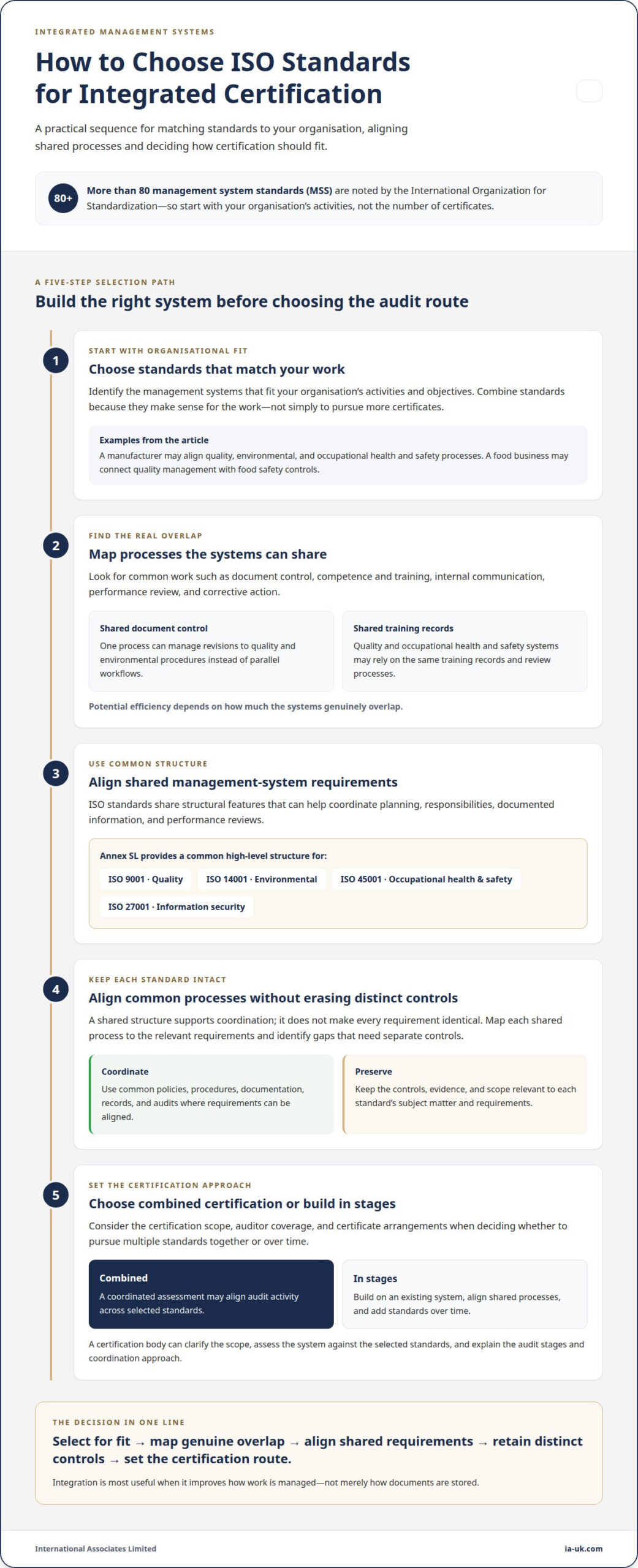
How to choose compatible ISO management system standards for integrated certification
Compatible standards reflect connected business processes, not just similar clause structures. The right combination depends on an organisation’s activities, operational risks, customer expectations and intended certification scope. No ISO standard is specifically published for integrated management systems. Instead, organisations coordinate two or more management system standards within one framework.
A useful assessment begins with the business purpose of each standard. ISO 9001 and ISO 22000 can support a combined quality and food safety framework, while ISO 9001 and ISO/IEC 27001 can connect quality processes with information security. These combinations make sense when the standards address related operations, evidence or responsibilities. They do not make the standards interchangeable.
To compare potential combinations, certification professionals consider several practical factors:
- Operational connection: Identify whether standards apply to the same activities, sites, teams or processes.
- Shared requirements: Assess common elements and overlaps before defining an implementation plan.
- Distinct controls: Preserve requirements that address a specific subject, such as food safety under ISO 22000.
- Scope and sequencing: Determine whether an existing system can form a foundation, with further standards added gradually.
That last factor can shape a manageable route. Organizations commonly begin with an existing quality management system, often based on ISO 9001, then add relevant systems over time. A business with established quality processes might later assess ISO 22000 for food safety or ISO/IEC 27001 for information security. The sequence should follow business priorities and process readiness, not a target number of certificates.
Other standards may fit where organizational needs support them. ISO 22301 addresses business continuity, ISO 39001 road traffic safety, ISO 55001 asset management, and ISO 46001 water efficiency. Their inclusion depends on whether the associated management discipline is relevant to the organization’s activities and objectives. A combination is not automatically efficient simply because several standards can share a framework.
Select standards for their operational relevance first, then assess their overlaps and distinct requirements. This helps establish a realistic scope, identify shared processes and retain controls specific to each standard. Organisations can pursue certification for ISO standards individually or coordinate multiple standards when the scope and processes support an integrated approach.
Management system policies, procedures, and internal audits
Integrated management system certification is estimated to take 3 to 6 months for small organizations and 3 to 12 months for medium to large organizations. The schedule depends on system readiness, audit scope, and how quickly required evidence is available.
A shared policy can set common commitments, while procedures explain how teams apply controls across operations. For example, a manufacturer may use one document-control procedure for quality and health and safety records. It can standardise approvals and revisions, while separate work instructions preserve requirements specific to each management system. This can reduce duplication without merging distinct controls.
Internal audits test whether documented processes work in practice. In an integrated system, audits can cover all selected standards at the same time and be conducted by the same auditor. For example, an audit of a production change could review quality controls, environmental impacts, and worker safety evidence. Findings can then be recorded in a shared corrective-action process, with responsibility assigned to the relevant process owner.
Certification body accreditation and auditor coverage are important when defining the assessment. Accreditation relates to the certification body’s recognized scope, while auditor assignments need to cover the standards and activities included. Organizations can review the body’s certification accreditations as part of understanding its scope. Audit planning should also make clear which sites, processes, and standards are assessed.
Certificate arrangements affect how certification is presented. A combined certificate can show multiple standards and a shared scope together; separate certificates can present each standard independently. The appropriate format depends on how the organisation needs to communicate its certification and define its scope. Either way, make the standards and covered activities clear to customers and other stakeholders.
Certification audits assess a management system against the selected standards. The process typically begins with a review of system documentation, followed by an assessment of implementation and evidence. After certification, surveillance audits review ongoing conformity and system performance. Coordinated audit planning can reduce repeated interviews and document requests, limiting audit fatigue while still assessing each standard’s requirements.
Clear policies, controlled documentation and scheduled internal audits help prepare an organisation for external assessment. For example, management reviews can consider quality and safety audit findings together while tracking standard-specific actions separately. This connects leadership oversight while preserving accountability for each process.
International Associates Limited
International Associates provides independent assessment and certification for organisations preparing to integrate management systems. It assesses systems against selected standards, verifies evidence and conducts formal certification audits. This is a practical next step once you have defined your intended scope and need an independent assessment.
The applicable standards depend on the organization’s activities and objectives. International Associates Limited offers ISO 9001 Quality Management System Certification, ISO 14001 Environmental Management System Certification, and ISO 45001 Occupational Health and Safety. These standards can address quality, environmental management, and workplace health and safety within a coordinated framework. Social Accountability Audits are also available where organizations need assessment of social accountability practices.
Before assessment, define which standards and activities form the certification scope. The certification body needs information about the management system, relevant sites and operational processes to plan its assessment. Clear scope information helps align the audit with the systems being evaluated. For example, a business combining quality and environmental management can identify the operations where both systems apply.
Formal stage 1 and stage 2 audits are required to verify that an organization meets the requirements of a specific international standard. Stage 1 provides an initial assessment of system readiness and relevant documentation; stage 2 evaluates implementation and evidence against the selected standard. Audit planning also considers the processes and scope under assessment. The outcome is based on the evidence gathered, not simply on having shared policies or procedures.
An independent certification provider can assess your system once you have selected relevant standards and established it for evaluation, or when you need to define the certification scope. An assessment can clarify how the standards are addressed and whether the evidence demonstrates conformity. International Associates provides certification and audit services, not management-system consultancy, so its role is independent verification against applicable requirements.
If you are considering integrated management system certification, start by defining the standards and activities you want assessed. An outline of your current systems, relevant sites and intended scope gives the process a practical starting point. It also helps ensure the audit plan reflects your operations and chosen standards.
To discuss certification and assessment for your management system, contact International Associates Limited.
Frequently Asked Questions
How can a certification provider help me start with IMS?
A certification provider helps define which standards and activities will be assessed, then independently evaluates the system against those requirements. The organization supplies information about its processes, sites, documentation, and existing controls so the assessment can be scoped. Formal stage 1 and stage 2 audits verify conformity. The provider’s role is independent assessment, not developing the management system on the organization’s behalf.
Can I certify to just one of the three standards covered under IMS certification?
Yes. An organization can pursue certification to ISO 9001, ISO 14001, or ISO 45001 individually, rather than integrating all three. For example, a business focused on workplace health and safety can seek ISO 45001 certification without adding quality or environmental certification. The scope can expand later if other standards become relevant to its operations and priorities.
How much does it cost?
Certification costs depend on the organisation and assessment scope. A quote request sets out the applicable costs. Key factors include the selected standard, organisational size, operational complexity, number of sites and audit work required. For example, assessing multiple locations or standards can affect the audit plan. The quote details the costs for the requested assessment and related certification activity.
What happens if a company does not meet all the requirements during the certification audit?
Non-conformities must be addressed before certification can be issued if they prevent a positive certification decision. For minor issues, the process includes root cause analysis and a corrective action plan. If an audit identifies non-conformities, the organization may need to address them before certification can be issued. For example, incomplete records may require investigating why a process failed, then providing evidence that corrective action has been implemented.
What is Annex SL, and why is it important for IMS?
Annex SL is the common high-level structure used by several ISO management system standards. It allows organisations to map related requirements using aligned clauses and terminology, making coordinated processes easier to plan. For example, a company can identify where its leadership review addresses requirements across quality and environmental systems. The structure supports integration but does not remove each standard’s specific requirements.
How do I choose standards for integrated certification?
ISO management system standards cover areas such as quality, environmental management, and information security. To choose standards for integrated certification, identify the processes, risks, and objectives relevant to your organization. For example, ISO 9001 addresses quality management, while ISO 14001 addresses environmental management. A certification audit evaluates whether an organization’s system conforms to the requirements of each selected standard.
What is an integrated management system certification?
Integrated management system certification is an independent assessment of an organisation’s coordinated management system against two or more selected standards. It evaluates whether shared processes and standard-specific controls meet applicable requirements within the agreed scope. For example, an organisation may coordinate procedures while maintaining distinct evidence for quality and occupational health and safety. Certification applies to the assessed scope, not automatically to every activity or site.
Which ISO standards are commonly combined in an integrated management system?
Organizations commonly combine ISO 9001 for quality, ISO 14001 for environmental management, and ISO 45001 for occupational health and safety. Other combinations depend on business activities. For example, ISO 14001 and ISO 50001 may suit an organization aligning environmental and energy management, while a food business may integrate quality and food safety standards. Choose standards according to relevant processes and objectives, not simply their number.