

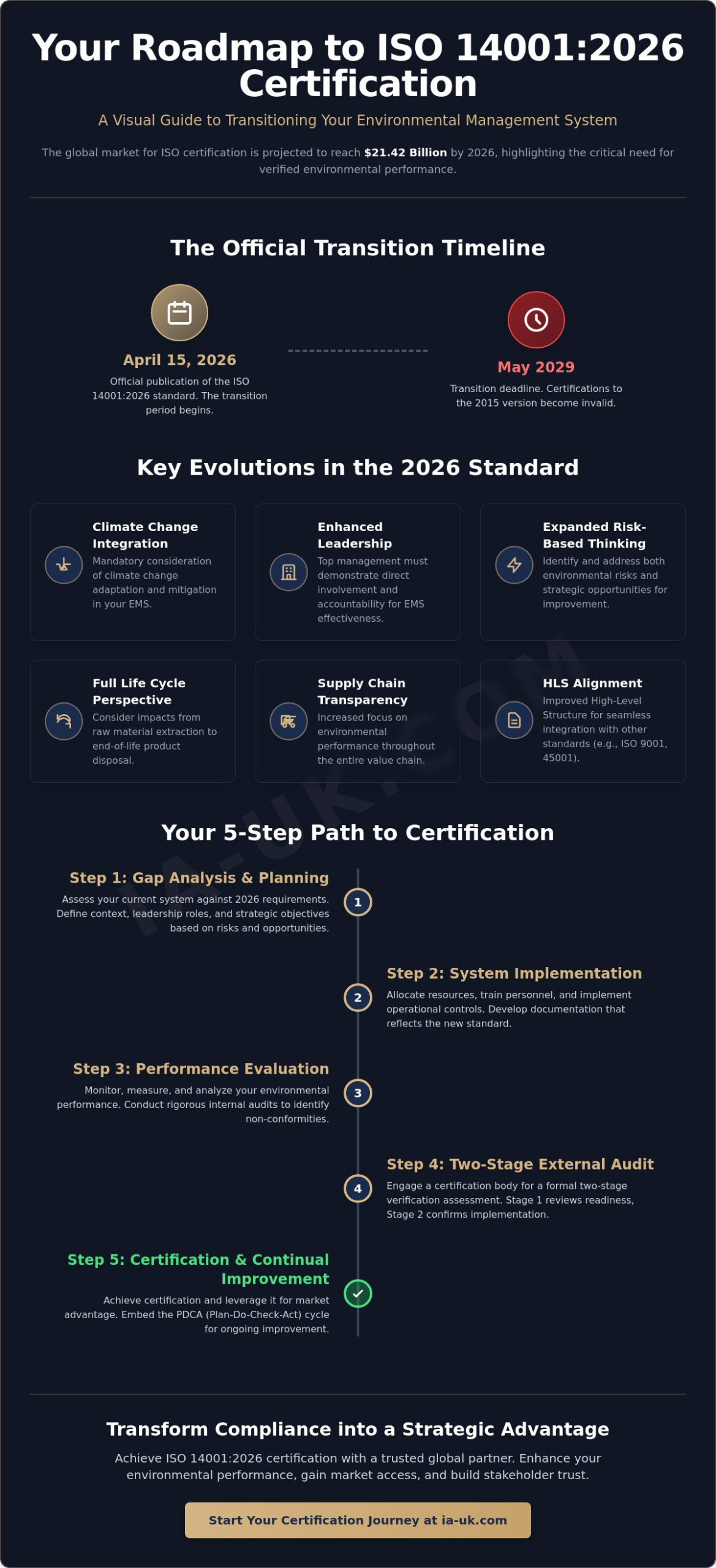
The global market for ISO certification reached an estimated value of USD 21.42 billion in 2026, signaling a profound shift in how international industries prioritize verified environmental performance. With the official publication of the ISO 14001:2026 standard on April 15, 2026, the transition period has begun for organizations seeking to maintain their competitive edge and regulatory standing. You likely recognize that the evolution from the 2015 version introduces technical complexities, particularly regarding climate change integration and supply chain transparency. The pressure to avoid major non-conformities while aligning environmental objectives with corporate strategy is a significant challenge for any management team.
This guide offers a comprehensive and methodical roadmap to achieving ISO 14001:2026 certification through a high-performance environmental management system. You’ll gain a clear understanding of the necessary technical updates, including the implementation of the new clause 6.3 for planning changes. We provide a structured checklist to ensure your transition is successful, efficient, and fully compliant with the latest international benchmarks before the May 2029 deadline.
Key Takeaways
- Define the technical transition requirements from the 2015 standard to the 2026 framework to ensure your iso 14001 certification remains valid through the 2029 deadline.
- Implement a methodical checklist for gap analysis and system design to align your environmental management system with modern global sustainability benchmarks.
- Identify strategies for integrating climate change considerations and life-cycle perspectives into the organizational context as required by the updated standard.
- Prepare for the two-stage audit process by recognizing and mitigating frequent sources of non-conformities before the final verification assessment.
- Leverage independent certification to transform regulatory compliance into a strategic advantage for global market access and improved environmental performance.
What is ISO 14001:2026? Understanding the Modern EMS Standard
ISO 14001:2026 represents the most current iteration of the international requirements for an Environmental Management System (EMS). Published on April 15, 2026, this standard serves as a rigorous framework for organizations to enhance their environmental performance while fulfilling compliance obligations. It isn’t a radical departure from its predecessor but rather an evolution designed to address the escalating complexities of global environmental challenges. Organizations currently holding certification to the 2015 version have until May 2029 to transition their systems. This three-year window allows for a methodical integration of the updated requirements without disrupting operational continuity.
The core philosophy remains anchored in the Plan-Do-Check-Act (PDCA) cycle, a systematic approach to achieving continual improvement. This iterative process ensures that environmental objectives are not static but are consistently reviewed and refined in alignment with the broader ISO 14000 family of standards. By adopting this structure, businesses can transform environmental protection from a peripheral concern into a core strategic driver. The 2026 edition specifically emphasizes the synergy between environmental stewardship and sustainable business growth, recognizing that environmental risks are often indistinguishable from financial and operational risks.
Key Changes in the ISO 14001:2026 Revision
The 2026 revision introduces a more robust focus on leadership commitment, requiring top management to demonstrate direct involvement in the effectiveness of the EMS. It also strengthens the mandate for risk-based thinking. Organizations must now identify not only environmental risks but also opportunities that arise from their interaction with the environment. Additionally, the improved alignment with the High-Level Structure (HLS) facilitates seamless integration with other management systems, such as ISO 9001 for quality or ISO 45001 for occupational health and safety.
Who Should Adopt ISO 14001:2026?
The standard is designed for universal applicability, regardless of an organization’s size, sector, or geographical location. It’s particularly vital for entities operating within highly regulated global markets where proof of environmental due diligence is a prerequisite for supplier qualification. For small-to-medium enterprises (SMEs), achieving iso 14001 certification serves as a powerful instrument for building trust with stakeholders and securing ESG-linked financing. Whether in heavy manufacturing or the service sector, the framework provides a reliable bridge between complex regulatory expectations and efficient operational performance.
Core Requirements of an Environmental Management System
Establishing a robust Environmental Management System (EMS) requires a meticulous understanding of five foundational pillars. First, you must define the “context of the organization.” This involves a thorough identification of internal and external environmental issues that influence your performance. These issues range from local regulatory shifts to global climate conditions. Once the context is established, leadership and commitment become the primary drivers of success. Top management’s role isn’t merely oversight; they’re accountable for the system’s effectiveness and must ensure environmental objectives align with the organization’s strategic direction.
Planning constitutes the third pillar, where you set measurable environmental objectives and identify significant environmental aspects. This phase requires a deep dive into risk-based thinking, ensuring that potential threats are mitigated and opportunities for improvement are seized. Support and operations then follow, focusing on resource allocation and the competence of personnel. You’ll need to maintain strict operational controls to ensure that everyday processes don’t deviate from your established environmental policy. Finally, performance evaluation through monitoring, measurement, and rigorous internal audits provides the necessary data to verify that the system is functioning as intended.
The Importance of Life Cycle Thinking
Life cycle thinking encourages organizations to look beyond their immediate operational boundaries. By considering upstream impacts, such as raw material extraction, and downstream impacts, like product disposal, you can make more informed procurement and design decisions. This holistic view prevents environmental burdens from simply being shifted from one life cycle stage to another. A life cycle perspective within the iso 14001 framework refers to the systematic consideration of environmental aspects throughout every stage of a product or service’s existence, from raw material acquisition to final disposal.
Integrating ISO 14001 with ISO 9001 and ISO 45001
Modern businesses often operate multiple management systems simultaneously. Integrating ISO 14001:2026 Environmental Management Systems with other standards like ISO 9001 and ISO 45001 creates a streamlined, unified framework. This integration is significantly simplified by the shared High-Level Structure (HLS) across these standards. If your organization is already following the principles in ISO 9001: The Comprehensive Guide to Quality Management Systems in 2026, you’ll find that documentation and audits can be combined to reduce administrative redundancy. Organizations often find that a professional ISO 14001 Environmental Management System Certification audit provides the necessary external verification to validate these integrated systems while improving overall operational efficiency.
The ISO 14001 Implementation Checklist
Successfully navigating the iso 14001 implementation process requires a disciplined, phase-based approach. Organizations must move beyond theoretical understanding to practical application, ensuring every process aligns with the 2026 standard’s rigorous demands. This checklist serves as a technical roadmap for businesses aiming to transition from the 2015 version or build a system from the ground up. It prioritizes clarity and procedural integrity to minimize friction during the eventual certification audit.
Phase 1: Readiness and Gap Analysis
Securing top-level commitment is the first hurdle. Without a clear mandate from the executive board, the environmental management system risks becoming a secondary administrative exercise. You must appoint an EMS champion—a dedicated individual with the authority to coordinate across departments. This phase involves a comprehensive review of existing environmental impacts and legal obligations. Defining the scope is equally critical; you must clearly document which activities, products, and services are covered to avoid ambiguity during verification. A thorough gap analysis at this stage prevents costly rework during the later stages of implementation.
Phase 2: Documentation and Planning
Documentation serves as the objective evidence of your system’s design. Your Environmental Policy must act as a formal statement of commitment, signed by top management and made available to all stakeholders. During this phase, you’ll identify significant environmental aspects and the risks associated with them, including those related to the new clause 6.3 regarding the management of change. Aligning your goals with ISO 14001:2026 requirements ensures that your objectives are SMART: Specific, Measurable, Achievable, Relevant, and Time-bound. This structured planning phase establishes the metrics by which your environmental performance will be judged.
Phase 3: Operational Implementation
Operational controls are the mechanisms that manage your significant environmental aspects on a daily basis. You must develop and test emergency preparedness and response procedures to mitigate potential environmental incidents. It’s vital that all documented information is controlled, version-tracked, and accessible to those who need it. Training programs should be rolled out to ensure staff competence across the organization. This isn’t just about awareness; it’s about verifying that employees understand their specific roles in maintaining the integrity of the iso 14001 framework. Efficient operational control often leads to improved resource efficiency and reduced waste.
The final stage before formal assessment is Phase 4: Internal Audit and Review. You must conduct a full internal audit to validate that the system meets both the standard’s requirements and your organization’s own internal criteria. This self-assessment identifies any remaining non-conformities, allowing for corrective actions before an independent auditor arrives. Organizations seeking a seamless transition often find that pursuing ISO 14001 Environmental Management System Certification through an established body provides the necessary objective verification to finalize the implementation process. This methodical review ensures the system is not just compliant, but high-performing.
Preparing for the Certification Audit: Avoiding Common Pitfalls
The certification process is a rigorous, two-stage evaluation designed to verify that your environmental management system is both designed correctly and implemented effectively. Stage 1 focuses on documentation review, where an independent auditor assesses the system’s readiness and defined scope. If the foundational documentation is deemed sufficient, the organization proceeds to the Stage 2 audit. This second phase constitutes an on-site verification of operational adherence to the iso 14001 standard. Auditors seek objective evidence that the procedures described in your manual are being executed by personnel throughout their daily tasks.
Top 5 Non-Conformities in ISO 14001 Audits
Identifying potential failures before the audit begins is essential for a successful outcome. Most major non-conformities arise from a lack of documented evidence rather than a total system failure. These include:
- Lack of leadership evidence: Top management must demonstrate direct involvement in the EMS, not just delegate it to a coordinator.
- Incomplete legal registers: Failure to identify all relevant environmental laws and specific regulatory compliance requirements.
- Vague environmental objectives: Objectives that lack measurable targets or specific timelines for completion.
- Competence gaps: Inadequate training records or a failure to prove that employees understand their specific environmental impacts.
- Superficial root cause analysis: Addressing the immediate symptom of a problem without investigating why the system allowed it to happen.
When a non-conformity is identified, the organization must implement a formal corrective action plan. This process begins with a root cause analysis to determine why the failure occurred. For instance, if a hazardous waste container is labeled incorrectly, the corrective action isn’t just to replace the label. It’s to investigate whether the training program was insufficient or if the labeling procedure was poorly communicated. This methodical approach ensures that the management system remains resilient and capable of preventing recurrence.
The Role of Internal Audits
Internal audits serve as the final verification layer before the external assessment arrives. By conducting an objective assessment of the EMS against the 14001:2026 standard, you can identify weaknesses in a controlled environment. These findings should be viewed as tools for continual improvement. Many organizations find that managing environmental risks is more effective when integrated with other safety protocols, as detailed in our guide to ISO 45001 Certification: The Definitive Guide to Occupational Health and Safety in 2026. To ensure your organization is prepared for a seamless verification process, you can schedule an independent ISO 14001 Environmental Management System Certification audit with our global network of experts.
Achieving Global Certification with International Associates Limited
International Associates Limited serves as a meticulous guardian of international standards, providing the independent verification required for high-stakes environmental certification. Our firm operates as a sophisticated bridge between complex global regulations and the industries that must adhere to them. By choosing an independent body, organizations ensure that their iso 14001 implementation is assessed with absolute impartiality and technical precision. This objective validation is essential for businesses navigating the sensitive regulatory landscapes of the 2026 standard revision. Our role’s to provide a calm, steady hand throughout the assessment process, ensuring that your management system meets every rigorous requirement for global compliance.
Our Certification Process
The journey toward formal recognition begins with a rigorous technical review of your Environmental Management System (EMS) documentation. This initial assessment identifies any procedural gaps before the formal audit commences. Once the system’s verified as compliant, International Associates Limited prioritizes a quick turnaround for certificates to support your immediate international growth objectives. Maintaining the integrity of your certification requires annual surveillance audits and a full recertification every three years. This methodical cycle ensures that environmental performance remains a consistent priority rather than a one-time administrative exercise. Our auditing approach utilizes advanced IT infrastructure to streamline data collection, which reduces administrative friction for your internal teams during the inspection.
Global Reach, Local Expertise
From our central administrative base in Glasgow, Scotland, International Associates Limited coordinates a vast network of regional offices spanning Europe, Asia, and the Middle East. This global-local duality allows us to provide institutional reliability while maintaining a deep understanding of regional regulatory niches. Stakeholder confidence is built on the foundation of our independence; when a certificate bears our mark, it signals to investors and regulators that your environmental claims have been verified by a globally-minded expert. We don’t just check boxes; we provide a thorough evaluation that reflects the orderly and disciplined way your organization conducts its environmental duties.
Our expertise extends beyond environmental standards into broader corporate responsibility frameworks. Organizations looking to verify their ethical supply chain practices often integrate their EMS with Social Accountability Audits: The Definitive Global Guide for 2026. This holistic approach to compliance strengthens your market position and demonstrates a comprehensive commitment to sustainable operations. By partnering with a firm that possesses both specialized technical knowledge and a worldwide operational capacity, you’ll ensure that your iso 14001 certification acts as a reliable foundation for your international expansion and regulatory adherence.
Advancing Global Operational Resilience through Verified Standards
The transition to the 2026 standard represents a critical milestone for organizations aiming to demonstrate environmental leadership within a complex regulatory landscape. Achieving successful iso 14001 certification requires more than a simple documentation update; it demands a methodical alignment of environmental objectives with core business strategy. By prioritizing life cycle thinking and robust risk management, your organization establishes a high-performance framework that satisfies both international auditors and global stakeholders.
International Associates Limited acts as your steady hand in the world of corporate compliance, offering the independent verification necessary for secure market access. Our Glasgow-based head office coordinates an expansive regional network to provide institutional reliability with a global reach. We utilize advanced IT infrastructure to ensure our auditing processes are efficient, precise, and supportive of your international growth. You’re invited to Request an ISO 14001 Certification Quote from International Associates Limited to begin your transition with a recognized specialist in environmental management systems. Navigating these updated requirements with a meticulous partner ensures your certification remains a reliable pillar of your corporate identity.
Frequently Asked Questions
What is the main difference between ISO 14001:2015 and ISO 14001:2026?
The 2026 revision is an evolution of the previous standard that introduces a more rigorous focus on climate change and the management of organizational change through the new clause 6.3. While the 2015 version established the core framework, the 2026 update clarifies existing requirements and strengthens the mandate for a life-cycle perspective across the supply chain. Organizations must now demonstrate how environmental conditions and climate-related risks are integrated into their strategic context.
How much does ISO 14001 certification cost for a UK business?
Certification costs are determined by the size of the organization, the number of operational sites, and the technical complexity of its environmental aspects. A micro-business with minimal environmental impact will naturally face lower audit fees than a large-scale manufacturing entity with complex waste and emission profiles. Since each assessment is unique, businesses should provide their specific operational details to receive a formal quotation that reflects their required audit duration.
Can an organisation achieve ISO 14001 certification without a consultant?
Yes, an organization can achieve iso 14001 certification using internal resources if the team possesses the necessary technical competence and understanding of the standard. This path requires a dedicated internal champion to conduct the gap analysis, develop the documentation, and oversee the implementation of operational controls. Success depends on the organization’s ability to objectively evaluate its own processes and rectify non-conformities before the independent audit begins.
How long does the implementation of an ISO 14001 EMS typically take?
The implementation process typically requires six to twelve months to ensure the system is fully embedded into daily operations. Smaller organizations with existing procedural structures may achieve readiness faster, while larger entities often need more time to conduct training and verify compliance across multiple departments. It’s essential that the system operates for several months to generate sufficient objective evidence for the stage 2 implementation audit.
Is ISO 14001 certification mandatory for international trade?
While not a universal legal requirement, certification is increasingly mandatory for participation in global supply chains and high-value tenders. Many international corporations and government agencies require a valid iso 14001 certificate as proof of environmental due diligence and regulatory adherence. Holding this certification facilitates market entry by providing a recognized benchmark of stability and environmental responsibility that stakeholders and regulators trust.
How often are surveillance audits required for ISO 14001?
Surveillance audits are conducted annually to verify that the management system remains compliant and continues to improve between recertification cycles. The initial certificate is valid for three years, provided the annual surveillance assessments don’t identify major system failures. This regular oversight ensures that environmental objectives remain aligned with the organization’s performance and that any changes to the standard or the business are effectively managed.
What is the relationship between ISO 14001 and LEED certification?
ISO 14001 provides the framework for an organization’s internal management processes, while LEED focuses specifically on the environmental performance and design of physical buildings. They are complementary standards; an effective environmental management system provides the structured data and operational controls necessary to maintain and improve the benchmarks required for LEED. Many firms use the standard to manage the ongoing environmental impacts of activities within their LEED-certified facilities.
Can ISO 14001 be integrated with ISO 9001 and ISO 45001?
The standard is designed for seamless integration with other ISO management systems through the shared High-Level Structure (HLS). This alignment allows organizations to combine their quality, health and safety, and environmental policies into a single, unified framework. Integration reduces the administrative burden by allowing for synchronized documentation and combined audits, which leads to more consistent decision-making and improved operational efficiency across the entire organization.