

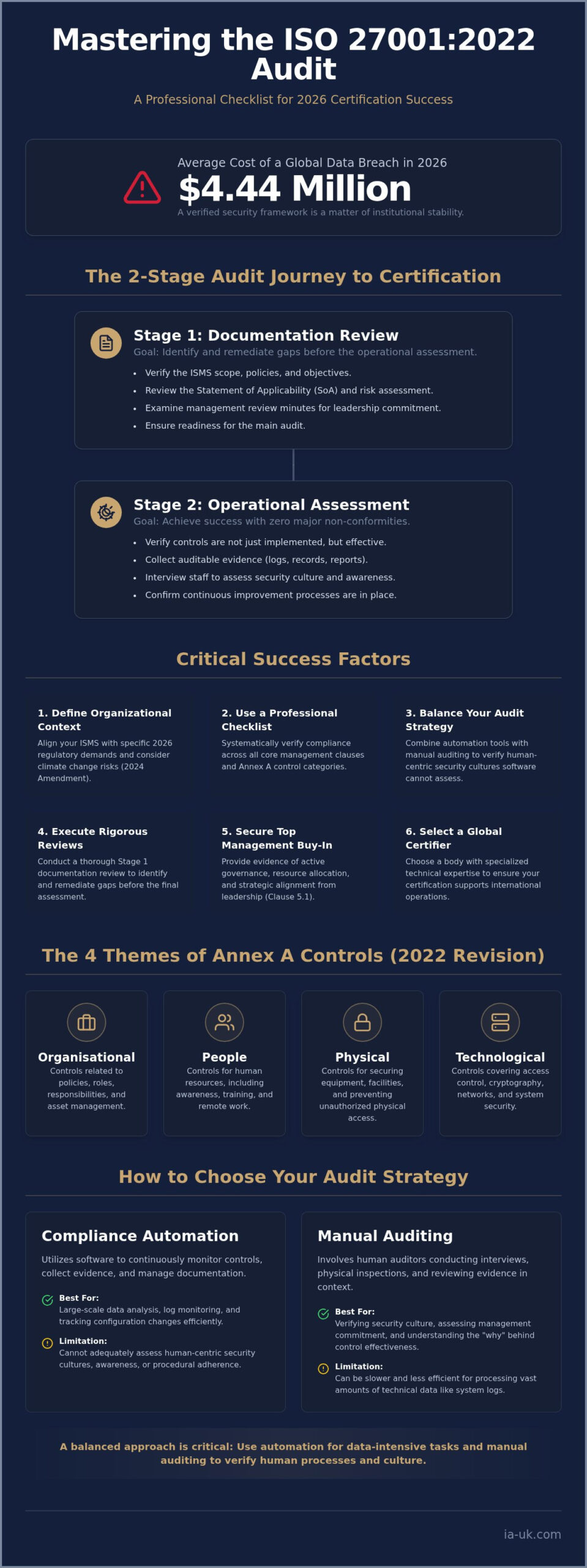
With the average cost of a global data breach reaching $4.44 million in 2026, the necessity for a verified security framework is a matter of institutional stability. You’re likely concerned about the complexity of Annex A controls and the risk of failing a high-stakes assessment after significant investment. This professional ISO 27001 audit checklist provides the technical precision required to align your operations with international standards and ensure audit readiness.
We’ll provide a methodical roadmap to master the ISO/IEC 27001:2022 requirements, including the mandatory 2024 amendments regarding climate change risks. This guide is designed to lead your organization through the Initial Certification Assessment with a focus on achieving Stage 2 success with zero major non-conformities. You’ll learn how to build a scalable Information Security Management System that satisfies rigorous regulatory scrutiny and supports long-term global growth.
Key Takeaways
- Establish a precise “Context of the Organisation” to ensure your Information Security Management System (ISMS) aligns with specific 2026 regulatory demands.
- Utilize a professional ISO 27001 audit checklist to verify compliance across core management clauses and the four thematic Annex A control categories.
- Balance compliance automation tools with manual auditing to effectively verify human-centric security cultures that software cannot adequately assess.
- Execute a rigorous Stage 1 documentation review to identify and remediate gaps before the final Stage 2 operational assessment begins.
- Select a certification body with global reach and specialized technical expertise to ensure your certification supports international operational capacity.
Preparing for the ISO 27001 Audit in 2026: Critical Success Factors
Success in an Initial Certification Assessment begins long before an auditor arrives on-site. In 2026, the information security environment is defined by the full adoption of ISO/IEC 27001:2022 and the critical 2024 Climate Action Amendment. Auditors now expect organizations to demonstrate a sophisticated understanding of their “Context of the Organisation” under Clause 4. This foundation requires you to move beyond technical configurations and prove how your Information Security Management System (ISMS) addresses specific external and internal issues. A rigorous gap analysis serves as the most vital pre-audit step, allowing your team to allocate resources effectively rather than spreading efforts across non-critical areas.
Defining the ISMS Scope and Risk Appetite
Establishing clear boundaries for your ISMS is essential to prevent audit failure. Auditors will scrutinize the scope to ensure it includes all relevant processes, locations, and technologies that handle sensitive data. You must map internal and external stakeholders, documenting their specific security requirements and how your organization meets them. When using your ISO 27001 audit checklist, ensure your risk assessment methodology is documented with enough detail to satisfy an auditor’s need for reproducibility. Your risk appetite shouldn’t be a vague statement; it must be a defined threshold that informs which Annex A controls are selected or excluded in your Statement of Applicability (SoA).
The Auditor’s Perspective on Management Review
Top management commitment is a non-negotiable requirement of Clause 5.1. During a Stage 1 review, auditors don’t just look for a signed policy; they examine management review meeting minutes for evidence of active governance. They seek proof that the ISMS aligns with strategic business objectives and that leadership has provided sufficient resources for control implementation. If leadership remains detached from the security process, the risk of a major non-conformity increases significantly. Organizations often bridge these competency gaps through Lead Auditor training, which provides internal teams with the same perspective used by professional certification bodies during a management system certification process. This ensures that the evidence provided, such as resource allocation logs and strategic alignment reports, meets the professional threshold for global reliability.
The Essential Internal Audit Checklist: Clauses and Annex A Controls
The transition from management planning to operational verification represents the most challenging phase of the certification journey. Auditors distinguish between “implemented” controls, which merely exist, and “effective” controls, which consistently achieve their intended security outcomes. Your internal ISO 27001 audit checklist must prioritize the collection of auditable evidence that demonstrates this effectiveness over time. A common pitfall in the Statement of Applicability (SoA) is failing to provide a technical or business justification for excluded controls, particularly those related to the 11 new controls introduced in the 2022 revision. Every entry in the SoA must be cross-referenced with the risk assessment to prove that the selection of controls is a deliberate, risk-based decision.
Verification of Clauses 4 through 10 ensures the management system’s structural integrity. Auditors look for a “closed-loop” system where internal audit results from Clause 9 directly inform the corrective actions required by Clause 10. This requires:
- Clause 4: Evidence that climate change risks were considered in the organizational context.
- Clause 7: Validated records of employee competence and resource availability.
- Clause 9: Comprehensive results of internal audits and management reviews.
- Clause 10: Documented evidence of non-conformities and the systematic corrective actions taken to prevent recurrence.
Clause 6 and 8: Planning and Operational Evidence
Auditors require proof that risk treatment plans aren’t static documents. You must demonstrate how risks identified during the planning phase in Clause 6 are actively managed through operational controls in Clause 8. For instance, if a risk of unauthorized data access is identified, you must provide system logs showing that access reviews were conducted according to the defined schedule. Auditing the effectiveness of security awareness training is also vital. Rather than just showing attendance lists, provide evidence of improved user behavior, such as reduced click rates in simulated phishing exercises or increased reporting of suspicious activities.
Annex A: Technical and Physical Control Verification
In 2026, the auditor’s focus has shifted toward the four thematic control categories: Organizational, People, Physical, and Technological. For SaaS-heavy environments, auditors will verify how you manage supplier relationship security. This includes reviewing service level agreements and ensuring that third-party access is restricted through robust encryption and multi-factor authentication. Physical security checks must now extend to remote and hybrid work environments, requiring evidence of clear desk policies and secure equipment disposal procedures. If your internal team doesn’t have the technical depth to verify these complex controls, Lead Auditor training can provide the necessary skills to conduct a professional-grade internal assessment before the certification body arrives.
Compliance Automation vs. Manual Auditing: How to Choose Your Strategy
The selection of an auditing strategy in 2026 involves a definitive choice between automated Governance, Risk, and Compliance (GRC) tools and traditional manual verification. Continuous monitoring provides a real-time view of technical control health, which is essential given that the average cost of a data breach has reached $4.44 million. While these tools offer undeniable efficiency in evidence collection, they can’t replace the professional judgment required to assess a management system’s maturity. A balanced approach ensures that technical data is supported by qualitative evidence, which is vital for a successful Initial Certification Assessment.
Organizations must evaluate tool costs against the efficiency gains they provide during the audit cycle. Automation is most effective when it handles repetitive tasks, such as verifying encryption settings or monitoring access logs. However, the auditor’s focus remains on the “closed-loop” integrity of the system. This means proving that when an automated tool identifies a gap, the organization’s leadership took documented, corrective action. Relying solely on a dashboard without human oversight often leads to major non-conformities during the Stage 2 assessment.
The Role of GRC Platforms in Audit Preparation
While automating security checks is efficient, other areas of digital compliance, such as web accessibility, often require specialized expertise to navigate effectively. For businesses looking to ensure their websites are fully inclusive and compliant, check out 216digital to learn about their ADA and WCAG auditing services.
GRC software is highly effective for mapping technical controls to the ISO 27001 audit checklist and managing the rigorous document version control required for Stage 1. These platforms provide a centralized repository for policies, risk registers, and the Statement of Applicability. It’s much easier for an auditor to review a well-organized digital environment than to sift through disparate spreadsheets. For organizations seeking to understand the infrastructure required to support these systems, reviewing International Associates Limited Software solutions provides valuable insights into professional-grade management system architecture.
Manual Verification: What the Auditor Must See Personally
Auditors must personally verify the security culture through direct staff interviews to ensure that security awareness isn’t just a “check-box” exercise. An automated report won’t reveal if employees actually understand their specific roles within the ISMS or if they know how to report a security incident. Physical or remote walkthroughs of sensitive areas are also required to confirm that the physical security controls described in the SoA are operational. The auditor also evaluates the professional competence of the internal audit team. If the internal team lacks the technical depth to challenge existing processes, it suggests a weakness in the management system’s ability to self-correct and improve. To mitigate this, many organizations partner with Insoft Services for professional IT training and consultancy, ensuring their internal teams have the specialized knowledge to maintain and verify robust cybersecurity frameworks.
Successful completion of the Initial Certification Assessment requires a disciplined transition from documented policy to operational reality. This process is divided into two distinct phases: the Stage 1 documentation review and the Stage 2 implementation audit. Stage 1 acts as a “readiness review” where the auditor evaluates whether the structural requirements of the standard are met. If gaps are identified, they are recorded as “Areas of Concern” that must be resolved before the Stage 2 assessment begins. This hierarchical approach ensures that organizations don’t waste resources on a full-scale audit if their management system’s foundation is incomplete.
Managing non-conformities is a critical part of the remediation phase. A Major Non-Conformity represents a systemic failure to meet a requirement of the standard, such as the total absence of an internal audit program. This finding will block certification until the issue is fully corrected and verified. Conversely, a Minor Non-Conformity is an isolated lapse, such as a single staff member failing to follow a specific procedure. While minor findings don’t necessarily prevent a recommendation for certification, they require a documented corrective action plan that the auditor will review during the Annual Surveillance audit.
The Stage 1 Document Review Checklist
During Stage 1, the auditor focuses on the “desk audit” of your Information Security Management System (ISMS). Using a comprehensive ISO 27001 audit checklist during your internal preparation ensures that mandatory documents, such as the Statement of Applicability (SoA), Risk Treatment Plan, and Information Security Policy, are finalized. The auditor also verifies the presence of mandatory records, specifically the results of your internal audit and management review meetings. This phase concludes with a formal Stage 1 report that outlines your readiness and establishes the specific schedule and sampling plan for the Stage 2 assessment.
Stage 2: On-Site and Remote Verification Tactics
Stage 2 is where you must prove that you “do what you say” across all departments included in the ISMS scope. The auditor will conduct staff interviews to verify that security controls are operational and understood at all levels of the organization. They will sample technical evidence, such as system logs, change tickets, and firewall configurations, to ensure that the controls listed in your SoA are functioning as intended. Organizations ready to proceed should engage with a global partner for their management system certification to ensure a smooth and professional transition between these critical audit stages. The process concludes with a closing meeting where the auditor provides their recommendation for certification based on the evidence gathered.
Selecting a Global Certification Body: Beyond the Checklist
While an internal ISO 27001 audit checklist ensures your technical and management system controls are documented, the final certification outcome is heavily influenced by the competence of your chosen certification body. Organizations must evaluate whether an auditor possesses specific expertise in their industrial sector, particularly in highly regulated fields like medical devices or energy. A certification body with a global network of regional offices across Europe, Asia, and the Middle East provides a unique advantage for multinational firms. This global-local duality ensures that while the audit is conducted with local context, it’s supported by a central administrative base that guarantees institutional reliability and professional turnaround times for technical reviews.
Efficiency is further enhanced through integrated audits. Many organizations find that combining their information security assessment with an ISO 9001 certification reduces audit fatigue and lowers overall administrative costs. This holistic approach ensures that quality management and information security operate as a single, unified system. When selecting a partner, look for a firm that prioritizes advanced IT infrastructure to provide quick certificate turnaround after the recommendation is made at the closing meeting.
Accreditation and Global Recognition
Choosing an accredited certification body is a non-negotiable requirement for organizations seeking international trust. Accreditation provides independent verification that the certification body operates with the necessary impartiality and technical depth. International Associates Limited, with its Glasgow-based head office and expansive worldwide reach, acts as a sophisticated bridge between complex global regulations and the businesses that must adhere to them. You can verify the standing of a potential partner by reviewing IA-UK Our Accreditations, which serves as a foundational pillar of brand identity and reliability in the assurance industry.
Surveillance and Recertification: Maintaining Trust
Certification is the beginning of a continuous compliance cycle rather than a one-time achievement. Following the Initial Certification Assessment, organizations enter an Annual Surveillance cycle to ensure the ISMS remains effective against evolving threats. Every three years, a full recertification process is required to verify the long-term maturity of the management system. To maintain internal compliance between these external visits, many organizations invest in Lead Auditor Training. This training ensures that the internal audit team has the professional competence to use an ISO 27001 audit checklist effectively, closing any gaps before the external auditor arrives for the next surveillance visit.
Achieving Operational Resilience through ISO 27001 Certification
Mastering the rigorous requirements of first-time certification requires a methodical approach that extends beyond technical controls to encompass organizational culture and leadership commitment. By utilizing a structured ISO 27001 audit checklist, your team can effectively bridge the gap between documented policy and operational reality. This ensures that the Information Security Management System remains compliant with the latest regulatory amendments while supporting long-term international growth.
International Associates Limited acts as the steady hand for navigating this complex regulatory landscape. As an accredited certification body since 2005, we combine UK-based expertise with an expansive network of global regional offices to support your certification journey. Our advanced IT infrastructure ensures an efficient auditing process and rapid certificate turnaround for all clients. We invite you to Request an Initial Certification Assessment from International Associates Limited to begin your path toward successful Stage 2 certification. We’re ready to help you achieve global security excellence with confidence.
Frequently Asked Questions
What is the difference between an ISO 27001 internal audit and an external audit?
Internal audits are conducted by the organization or on its behalf to verify management system health before the official assessment. External audits are performed by an independent, accredited certification body like International Associates Limited to verify compliance for certification purposes. While internal audits focus on identifying gaps and improvement areas, external audits focus on the objective verification of the standard’s requirements to issue the final certificate.
How long does the ISO 27001 certification process take in 2026?
The duration for achieving certification typically ranges from three to six months, depending on the organization’s initial maturity and complexity. This timeline includes the development of the ISMS, the mandatory internal audit, and the formal Initial Certification Assessment process. Organizations utilizing advanced IT infrastructure for evidence collection often experience a more efficient Stage 1 and Stage 2 review, leading to a quicker certificate turnaround.
Can we achieve ISO 27001 certification if we have minor non-conformities?
Yes, an organization can be recommended for certification even if minor non-conformities are identified during the Stage 2 audit. A minor non-conformity is an isolated incident that doesn’t represent a systemic failure of the management system. While these findings don’t block certification, the auditor requires a documented corrective action plan. This plan must demonstrate how the organization will address the issue before the first Annual Surveillance audit.
What are the mandatory documents required for an ISO 27001 Stage 1 audit?
Mandatory documentation for a Stage 1 audit includes the Information Security Policy, the Statement of Applicability (SoA), and the Risk Treatment Plan. Auditors also require evidence of a completed internal audit and a management review meeting. Using a professional ISO 27001 audit checklist helps ensure that these structural requirements are finalized. Stage 1 serves as a readiness review to confirm that the ISMS foundation is sufficient for implementation testing.
How often must we perform a risk assessment to remain compliant?
Risk assessments must be performed at planned intervals or whenever significant changes occur within the organization or its operational context. While the standard doesn’t mandate a specific timeframe, auditors generally expect an annual review to maintain compliance. This ensures the ISMS remains aligned with the 2026 threat landscape. Any updates to the risk assessment must be reflected in the Statement of Applicability and documented in management review minutes.
Is a 100% automated ISO 27001 audit possible?
A 100% automated audit isn’t possible because the standard requires the verification of human-centric processes and security culture. While GRC software streamlines technical evidence collection for an ISO 27001 audit checklist, professional auditors must personally conduct interviews and walkthroughs. These manual steps verify that employees understand their roles and that management commitment is active. Automation supports the audit process but cannot replace the independent judgment of an accredited certification body.
What is a Statement of Applicability (SoA) and why is it critical?
The Statement of Applicability is a mandatory document that lists which Annex A controls were selected or excluded based on the risk assessment. It’s critical because it defines the operational scope of your security controls and provides a technical justification for every decision. Auditors use the SoA as the primary roadmap during the Stage 2 assessment to verify that the organization has implemented all necessary protections for its specific risks.
How much does ISO 27001 certification cost for a mid-sized business?
Certification costs vary based on the organization’s size, the complexity of its data environment, and the number of sites included in the scope. Fees typically cover the Initial Certification Assessment, which includes Stage 1 and Stage 2 reviews, followed by Annual Surveillance and Recertification Fees. Organizations should request a formal proposal to understand the specific investment required for their unique management system certification needs without relying on generic industry averages.