

Possessing a documented safety policy isn’t the same as providing verifiable evidence of its execution. This distinction often separates a successful Stage 1 assessment from a costly delay caused by major non-conformities. If you’re managing occupational health and safety across global sites, the fear of failing a formal assessment is a rational concern. An effective ISO 45001 audit checklist must do more than tick boxes; it should serve as a diagnostic tool that mirrors the rigorous perspective of an independent certification body.
We understand that managing the transition toward the upcoming ISO 45001:2027 revision, which introduces stricter requirements for climate-related risks and worker well-being, adds a layer of complexity to your preparation. This guide provides a professional framework to identify critical gaps in your management system before they become liabilities. You’ll gain a clear “Go/No-Go” decision framework for your Stage 1 audit and a technical understanding of how auditors evaluate worker participation and regional site compliance.
By aligning your internal reviews with the methodology used by our Glasgow based lead auditors, you can significantly reduce audit turnaround time. We’ll outline the exact evidence required to move beyond simple policy statements and achieve a state of true certification readiness.
Key Takeaways
- Distinguish between the mere existence of safety policies and the objective evidence of their effectiveness required to avoid major non-conformities.
- Use a professional ISO 45001 audit checklist to conduct a rigorous gap analysis that mirrors the perspective of a third-party auditor.
- Master the specific requirements for worker participation and leadership commitment, which are the most scrutinized elements during a formal assessment.
- Identify the minimum documentation mandatory for Stage 1, including the scope, objectives, and risk assessments, to ensure your system is audit-ready.
- Understand how independent verification from a global certification body provides the reliability needed to secure high-stakes international contracts.
Audit Readiness: Why Your Checklist Must Reflect Auditor Expectations
An internal safety check often confirms that a policy exists, but a certification assessment verifies that it actually works. This distinction is the fundamental purpose of a professional ISO 45001 audit checklist. In 2026, auditors prioritize system effectiveness over the mere existence of documentation. The checklist serves as a diagnostic tool within the ISO 45001 certification lifecycle, facilitating a definitive “Go/No-Go” decision during the Stage 1 assessment. It ensures that your Occupational Health and Safety (OH&S) management system isn’t just a manual on a shelf. It’s a functional framework that protects your workforce and satisfies independent inspectors from our Glasgow head office or our global regional network.
Internal Audit vs. Certification Audit Expectations
Internal audits are typically designed to identify opportunities for improvement and operational efficiencies. However, a certification audit is an independent verification process intended to confirm adherence to the international standard. Auditors don’t rely on subjective claims of intent; they require objective evidence. This means your records must demonstrate that safety protocols are active and understood across the organization. This includes everything from meeting minutes to equipment maintenance logs. Businesses moving away from the reactive OHSAS 18001 mindset find that a structured checklist helps them adopt the proactive, risk-based approach required by the current standard. It moves the conversation from what you plan to do to what you’ve actually achieved.
High-Risk Areas in the 2026 OH&S Landscape
The 2026 safety environment presents unique challenges that your ISO 45001 audit checklist should address to prevent major non-conformities. Auditors now look closely at how health and safety management extends into hybrid and remote work environments. Mental health and psychosocial risks aren’t secondary concerns anymore. Under Clause 6.1.2.1, you must provide evidence that workplace stress and psychological safety are being managed. Global supply chain scrutiny has also increased. Integrating safety checks with social accountability audits ensures that contractors and external providers align with your corporate safety values. This creates a unified shield against operational risk and ensures your organization remains a reliable partner in global tenders.
Clause-by-Clause Checklist: Leadership and Planning (Clauses 4-6)
Every comprehensive ISO 45001 audit checklist begins with the foundational elements of the management system, spanning from the context of the organization to strategic planning. Clause 4 requires the identification of internal and external issues that influence your safety performance. This includes external regulatory shifts and internal cultural factors. Auditors verify that the scope of the management system is clearly defined and documented, ensuring no high-risk operational areas are omitted. This stage sets the boundaries for the entire assessment and informs how subsequent clauses are applied to your specific business environment.
Clause 5: Leadership and Worker Participation (The #1 Fail Point)
Leadership commitment is frequently the most audited section of the standard because it dictates the success of the entire system. Auditors look for evidence that top management is personally involved in OH&S activities rather than simply delegating responsibility to a safety officer. This evidence includes participation in safety committee meetings and the active promotion of a safety culture. Worker participation is a mandatory, non-negotiable evidence requirement for 2026. You must demonstrate that workers have been consulted on the system’s development and have access to mechanisms for reporting hazards without fear of reprisal. Organizations identifying competency gaps during their internal reviews often benefit from Lead Auditor Training to ensure their internal teams understand these technical requirements. Effective systems also address barriers to participation, such as language differences or literacy levels, to ensure every employee is engaged.
Clause 6: Risk and Opportunity Management
The standard has shifted the focus from simple hazard identification to a more sophisticated assessment of risks and opportunities. This requires a documented process for identifying legal requirements and other obligations relevant to your operations. Your ISO 45001 audit checklist should verify that these risks are not just listed but are actively managed through prioritized action plans. Objectives must be SMART: specific, measurable, achievable, relevant, and time-bound. These goals should align with the organization’s strategic direction, ensuring that safety is integrated into business planning rather than treated as a separate administrative burden. Auditors will expect to see that these objectives are tracked and that resources have been allocated to achieve them. This proactive planning ensures the management system can adapt to operational changes while maintaining a high level of worker protection.
Clause-by-Clause Checklist: Support, Operation, and Evaluation (Clauses 7-10)
Clauses 7 through 10 represent the transition from strategic planning to operational execution and systemic improvement. A robust ISO 45001 audit checklist must verify that the organization’s resources, competence, and awareness are sufficient to sustain the OH&S management system. This phase ensures that the theoretical plans developed in earlier stages are effectively implemented through rigorous operational controls and measured against predefined performance criteria. Central to this process is the maintenance of regulatory compliance, which acts as the baseline for all operational activities across your global sites.
Clause 8: Operational Planning and Control
Auditors expect to see a clear application of the Hierarchy of Controls as defined in Clause 8.1.2. This means you must provide evidence that you’ve prioritized hazard elimination and substitution over secondary measures like administrative controls or Personal Protective Equipment (PPE). Your checklist should also address Management of Change (MoC) protocols. These documents prove that safety integrity was maintained during organizational shifts, such as new equipment installation or process changes. Procurement and contractor management are equally critical. You’re responsible for ensuring that third-party providers align with your safety standards, which requires documented verification of their competence and safety performance before they begin work on your sites.
Clause 9 & 10: Evaluation and Improvement
Performance evaluation under Clause 9 requires systematic monitoring and measurement. This includes maintaining records for calibrated safety equipment and documented health surveillance where applicable. Your Internal Audit program is a vital component of this evaluation. Auditors will examine the frequency and methodology of these audits, as well as the competency of the individuals conducting them. If your internal reviews reveal gaps, our Lead Auditor Training can help bridge those competency deficits. Finally, Clause 10 focuses on continuous improvement. Management reviews shouldn’t be passive meetings; they’re opportunities to use audit data to drive strategic safety decisions. You must demonstrate a proactive approach to handling non-conformities, ensuring that corrective actions address the root cause rather than just the symptoms. This systematic loop ensures the management system remains resilient and effective over the long term.
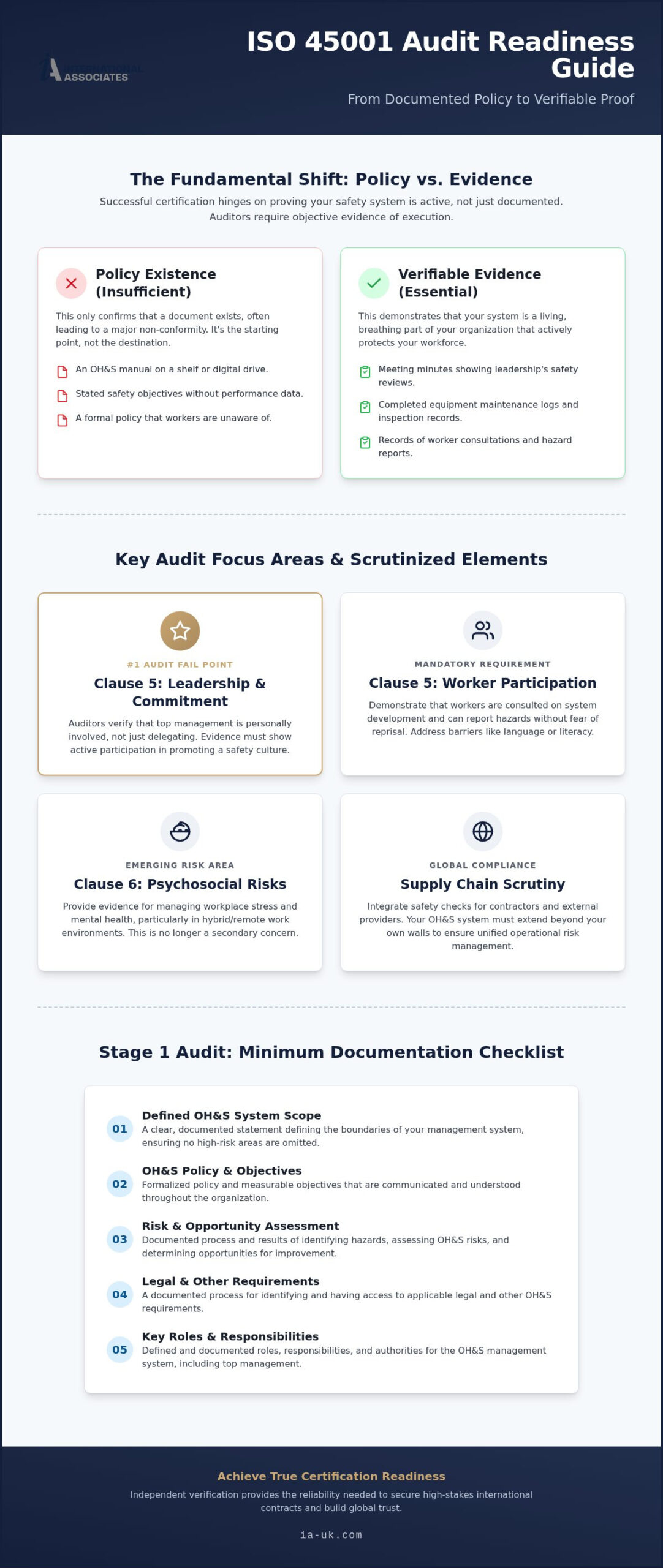
Preparing for the Stage 1 Audit: Documentation vs. Evidence
The Stage 1 audit serves as the gateway to certification. It’s a document review and readiness assessment where the auditor determines if your management system is sufficiently developed for a full Stage 2 evaluation. Utilizing a professional ISO 45001 audit checklist during your internal pre-assessment allows your team to distinguish between mere policy statements and the objective evidence required for compliance. Auditors prioritize “show me” evidence over “tell me” narratives. They expect to see records, data logs, and verified meeting minutes that prove the system is active. At a minimum, Stage 1 requires documented evidence of the system’s scope, the OH&S policy, measurable objectives, and a comprehensive register of risks and opportunities.
Identifying Critical Gaps (NCs)
A rigorous pre-audit review identifies potential Major Non-Conformities (NCs) before the formal assessment begins. A Minor NC is typically an isolated lapse in a functional process. However, a Major NC signifies a systemic failure, such as the total absence of a required procedure or a failure to address significant safety risks. When these gaps appear, your team must perform a thorough root cause analysis. Professional auditors don’t accept “human error” as a corrective action. It’s almost always a symptom of a flawed process or inadequate training. This internal analysis informs your “Go/No-Go” decision. If systemic failures are identified, delaying the Stage 2 audit is often the more professional and cost-effective choice. To ensure your internal team can identify these gaps effectively, consider enrolling them in Lead Auditor Training to align their skills with international standards.
Evidence in the Digital Age
The 2026 auditing environment relies heavily on digital verification and remote protocols. Auditors now evaluate cloud-based safety management systems and digital signatures to confirm the integrity of your records. This IT-driven auditing framework significantly reduces turnaround times for certificates and facilitates seamless coordination between our Glasgow head office and international regional sites. When preparing for remote interviews, you must verify your connectivity and screen-sharing protocols. The auditor needs to see real-time data and live reporting platforms rather than static, historical documents. This digital transparency allows for a more efficient and objective verification of your OH&S performance.
For an independent verification of your system’s readiness, apply for an ISO 45001 certification assessment with our global team of experts.
Beyond the Checklist: Choosing Your Certification Partner
Independent verification is a strategic necessity for organizations competing in high-stakes global tenders. Whether managing industrial sites or the complex delivery of high-profile live entertainment experiences by firms like Lar&Co, the final certificate serves as an authoritative statement of trust and regulatory adherence. International Associates Limited provides a methodical, professional approach to management system certification, acting as an impartial bridge between complex safety standards and your business objectives. Our role is to provide a rigorous assessment that confirms your health and safety framework is capable of protecting your workforce while meeting international legal requirements.
The path to certification follows a structured three-year cycle designed to ensure sustained effectiveness beyond the initial assessment. The process begins with a Stage 1 audit, which is a documentation review that builds on the readiness identified during your pre-assessment. This stage confirms that the foundational elements of your system are in place before moving to Stage 2. The Stage 2 audit involves a deep-dive verification of implementation, where auditors observe your processes in action and interview staff at all levels. Once certification is granted, the system is maintained through annual surveillance audits, culminating in a full recertification assessment every three years. This methodical sequence ensures that safety performance is a continuous process rather than a static achievement.
Selecting a Global Certification Body
Continuous improvement and professional development are vital across all business functions. For those looking to enhance performance in the insurance sector, you can read more about the Sales Academy and coaching programs provided by IICS.
Choosing the right partner requires balancing technical expertise with operational efficiency. International Associates Limited combines the authority of our Glasgow head office with an expansive network of international offices, providing a unique blend of institutional reliability and worldwide reach. It’s essential to verify a provider’s accreditations and memberships to ensure the validity of your certificate in all regional markets. We utilize an advanced IT infrastructure to deliver efficient audit turnaround times without compromising the depth of our professional inspections. This digital framework, previously mentioned as a benefit for remote evidence verification, allows for seamless data management and rapid report generation. By aligning with a globally recognized body, you ensure that your ISO 45001 audit checklist leads to a credential that is respected by clients and regulators across the sensitive industrial sectors you serve.
Securing Your Global Safety Credentials in 2026
Achieving certification requires a transition from simply maintaining a policy manual to providing objective, verifiable evidence of a functional management system. A professional ISO 45001 audit checklist is the most effective tool to identify systemic gaps before a formal assessment. By focusing on leadership commitment and the non-negotiable requirement for worker participation, your organization builds a resilient safety culture that satisfies independent auditors. It’s about moving beyond intent to demonstrate operational reality.
International Associates Limited supports your international growth from our Glasgow head office; we utilize an expansive global network and advanced IT infrastructure to ensure efficient audit turnaround times. If your internal reviews reveal competency deficits, it’s helpful to know we are an accredited Lead Auditor training provider capable of upskilling your team. Verification from a trusted, independent certification body provides the stability your business needs to navigate complex regulatory landscapes without friction.
Request a Professional ISO 45001 Certification Quote to begin your journey toward a safer, more compliant workplace. We look forward to verifying your commitment to excellence and supporting your continued operational success.
Frequently Asked Questions
What is the most important item on an ISO 45001 audit checklist?
The most critical item on an ISO 45001 audit checklist is objective evidence of leadership commitment and worker participation. Clause 5 requirements are foundational; without documented proof that top management is involved and workers are consulted, the entire system lacks authority. Auditors prioritize seeing how safety decisions are made and whether employees at all levels feel empowered to report hazards without fear of reprisal or institutional friction.
Can we fail the ISO 45001 audit if we don’t have a safety committee?
You won’t automatically fail if you lack a formal safety committee, provided you demonstrate effective alternative methods for worker consultation and participation. ISO 45001 requires that non-managerial workers are involved in safety decisions. If your organization is small, suggestion boxes, toolbox talks, or digital feedback loops may suffice. However, larger organizations often find committees the most reliable way to provide the structured evidence auditors require during an assessment.
How long should we keep safety records for an ISO 45001 audit?
Safety records should be retained for at least one full three-year certification cycle to demonstrate systemic performance over time. However, legal requirements often dictate longer periods for specific data, such as health surveillance or incident reports. Your management system must define these retention periods clearly. Auditors check these records to verify that your operational controls are consistently applied and that past non-conformities have been effectively resolved.
Is a digital checklist sufficient for a certification body auditor?
A digital ISO 45001 audit checklist is entirely sufficient and often preferred by modern certification bodies. Digital tools facilitate real-time data capture and easier integration with cloud-based management systems. Auditors appreciate the transparency and accessibility that digital records provide, especially during remote assessments. Ensuring your digital system includes time-stamped signatures and version control demonstrates a high level of procedural integrity and the technical competence expected in 2026.
What is the difference between an internal audit and a gap analysis?
An internal audit verifies that your established management system is functioning according to your own procedures and the standard’s requirements. In contrast, a gap analysis is a diagnostic tool typically used before implementation to identify which requirements of ISO 45001 are currently missing. While both use a checklist, the gap analysis focuses on system design, while the internal audit focuses on operational adherence and systemic effectiveness.
How often should we update our ISO 45001 audit checklist?
Your checklist should be updated whenever there are significant changes to your operations, legal obligations, or when the international standard itself is revised. For instance, the upcoming 2027 revision will necessitate updates to reflect new requirements regarding climate change and worker well-being. Regular reviews ensure that your internal assessments remain aligned with the latest auditor expectations and regional regulatory shifts across your global sites and administrative bases.
Do we need to audit our contractors as part of our checklist?
You must include contractor management in your audit process as required by Clause 8.1.4. Your organization is responsible for ensuring that third-party providers align with your safety protocols while working on your sites. Auditors will look for evidence that you’ve assessed contractor risks and verified their competence. This oversight ensures that external parties don’t introduce new hazards into your environment or compromise your overall occupational health and safety performance.
What happens if our checklist identifies a major non-conformity?
If a major non-conformity is identified, you must perform a root cause analysis and implement corrective actions before proceeding to a Stage 2 audit. A major non-conformity indicates a systemic failure that prevents the management system from achieving its intended outcomes. Identifying these gaps early allows your team to rectify the issue and avoid a “No-Go” decision from the certification body. This proactive approach maintains the integrity of your certification timeline.