

What if your legacy safety system is actually the greatest risk to your global tender eligibility in 2026? Implementing a comprehensive ISO 45001 audit checklist isn’t just a compliance exercise; it’s a strategic necessity for businesses navigating the technical transition from OHSAS 18001. You likely agree that the complexity of the Annex SL structure and the rigorous mandates for worker participation create significant hurdles during internal reviews. It’s a common concern that these technical shifts might lead to major nonconformities during a high-stakes transition audit, potentially stalling your organization’s international growth and partnership opportunities.
This article provides the technical insights and strategic roadmap needed to master the essential requirements of the standard and achieve successful certification. We will examine the key clauses of the 2018 standard, compare legacy systems to modern process-based management, and outline the exact steps required for audit preparation. By following this structured path, your organization can establish a steady, reliable foundation for corporate compliance. You’ll gain the clarity necessary to transform your safety management system into a proactive asset that meets the highest international benchmarks for reliability and trust.
Key Takeaways
- Understand the fundamental shift from the procedure-based OHSAS 18001 to the proactive, process-based requirements of the ISO 45001:2018 standard.
- Utilize a comprehensive ISO 45001 audit checklist to perform a rigorous gap analysis, ensuring all legacy systems align with modern Annex SL structures.
- Prioritize Clause 4 and Clause 5 requirements by documenting the organizational context and providing verifiable evidence of top-management leadership and worker participation.
- Identify opportunities to integrate occupational health and safety with existing ISO 9001 and ISO 14001 systems to streamline audits and reduce operational friction.
- Select an independent certification body with global reach to ensure your credentials provide the necessary trust for international tender eligibility.
What is an ISO 45001 Audit Checklist and Why is it Essential in 2026?
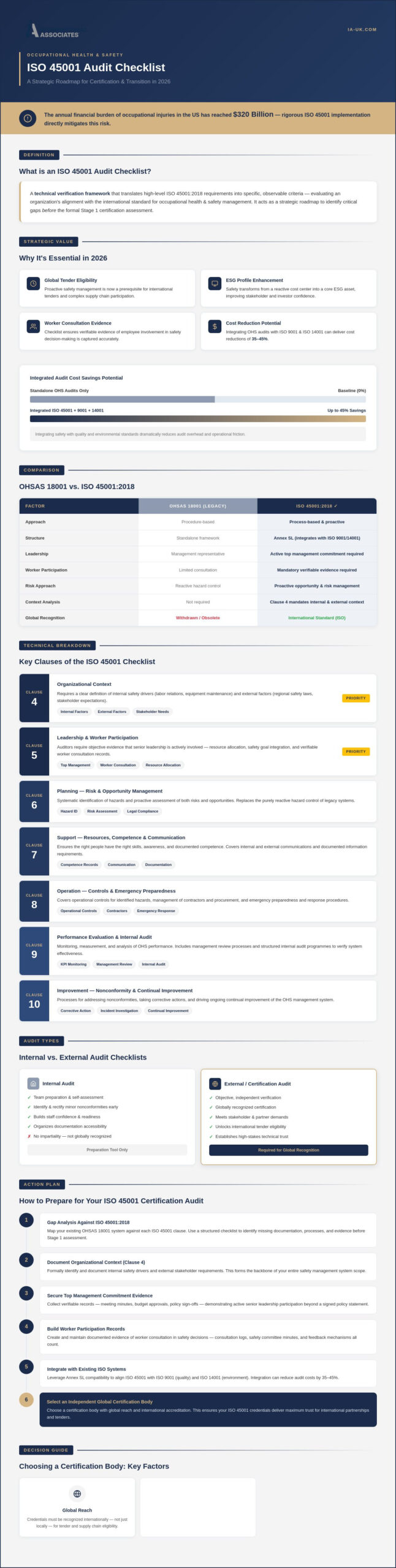
An ISO 45001 audit checklist is a technical verification framework designed to evaluate an organization’s alignment with the international standard for occupational health and safety. It translates high-level requirements into specific, observable criteria that ensure operational integrity. By 2026, the landscape of global trade has shifted significantly. Proactive safety management is now a prerequisite for participating in international tenders and complex supply chains.
This checklist acts as a strategic roadmap during the transition from legacy systems. It allows leadership to identify critical gaps before the formal Stage 1 assessment takes place. Moving from basic compliance to measurable performance requires this kind of systematic verification. When safety is treated as a proactive asset, it transforms from a reactive cost center into a core component of a firm’s ESG profile. Data from June 2026 indicates the annual financial burden of occupational injuries in the United States has reached $320 billion. A rigorous checklist helps organizations mitigate these substantial financial risks.
The Strategic Value of an ISO 45001 Checklist
Standardizing safety protocols across diverse global sites is a primary challenge for modern enterprises. A unified checklist ensures that every facility adheres to the same high standards, regardless of local jurisdictional differences. This consistency is essential for satisfying ISO 45001 mandates regarding worker consultation. The standard requires verifiable evidence that employees are involved in safety decision-making. Utilizing a structured checklist during Management System Certification Services ensures this evidence is captured accurately. It also facilitates the integration of safety with social accountability audits, providing a comprehensive view of corporate responsibility.
Internal vs. External Audit Checklists
Internal checklists are essential for team preparation and self-assessment. They allow your staff to identify and rectify minor nonconformities before an official auditor arrives. This internal process builds confidence and ensures that the necessary documentation is organized and accessible. However, an internal review lacks the impartiality required for global recognition. It’s a tool for preparation, not a final stamp of approval.
External audits conducted by independent bodies provide the objective verification that stakeholders and international partners demand. While internal tools are excellent for operational maintenance, external certification confirms that your system meets rigorous international benchmarks. It’s a critical step for establishing trust in high-stakes technical sectors. Organizations that integrate their health and safety audits with quality or environmental standards can see cost reductions of 35-45%. This makes the strategic use of an ISO 45001 audit checklist a vital decision for any organization focused on long-term resilience.
Key Clauses of the ISO 45001 Checklist: A Technical Breakdown
The ISO 45001 audit checklist provides a methodical structure for assessing an organization’s occupational health and safety management system. It follows the Annex SL high-level structure, ensuring compatibility with other international standards. Clause 4 initiates the process by requiring a clear definition of the organization’s context. This involves identifying internal safety drivers, such as labor relations and equipment maintenance, alongside external factors like regional safety laws and stakeholder expectations. Organizations that have completed the transition to its replacement standard, ISO 45001:2018, understand that these clauses form the technical backbone of a resilient safety culture.
Clause 5: The Leadership and Participation Pillar
Verification of Clause 5 requires more than a signed policy statement. Auditors seek objective evidence that senior leadership is actively involved in the management system. This includes the allocation of necessary resources and the integration of safety goals into the broader business strategy. A critical component is the mechanism for non-managerial worker consultation. You must demonstrate that workers have been provided with the time and training to participate in hazard identification and risk assessment. Records of safety committee meetings and employee feedback loops serve as essential documentation for this requirement. Developing the internal expertise to interpret these requirements is often best achieved through specialized Lead Auditor Training.
Clause 6: Risk-Based Planning in 2026
Clause 6 shifts the focus from simple hazard identification to a broader management of risks and opportunities. In 2026, this includes addressing emerging factors such as psychosocial risks and the health implications of climate change. The ISO 45001 audit checklist ensures that safety objectives are measurable and aligned with the organization’s strategic direction. Documentation must include a clear register of legal requirements and other compliance obligations. This planning phase ensures that the management system is proactive rather than reactive, identifying potential failures before they result in workplace incidents.
Operational integrity is verified through Clauses 7 and 8. These sections focus on resource management, competence, and operational controls. Auditors will examine how your organization manages change and ensures that outsourced processes meet your safety standards. Emergency preparedness and response plans are also scrutinized here to ensure they are tested and effective. The final stages of the checklist cover Clauses 9 and 10, which focus on performance evaluation and improvement. This involves conducting regular internal audits and implementing corrective actions for any identified nonconformities. This cyclical process ensures that the management system remains effective and continues to protect the workforce in a changing global environment.
OHSAS 18001 vs ISO 45001: Key Factors for a Successful Transition
OHSAS 18001 is now an obsolete framework. In the current global marketplace, it’s considered a legacy system that doesn’t meet the rigorous expectations of modern stakeholders or international regulatory bodies. The transition to ISO 45001:2018 represents a fundamental shift from a ‘procedure-based’ management style to a ‘process-based’ approach. While OHSAS 18001 focused on following established rules, ISO 45001 requires organizations to understand how their safety processes interact with overall business goals. This proactive nature is designed to prevent long-term ill-health and psychosocial risks, moving beyond the traditional focus on immediate physical accidents.
Structural and Conceptual Differences
The foundation of a successful transition lies in understanding Annex SL. This high-level structure ensures that your safety management system integrates perfectly with your quality and environmental frameworks. Organizations that align these systems often achieve a 35-45% reduction in total audit costs compared to conducting three separate assessments. A core requirement of the modern standard is defining the ‘Context of the Organisation’. This involves identifying the internal and external factors that influence safety performance. As detailed in our ISO 9001 Comprehensive Guide, this alignment is essential for maintaining operational consistency across global sites. The standard now mandates a much higher degree of oversight for outsourced processes and contractor safety, reflecting the reality of contemporary global supply chains.
Transition Challenges and Solutions
Moving away from a legacy system can be difficult for any workforce. Change fatigue often sets in when teams are asked to adopt new documentation requirements and engagement protocols. To mitigate this, technical training is vital. Completing an ISO 45001 Lead Auditor Course provides your team with the authoritative knowledge needed to lead the migration with confidence. Implementing a digital ISO 45001 audit checklist simplifies the verification process. It allows for real-time data entry and ensures that no critical clause is overlooked during the gap analysis. Leveraging modern IT infrastructure for document control and certificate turnaround is a hallmark of an efficient, globally-minded enterprise. This steady, methodical approach ensures that your transition is not just a compliance exercise, but a strategic improvement of your corporate resilience.
Maintaining a high-level of expertise within your organization is the most effective way to ensure long-term adherence to these standards. If you’re ready to verify your system’s readiness, consider our Management System Certification Services to achieve independent, global recognition.
How to Prepare for Your ISO 45001 Certification Audit
Preparation for a formal assessment requires a disciplined, multi-stage approach. The first step involves conducting a thorough Gap Analysis using your ISO 45001 audit checklist. This initial review identifies where your current management system falls short of the 2018 standard’s requirements. Once gaps are identified, you must formalize leadership commitment and establish clear channels for worker consultation. It’s not enough to have a policy on paper. You must prove that employees at all levels are actively engaged in safety decision-making.
Before inviting an external body, your organization must complete a full cycle of internal audits and a formal management review. This internal verification ensures that corrective actions have been implemented and that the system is functioning as intended. Selecting an accredited certification body with global reach is the next critical decision. A firm with international regional networks provides the necessary institutional weight to validate your compliance for global trade partners. The final preparation involves understanding the two-stage assessment process:
- Stage 1: A documentation review where the auditor verifies that your system’s framework is technically compliant.
- Stage 2: An implementation audit where the auditor observes your processes in action and interviews staff to ensure the system is embedded in daily operations.
Avoiding Common Audit Nonconformities
Many organizations fail their initial audit because of outdated legal registers. For 2026, you must ensure all regional and international safety regulations are current and accessible. Another common pitfall is failing to track ‘Opportunities’ for safety improvement. The standard requires you to look beyond hazard mitigation and actively seek ways to enhance performance. For those operating in complex supply chains, reviewing our guide on How to Prepare for a SMETA 4-Pillar Audit can provide additional insights into integrated compliance and social accountability. Similarly, organizations supplying into the rail sector should consult our IRIS certification audit checklist for rail industry suppliers, which addresses the specialized RAMS and Life Cycle Costing requirements that intersect with broader safety management obligations.
The Role of Documentation in 45001
ISO 45001 emphasizes ‘documented information’ rather than rigid, bureaucratic procedures. The goal is to maintain enough records to prove compliance without stifling operational efficiency. Utilizing advanced software tools allows for real-time compliance tracking and facilitates a quick certificate turnaround. Finally, you must prepare your staff for auditor interviews. Employees should be able to explain their role in the safety system and how they contribute to hazard identification during site walk-throughs.
If you’re ready to initiate your formal assessment with a steady hand in corporate compliance, contact us to begin your ISO 45001 certification process today.
Choosing a Global Certification Body for ISO 45001
Selecting the right auditing partner is the final critical decision in your certification journey. While your internal team may have successfully navigated the ISO 45001 audit checklist, the value of your certificate depends entirely on the impartiality and global recognition of the issuing body. Independent verification isn’t merely a procedural requirement; it’s a foundational pillar of international trust. Stakeholders in high-stakes technical sectors require assurance that your safety management system has been scrutinized by experts who understand both the standard and the specific risks of your industry.
A global certification body must balance worldwide operational capacity with localized regulatory knowledge. This duality is essential for adhering to regional safety laws without compromising the integrity of a centralized management system. In 2026, the efficiency of an auditing partner is often defined by their IT infrastructure. Advanced systems, which can be further optimized by working with a global IT consultancy like Kagool, facilitate quicker certificate turnaround times, ensuring that your business remains eligible for global tenders without unnecessary delays. Modern enterprises also seek to integrate their safety protocols with broader ESG commitments. Partnering with a body that specializes in both ISO 45001 and social accountability audits provides a cohesive, streamlined approach to corporate responsibility.
Why Partner with International Associates Limited?
International Associates Limited acts as the steady hand in the world of corporate compliance. With our head office in Glasgow and an expansive network of international offices, we provide a unique blend of institutional reliability and global reach. Our auditors are specialists in high-stakes technical and industrial sectors, ensuring that your assessment is conducted with meticulous attention to detail. We prioritize a modern, IT-driven approach to minimize friction and deliver results efficiently. You can verify our standing and commitment to excellence by reviewing information About Our Accreditations.
Next Steps: Requesting Your Assessment
To begin the formal verification process, your organization should prepare its technical file for an initial review. This file should include your completed ISO 45001 audit checklist, evidence of leadership commitment, and records of your recent internal audit cycle. Reviewing our Cost of Certification Comparison Guide can help you understand the value and efficiency we bring to the process compared to other providers. When you’re ready to secure your organization’s future, you can request a formal quote for ISO 45001 certification. Our team will guide you through the transition with the professional rigor your business deserves.
Secure Your Global Standing Through Strategic Certification
Migrating from legacy OHSAS 18001 systems to the current international standard is a critical step for organizations aiming to demonstrate resilience in a competitive global marketplace. By utilizing a technical ISO 45001 audit checklist, your team can systematically verify compliance and identify gaps before they become major nonconformities. This proactive approach transforms safety from a reactive cost into a core ESG asset that improves eligibility for international tenders.
International Associates Limited provides the steady hand needed for these complex transitions. Our global network of regional offices ensures that you receive meticulous, ethical auditing services tailored to your specific technical sector. We utilize an efficient IT-driven infrastructure to provide a quick certificate turnaround, maintaining the procedural integrity your stakeholders expect. When you’re ready to validate your management system’s performance, we invite you to Request an ISO 45001 Certification Quote. We’re committed to helping your business achieve its safety and compliance goals with confidence.
Frequently Asked Questions
What is the main difference between OHSAS 18001 and ISO 45001?
ISO 45001 focuses on a proactive, process-based approach and leadership commitment, whereas OHSAS 18001 was largely procedure-based. This shift requires organizations to integrate health and safety into their core business strategy rather than treating it as a standalone administrative function. The modern standard also places a much stronger emphasis on worker participation and the management of psychosocial risks.
How long does it typically take to transition to ISO 45001?
The transition period typically spans six to twelve months depending on the maturity of your existing management system. This timeframe allows for a comprehensive gap analysis, the implementation of new processes, and a full cycle of internal audits. Organizations must ensure they’ve gathered sufficient documented evidence of the system’s effectiveness before the formal Stage 1 assessment begins.
Is an ISO 45001 audit checklist mandatory for certification?
An ISO 45001 audit checklist isn’t a mandatory requirement of the standard itself, but it’s a practical necessity for achieving certification. It serves as the primary tool for conducting a rigorous gap analysis and ensuring every clause of the Annex SL structure is addressed. Without a structured checklist, teams often overlook critical requirements like the context of the organization or worker consultation channels.
Can we integrate ISO 45001 with ISO 9001 and ISO 14001?
Yes, ISO 45001 is designed with the Annex SL high-level structure to facilitate seamless integration with ISO 9001 and ISO 14001. Combining these management systems can reduce total audit costs by 35% to 45% compared to separate assessments. This unified approach streamlines documentation and ensures consistent operational controls across quality, environmental, and safety frameworks.
What are the most common nonconformities in ISO 45001 audits?
The most frequent nonconformities relate to insufficient evidence of top-management leadership and a lack of documented worker participation. Auditors also commonly find outdated legal registers that fail to account for the latest regional safety regulations. Utilizing a comprehensive ISO 45001 audit checklist during internal reviews helps teams identify these weaknesses before the formal certification body audit.
Does ISO 45001 certification improve our ESG score?
Certification directly enhances your ESG score by providing independent verification of your commitment to social responsibility and worker welfare. It demonstrates to investors and global trade partners that your organization has a robust framework for mitigating occupational risks. This transparency is increasingly vital for maintaining global tender eligibility and stakeholder trust in high-stakes technical sectors.
How often must surveillance audits be conducted for ISO 45001?
Surveillance audits are conducted annually to ensure your management system remains effective and compliant between recertification cycles. These periodic reviews verify that corrective actions have been maintained and that the system continues to evolve with your business. A full recertification audit is required every three years to renew the validity of your ISO 45001 certificate.
What training do our internal auditors need for the transition?
Internal auditors require specialized training to understand the conceptual shift from legacy systems to the current Annex SL framework. They must be able to verify leadership commitment and evaluate the effectiveness of worker consultation channels. Many organizations find that enrolling their team in a Lead Auditor Training course provides the authoritative expertise needed to lead a successful transition.