

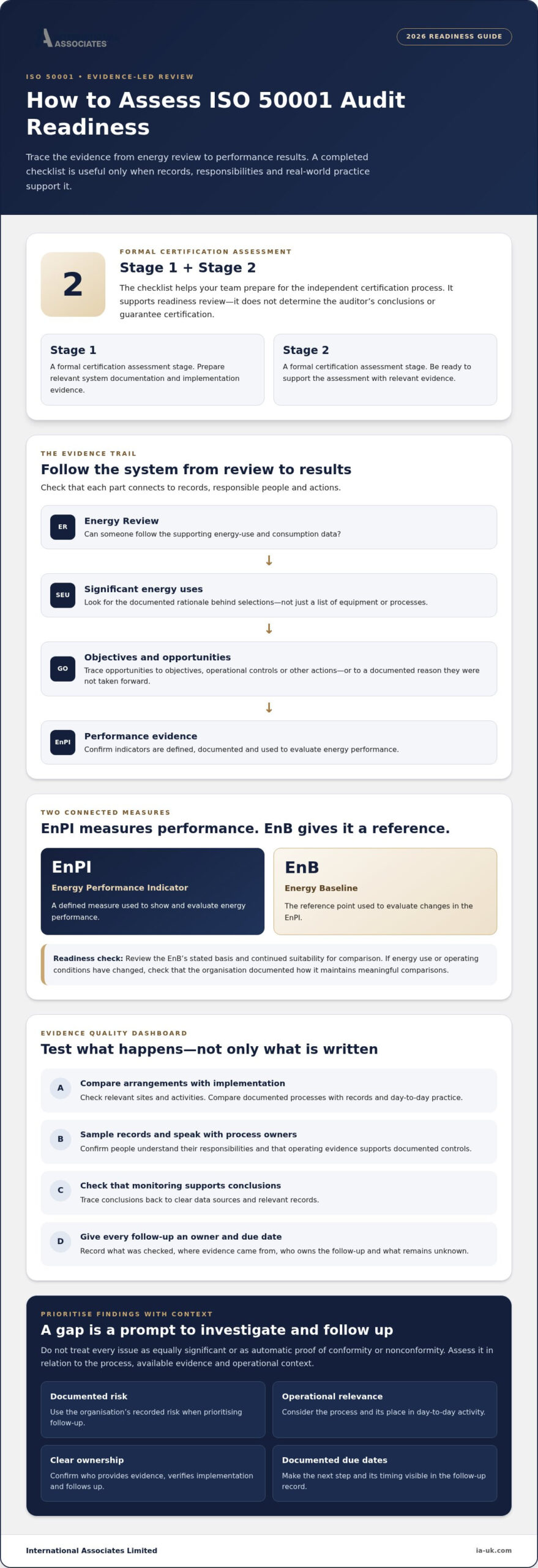
A completed checklist can still miss the gaps that matter. An effective ISO 50001 audit checklist tests whether energy-management arrangements are supported by traceable evidence, not simply whether documents exist. Follow the evidence from the Energy Review to significant energy uses, objectives, the Energy Baseline and Energy Performance Indicators (EnPIs) to see whether the system can demonstrate how it evaluates energy performance.
Before an assessment, compare documented arrangements with records and day-to-day practice. Check whether staff know their responsibilities, whether monitoring data supports the conclusions drawn, and whether follow-up actions have owners and due dates. A checklist can help reveal gaps and organise next steps, but it does not guarantee certification.
This 2026 guide sets out what to examine, from energy data and operational controls to internal audit and management review records. It also explains how to record and prioritise findings, then prepare for the independent certification process, including the Stage 1 and Stage 2 assessments. Use it to create a clear, evidence-led view of readiness before assessment begins.
Key Takeaways
- Use the ISO 50001 audit checklist to compare documented processes with implementation across relevant sites and activities.
- Check that energy reviews, significant energy uses and relevant variables are recorded and connected to assigned responsibilities.
- Sample records and speak with process owners to distinguish reliable evidence from incomplete documentation or unanswered questions.
- Prioritise follow-up actions using documented risk, operational relevance, ownership and due dates.
- Prepare relevant system documentation and implementation evidence for the formal Stage 1 and Stage 2 certification assessments.
ISO 50001 audit readiness: what this checklist can, and cannot, establish
Use an ISO 50001 audit checklist to identify readiness gaps before an independent assessment. For each gap, decide who will address it and what evidence will show that action was taken. Readiness is more than having procedures on file: the energy management system should be implemented, relevant records should be consistent, and people should be able to explain the responsibilities assigned to them.
An internal readiness review and a certification audit have different purposes. Your team uses a checklist to test its own documented arrangements and implementation. An independent assessment evaluates conformity based on evidence gathered through the formal audit process. A completed checklist supports preparation, but it cannot determine the auditor’s conclusions or guarantee certification. For an overview of the standard’s purpose and relationship to other ISO standards, see the ISO 50001 Wikipedia page.
Use the review to decide where to gather stronger evidence, which responsibilities need clarification and which issues need attention before assessment. International Associates Limited provides independent management system certification assessment to evaluate conformity against applicable requirements.
Who should use an ISO 50001 audit checklist?
Energy managers can coordinate the review and connect system requirements with energy-related processes. Internal auditors can test whether evidence supports documented arrangements. Site leaders and management-system coordinators can confirm that controls are understood and applied in day-to-day operations.
Responsibilities vary across organisations. A central team might maintain common procedures and reporting, while site leaders oversee local implementation. Different locations may also have different energy uses, controls and record owners. Assign an owner to each checklist area and its supporting evidence. Make clear who provides records, who verifies implementation and who follows up on gaps. This prevents an item being marked complete simply because responsibility is assumed rather than confirmed.
What a checklist can reveal before an audit
A structured review can expose missing records, unclear ownership and inconsistencies between documented processes and actual practice. It can also distinguish a documentary gap, such as an absent record, from an issue that needs operational evidence or staff input. For example, a procedure may describe a control, but a sample of operating records or a discussion with the person responsible may be needed to establish whether the control is followed.
Record unresolved issues as questions for evaluation, not as automatic proof of conformity or nonconformity. Note what was checked, where the evidence came from, who owns the follow-up and what remains unknown. Assess each gap in relation to the relevant process, available evidence and operational context instead of treating every issue as equally significant. This gives management a grounded basis for assigning next steps and helps the independent assessment start from a clearer record of implementation.
Check the ISO 50001 system’s energy review, objectives and performance evidence
For this part of the ISO 50001 audit checklist, trace evidence from the organisation’s defined energy-management processes to the people responsible for carrying them out. Check whether the information reviewed by management is consistent with data collected in operations, and whether decisions can be traced to assigned owners and documented actions. A useful record has a clear purpose, source and connection to the system.
Test whether someone unfamiliar with a process can follow the trail from the Energy Review to significant energy uses, objectives and performance monitoring. The U.S. Department of Energy’s 50001 Ready Program also provides resources for implementing an ISO 50001-based energy management system, offering a practical reference point when reviewing your arrangements.
Energy review and significant energy uses
Check whether the Energy Review reflects relevant energy use and consumption, and whether its supporting data is available and clear enough to follow. Review how significant energy uses were selected. The organisation should be able to show its documented rationale, not just a list of equipment or processes. Confirm that relevant variables considered in the review are recorded and linked to the energy uses they may affect.
Then trace identified opportunities forward. If an opportunity led to an objective, operational control or other action, check that the decision and follow-up responsibility are recorded. If it was not taken forward, look for a documented basis for that decision. This helps establish whether the Energy Review informs the system’s activities rather than remaining a standalone analysis.
Energy baselines, EnPIs and objectives
Check that Energy Performance Indicators (EnPIs) are defined, documented and used to evaluate performance. Review each Energy Baseline (EnB) for its stated basis and confirm that it remains suitable for comparison with current results. If energy use or operating conditions have changed, check whether the organisation has documented how it maintains meaningful comparisons.
An EnPI shows energy performance through a defined measure, while the EnB provides the reference point against which changes in that measure can be evaluated. Together, they allow performance claims to be traced to recorded data rather than unsupported impressions. For each objective, follow the action plan through its assigned owner, required resources, progress updates and monitoring evidence. If progress is delayed or results differ from expectations, check that the record reflects the status and any decisions made.
Keep evidence proportionate to the process being checked. Source data, calculation methods, review records and action updates should form a consistent trail. International Associates Limited provides an independent management system certification assessment to evaluate conformity.
Use this ISO 50001 audit checklist to test implementation, not just paperwork
Use the ISO 50001 audit checklist to trace documented arrangements into practice. Select relevant sites, processes and significant energy uses, then compare records with what people do. A procedure may be current and approved, but the review should also establish whether staff understand it, controls are applied and monitoring results lead to appropriate decisions.
Apply the review in a consistent sequence:
- Define the scope. Identify the activities, sites, processes and energy-management responsibilities included in the review. For a multi-site organisation, document which locations are sampled and why.
- Select evidence. Choose records that demonstrate implementation, such as operating instructions, monitoring data, training records, communications and action logs. Trace selected records from their source through review and approval.
- Interview process owners. Ask relevant staff to explain the controls they use, how they report issues and what they do when results differ from expectations. Compare their answers with documented processes.
- Record gaps and follow-up. Note the evidence reviewed, the process or location, what remains unclear, who owns the next action and its due date. Keep observations factual so they can be evaluated consistently.
Use a simple evidence map to make the review repeatable. The questions below are prompts. Adapt the sample evidence to the organisation’s documented processes and responsibilities.
| Checklist area | Sample evidence | Typical review question |
|---|---|---|
| Operational controls | Operating instructions, control records, site observations | Does practice at the selected site match the documented control? |
| Competence and awareness | Role requirements, training records, staff explanations | Can people explain the energy-related responsibilities relevant to their work? |
| Communication | Internal notices, meeting records, reported issues | Do communication arrangements match what staff know and do? |
| Monitoring and corrective action | Collected data, evaluation records, action and closure evidence | Can a result or deviation be traced through review to a documented decision? |
Operational controls, competence and communication
Focus on controls used to manage significant energy uses. Where a documented process sets an operating condition or monitoring task, compare it with records and, where appropriate, observed practice. Review competence evidence for roles that can affect energy performance, then ask staff to describe the relevant instruction or escalation route. Compare planned communication with retained records and staff understanding. A message being sent does not, by itself, show that its intended audience understood it.
Monitoring, measurement and corrective action
Select a monitoring result and trace it from data collection through analysis and evaluation to any recorded decision. Check that records identify their source and are complete enough to support the conclusions drawn. If a deviation or nonconformity has been recorded, follow the organisation’s defined process: review the response, assigned responsibility and retained evidence. Confirm that action effectiveness is evaluated rather than treating task completion alone as proof that the issue was addressed. Record unresolved questions for further assessment.
Prioritise checklist findings and connect energy-system evidence to business value
Once you have recorded review observations, make them useful for management decisions. The ISO 50001 audit checklist should distinguish between confirmed evidence, incomplete evidence and unresolved questions. These categories describe what the review established; they are not severity ratings or automatic conclusions about conformity.
Prioritise follow-up using the organisation’s documented risk, operational relevance, assigned responsibility and due dates. For example, a missing record affecting an important energy-related process may need attention before a minor filing inconsistency. Record the reason for the order so managers can see how decisions were reached and adjust priorities if new evidence changes the context.
Turn audit gaps into controlled follow-up actions
For each issue, record the evidence source, the process or activity involved, the responsible owner and the planned response. Be precise: “monitoring record is incomplete for the reviewed period” is more actionable than “monitoring needs improvement.” Clear descriptions also distinguish what has been verified from what still requires investigation.
Where the organisation’s process requires it, separate correction of the immediate issue from analysis of its underlying cause. Replacing a missing record may address the immediate gap, while further analysis may be needed to understand why it was missing. Retain evidence of the response, then evaluate whether the action addressed the issue. Closing a task alone does not demonstrate effectiveness.
Use energy-management evidence in ROI decisions
Energy data can support decisions about operational changes and proposed investments when it is presented with its context. For an evaluation, identify the consumption or performance data used, the period it represents and the documented assumptions applied to any estimate. If operating conditions or relevant variables affect comparisons, make those factors clear instead of presenting unlike periods as directly equivalent.
Measured energy-performance evidence shows what has been observed; projected financial return estimates what may result under stated assumptions. Keep the two distinct in reports and decision papers. A forecast may inform an investment case, but it is not a measured outcome, and a performance indicator alone does not establish financial return. This distinction supports transparent decisions without implying that a proposed measure will deliver guaranteed savings.
Where energy controls and records sit within an integrated management system, clarify which evidence serves energy-management purposes and which supports other system objectives. Shared processes can reduce duplication, but responsibilities and evaluation criteria should remain clear. Managers can then use verified results alongside documented assumptions when comparing options, approving resources or setting follow-up priorities.
For an independent assessment of your ISO 50001 management system, arrange a management system certification assessment with International Associates Limited.
Prepare for ISO 50001 certification assessment and define the next step
Use the internal review to decide whether the organisation is ready to move from preparation to independent assessment. Close or assign outstanding readiness actions, organise records so they can be traced to relevant processes, and ensure responsible people can explain how the system is implemented. An ISO 50001 audit checklist structures this preparation, but assessment conclusions depend on the evidence examined and the applicable requirements.
Certification assessment is a formal process, not a repeat of the organisation’s internal review. The organisation provides relevant system documentation and implementation evidence. The assessment evaluates that evidence independently; completing internal actions does not predetermine the conclusions.
From internal checklist review to independent assessment
The initial certification process includes Stage 1 and Stage 2 assessments. Stage 1 reviews documented information and provides a basis for preparing for the next assessment stage. Before it begins, organise key system documents, clarify the scope and make sure responsible people can locate the relevant records. If a readiness action remains open, record its status and owner rather than presenting it as complete.
Stage 2 focuses on verifying implementation against applicable requirements. The assessment considers whether system arrangements operate in practice and whether the evidence supports conformity. Records should be traceable to the activities they represent, and relevant personnel should understand their roles. Findings and conclusions are based on available audit evidence, not on the volume of documents prepared.
Include access to relevant records and responsible personnel in assessment planning. Keep current versions of procedures and records identifiable, and organise supporting evidence so it can be retrieved without relying on one individual’s memory. Where activities take place across multiple sites, make sure documentation reflects the defined system scope and evidence can be connected to the locations and operations covered.
What to consider when planning certification
Define the proposed scope, relevant sites and management-system boundaries before formal assessment planning. These details establish which activities and locations the system covers and which documentation and implementation evidence are relevant. Check that the stated scope is consistent with how the organisation describes its operations, responsibilities and energy-management processes.
Planning should also identify who will coordinate assessment information and who can explain key processes at relevant sites. Organise records by process or responsibility rather than gathering unrelated files into a single collection. This makes it easier to show how documented arrangements connect with implementation and respond clearly when evidence is requested.
International Associates Limited provides ISO 50001 certification assessment through a structured process that includes Stage 1 and Stage 2. Organisations ready to proceed can explore management system certification and take the next step toward an independent assessment.
Turn audit readiness into sustained energy-system oversight
Use the ISO 50001 audit checklist as a starting point for continuing management practice, not a document to file away after assessment. Keeping evidence current between assessment stages helps the organisation respond to operational changes and make informed decisions using recorded performance information. It also gives responsible teams a clearer basis for maintaining the system over time.
International Associates Limited provides ISO 50001 Energy Management certification, including initial assessment, surveillance and recertification. The organisation works through a global network of regional offices. Certification assessment provides an independent evaluation of management-system conformity, while the organisation remains responsible for implementing and maintaining its system.
If your readiness review has clarified the scope and evidence for assessment, take the next step with Explore ISO 50001 certification assessment. International Associates Limited can assess your management system through the Stage 1 and Stage 2 certification process.
Frequently Asked Questions
What should an ISO 50001 audit checklist include?
An ISO 50001 audit checklist should cover management-system processes from planning through performance evaluation and improvement. Include prompts for assigned responsibilities, energy-related operational controls, monitoring records, internal audit and management review outputs, and follow-up actions. Tailor each prompt to the organisation’s documented arrangements. For instance, if a process uses a local procedure, check whether staff follow the current version, not only whether the procedure exists.
Does an ISO 50001 checklist guarantee certification?
No. A checklist helps an organisation organise its internal review, but it cannot guarantee certification or determine an independent assessor’s conclusion. Its value depends on whether it tests actual implementation and leads to evidence-based follow-up. Treat completed items as review results, not certification decisions. If a prompt is marked complete, retain enough context to show what was examined and why the evidence supports that response.
What evidence is needed for an ISO 50001 audit?
Evidence should be relevant to the system’s scope and the processes being assessed. Depending on the organisation’s arrangements, it may include controlled procedures, records of operational activities, monitoring outputs, internal audit results, management review records and documented follow-up. Keep records identifiable by process, site or period where relevant. A clear audit trail shows where information came from, who reviewed it and how it informed a decision.
How do energy performance indicators relate to an ISO 50001 audit?
Energy performance indicators help an organisation evaluate whether energy performance is changing in relation to its defined measures and baseline. For example, a manufacturer might track energy used per unit produced if that indicator suits its operations. During an audit, check whether the chosen indicator is defined, supported by data and applied consistently. Explain the calculation method so results can be understood and compared appropriately.
Can a small organisation use the same ISO 50001 audit checklist as a large organisation?
A small organisation can use the same broad audit topics, but the checklist should reflect its scope, activities and management-system arrangements. A single-site operation may need fewer location-specific prompts than a group with varied processes and sites. Avoid adding irrelevant questions just to make the checklist appear comprehensive. The objective is to test applicable processes and retain evidence that corresponds to the organisation’s operations.
What happens if an audit identifies a nonconformity?
If an audit identifies a nonconformity, the organisation should address it through its defined corrective-action process. That generally involves understanding the finding, deciding how to respond, assigning responsibility and retaining evidence of action. The appropriate response depends on the specific issue and applicable assessment requirements. Recording an action alone does not necessarily close the matter; relevant evidence and any required follow-up are considered in the assessment process.
How does an ISO 50001 certification audit differ from an internal audit?
An internal audit is arranged by the organisation to evaluate its own system and identify areas for follow-up. A certification audit is an independent assessment of conformity against applicable requirements. The purposes and conclusions differ: internal review supports management oversight, while certification assessment informs an independent decision. Keep internal audit records available, while recognising that they do not replace external assessment evidence.