

With the ISO 9001:2026 revision expected in September, many global organizations mistakenly believe that delaying their quality management initiatives is the safest path to compliance. Waiting for the new publication often results in missed tenders and operational stagnation, especially as over one million organizations already utilize iso 9001 certification to secure international market access. You’re likely aware that a robust management system is a prerequisite for global trade, yet the complexity of documentation and the fear of a failed audit can feel like significant barriers to progress.
It’s understandable to feel cautious about the investment and effort required for such a high-stakes process. This guide provides the technical clarity you need to navigate the selection of an accredited certification body and ensure audit success with minimal business disruption. We’ll examine the critical 2024 climate change amendments, the transition timeline for the 2026 standard, and the methodical steps your organization must take to achieve operational efficiency. By the end of this article, you’ll have a clear roadmap for leveraging quality standards as a strategic asset for global growth and resilience.
Key Takeaways
- Learn why iso 9001 certification serves as a strategic asset for global trade and how to navigate the 2026 regulatory updates without disrupting current operations.
- Gain clarity on the investment structure of the three-year certification cycle, focusing on the technical requirements of Stage 1 and Stage 2 initial assessments.
- Differentiate between accredited and non-accredited certification bodies to ensure your quality management system meets the rigorous standards required by international markets.
- Discover how internal audits and professional Lead Auditor Training can mitigate the risk of non-conformities during the formal certification process.
The Strategic Value of ISO 9001 Certification in 2026
ISO 9001:2015 represents the globally recognized foundation for the ISO 9000 family of standards. It’s the primary framework used by organizations to build a resilient Quality Management System (QMS). In the current 2026 landscape, the standard’s core principles have been reinforced by mandatory amendments regarding climate change and sustainability. Achieving iso 9001 certification provides a clear signal to stakeholders that an organization operates with technical precision and ethical oversight. It’s an essential tool for businesses that need to prove their stability to investors, customers, and regulatory bodies alike.
International trade in 2026 demands a high level of transparency. ISO 9001 remains a non-negotiable prerequisite for entry into global supply chains and participation in government tenders. Procurement officers use these standards to verify that a potential partner has the infrastructure to manage quality consistently. Without this verification, businesses often find themselves excluded from high-stakes opportunities in sectors like aerospace, energy, and defense. The shift toward risk-based thinking ensures that certified companies aren’t just following a checklist; they’re actively managing the variables that could impact their ability to deliver on promises.
Quality Management as a Competitive Advantage
Consistency is the hallmark of a mature organization. By establishing repeatable processes, companies ensure their products and services meet exact specifications every time. This structured approach significantly reduces operational waste and the costs associated with rework. It’s a methodical way to drive efficiency. Proactive feedback loops are integrated into the QMS, allowing leadership to capture customer insights and translate them into service enhancements. This creates a cycle of continuous improvement that keeps the business ahead of competitors who rely on reactive management styles.
Global Trade and Regulatory Alignment
International trade agreements frequently reference ISO standards as a baseline for quality and safety. Aligning with these benchmarks simplifies the process of entering new markets. For organizations in technical niches, iso 9001 certification serves as a stepping stone to specialized frameworks like ISO 13485 for the medical device industry. Additionally, the governance requirements of the standard support the data collection necessary for Environmental, Social, and Governance (ESG) reporting. This alignment ensures that a company’s quality objectives are synchronized with its broader regulatory and ethical commitments.
Understanding the Certification Cycle and Investment
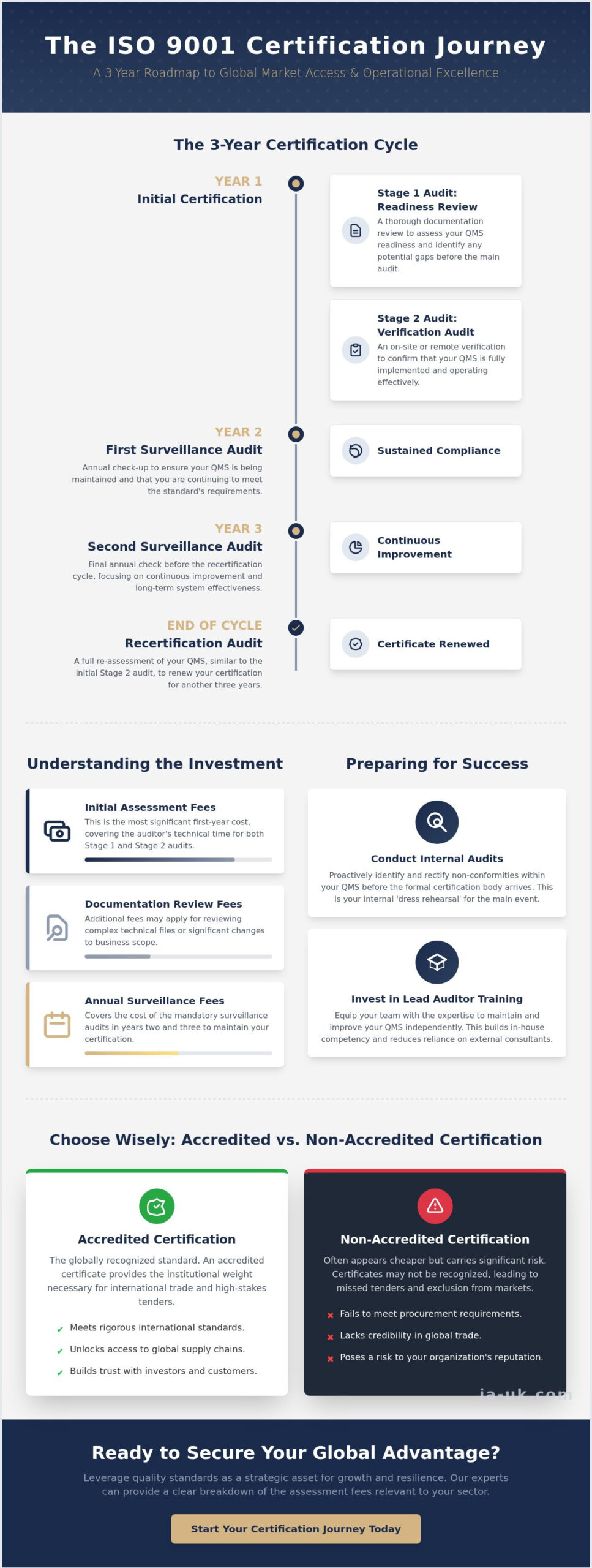
Organizations often confuse the purchase of the ISO 9001:2015 Standard with the professional service of iso 9001 certification. The former is a document outlining requirements, while the latter is a rigorous, multi-year verification process conducted by an independent audit body. This investment isn’t a one-off transaction but a three-year lifecycle designed to ensure sustained compliance. The cycle begins with an initial two-stage assessment, followed by annual surveillance audits in years one and two, and concludes with a full recertification audit in the third year. This methodical sequence provides the institutional weight necessary to maintain trust in global markets.
Initial assessment fees are the most significant part of the first-year budget. These cover the technical time required for auditors to evaluate your Quality Management System (QMS) against the international standard. Beyond the audit days, organizations should account for technical documentation review fees. These apply when an auditor must spend additional time verifying complex technical files or when significant changes to the business scope occur. Understanding this breakdown helps leadership teams avoid unexpected costs and ensures that the certification process remains a transparent financial commitment. If you’re planning your budget, you can contact our global offices for a clear breakdown of the assessment fees relevant to your sector.
Stage 1 vs. Stage 2 Audits: What You Are Paying For
The initial certification is divided into two phases to ensure audit success. Stage 1 is a documentation review where the auditor assesses your readiness. It’s a technical safeguard to identify gaps before the more intensive Stage 2 begins. Stage 2 involves the actual verification of your processes, either through on-site inspections or remote auditing. The goal is to see the QMS in action. For businesses operating in fast-moving industries, a quick turnaround between these stages is essential to meet contract deadlines or tender requirements.
Surveillance and Maintenance
Maintaining a certificate requires consistent oversight. Annual surveillance audits are mandatory to verify that the QMS hasn’t degraded over time. These audits are typically shorter than the initial assessment but focus on core processes and areas of previous non-conformity. Maintenance also includes administrative costs for global registry updates. These ensure your certificate remains visible and verifiable to international partners. Budgeting for these recurring fees is a prerequisite for long-term operational stability and continued access to regulated markets.
How to Choose the Right ISO 9001 Certification Body
Selecting an audit partner is a critical governance decision that extends beyond mere cost comparison. The market contains various providers, but the value of an iso 9001 certification is directly tied to the reputation and accreditation of the issuing body. As the American Society for Quality explains ISO 9001, the standard serves as a foundation for quality improvement, but its effectiveness relies on rigorous, impartial verification. Organizations must evaluate whether a Certification Body (CB) possesses the technical depth to understand their specific sector, whether that involves high-stakes medical device manufacturing or complex social accountability standards.
A provider with a global-local duality offers a distinct advantage. Having a central administrative base, such as a Glasgow headquarters, provides institutional stability and centralized quality control. Simultaneously, a network of international offices ensures that auditors understand local regulatory nuances and language requirements. This combination allows for a seamless audit experience that supports a client’s international growth while maintaining the highest standards of procedural integrity. It ensures that the audit process is both globally consistent and locally relevant.
Accreditation and Independence
Verification of a CB’s accreditation status through national bodies, such as UKAS, is the first step in the selection process. Non-accredited certificates often lack recognition from international procurers and government agencies, rendering the investment ineffective for global trade. Independence is equally vital. A conflict of interest arises if a CB offers both management system consultancy and certification services; therefore, these functions must remain strictly separate. This separation ensures that the audit remains an objective assessment of compliance rather than a self-evaluation of consulting work.
Audit Methodology and Efficiency
Modern auditing requires a sophisticated IT infrastructure to facilitate efficient data verification and remote assessments. This capability is especially important for global organizations with dispersed operations. High-performing CBs utilize advanced digital tools to streamline the audit process without compromising the technical rigor required for iso 9001 certification. Efficiency also manifests in turnaround times. Once a successful audit is concluded, the administrative process for issuing the certificate should be methodical yet swift. The goal is to provide a rigorous assessment that supports, rather than hinders, business momentum.
Preparing for Your ISO 9001 Quality Audit
Preparation for a formal assessment is a multi-layered process that involves a technical review of internal processes and the verification of personnel competency. It’s the bridge between developing a Quality Management System (QMS) and achieving iso 9001 certification. This stage requires a methodical approach to documentation and a clear understanding of how your organization meets each clause of the standard. An internal audit serves as the final rehearsal, allowing the organization to identify and rectify gaps without the immediate pressure of a formal certification decision.
To ensure these internal reviews are effective, many global organizations invest in Lead Auditor Training for their internal champions. This training provides the technical skills required to evaluate compliance with the same rigor as an external body. Technical files must be organized for efficient reviewer access, particularly as digital audit trends in 2026 favor structured, cloud-based repositories. Common non-conformities, such as incomplete management reviews or inadequate risk assessments, should be resolved before the Stage 1 visit to ensure a smooth transition to the full assessment. For professionals operating in regulated healthcare sectors, ISO 13485 lead auditor training provides the specialized competency required to audit medical device quality management systems to the same exacting standard.
Internal Auditing and Competency
Internal auditors must meet professional competency standards to provide reliable insights to leadership. These audits shouldn’t be viewed as a simple checklist exercise; they’re a tool for continuous improvement and operational resilience. Documenting corrective actions effectively is essential, as it proves to the external auditor that the organization possesses the maturity to identify its own failures and implement systematic changes. This internal oversight reduces the risk of major non-conformities during the formal assessment.
The Audit Day: What to Expect
The formal audit follows a predictable and disciplined rhythm that mirrors a professional assessment process. It begins with an opening meeting to confirm the scope and schedule, followed by evidence gathering through process observations and staff interviews. Auditors look for evidence of management commitment and process control to verify that the QMS is fully integrated into daily operations. The day concludes with a closing meeting where findings are presented. Understanding the distinction between major and minor non-conformities is vital for managing the next steps toward your iso 9001 certification. If your team needs to develop these internal skills, you can explore our professional lead auditor training to ensure your staff are prepared for every stage of the audit.
Secure Your ISO 9001 Certification with International Associates
International Associates Limited operates as a meticulous bridge between complex international regulations and the global businesses that must adhere to them. Our Glasgow headquarters serves as the central administrative base for a worldwide network of offices, providing institutional reliability with an expansive reach across Europe, Asia, and the Middle East. When you partner with us for iso 9001 certification, you gain access to a firm that prioritizes procedural integrity and technical precision. We understand that time is a critical factor in global trade; therefore, we’re committed to a quick turnaround for certificates without compromising the rigorous standards required by accreditation bodies.
Efficiency in the audit process is enhanced through our ability to offer integrated assessments. Organizations can streamline their compliance efforts by combining their quality audits with ISO 14001 environmental management or Social Accountability Audits. This consolidated approach reduces business disruption and provides a more holistic view of organizational performance. By leveraging advanced IT infrastructure, we facilitate seamless transitions between remote and on-site assessments, ensuring that your iso 9001 certification remains robust regardless of your geographic location.
A Modern Approach to Auditing
Our technology-driven methodology is designed to minimize administrative friction. We utilize secure digital platforms for data verification, which allows for a more focused and methodical audit experience. Transparency is a foundational pillar of our service; we provide clear, structured fee schedules for initial assessments and annual surveillance. This ensures that leadership teams can budget with confidence. Clients also benefit from our network of regional audit specialists who bring deep technical expertise to every inspection.
Next Steps for Your Organisation
The journey toward international recognition begins with a clear understanding of your current regulatory standing. Our technical team is available to provide a formal quote tailored to your specific operational scope and complexity. Once the initial agreement is finalized, we’ll work with you to schedule your Stage 1 assessment. This initial step ensures your documentation is prepared for the final certification audit. You can Contact International Associates Limited today to start your certification process.
Securing Operational Resilience through Quality Standards
Achieving iso 9001 certification is a methodical process that transforms quality management into a strategic driver for international trade. By navigating the certification cycle with a focus on risk-based thinking, organizations secure their position within global supply chains. Success depends on selecting an accredited, independent partner capable of providing rigorous oversight. It’s essential to partner with a body that understands the technical nuances of your specific industry while supporting your long-term growth objectives.
International Associates combines the reliability of a Glasgow-based Head Office with the capacity of an expansive global regional network. We’ve developed an advanced IT infrastructure to ensure efficient auditing; this ensures your management system meets high regulatory benchmarks without administrative friction. Our technical teams provide the steady hand needed to navigate the evolving 2026 landscape with confidence. Don’t leave your compliance to chance when international tenders are at stake.
Request a Comprehensive ISO 9001 Certification Quote
We look forward to supporting your organization’s journey toward global compliance and excellence.
Frequently Asked Questions
How long does it take to get ISO 9001 certified in 2026?
The duration of the certification process typically spans three to six months depending on the maturity of your existing management system and the complexity of your operations. This timeline accounts for the initial gap analysis, the implementation of required processes, and the mandatory interval between Stage 1 and Stage 2 assessments. Organizations with established quality protocols may achieve certification more rapidly, while those building a system from the ground up require more time for process embedding.
Can we conduct our ISO 9001 audit remotely?
Remote auditing is a standard and effective methodology that utilizes secure Information and Communication Technology (ICT) to verify compliance. This approach is particularly suitable for service-based sectors or organizations with centralized digital data management. Our technical teams conduct these assessments through secure video conferencing and document-sharing platforms, ensuring that the rigor of the iso 9001 certification process is maintained without the need for physical travel.
What is the total cost of ISO 9001 certification including surveillance fees?
Total investment is structured across a three-year cycle and includes initial assessment fees, annual surveillance costs, and administrative registry charges. The final fee is determined by the number of audit days required, which is dictated by your organization’s headcount, sector risk, and the number of physical or virtual sites. Because these variables differ for every business, it’s essential to obtain a formal, tailored quote to ensure accurate budgeting for the full certification lifecycle.
What happens if we find non-conformities during our Stage 2 audit?
If a non-conformity is identified, your organization must implement and document corrective actions before a certificate can be issued. Minor non-conformities require a plan for rectification that the auditor will verify during the next surveillance visit. Major non-conformities, however, represent a systemic failure and require a follow-up assessment to confirm that the issue has been resolved. The audit report provides a technical roadmap for these necessary improvements.
Is ISO 9001 certification mandatory for UK businesses post-Brexit?
Certification is not a legal mandate for UK businesses, but it remains a commercial necessity for participating in international tenders and global supply chains. Post-Brexit, holding an accredited certificate is a vital trust signal that ensures UK firms remain aligned with international quality benchmarks. It provides a recognized framework that facilitates trade with European and global partners by proving that your quality management meets rigorous international standards.
How often do we need to undergo surveillance audits?
Surveillance audits are conducted annually during the first and second years of your three-year certification cycle. These assessments are focused on ensuring that your Quality Management System remains effective and that any changes in your business scope are properly managed. These visits are shorter than the initial assessment but are critical for maintaining the validity of your iso 9001 certification and identifying opportunities for further operational efficiency.
Can we integrate ISO 9001 with other standards like ISO 45001?
Integration is a highly efficient strategy facilitated by the Annex SL structure, which provides a common framework for most ISO management standards. Organizations frequently combine their quality management with ISO 45001 for occupational health and safety or ISO 14001 for environmental management. This integrated approach reduces total audit time and administrative overhead, allowing a single assessment team to verify multiple systems during a consolidated audit visit.
What is the difference between an internal auditor and a lead auditor?
An internal auditor is trained to conduct first-party assessments within their own organization to verify ongoing compliance and identify areas for improvement. A lead auditor possesses the advanced technical competency and authority to manage an audit team during formal third-party certification assessments. Lead auditors are responsible for the final technical report and the recommendation for certificate issuance, requiring a deeper immersion in audit methodology and international standards. For those operating within the medical device sector, pursuing ISO 13485 lead auditor training provides the sector-specific expertise necessary to manage audits against the FDA-aligned global compliance framework.