

A polished procedure can still conceal a quality management system that doesn’t reflect everyday work. Effective ISO 9001 certification audit preparation tests what happens in practice by tracing real processes from requirements through to records and results, rather than rehearsing answers for audit day.
Incomplete records, unclear staff understanding or unresolved corrective actions can expose gaps. Internal validation helps find those gaps early and assess whether the QMS is implemented and effective. It is distinct from the independent certification assessment, which evaluates evidence against applicable requirements and does not guarantee an outcome.
This guide sets out a practical, evidence-led approach for 2026. You’ll learn how to follow processes from start to finish, which records and personnel to include, and how to prioritise findings before the external audit. Preparation should confirm that the system reflects the applicable ISO 9001 requirements and the way your organisation actually works.
Key Takeaways
- Check whether your QMS is implemented, supported by evidence and producing the intended results before deciding what needs attention.
- Trace selected processes from inputs and responsibilities to controls, outputs and retained records, then compare the evidence with actual work.
- Use ISO 9001 certification audit preparation to set a clear validation scope, test process effectiveness and prioritise actions by their impact.
- Keep internal audits, management review and independent certification assessment distinct, with clear responsibilities, evidence and outputs for each.
- Present your certification scope, process evidence and open findings clearly during assessment, supported by a realistic action plan.
ISO 9001 certification audit preparation starts with a QMS reality check
Start by checking whether your quality management system (QMS) is implemented, supported by evidence and producing its intended results. If procedures describe a process that staff do not follow, or records cannot show what happened, the gap is operational, not cosmetic. Finding it early gives you time to prioritise corrective action before an independent assessment.
QMS validation is a practical review of whether defined processes operate as intended, with evidence that their outputs meet relevant requirements and support performance objectives. It is an internal check, not a separate certification or a guarantee of passing. ISO 9001 certification audit preparation should test routine work, not focus on last-minute document tidying or coaching employees to recite procedures. Staff need to understand their responsibilities and follow the process. Rehearsed answers cannot demonstrate that controls work.
What does validating a quality management system mean?
Follow a process through actual work. For example, trace a customer order from the information received and responsibilities assigned, through review and fulfilment, to the resulting output and retained records. Compare what people do with the defined process, then assess whether the evidence shows that customer requirements were addressed and relevant quality objectives are being monitored.
A document’s existence proves only that it has been created. It does not establish that staff use it, that records are complete or that the process consistently produces suitable outputs. Look for differences between documented arrangements and routine practice. Then consider whether those differences affect conformity, customer needs or the reliability of results.
Which QMS scope and criteria should the review cover?
Start with the organisation’s stated QMS scope: the activities, sites and products or services it covers. Identify the processes within that boundary, their owners, responsibilities and interfaces. Pay particular attention to handovers, such as how customer requirements pass to operations or how operational results reach the people responsible for monitoring and improvement. These connections can reveal gaps that a document-by-document review misses.
Set the criteria against the applicable ISO 9001 requirements, the organisation’s documented arrangements, customer requirements and relevant quality objectives. The ISO 9000 family provides background on how ISO 9001 fits within the wider quality-management standards. For practical context, consult this management system certification information. Check clause-level interpretations against the current applicable requirements rather than relying on older checklists or guidance.
Keep the review proportionate to the scope and to the processes that determine output quality. Record what was examined, where the evidence came from and which criteria were applied. This gives the organisation a clear basis for deciding whether the system works in practice and what needs attention before the certification assessment.
Trace ISO 9001 processes from requirements to evidence and results
A process is easier to validate when its evidence can be followed from the requirement it addresses to the result it produces. For each selected process, map its inputs, assigned responsibilities, controls, outputs and retained records. Use that map to guide sampling instead of treating policies and procedures as proof that work is effective.
A process map supported by sampled records provides stronger evidence than policies alone because it connects defined controls with actual practice and resulting outputs. For example, in a purchasing process, trace how a need is raised, who reviews and approves it, what controls apply before an order is placed, and what evidence shows that received materials were handled according to the organisation’s arrangements. Follow the trail to its outcome, not just to the procedure describing it.
How can you test whether documented processes match actual work?
Select completed transactions or work examples that reflect routine operations, then follow each from start to finish. Compare relevant instructions with records, observed practice and explanations from the people carrying out or overseeing the work. Check that responsibilities are understood, controls appear at the points defined by the process, and records clearly relate to the activity under review.
Record discrepancies without coaching interviewees towards expected answers. A difference might be an unrecorded approval, an unclear handover or a local variation in how work is performed. Establish what happened and whether the variation is isolated or recurring. A polished explanation is not a substitute for corroborating evidence.
Which evidence helps demonstrate QMS performance?
Choose evidence that connects process activity to outcomes. Depending on the process, this may include monitoring results, customer feedback, nonconformity records and corrective-action evidence. Check that records can be traced to the relevant process and period, and that they provide enough context to interpret what occurred. A result without its source, date or connection to the process may be difficult to assess reliably.
Look for patterns as well as individual exceptions. Repeated customer concerns, recurring nonconformities or measures moving away from an objective may warrant investigation. Follow the organisation’s evidence of response: was the issue assessed, was action taken where appropriate, and is there information showing whether that action addressed the cause? The aim is to assess how the QMS identifies and responds to performance signals, not to assume that every adverse result proves system failure.
Use this evidence-led approach as part of ISO 9001 certification audit preparation, while keeping internal validation distinct from the independent certification assessment. International Associates Limited provides independent management-system certification. Organisations can review its management-system certification information to understand the assessment context. A clear evidence trail shows how processes operate, while the external audit independently evaluates the QMS against applicable requirements.
Internal audit, management review and certification audit: compare their roles
These activities support the QMS in different ways, and one cannot replace another. An internal audit tests selected arrangements. Management review considers system performance and decisions. An independent certification audit evaluates the QMS against applicable certification criteria. A successful internal review is useful evidence of oversight, but it does not guarantee certification.
| Activity | Responsible party | Purpose | Evidence | Typical output |
|---|---|---|---|---|
| Internal audit | Organisation’s designated auditors | Assess selected processes against applicable criteria | Audit plan, sampled records, interviews and observations | Findings and follow-up actions |
| Management review | Top management | Evaluate QMS performance and determine whether decisions or changes are needed | Performance information, customer feedback, audit results and actions | Decisions, priorities and assigned actions |
| Certification audit | Independent certification body | Assess the QMS against applicable certification criteria | Records, interviews, observation and other relevant evidence | Assessment findings and a certification decision through the independent process |
What does an internal audit establish before certification?
A planned internal audit examines defined processes against relevant criteria and gathers evidence to determine whether arrangements are followed and effective. Its value lies in the findings and the organisation’s response. Unresolved issues, recurring weaknesses or incomplete follow-up may indicate that further action is needed. Internal audit conclusions inform improvement, but remain the organisation’s own assessment.
Auditors should have the competence to assess the processes in scope and be sufficiently impartial to reach objective conclusions. Where capability needs development, International Associates Limited’s Lead Auditor Training can support stronger audit practice.
How is independent certification assessment different?
The certification body assesses the QMS independently against applicable certification criteria. Evidence may come from reviewing records, interviewing personnel and observing relevant activities, then comparing what is found with the organisation’s arrangements and the criteria. The assessment is not a coaching session or a repeat of the internal audit. Its outcome is not determined by the organisation’s own review.
Review findings proportionately, considering their significance, the process or requirement affected and whether the response addresses the underlying issue. Do not assume that a completed internal audit, a tidy set of files or closed actions will secure a positive certification decision. Effective ISO 9001 certification audit preparation uses internal results to identify and address risk, while leaving the independent certification process to reach its own evidence-based conclusion.
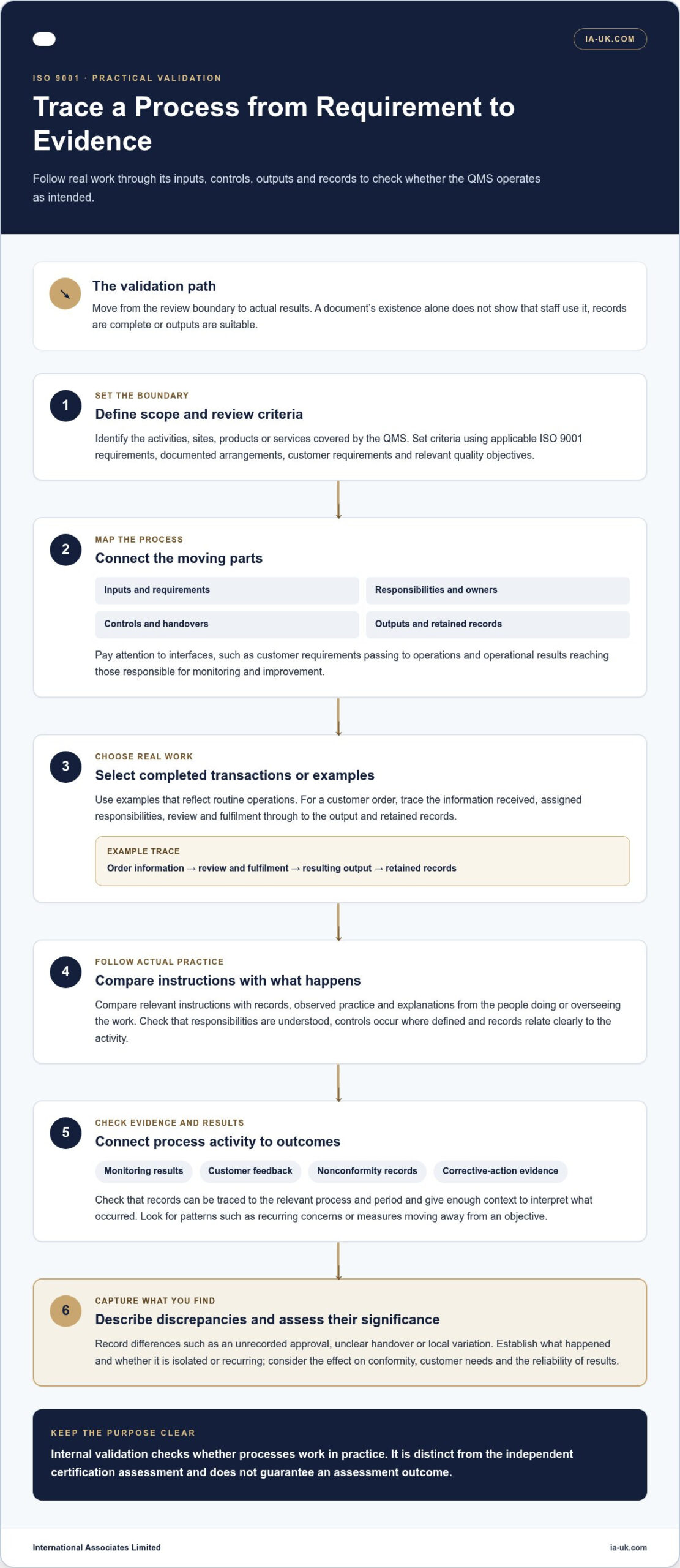
How to validate your QMS before the ISO 9001 certification audit
A focused review should produce more than a list of documents checked. Use the sequence below to test how processes operate, identify significant gaps and turn findings into owned actions. This makes ISO 9001 certification audit preparation a structured validation exercise, not a last-minute attempt to make records look complete.
How should you plan a focused validation review?
Before sampling begins, define the review boundaries, applicable criteria, participants and a realistic schedule. Choose processes that represent routine work and important interfaces, such as handovers between sales and operations. Prepare neutral questions that invite employees to explain what they actually do, rather than prompting them to repeat written procedures.
- 1. Set the scope. State which activities, locations and processes the review will cover, and identify the requirements and internal criteria used to assess them. Keep the boundaries clear so reviewers know what is included and where a process connects to another.
- 2. Select processes and samples. Prioritise processes that affect customer requirements or the reliability of outputs. Select representative completed work and records, including examples from relevant handovers, rather than relying only on convenient or recently prepared files.
- 3. Gather evidence. For each sample, collect the records needed to follow the work through its defined controls and responsibilities. Note the source and period of each record so the evidence can be traced back to the process under review.
- 4. Test effectiveness. Compare documented arrangements with staff explanations, available records and observed practice. Assess whether controls are applied and whether process outputs meet relevant requirements. Investigate differences rather than assuming a single document or explanation tells the whole story.
- 5. Document and prioritise actions. Rank findings by their effect on conformity, customer requirements and output reliability. Assign an accountable owner and an internally agreed follow-up date for each action. There is no need to imply a prescribed response period.
How should findings be recorded and followed through?
Make each finding specific enough to guide a decision. Record the relevant requirement or criterion, the objective evidence reviewed, the gap observed and the process affected. Then assess whether the issue appears isolated, such as one incomplete record, or points to a broader weakness, such as unclear ownership or a control that is routinely missed. Keep conclusions within the limits of the evidence.
Validation is complete only when each action has an accountable owner and follow-up date, implementation is verified against objective evidence, and effectiveness is checked against the intended result. If a corrective action addresses a record but the underlying process still produces the same problem, do not treat it as effective. Reopen or revise the action as appropriate, and retain the basis for the decision.
Once the review has produced a prioritised, evidence-based action plan, consider how the organisation’s QMS will be assessed independently. Explore ISO 9001 management-system certification to understand International Associates Limited’s independent certification assessment.
Prepare for independent ISO 9001 assessment with International Associates
A clear, traceable presentation helps an independent assessment focus on how the QMS operates, rather than on locating basic information. Organise evidence so the organisation’s scope, process arrangements and results can be understood together. Preparation supports an orderly assessment, but it does not determine the outcome. The certification decision remains part of the independent process.
International Associates Limited is a UK-based independent auditing and certification body serving organisations globally. For the organisation being assessed, the practical objective is to make relevant information accessible and explainable, while ensuring that what is presented reflects normal operations rather than an audit-day version of the system.
What should the organisation have ready for the assessment?
Keep QMS scope information, process records, internal audit results and management review evidence organised and traceable. People responsible for relevant activities should understand their roles and be able to locate evidence connected to their work. They do not need to recite procedures. They should be able to describe routine practice accurately and explain how records are used.
- Scope: Provide a clear account of the activities and boundaries covered by the QMS.
- Process evidence: Arrange representative records so the relationship between activity, controls and outputs can be followed.
- Review and monitoring: Make relevant internal audit results, management review information and performance records accessible.
- Findings: Present open issues accurately, with the action taken so far, accountable ownership and evidence available to date.
Clear organisation is not the same as selecting only favourable examples. If a record is incomplete or a finding remains open, describe the position accurately and make the supporting evidence available. This lets the assessment consider both the issue and the organisation’s response without presenting an action in progress as verified effective.
What happens after the validation review?
Close internal actions when implementation and effectiveness have been verified, and retain traceable evidence for the closure decision. If an issue or uncertainty remains unresolved, carry it into the certification assessment openly. A realistic account of what is known, what has been done and what still requires attention is more useful than presenting an incomplete action as resolved.
ISO 9001 certification audit preparation should leave the organisation able to explain its QMS scope, direct the assessor to relevant process evidence and account for findings without overstating readiness. International Associates Limited provides independent assessment and certification through its ISO management-system certification service. Organisations planning an assessment can discuss ISO 9001 certification with International Associates Limited. Certification is subject to the independent assessment process and its findings.
Make QMS validation part of ongoing performance
Use each validation review to consider what has changed in the organisation’s work and whether the QMS still supports its priorities. New services, revised responsibilities or changes in customer expectations can prompt a review of how processes are managed. Treating these developments as review triggers helps keep the system relevant between formal assessments.
Build that consideration into routine planning so quality management stays connected to operational decisions rather than becoming an activity reserved for audit preparation. This gives teams a practical way to identify when their arrangements may need attention as the organisation develops.
To plan your next step, discuss ISO 9001 certification assessment with International Associates Limited and consider how independent assessment fits your organisation’s plans. Certification remains subject to the independent assessment process.
Frequently Asked Questions
Can a small business validate its QMS before an ISO 9001 audit?
Yes. A small business can organise a review around its actual QMS scope and processes. Start by clarifying who holds each quality-related responsibility, particularly where one person performs several roles. Then plan review activity around operational demands so key responsibilities remain covered. This keeps the review manageable without reducing it to a document-only exercise or assuming a particular certification result.
Can an ISO 9001 QMS be validated through a remote review?
Some evidence may be reviewed remotely, but the suitable method depends on the audit arrangement and what needs to be assessed. Secure access to records and video interviews can help clarify how a process is managed. A remote review may provide a limited view of physical activities or working conditions, so it should not be assumed sufficient in every case or treated as a substitute for the certification body’s assessment.
How should employees respond when they do not know an auditor’s answer?
Employees should answer honestly based on their own responsibilities and experience. If they are unsure what a question means, they can ask for clarification. If they do not know a detail, they can say so and identify who or what source may provide it. For example, a staff member can explain where a controlled instruction is normally accessed rather than guess its revision. Guessing or scripted replies can obscure actual practice.
Does having all QMS documents in place prove the system is effective?
No. A complete document set does not establish that the information is current, accessible or used consistently. Check practical details, such as whether employees can identify the instruction that applies to their task, whether obsolete versions remain in use, and whether records can be connected to the relevant activity. These checks distinguish a well-organised file structure from information that genuinely supports controlled work.
What should an organisation do when its internal review identifies a gap?
First consider whether the issue could affect current products, services or customer commitments, then take proportionate steps through the organisation’s established processes. For example, a suspected error in a released output may need prompt review beyond the record where it was first noticed. Keep internal decisions traceable, and distinguish them from any finding raised by the certification body, which is handled through the independent assessment process.
How long does ISO 9001 certification audit preparation take?
There is no fixed preparation period that suits every organisation. The time needed can depend on scope, process complexity, implementation maturity and whether relevant personnel and information are available when required. Seasonal work, staff changes or recently revised processes may affect planning. Allow enough time to complete the organisation’s intended review and respond to what it identifies. A particular duration cannot guarantee certification.