

ISO 9001 lead auditor training requirements typically include a fundamental understanding of ISO 9001 quality management system requirements and comprehensive knowledge of audit principles. These foundations help participants engage with the course’s practical work, including planning, conducting and closing audits. The training also addresses how audits are guided by ISO 19011 and, for third-party audits, ISO/IEC 17021-1 requirements.
Knowing the entry requirements is only part of choosing a course: you also need to understand its duration, what recognition it supports and which audit skills it develops. This guide explains how to prepare, what to expect from course scheduling and assessment, and how training fits into a lead auditor certification pathway. It also outlines the practical competencies covered, so you can judge whether the course aligns with your experience and professional goals.
Key Takeaways
- Assess your foundation in ISO 9001 requirements and audit principles before enrolling, since these are expected course prerequisites.
- Understand how the training develops the ability to plan, conduct and close audits, with ISO 19011 guidance and third-party audit requirements in view.
- Compare course schedules and assessment methods to choose a format that fits your learning needs and professional plans.
- Explore the certification pathway, including when a knowledge examination or an audit log may be relevant; the audit-log route requires evidence of 10 audit days for the applicable scheme and grade.
- See how International Associates Limited’s Social Accountability Audits relate to organizational assurance, alongside its ISO 9001 Quality Management System Certification.
ISO 9001 quality management system auditor certification
ISO 9001 auditor training develops the competence to assess a quality management system, while organizational certification evaluates the organization itself. Understanding that distinction helps you select training aligned with your role and intended certification pathway.
Auditor Certification and QMS Requirements
According to the International Organization for Standardization, ISO 9001 is an international standard that specifies requirements for a quality management system. Auditors use those requirements as criteria when evaluating how an organization defines, operates, and improves its processes. Course materials should explain how to gather evidence and assess whether documented arrangements are reflected in practice.
Auditor training and organisational certification serve different purposes. Internal auditor training prepares staff to assess their organisation’s management system—often coordinated across enterprise teams using WestNet LMS—while lead auditor training develops the skills to lead an audit team and coordinate a broader audit. Neither course certifies an organisation. Certification applies to the organisation’s quality management system, not to an individual auditor.
Training and Audit-Program Management
ISO 9001 quality management system training should connect requirements with practical audit work. Check that course exercises address audit objectives, evidence collection, reporting, and follow-up. The course should also identify the edition it teaches: current course material covers ISO 9001:2026. This matters when learning to interpret requirements against the version used for the audit.
Audit-programme management involves setting a coordinated plan to evaluate relevant processes. Select the audit team according to the assignment’s scope, required process knowledge and need for impartiality. For example, an audit of purchasing and production may require team members who can trace supplier controls through to operational records. A clear programme defines responsibilities, timing and reporting.
According to the International Organization for Standardization, the ISO 9000 family includes ISO 19011, which provides guidance on auditing management systems for conformity. Use that guidance to understand how audits are planned and conducted, while distinguishing it from the requirements used to assess a particular quality management system. A training course page should make the relationship between these references clear. The lead auditor training information can help you review the course offering in context.
In the United States, course fees depend on the delivery format, assessment arrangements and included materials. The provider supplies the fee after receiving a quote request.
Lead auditor course duration and schedule
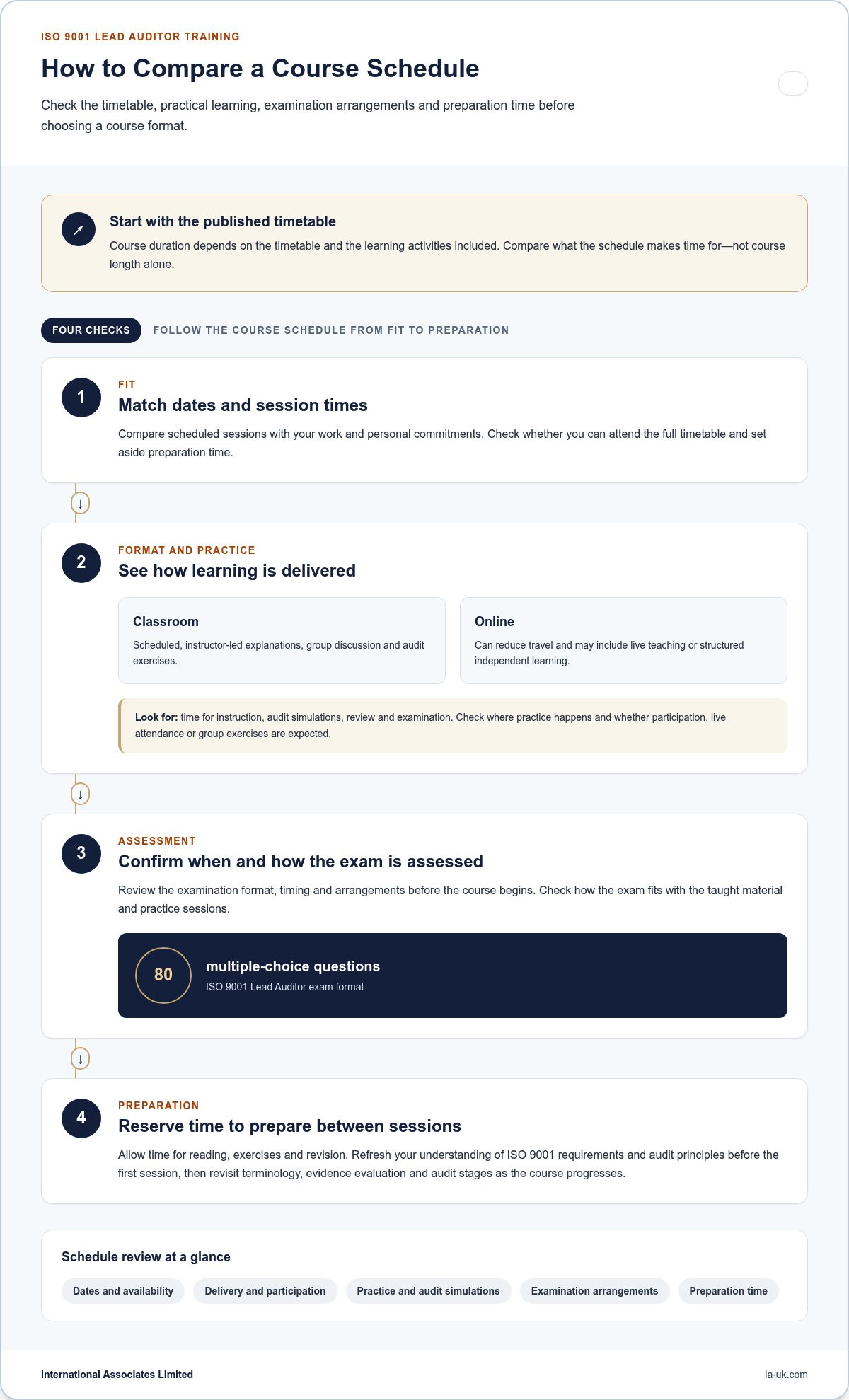
Course length and timetable affect how well you can balance training with work commitments. Compare the delivery format, learning activities, assessment timing and time available for practice before choosing a course.
Course Delivery and Format
Classroom courses offer scheduled, instructor-led explanations, group discussion and audit exercises. Online delivery can reduce travel and may include live teaching or structured independent learning. Before enrolling, check the timetable and how it balances instruction, practice and assessment.
A lead auditor training course should build competence through practical exercises, not concepts alone. Participants might review a process description, identify evidence to sample and present findings to a group. Look for activities that let you practise the auditor’s role as well as understand the requirements.
Use the course schedule to decide whether the format suits your learning needs. A fixed classroom timetable may suit those who benefit from direct discussion and routine. Online learning may work better if you need to fit study around work, provided participation expectations and assessment arrangements are clear.
Before booking, compare each scheduled session with your availability and preparation time. Check whether you must attend live sessions, complete independent assignments or take part in group exercises. For an online course, make sure you can access the learning platform and join discussions at the scheduled times.
Course Duration and Examination
Course duration depends on the published timetable and included learning activities. Compare the time set aside for instruction, audit simulations, review and examination, rather than relying on course length alone. A schedule that includes practice gives you time to apply audit concepts before assessment.
The ISO 9001 Lead Auditor exam consists of 80 multiple-choice questions. Review the examination format, timing, and assessment arrangements before the course begins. Planning study sessions around the course modules can help you revisit terminology, evidence evaluation, and audit stages in sequence.
Use these steps to compare schedules:
- Match the course dates and session times against work and personal commitments.
- Check how classroom or online learning is delivered and where practice occurs.
- Review when the examination takes place and how it relates to the taught material.
- Allow preparation time for reading, exercises, and revision between sessions.
Course prerequisites also influence readiness and pace. Refresh your understanding of ISO 9001 and audit principles before the first session, then note unfamiliar concepts for discussion. This preparation can make exercises on audit planning, evidence, and reporting more productive.
For a course schedule and format suited to professional learning, review the Lead Auditor Training programme and compare its delivery details with your availability.
ISO 19011 audit principles and practices
ISO 19011 provides practical guidance for preparing, conducting, and leading management-system audits. Understanding its role helps you distinguish audit guidance from requirements governing third-party certification.
To assess certificate recognition, identify the scheme named by the training provider and the credential you intend to pursue. Some Exemplar Global schemes require training certificates issued within the last three years. If the training falls outside that period, a relevant knowledge examination may apply, or an audit log may be used.
ISO 19011 Auditing Guidance
ISO 19011 supports consistent audit practices, including preparation, evidence gathering, and reporting. For a first-party audit within an organization, the auditor can use its guidance to structure the process and assess relevant management-system evidence. For a second-party audit, such as a supplier assessment, the same guidance helps organize the audit around its objectives and scope.
During training, look for exercises that turn guidance into decisions. For example, participants can prepare an audit plan, select records to sample and explain how the evidence supports a finding. These activities build practical audit competence instead of relying only on memorised principles.
ISO 19011 and ISO 17021 References
The course should explain how ISO 19011 and ISO 17021 relate to different audit contexts. ISO 19011 is referenced for first- and second-party audits, while ISO 17021 requirements apply to third-party audits. This distinction helps learners understand which framework informs their audit practices and responsibilities.
When reviewing course materials, check whether they identify the audit type used in each exercise. A supplier audit and an external certification audit have different contexts, so the relevant references should be clear. Training that explains the distinction helps lead auditors prepare for the assignment.
No single United States organization accredits every ISO 9001 lead auditor course. Recognition is scheme-specific: Exemplar Global has a Quality Management System certification scheme, and current certifications with IRCA/CQI, PECB, or CCAA can support recognition under that scheme.
Use these checks to assess a certificate’s recognition pathway:
- Identify the scheme and grade named for the intended credential.
- Review the certificate issue date against the scheme’s training-recency rule.
- Determine whether a knowledge examination or audit log applies.
- For an audit-log route, prepare evidence of 10 audit days for the relevant scheme and grade.
A relevant knowledge examination may satisfy the examination requirement for the Exemplar Global Quality Management System scheme. A certificate’s value therefore depends on its stated scheme, the training date and the recognition route pursued.
Auditing principles and personal behaviors
Auditing principles guide how evidence is gathered, assessed and reported. An auditor’s personal conduct determines whether those principles are applied consistently in real interactions.
ISO 19011 describes a disciplined approach to management-system auditing. Integrity means recording evidence accurately, even when results challenge expectations. Fair presentation requires findings to reflect the evidence reviewed. For example, an auditor should distinguish a verified process failure from an assumption based on one incomplete record.
Impartiality is essential: auditors should base conclusions on objective evidence, not personal preference or pressure from the organisation being audited. Confidentiality protects information accessed during the audit. Due professional care means preparing thoroughly, recognising the limits of one’s knowledge and communicating conclusions clearly.
Evidence-based and risk-based approaches guide practical decisions. An auditor might compare a procedure with completed records, then interview the process owner to understand a discrepancy. The audit should focus on relevant risks and objectives instead of treating every document as equally significant.
Lead auditors should model these behaviours for the audit team. Before the opening meeting, clarify roles, confirm the audit scope and explain how findings will be recorded. During interviews, open questions help people describe their actual work without being steered towards a preferred answer.
Useful behaviors to develop include:
- Active listening: allow process owners to explain evidence before forming conclusions.
- Clear communication: describe findings in direct language and identify supporting records.
- Adaptability: adjust interview questions when new evidence changes the audit trail.
- Professional composure: address disagreement by returning to the criteria and evidence.
- Sound judgment: separate a one-off error from evidence of a wider process issue.
These skills develop through practice, feedback and reflection. After a simulated audit, review whether your notes distinguish observed facts from interpretation. A concise finding identifies the relevant requirement, the evidence sampled and the gap observed. This structure makes the report easier for organisations to understand and address.
Successful auditors combine technical knowledge with disciplined conduct. Exemplar Global recognition relates to a certification pathway, while professional behaviour is demonstrated through decisions made during audit work. If you are preparing for assessment, practise neutral questioning, evidence-based conclusions and concise reporting in realistic scenarios.
For example, if a team member finds an outdated work instruction, the lead auditor should ask how the process is controlled and sample relevant records. The conclusion should reflect the evidence, not assume that every related process has failed. This measured approach supports credible reporting and maintains trust throughout the audit.
What are the prerequisites for ISO 9001 lead auditor training?
Prepare by building two foundations: a fundamental understanding of ISO 9001 quality management system requirements and comprehensive knowledge of audit principles. These are the stated knowledge prerequisites for taking the course. They help participants follow audit exercises and assess evidence without learning basic quality management concepts from scratch.
Use a focused readiness review before enrolling. Read the ISO 9001 requirements and identify how they relate to an organization’s processes. Then practise distinguishing objective evidence from assumptions. For example, compare a documented procedure with records showing how a process was performed. This helps reveal whether you understand both the requirement and the auditor’s evidence-based role.
Audit principles need practical application. Review how an audit is prepared, how questions are asked and how findings are supported. Practise drafting a short finding from a sample process record, separating the requirement, evidence and observed gap. This exercise shows whether you are ready for lead auditor-level training, which includes coordinating audit work and communicating conclusions.
Course entry preparation and later certification recognition are separate matters. After training, the relevant scheme may set its own recognition criteria. Some Exemplar Global certification schemes require a training certificate issued within the last three years. Consider both your preparation and the scheme linked to your intended credential.
If training falls outside an applicable recency requirement, a relevant knowledge examination may be used when available. Otherwise, an audit log may be used instead. Applicants using an audit log instead of a knowledge examination must provide evidence of 10 audit days for the relevant scheme and grade. Keep records organized by audit date, scheme, grade, and role to support a clear submission.
Before starting, use this preparation sequence:
- Review ISO 9001 requirements and note unfamiliar quality management terms.
- Practise applying audit principles to a process example and its records.
- Identify the certification scheme and grade relevant to your intended pathway.
- Check whether your training date falls within the scheme’s recency requirement.
- Organize examination or audit-log evidence according to the route you pursue.
This approach helps you identify knowledge gaps before the course, while keeping training prerequisites distinct from scheme-specific recognition steps. To build these competencies through structured Lead Auditor Training, review the course information and prepare using the criteria above.
International Associates Limited: Social Accountability Audits
International Associates Limited provides Social Accountability Audits for organisations assessing workplace practices and accountability. Choose this service when your priority is evaluating social responsibility, rather than gaining individual lead auditor training recognition. Its independent assessments support organisations seeking a structured review of social accountability practices.
For organizations focused on quality management system certification, International Associates Limited also provides ISO 9001 Quality Management System Certification. The appropriate next step depends on your objective: develop personal audit competence through training, assess social accountability through an audit, or pursue certification for an organization’s quality management system. Explore the Social Accountability Audits service to understand its relevance to your organization’s needs.
Contact International Associates Limited to discuss Social Accountability Audits or ISO 9001 certification.
Take the Next Step in Your Audit Career
Use your course decision to define the work you want to undertake next. If you’re preparing to lead audits, map the ISO 9001 lead auditor training requirements against your current knowledge, intended certification pathway, and preferred learning format. A clear plan helps you focus preparation on the competencies you’ll use in practice.
Organizations pursuing broader assurance goals may also consider how different services fit their needs. International Associates Limited provides ISO 14001 Environmental Management System Certification, alongside its training and other assurance services. The right next step depends on whether your priority is individual audit development or organizational certification.
Discuss your training plans and next steps with International Associates Limited. Contact International Associates Limited to discuss training, and move forward with a clear professional objective.
Frequently Asked Questions
What are the prerequisites for this course?
Participants should be comfortable interpreting ISO 9001 requirements and applying audit principles before training begins. To assess readiness, choose a familiar workplace process and ask what records, interviews, or observations could demonstrate how it operates. If identifying relevant evidence feels difficult, review the standard and basic audit methods first. This self-check helps you enter the course prepared for applied exercises.
What topics will this course cover?
The course connects ISO 9001 criteria with the practical work of a lead auditor. Review the syllabus for coverage of audit preparation, team coordination, assessment activities, and communication of outcomes. A useful way to judge its relevance is to compare those topics with your intended audit role. For instance, someone preparing to coordinate a team should look for leadership activities, not only individual auditing exercises.
Who should attend this course?
This course suits professionals who expect to lead or take part in quality management system audits. Quality personnel, auditors expanding their responsibilities and staff involved in external assessments may find the content relevant. Before enrolling, define the role you want to perform. If your immediate responsibility is limited to checking one internal process, compare the course scope with that narrower need.
How many hours or days does ISO 9001 lead auditor training take?
The course duration is set by its schedule and delivery format. Compare the timetable with your availability, including preparation, live instruction, independent learning and assessment. For a practical check, block the published sessions in your calendar and identify work commitments that could interrupt attendance. This helps you judge whether the schedule will support focused participation from the first session to completion.
What topics and competencies must an ISO 9001 lead auditor course cover?
Choose a course that teaches you to apply audit methods to realistic organisational situations. Check whether the learning activities assess judgement, clear communication, team coordination and appropriate handling of audit information. A useful syllabus explains how participants practise these skills rather than simply listing topics. Consider whether the exercises reflect the processes, documentation or operational context you expect to encounter.
What are the requirements for passing an ISO 9001 lead auditor course and exam?
Passing depends on meeting the course’s stated assessment criteria. Before enrolling, find out how the examination is administered, what participation is expected and how successful completion is recorded. Plan revision around the course materials and note unfamiliar terminology as it arises. This helps you prepare systematically without assuming that attendance alone demonstrates competence or meets every assessment requirement.
Does completing a lead auditor course qualify someone to become a certified ISO 9001 auditor?
Completing a course provides evidence of training, but professional recognition depends on the certification scheme pursued. A course certificate and a personal auditor credential are not necessarily the same. Before choosing a pathway, identify the credential’s intended grade and required supporting records. This distinction clarifies whether your next step is further assessment, an application or documented audit experience.
What experience is required to become a registered or certified ISO 9001 lead auditor?
Experience criteria depend on the registration or certification scheme and the grade sought. Relevant work may include participating in audits, documenting your responsibilities and showing how audit activities were completed. Keep a clear record of your role and each assignment’s scope, as these details can help demonstrate professional experience. Review the applicable scheme’s criteria before planning your route to recognition.