

Holding a five-day course certificate does not prove an auditor is truly qualified. National accreditation bodies like UKAS increasingly challenge paper-only credentials during surveillance assessments, demanding demonstrable proof of sector knowledge and practical mechanics. Consequently, meeting formal ISO auditor competency requirements in 2026 requires verified operational experience, robust risk evaluation, and documented technical capability rather than passive classroom attendance.
It’s understandable to feel caught between internal audit guidelines and the demanding prerequisites enforced by certification bodies. Demonstrating sector-specific competence to external assessors often creates friction, particularly as updated frameworks like ISO 19011:2026 place heightened expectations on hybrid auditing techniques, risk-based thinking, and regulatory compliance.
This guide provides the clear benchmark you need to master the technical, regulatory, and practical criteria for both internal and lead auditors. You will learn how to construct a fully defensible competence evaluation matrix, progress methodically along the professional qualification pathway, and select the accredited lead auditor training routes necessary to satisfy rigorous international standards.
Key Takeaways
- Understand the critical operational differences between ISO 19011 internal audit guidelines and mandatory ISO/IEC 17021-1 certification body prerequisites.
- Meet formal ISO auditor competency requirements by combining verifiable education and practical audit mechanics with modern risk-based and hybrid auditing skills.
- Identify the specialized technical criteria demanded in high-stakes sectors, including ISO 13485 medical devices, ISO 27001 information security, and SA8000 social accountability.
- Deploy a structured four-step evaluation matrix to prove ongoing auditor capability during accreditation assessments rather than relying on course attendance sheets.
- Select the appropriate accredited lead auditor training pathway to ensure your qualifications achieve international recognition by registrars and regulators.
ISO Auditor Competency Framework: ISO 19011 vs ISO/IEC 17021-1
Understanding ISO auditor competency requirements begins with recognizing the clear separation between auditing guidance and conformity assessment regulations. While many organizations conflate internal audit best practices with certification body prerequisites, international governance divides these roles strictly by operational intent and oversight level.
| Dimension | ISO 19011:2026 (Internal / Supplier) | ISO/IEC 17021-1:2015 (Certification Bodies) |
|---|---|---|
| Scope | First- and second-party audits | Third-party certification audits |
| Legal Status | Non-mandatory international guidance | Mandatory standard for accreditation |
| Enforcement | Defined internally by organization management | Enforced by national accreditation bodies (e.g., UKAS) |
| Technical Proof | Discretionary based on risk and scope | Documented technical knowledge and witnessed audits |
The Role of ISO 19011 in First- and Second-Party Audits
The revised ISO 19011 guidelines, published in May 2026, provide the benchmark framework for managing internal and supplier audit programs. Rather than enforcing rigid mandates, the standard grants leadership teams the flexibility to calibrate competence criteria against organizational risk and process complexity. Auditors operating under this framework must demonstrate practical proficiency in process-based auditing, digital data handling, and hybrid assessment methods without requiring statutory registrar accreditation.
Mandatory Third-Party Registrar Competence Under ISO/IEC 17021-1
Third-party certification bodies operate under completely different parameters. Governed by ISO/IEC 17021-1:2015, registrars must define formal, documented qualification mechanisms that satisfy national accreditation assessors. Satisfying formal ISO auditor competency requirements at this level demands verifiable proof of sector-specific technical education, practical industry experience, and successful initial qualification monitoring through witnessed assessments.
A standard five-day training certificate establishes foundational knowledge, but it does not satisfy third-party compliance alone. Registrars verify technical codes through rigorous peer evaluations, continuous professional development records, and demonstrated proficiency in applicable regulatory frameworks before authorizing lead status. For professionals seeking career progression, completing accredited lead auditor training provides the structured baseline necessary to enter this formal qualification pipeline.
Core Competency Requirements: Knowledge, Personal Attributes, and Skills
Mastering ISO auditor competency requirements entails far more than passing a standardized multiple-choice test. Competence requires an integration of formal academic training, continuous field work, and acute behavioural awareness. When accreditation bodies audit an organization’s internal assessment logs, they examine whether personnel can translate standard clauses into rigorous verification on the shop floor.
Essential Knowledge and Management System Understanding
Effective practitioners must command the underlying architecture of management systems. This involves navigating the Harmonized Structure (formerly Annex SL) across common operational frameworks, interpreting corporate risk mechanisms, and evaluating compliance with statutory mandates. Grounding these skills in the foundational ISO 19011:2018 guidelines ensures audit teams correctly distinguish between systemic requirements, corporate policy choices, and legal baselines during review cycles.
Mandatory Personal Behaviors Defined by ISO 19011
Audit findings remain vulnerable to challenge if the assessor lacks personal impartiality and composure. Clause 7 of the auditing guidelines outlines core behavioural attributes necessary to preserve assessment integrity:
- Ethical Conduct and Discretion: Handling sensitive operational data, trade configurations, and personnel records with complete confidentiality.
- Perceptive Tenacity: Staying focused on procedural fact-finding during high-pressure interviews without becoming adversarial.
- Analytical Independence: Evaluating evidence objectively against defined criteria while resisting executive interference or operational bias.
- Cultural Diplomacy: Respecting local workplace customs and workforce dynamics across international facilities.
Technical Auditing Skills and Evidence Verification
Auditors fail most frequently in evidence collection and nonconformity writing. Technical competence requires open questioning methods that encourage auditees to demonstrate everyday procedures naturally rather than rehearsing prepared answers. Assessors must sample production batches, review digital audit trails, and inspect physical machinery to verify reported metrics.
Any identified breakdown must be documented using an indisputable three-part statement: the specific requirement violated, the objective evidence observed, and the extent of the operational departure. Vague summaries cause disputes during surveillance assessments. Organizations seeking to strengthen their team’s evidence-gathering discipline often enroll key personnel in formal lead auditor training to instill reliable, standardized evaluation habits across all operating units.
Sector-Specific Competence: Medical Devices, InfoSec, and Social Accountability
Generic quality principles do not satisfy accreditation requirements in high-consequence industries. National bodies such as UKAS allocate specific technical sector codes to auditors, demanding verifiable field experience alongside formal assessment credentials. Fulfilling sector-specific ISO auditor competency requirements ensures assessors possess the technical literacy to identify critical process failures before products reach global markets. Organizations can review how these sector codes govern third-party assessment through accredited management system certification criteria.
ISO 13485 Competency for Medical Device Professionals
Auditing medical device manufacturing requires specialized engineering or life-science knowledge that extends beyond generic quality management. Assessors must demonstrate practical fluency in risk management under ISO 14971, cleanroom biocontamination controls, and technical documentation reviews. Regulatory shifts demand heightened precision. Since February 2, 2026, the U.S. FDA Quality Management System Regulation (QMSR) officially incorporates ISO 13485:2016 by reference. Auditors must therefore evaluate compliance against both the international standard and statutory frameworks like the EU MDR and UKCA directives simultaneously.
ISO/IEC 27001 and Technical Cybersecurity Audit Credentials
Information security audits require deep technical acumen rather than simple administrative checklist reviews. With average data breach costs reaching $4.45 million, organizations cannot afford superficial assessments. Qualified lead auditors must understand threat modeling, public key infrastructure, and cloud network architecture. Under ISO/IEC 27001:2022, assessors must verify an organization’s Statement of Applicability against Annex A operational controls, assessing technical resilience against unauthorized exfiltration, configuration drift, and regulatory data protection breaches.
Social Accountability and Ethical Supply Chain Competence
Social compliance assessments present distinct operational challenges that mechanical quality audits do not face. Following the release of the updated SA8000:2026 standard on January 1, 2026, which covers over 2.8 million workers across more than 5,000 facilities, auditor competence relies heavily on specialized worker engagement. Lead assessors must conduct private, uncoerced interviews across diverse factory shifts, verify complex payroll structures against local minimum wage statutes, and evaluate operations against International Labour Organization conventions. Professionals aiming to build defensible qualifications across these technical scopes can progress through structured IA professional training pathways to master accredited protocols, while facilities can examine baseline operational expectations through social accountability audits.
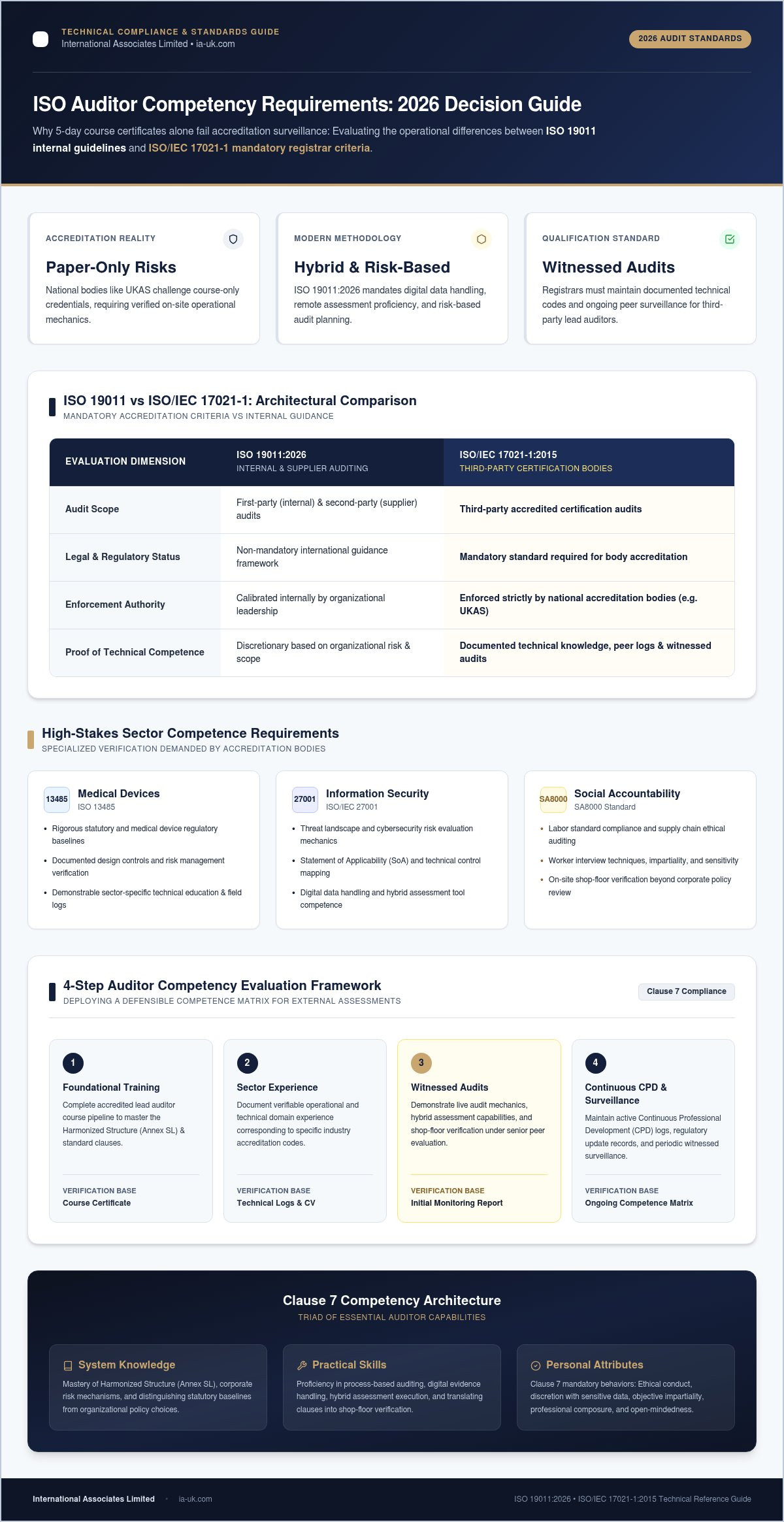
How to Evaluate and Maintain Auditor Competency: A 4-Step Framework
Completing a training course marks the start of professional qualification rather than its conclusion. National accreditation bodies require operating facilities and registrars to maintain active, defensible evidence that assessors preserve their technical sharp edge over time. Satisfying rigorous ISO auditor competency requirements demands an ongoing, multi-stage governance framework that continually validates performance against operational risks.
- Benchmark Definition: Establish technical criteria based on operational risk, relevant standard clauses, and sector-specific statutory mandates.
- Initial Verification: Screen candidates through formal credential reviews, technical interviews, and practical scenario tests.
- Supervised Witness Audits: Evaluate live performance on site under the direct observation of a qualified lead auditor.
- Continual Monitoring and CPD: Track annual audit logs, mandate technical refreshers, and conduct periodic reassessments.
Step 1 & Step 2: Setting Benchmarks and Initial Evaluation
The qualification process begins by establishing concrete benchmarks matched to operational complexity. Rather than accepting generic training credentials at face value, governance teams must map specific prerequisites across education, technical sector disciplines, and management system structures. Initial evaluations should screen candidates through detailed reviews of past operational experience, peer-led technical interviews, and written scenario testing to verify that auditors can analyze process failures under actual operating conditions.
Step 3 & Step 4: Practical Witness Audits and Ongoing CPD
Practical execution separates theoretical understanding from verified capability. Candidate auditors must complete formal witness audits, conducting opening meetings, plant inspections, and closing conferences under the direct scrutiny of an experienced lead assessor. The observing lead evaluates evidence collection methods, nonconformity grading accuracy, and interview poise using standardized scoring criteria.
Maintaining competence subsequently requires structured governance. Assessors must maintain documented annual audit logs confirming a minimum volume of operational audits across relevant standards. In addition, auditors must record verified Continuous Professional Development (CPD) hours covering legislative amendments, new standard publications, and evolving technical risks. You can establish this structured qualification pathway for your internal teams by enrolling them in accredited lead auditor training courses to ensure your audit program withstands rigorous accreditation scrutiny.
Selecting Accredited Auditor Training and Certification Pathways
Choosing the appropriate qualification pathway requires aligning professional training investments with the specific operational mandates of your industry. Because national accreditation assessors scrutinize the credibility of training certificates, relying on unaccredited courses can invalidate internal audit findings and delay certification decisions. Selecting the right program ensures personnel satisfy rigorous ISO auditor competency requirements recognized by registrars globally.
Internal Auditor vs Lead Auditor Course Curriculums
Deciding between internal auditor and lead auditor credentials depends on the intended operational scope and level of evaluation responsibility:
- Internal Auditor Courses (Typically 2 Days): These programs focus on internal conformance auditing, basic sampling mechanics, operational risk identification, and internal corrective action tracking. They prepare personnel to evaluate single departments or internal workflows against established procedures.
- Lead Auditor Courses (Intensive 5 Days): These rigorous courses prepare assessors to manage complete audit teams, plan and execute Stage 1 document reviews and Stage 2 on-site assessments, and conduct formal executive closing meetings. Qualification requires passing continuous practical evaluations alongside a closed-book invigilated examination.
While internal auditor courses suit team members reviewing everyday facility processes, lead auditor qualifications are essential for quality directors, corporate compliance managers, and external assessment professionals. Completing an accredited program provides the foundation needed to satisfy third-party oversight expectations.
Verification of Accredited Training Providers
The credibility of your qualification depends directly on the governance standing of the issuing provider. Before booking a course, organizations must confirm that the training organization operates under recognized accreditation frameworks or approved professional registers. Course completion certificates from unverified entities carry little weight when reviewed by national accreditation bodies like UKAS, ANAB, or DAkkS.
Tutor credentials demand equal scrutiny. Instructors must have documented field experience as practicing third-party lead auditors across complex technical sectors rather than merely theoretical knowledge. Assessors with active, real-world experience ensure students learn practical evidence sampling, conflict resolution, and objective interview techniques that survive external audit scrutiny. You can review established institutional credentials through International Associates accreditations to understand how accredited providers maintain global recognition across quality, safety, and regulatory compliance sectors.
Aligning your training investment with recognized certification bodies safeguards your professional credentials and streamlines future compliance assessments.
Strengthen Your Audit Governance for 2026 and Beyond
Establishing a defensible audit program requires moving beyond classroom attendance to demonstrate verified technical acumen, risk-based thinking, and practical evaluation skills. Whether you conduct internal reviews or oversee complex global supply chains, satisfying modern ISO auditor competency requirements demands continuous performance monitoring, structured witness assessments, and documented professional development.
As a UK-based certification and verification body established in 2005 with global operational reach, International Associates delivers decades of technical leadership across ISO 9001, ISO 13485, and social accountability schemes. Our transparent, accredited audit processes and modern assessment infrastructure ensure that your personnel build practical capabilities recognized by international accreditation authorities.
Position your compliance team for long-term operational success. Advance your career or certify your audit team with International Associates accredited training programs to ensure your management systems remain robust, defensible, and fully aligned with evolving global standards.
Frequently Asked Questions
What is the difference between an internal auditor and a lead auditor certification?
Internal auditor certification qualifies an assessor to conduct first-party internal and second-party supplier reviews within an organization’s existing governance system. In contrast, a lead auditor qualification certifies a professional to manage assessment teams and conduct third-party certification audits. Lead auditor courses demand 40 hours of intensive study and closed-book examinations, establishing the credentials needed to lead complex multi-site assessments and liaise directly with external accreditation assessors.
Does completing a 5-day lead auditor course automatically qualify someone as an auditor?
No, completing a five-day training course only satisfies the initial knowledge requirement. Meeting full ISO auditor competency requirements demands practical execution under supervision. Professional certification bodies and registrar qualification schemes require candidates to log practical audit days, complete witnessed on-site assessments, and demonstrate relevant sector work experience before granting independent auditor or lead status. The certificate verifies academic understanding, not fully validated field competence.
How often must ISO auditor competency be re-evaluated?
Auditor competency should undergo formal re-evaluation at least annually. Most organizations review assessor performance yearly by assessing audit logs, report accuracy, and stakeholder feedback. Third-party certification bodies enforce strict continual monitoring through mandatory annual witness audits, ongoing surveillance of technical files, and verified records of Continuous Professional Development. If standard revisions or significant operational changes occur, competency reassessments must happen immediately to maintain system integrity.
What are the minimum work experience requirements for specialized ISO standards?
Specialized standards require documented, sector-specific industry experience alongside general audit training. For complex scopes like ISO 13485 medical devices, ISO 27001 cybersecurity, or operational technology sectors like mission critical control systems aviation, accreditation bodies typically require two to four years of full-time professional experience within that technical domain. This ensures the auditor understands specialized technical controls, legal mandates, and clinical, cryptographic, or operational risk factors before evaluating manufacturing facilities or complex technical systems.
Can an organisation set its own internal auditor competency requirements?
Yes, organizations have the flexibility under ISO 19011 to establish their own internal auditor competency criteria based on their operational risk profile. While leadership can define custom education and internal training thresholds, these standards must remain defensible. External certification body auditors will evaluate whether your internal auditors possess sufficient process knowledge and impartiality to identify real systemic nonconformities during their routine management system surveillance.
What is an auditor witness audit and when is it required?
A witness audit is a live on-site assessment where a senior qualified lead auditor observes and evaluates a candidate auditor’s performance. It is mandatory during initial auditor qualification and periodic surveillance reviews under ISO/IEC 17021-1 frameworks. The evaluator grades the candidate’s interview composure, objective evidence sampling, time management, and nonconformity writing without intervening in the audit process unless procedural errors compromise findings.
How do changes in ISO standards affect an auditor certified status?
Standard revisions require certified auditors to complete formal transition training within designated implementation deadlines. When international technical committees publish revised standards or major structural amendments, auditors must update their ISO auditor competency requirements through verified professional development courses. Failure to complete transition examinations before accreditation transition periods expire invalidates an assessor’s qualification to conduct compliant third-party audits against the updated criteria.