

A successful ISO certification audit UK assessment depends on evidence that your management system works in practice, not just a polished folder of procedures. If you are planning certification, it can be difficult to know how the independent assessment differs from an internal audit, what evidence to prepare, or whether findings could affect the certification decision.
This guide explains the certification assessment stages and how to prepare relevant records and staff without creating unnecessary work. It also sets out practical ways to assess a certification body’s competence, impartiality, accreditation status and scope, so you can compare providers against the needs of your organisation.
You’ll learn what auditors may examine beyond documented procedures, how to respond if findings are raised, and what to check before choosing a provider. In particular, confirm that the body’s accreditation applies to the standard and scope you need. With these checks in hand, you can plan the assessment around your real processes and evidence.
Key Takeaways
- Identify the standard and scope your organisation needs before comparing certification options.
- Understand how an ISO certification audit UK typically progresses from application and Stage 1 through Stage 2, a certification decision and ongoing surveillance.
- Compare certification bodies by relevant standard scope, sector experience, impartiality, location and communication.
- Check a provider’s current accreditation status and scope in the relevant accreditation body’s directory before making a decision.
- Prepare documented processes, implementation evidence and staff availability, then check whether a provider’s listed services fit your requirements.
ISO Certification Audit UK: What the Audit Covers and Why It Matters
Begin by identifying the management-system standard that matches your organisation’s needs, then confirm that independent certification is the outcome you require. An ISO certification audit UK assessment checks whether a defined management system meets the requirements of a specified standard within an agreed scope. Auditors look beyond whether procedures exist: they consider evidence of how the system is applied in practice.
A certification audit is an independent, evidence-based assessment of a management system against a specified standard, intended to establish whether the system conforms within its defined scope. ISO develops and publishes standards; it does not audit or certify individual organisations. Certification bodies conduct those assessments. The International Organization for Standardization provides background on the organisation behind the standards.
Keep the purpose of each activity clear. Internal audits help an organisation evaluate its own management system. Supplier audits assess a supplier against requirements set by the purchasing organisation. Consultancy supports system development or improvement, while certification auditing is an independent assessment. Although these activities can examine similar processes, they are not interchangeable.
Certification audit versus internal audit: who assesses what?
An internal audit is arranged for an organisation’s own evaluation and can help identify gaps before an external assessment. A third-party certification audit is conducted by a certification body, which assesses evidence against the chosen standard and scope. Internal audit results can inform preparation, but they do not replace independent certification assessment.
A finding identifies an issue or a point requiring attention. It does not automatically mean certification has been refused. The certification body evaluates findings under its process before reaching a certification decision. Ask in advance how findings are reported, what response is expected and whether follow-up assessment may be needed.
Which ISO standard is relevant to your organisation?
Choose a standard based on the activities and management-system scope you need assessed, not simply because it is familiar. ISO 9001 may be relevant when the focus is quality management. ISO/IEC 27001 may be appropriate when the intended scope concerns information security management. Neither is a universal recommendation. Consider which processes, locations and services need to be included, and what recognition customers or other stakeholders expect.
If you are assessing quality-management certification, the management system certification information outlines a relevant service area. Before proceeding, compare the certification body’s stated standard and scope with your intended assessment, then verify its current accreditation status and scope with the relevant accreditation body.
How the UK ISO Certification Audit Process Works from Stage 1 to Decision
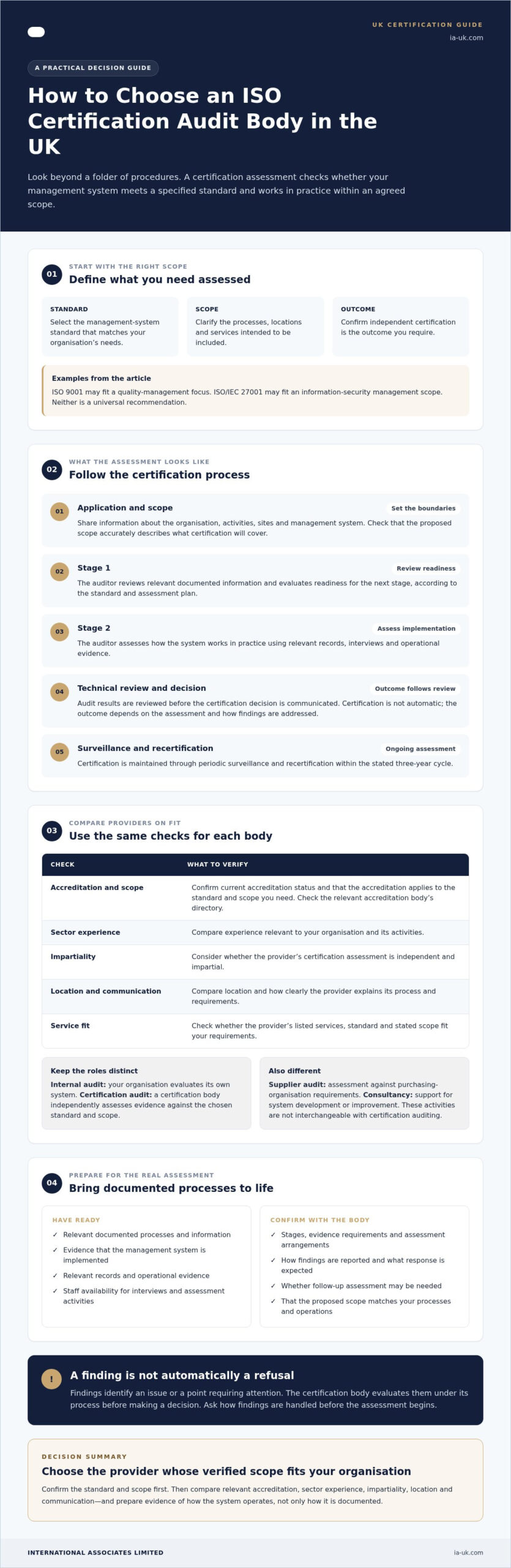
An ISO certification audit UK typically follows a defined sequence, but the audit plan depends on the applicable standard, requested scope and organisation’s operations. Before assigning staff time or planning readiness activities, confirm the stages, evidence requirements and arrangements directly with the certification body.
- Application and scope: Provide information about the organisation, activities, sites and management system to be assessed. Check that the proposed scope accurately describes what certification will cover.
- Stage 1: The auditor reviews relevant documented information and evaluates readiness for the next stage. The review depends on the standard and assessment plan.
- Stage 2: The auditor assesses how the management system is implemented in practice, using relevant records, interviews and operational evidence.
- Technical review and decision: Audit results are reviewed before the certification decision is communicated. Certification is not automatic; the outcome depends on the assessment and how any findings are addressed.
- Surveillance and recertification: Certification is maintained through ongoing assessment, including periodic surveillance and recertification within the stated three-year cycle.
What happens during Stage 1 and Stage 2?
Stage 1 reviews readiness; Stage 2 assesses implementation against the standard using relevant evidence and operational activity. This distinction helps teams prepare. Stage 1 considers whether the system and organisation are ready for a fuller assessment, while Stage 2 examines whether processes are being carried out and supported by evidence. Ask the certification body to confirm the audit plan and evidence requested, since requirements vary by standard and scope.
International Associates describes its initial certification fees as covering formal Stage 1 and Stage 2 audits. The service includes a technical review of documentation and on-site or remote verification of management-system implementation. Confirm the proposed scope and assessment arrangements before proceeding. For UK-specific context on how accreditation demonstrates competence, consult the government’s policy on accreditation, and check a certification body’s current status and relevant scope with the appropriate accreditation body.
What happens after the certification audit?
Following the audit, results are subject to technical review before a decision is issued. If findings are raised, ask the certification body to explain their classification, the required response and any follow-up assessment. Clarifying these points helps you plan the next steps without assuming that a finding automatically prevents certification.
Surveillance and recertification are continued assessments, not automatic certificate renewals. Keep the cycle in view when selecting a provider and assigning responsibility for evidence and audit coordination. To compare available standards and assessment services, explore International Associates’ management-system certification services, then confirm that the relevant standard and scope meet your needs.
How to Compare ISO Certification Audit Bodies in the UK
Compare certification bodies against the same practical criteria, rather than relying on headline claims. For an ISO certification audit UK assessment, first confirm that the provider can assess your exact standard and organisational scope. Then check how it demonstrates competence, independence and clear audit arrangements.
| Comparison factor | What to verify |
|---|---|
| Standard and scope | Ask whether the proposed service covers the precise standard, activities, sites and boundaries you want assessed. |
| Sector competence | Request substantiated information about auditor qualifications and experience relevant to your operations. |
| Impartiality | Ask how conflicts of interest are identified and managed, and how independent audit conclusions are protected. |
| Geography | Confirm how the provider will cover your locations and whether the planned assessment arrangements suit your sites. |
| Communication | Check how audit planning, evidence requests, findings, reporting and technical review will be explained and handled. |
What evidence should you request from a certification body?
Request written confirmation of the proposed standard and scope, along with the basis for the audit plan. Ask who will conduct the assessment, what evidence supports their relevant competence, and how reporting and technical review are managed. These details make providers easier to compare on verifiable information instead of broad claims about experience, coverage or turnaround. Treat an unsubstantiated promise as a question to resolve, not evidence of suitability.
Impartiality matters too. A certification body must be able to assess the management system independently. If a provider offers to design the same system it will later certify, ask how the activities are separated and whether the arrangement could create a conflict. Certification auditing is an independent assessment, not a substitute for management-system consultancy.
How should you interpret accreditation and certification claims?
Accreditation applies to a certification body’s competence for defined activities; certification applies to an organisation’s management system. A claim of accreditation alone is not enough. Check the relevant accreditation body’s current directory and confirm that the listing covers the exact standard and scope being offered. UKAS is the UK accreditation entity. Do not assume a provider is UKAS-accredited without checking its current status and scope.
A provider’s website can be a useful starting point, but it is not the final verification. Review International Associates’ accreditation information alongside the relevant accreditation body’s directory. Apply the same independent check to any certification body you are considering.
How to Prepare for an ISO Certification Audit in the UK
Effective preparation starts with a clear scope and evidence that reflects how work is actually carried out. For an ISO certification audit UK assessment, use the audit plan agreed with the certification body to focus on relevant processes, records and people. This is more useful than assembling documents without considering how they relate to day-to-day operations.
What should be ready before the auditor arrives?
Work through these steps before the audit:
- Confirm the scope: Check the organisation’s boundaries, sites, activities and management-system scope against the application and audit plan. Resolve any mismatch with the certification body before the assessment.
- Organise current information: Make relevant procedures, records, process responsibilities and other requested evidence accessible. Check that staff use current documents and know where records are maintained.
- Demonstrate implementation: Select evidence that shows processes operating in practice, such as completed records or examples of how responsibilities are carried out, where relevant to the standard and audit scope. Documentation alone cannot demonstrate that the system is implemented effectively.
- Coordinate people and logistics: Confirm the audit schedule, locations, access arrangements, evidence expectations and main points of contact with the audit team. Brief relevant staff on the plan so they can describe their actual work accurately.
Keep the briefing factual. Staff should explain the processes they perform and show how they use the system. They do not need to memorise standard language or rehearse scripted answers. If a requested record is unavailable or a process has changed, identify that clearly and discuss it through the agreed audit channels.
How should an organisation respond to audit findings?
Record each finding accurately and ensure the team understands the evidence and requirement cited in the audit report. Do not treat findings as interchangeable. Their significance and required follow-up depend on the assessment and the certification body’s process.
For each finding, document the response so it can be reviewed:
- Investigate the cause rather than recording only the immediate correction.
- Define proportionate corrective action, assign an owner and establish a practical completion plan.
- Retain evidence showing what changed and how follow-up was completed.
- Submit requested information through the method and process agreed with the certification body.
Ask the audit team to clarify any uncertainty about the evidence required, response process or next steps. A finding does not, by itself, establish the certification decision, and preparation cannot guarantee an outcome. If you are assessing your requirements, review management-system certification services and confirm the proposed scope and audit arrangements with the certification body.
Choosing International Associates for ISO Certification Audits in the UK
Once you have established the relevant standard, organisational scope, evidence needs and provider credentials, International Associates may be one option to consider for an ISO certification audit UK. The company is UK-based, with its head office in Glasgow and regional offices across Europe, Asia and the Middle East. This may be relevant to organisations looking for a UK-based provider with an international office network.
When may International Associates be relevant to your audit search?
International Associates lists certification services for standards including ISO 9001, ISO 14001, ISO 45001, ISO 13485, ISO 22000, ISO 50001, ISO 27001 and ISO 22301. If one of these matches your intended management-system scope, review the management-system certification services for information relevant to your selection.
A listed service is a starting point for discussion, not proof that a particular accreditation applies. Before making a decision, verify the provider’s current accreditation status and confirm that the relevant standard and scope are covered. This check is especially important if a customer, tender or other stakeholder specifies an accreditation requirement.
What should you confirm before requesting an audit proposal?
Prepare a concise outline of what you need assessed so the provider can respond to the actual scope, rather than a broad description of your organisation. Include:
- The required ISO standard and intended management-system scope.
- Relevant locations, activities, sites and organisational boundaries.
- Your evidence needs and any stakeholder requirements for certification or accreditation.
- Questions about auditor competence, applicable accreditation scope, audit arrangements and how the certification decision is made.
Ask for clear confirmation of which services and locations are included, how the audit will be planned, and what information the provider needs from your organisation. Review the response against the same criteria used to compare other certification bodies. This keeps the decision grounded in scope, evidence and verifiable credentials, rather than assumptions based on a provider’s location or service list.
If International Associates appears to fit your requirements, discuss your ISO certification audit requirements, including the standard, organisational scope and audit arrangements you need to confirm.
Make Your Certification Decision with Confidence
Choosing an ISO certification audit UK provider starts with a clear standard and scope, followed by checks on relevant competence, impartiality and applicable accreditation. Prepare evidence that shows how your management system operates, and confirm the audit stages and follow-up process with the certification body before committing.
International Associates Limited was founded in 2005, has its head office in Glasgow, and lists ISO management-system certification services. These details may help you decide whether to include the company in your provider assessment, but verify the accreditation status and scope relevant to your requirements independently.
To discuss the standard, organisational scope and audit arrangements you need to confirm, discuss your ISO certification audit requirements. With a well-defined scope and clear selection criteria, you can take the next step with confidence.
Frequently Asked Questions
What is an ISO certification audit in the UK?
An ISO certification audit in the UK is an independent assessment of an organisation’s management system against a specified ISO standard. A certification body conducts the assessment, not ISO itself. Auditors examine whether the system is defined and implemented within the agreed scope. Before proceeding, confirm the applicable standard, sites and activities covered, audit plan, evidence expectations and certification decision process with the certification body.
What happens during a Stage 1 and Stage 2 ISO audit?
Stage 1 reviews relevant documentation and assesses readiness, while Stage 2 checks how the management system is implemented using audit evidence. The exact activities depend on the standard, organisational scope and audit plan. Ask the certification body what records or other evidence will be requested, which people should be available, and whether any standard-specific arrangements apply. This helps you prepare for the actual audit scope.
How long does an ISO certification audit take in the UK?
There is no single audit duration that applies to every organisation. The planned time can depend on the standard, scope, locations, activities and applicable audit rules. Ask the certification body to explain the proposed audit plan and the basis for its duration. A generic estimate may not reflect your organisation’s circumstances, so confirm that the planned assessment accounts for the sites and activities included in your requested scope.
Can an organisation fail an ISO certification audit?
An audit can identify nonconformities or other findings that need a response, but their effect depends on the requirements and the certification body’s process. Review each finding, understand the evidence and requirement cited, investigate its cause, and provide appropriate corrective-action evidence if requested. Ask the certification body how findings affect the certification decision and what follow-up is required. Do not assume every finding has the same consequence.
How do I check whether a UK ISO certification body is accredited?
Check the certification body’s stated accreditation status against the current records of the relevant accreditation body, and confirm that the accreditation scope covers the standard and certification activity you need. UKAS is the UK’s national accreditation body. Accreditation applies to the certification body’s defined competence and scope; it is distinct from certification of your organisation. Verify the relevant details directly before appointing a provider.
What is the difference between an ISO audit and an internal audit?
An internal audit is conducted for an organisation’s own evaluation of its management system. A certification audit is an independent third-party assessment against a specified standard. Both may review records and processes, but they have different purposes: internal auditing supports the organisation’s evaluation, while certification auditing informs an independent certification decision. An internal audit can help identify issues, but it does not replace assessment by a certification body.
What documents should be prepared for an ISO certification audit?
Prepare information relevant to the agreed scope, including applicable procedures, current records, assigned responsibilities and evidence that processes operate as intended. The exact documentation depends on the standard and your organisation, so confirm evidence requirements and logistics with the certification body. Organise evidence so it can be related to actual activities and responsibilities. Procedures alone do not show that the management system is implemented effectively in day-to-day operations.