

By May 1, 2026, the transition window for the 2024 Code of Practices (COP 24) closes for many industry participants, transforming what was once a distinction into a baseline requirement for global market access. You’ve likely recognized that the rjc certification requirements for jewelers have become significantly more rigorous, especially with new mandates for greenhouse gas emissions and OECD due diligence for gemstones. It’s common to feel concerned about the technical complexity of these updated standards or the potential for friction during a third-party audit. We understand that maintaining institutional reliability requires a clear, risk-based approach to these evolving legal and ethical frameworks.
This guide provides a precise framework to help you secure your standing within the global supply chain. You’ll gain a clear understanding of the mandatory Code of Practices compared to the voluntary Chain of Custody (CoC) standard, allowing for informed strategic decisions. We’ll also outline the specific 2026 deadlines for laboratory-grown materials and provide a logical strategy for selecting a certification body that verifies your supply chain integrity with absolute precision. By focusing on practical application rather than abstract theory, you can approach your next audit with the confidence that your operations meet the highest international benchmarks.
Key Takeaways
- Identify the critical transition from COP 2019 to the mandatory 2024 Code of Practices to ensure your business maintains its global market eligibility.
- Decide between the foundational Code of Practices and the optional Chain of Custody standard based on your specific material traceability needs.
- Compare the rjc certification requirements for jewelers with industry-agnostic frameworks like SA8000 to determine which audit best serves your strategic goals.
- Establish a practical roadmap to compliance by prioritizing management system gap analysis and the development of robust human rights policies.
- Understand the role of independent auditing bodies in navigating complex OECD due diligence requirements for gemstones and laboratory-grown materials.
RJC Certification Requirements for Jewelers in 2026: An Overview
RJC certification serves as the definitive global standard for establishing and verifying responsible business practices across the entire jewelry and watch supply chain. As of January 1, 2026, the 2024 Code of Practices (COP 24) has become the mandatory framework for all members, replacing previous iterations. This transition reflects a broader institutional shift toward rigorous environmental and social accountability. The scope of materials covered by these standards has expanded significantly, now encompassing diamonds, gold, silver, platinum group metals, and colored gemstones such as rubies, sapphires, and emeralds. Understanding the rjc certification requirements for jewelers is essential for maintaining market access, as the industry moves away from the history of conflict diamonds toward a fully transparent, verified model.
Businesses must distinguish between membership and certification status. Membership is the initial administrative step, while certification is achieved only after a successful third-party assessment. All commercial members are required to achieve certification within two years of joining the council to remain in good standing. This two-tier structure ensures that while many firms may join the initiative, only those that undergo rigorous independent verification can claim certified status.
Why Jewelers are Prioritizing RJC Compliance Now
Major luxury houses and global retailers have accelerated their compliance timelines, frequently requiring RJC certification from all Tier 1 vendors by 2026. This mandate isn’t merely a preference; it’s a prerequisite for contractual eligibility. By aligning with these standards, organizations can integrate their operations with global ESG reporting requirements, which are increasingly scrutinized by institutional investors. Utilizing this framework allows for the systematic identification of human rights risks within the upstream supply chain, providing a robust layer of risk mitigation. This proactive approach is often paired with broader social accountability audits to ensure a comprehensive ethical posture across all business units.
The 2026 Regulatory Shift: Colored Gemstones and OECD Guidance
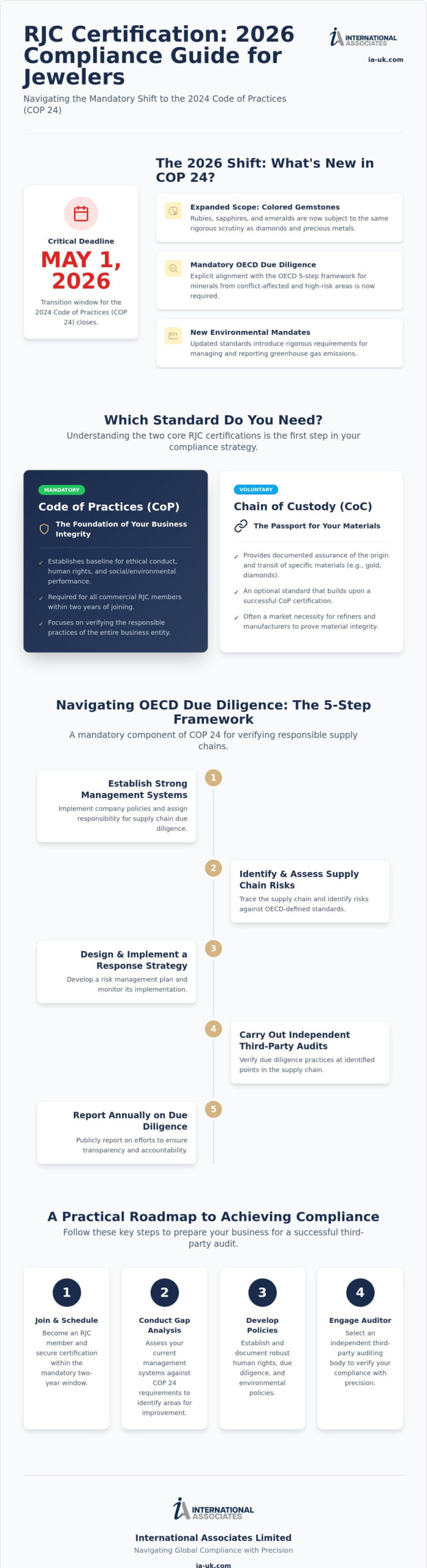
The COP 24 revision introduces mandatory due diligence requirements for colored gemstones, closing a previous gap in the regulatory landscape. This shift ensures that rubies, sapphires, and emeralds are subject to the same level of scrutiny as diamonds and precious metals. These requirements are explicitly aligned with the OECD Due Diligence Guidance for Responsible Supply Chains of Minerals from Conflict-Affected and High-Risk Areas. The OECD 5-step framework requires companies to establish strong management systems, identify and assess risks, design strategies to respond to those risks, carry out independent audits, and report annually on supply chain due diligence. Adhering to these steps is critical for any jeweler seeking to verify the integrity of their gemstone sourcing in the 2026 market.
RJC Code of Practices (CoP) vs. Chain of Custody (CoC): Which Standard Do You Need?
Deciding between the mandatory Code of Practices (CoP) and the voluntary Chain of Custody (CoC) requires a precise assessment of your position in the supply chain and your commercial objectives. The rjc certification requirements for jewelers begin with the CoP, which serves as the universal baseline for all members. It establishes the essential management systems for ethical conduct, human rights, and social performance. Conversely, the CoC standard is a specialized certification for firms that wish to provide documentable assurance regarding the origin and transit of specific materials. While the CoP focuses on the integrity of the business entity, the CoC focuses on the integrity of the material itself.
These standards are designed to work in tandem. The CoC builds upon the administrative and social foundations verified during a CoP audit. For a refiner or a manufacturer handling high volumes of gold or diamonds, CoC certification is often a market necessity to prove material integrity. For a retailer, the CoP might suffice to meet basic brand expectations, though many are moving toward CoC to satisfy consumer demand for full traceability. You can review how industry leaders manage these overlapping expectations in Richemont’s sustainability reporting, which details their reliance on these frameworks to maintain global trust.
Core Requirements of the 2026 Code of Practices
The 2024 revision, which governs all 2026 audits, mandates rigorous protocols for legal compliance and business ethics. This includes active measures to prevent money laundering and bribery. Social performance requirements have been strengthened, focusing on labor rights, occupational health and safety, and gender equality within the workshop environment. Environmental management remains a pillar, requiring verified procedures for the handling of waste, water, and chemicals. These foundational elements ensure that every certified member operates with institutional reliability across all global offices. Ensuring your documentation meets these high-stakes requirements is a complex process. Our team provides independent social accountability audits to help you verify these standards across your international operations.
Chain of Custody (CoC): Achieving Full Traceability
CoC 2026 protocols define ‘Conflict-Free’ and ‘Responsibly Sourced’ through strict, evidence-based criteria. To achieve this, companies must track ‘Eligible Materials’ throughout the production cycle, from receipt to final sale. This requires a meticulous transfer of documents at every stage of the journey. The objective is to ensure the paper trail remains unbroken. If a single link in the chain lacks certification, the CoC claim for that specific item is voided. This level of scrutiny provides the ultimate assurance to the end consumer and protects the brand from upstream reputational risks.
- Eligible Materials: Only materials sourced from RJC-certified mines or recycled sources can enter the CoC.
- Internal Controls: Companies must implement robust inventory management to prevent the mixing of certified and non-certified materials.
- Outsourced Processing: Contractors must also meet specific RJC standards to maintain the chain’s integrity.
RJC vs. Other Social Compliance Frameworks: SA8000 and SEDEX
Selecting the most appropriate compliance framework depends on your specific market position and the breadth of your product offerings. While the rjc certification requirements for jewelers are uniquely tailored to the precious metals and gemstone sectors, other standards like SA8000 and SEDEX provide alternative pathways for demonstrating ethical integrity. The RJC framework is widely considered the most comprehensive for the jewelry industry because it addresses sector-specific risks, such as gemstone provenance and precious metal refining, that broader standards might overlook. This focused approach is recognized by the UN Department of Economic and Social Affairs on RJC, which highlights its role as a leader in aligning jewelry supply chains with global sustainability goals.
Our auditors manage an expansive network of international offices to ensure that your rjc certification requirements for jewelers are met with consistent rigor across all manufacturing locations. Integrated audits often yield significant efficiency gains for businesses operating across multiple jurisdictions. For instance, a firm already maintaining a management system certification like ISO 9001 will find the documentation requirements for RJC more familiar than those of less structured platforms. In the European market, RJC certification is frequently the preferred credential for high-end luxury contracts, whereas US-based retailers may accept a wider variety of social compliance reports.
RJC vs. SA8000 for Jewelry Manufacturers
The primary distinction between these frameworks lies in their scope and technical focus. SA8000 is a dedicated social accountability standard that focuses intensely on labor rights and workshop conditions. Manufacturers often choose SA8000 social accountability audits when their primary goal is to verify the ethical treatment of workers across diverse product lines. However, the RJC includes these labor protections while adding essential layers of environmental management and supply chain due diligence. If your facility already meets ISO 14001 standards, the environmental components of the RJC will be easier to satisfy. For a more granular look at these differences, you can consult our SA8000 vs SEDEX comparison to understand how labor-focused audits differ from broader supply chain verifications.
SEDEX/SMETA: The Alternative for Multi-Sector Suppliers
SEDEX is a membership organization that facilitates the sharing of ethical data through the SMETA audit protocol. It’s often the preferred choice for fashion-focused jewelry brands that also produce apparel or accessories, as many department stores utilize SEDEX across all categories. While a SMETA 4-pillar audit covers labor, health and safety, environment, and business ethics, it lacks the specific gemstone due diligence found in the RJC. Cross-recognition is an evolving area; as of 2026, some retailers may accept an RJC audit as evidence of compliance for SEDEX-linked platforms, but this typically requires specific mapping of audit results to ensure all SMETA pillars are addressed. Choosing the right framework involves balancing these cross-recognition benefits against the depth of industry-specific verification required by your Tier 1 clients. Suppliers operating across both jewelry and apparel categories may also benefit from understanding how to prepare for a Higg FEM audit, as the environmental evidence standards demanded in that verification cycle share important parallels with the documentation rigor now required under COP 24.
A Practical Roadmap to Achieving RJC Compliance
Achieving certification requires a transition from informal practices to a structured, auditable management system. The rjc certification requirements for jewelers demand a methodical approach that starts long before the third-party auditor arrives on site. This process isn’t merely a paperwork exercise; it’s a fundamental alignment of your operational protocols with international ethical standards. By following a logical sequence of preparation, organizations can minimize friction during the formal assessment and ensure a successful outcome.
The first stage involves a comprehensive self-assessment. You must conduct a gap analysis to identify where your current procedures fall short of the 2024 Code of Practices. If your business already maintains a management system certification, such as ISO 9001, you’ll have a significant advantage in documenting these processes. Following this, you must develop formal policies that explicitly address human rights due diligence and environmental impact. These documents serve as the institutional record of your commitment to responsible sourcing and ethical labor practices.
Once policies are established, internal training is necessary to ensure every staff member understands their role in maintaining the Code of Practices. This is followed by the selection of an accredited, independent auditor to verify your compliance. The final audit involves an on-site review of your facilities and documentation. If non-conformities are identified, you’ll have a specific window to implement corrective actions. To ensure your facility is prepared for this level of scrutiny, you may schedule your social accountability audit with our global team of experts.
Common Pitfalls During the RJC Audit
Auditors frequently encounter inadequate provenance claims, particularly regarding the origin of recycled gold or diamonds. Without a verified paper trail, these materials cannot enter a Chain of Custody system. Small-scale jewelry workshops often struggle with health and safety gaps, such as improper chemical storage or lack of emergency exit protocols. The most common non-conformity in 2026 audits is the lack of a formal risk assessment. Failure to document potential supply chain risks according to OECD guidelines remains a primary reason for audit delays.
Timeline and Maintenance of Certification
The duration from your initial membership application to receiving a final certificate typically ranges from 6 to 12 months. This timeline depends on the complexity of your supply chain and the maturity of your existing management systems. Once achieved, the certification operates on a three-year cycle. Surveillance audits are conducted during this period to ensure continued adherence to the standards. Preparations for re-certification should begin at least six months before the expiration date to avoid any lapse in your certified status.
Navigating Global Compliance with International Associates
International Associates provides the specialized expertise required to verify rjc certification requirements for jewelers across the global supply chain. Our teams deliver independent social accountability audits that ensure your business meets the rigorous 2024 Code of Practices. We maintain a methodical approach to the assessment process, focusing on the identification of regulatory gaps while minimizing operational friction. This disciplined methodology is essential for businesses seeking to demonstrate institutional reliability to high-stakes stakeholders and luxury retailers.
Our global reach is supported by an expansive network of international offices situated in major jewelry hubs across Europe, Asia, and the Middle East. This global-local duality allows us to provide auditors who possess deep knowledge of regional legal frameworks while adhering to uniform international standards. Beyond RJC verification, we assist organizations in achieving a truly integrated management system. By aligning your social accountability goals with ISO standards for quality, environment, and safety, you create a robust structure for sustainable international growth and long-term risk mitigation.
Why Partner with an Independent Certification Body?
Ensuring impartial verification is the cornerstone of building trust with global investors and Tier 1 partners. We utilize an advanced IT infrastructure that facilitates efficient audit reporting and ensures a predictable turnaround for certification certificates. This technological capability reduces administrative delays and provides your management team with clear, actionable data. Additionally, we provide access to professional development through our accredited courses, which enable your staff to serve as competent internal auditors and maintain compliance between formal assessments.
Ready to Secure Your Supply Chain?
Organizations can request a technical documentation review prior to their formal audit to identify potential non-conformities in a lower-stakes environment. Given the rapid shifts in the legislative landscape, maintaining strict regulatory compliance is no longer optional for those operating in the jewelry sector. Our experts act as a sophisticated bridge between these complex regulations and your business operations. Contact International Associates to discuss your specific roadmap for meeting rjc certification requirements for jewelers and securing your position in the 2026 market.
Securing Your Position in the 2026 Jewelry Market
Adhering to the 2024 Code of Practices is no longer a secondary consideration for businesses seeking to maintain Tier 1 supplier status. Successfully navigating the rjc certification requirements for jewelers requires a shift from reactive paperwork to proactive risk management. By establishing a clear roadmap that includes thorough self-assessment and the implementation of OECD-aligned due diligence, your organization can verify its ethical integrity with absolute precision. This strategic alignment not only satisfies current retailer mandates but also prepares your business for the increasingly rigorous global ESG landscape.
International Associates operates as a UKAS accredited certification body with a global network of auditors across Europe, Asia, and the Middle East. Our deep expertise in SA8000, RJC, and ISO standards ensures that your verification process is conducted with institutional reliability and technical accuracy. We invite you to Contact International Associates today for an independent RJC compliance assessment. Taking these methodical steps now will provide the stability and confidence your brand needs to thrive in a transparent international marketplace.
Frequently Asked Questions
What is the difference between RJC and SEDEX for jewelers?
RJC is a sector-specific certification standard, whereas SEDEX is a membership platform for sharing ethical supply chain data. While SEDEX utilizes the SMETA audit protocol across multiple industries, the RJC provides a specialized certification that includes technical due diligence for precious materials. This makes RJC the preferred choice for Tier 1 jewelry suppliers who require verification of gemstone provenance and precious metal refining standards.
How much does RJC certification cost for a small jewelry business?
RJC membership fees for businesses with annual relevant sales under $2,599,999 are set at $845 as of July 2026. This administrative fee is separate from the cost of the mandatory third-party audit, which is determined by the size and location of your facilities. Small businesses must account for both the membership fee and the triennial audit expenses to satisfy the rjc certification requirements for jewelers.
Is RJC certification mandatory for selling to major luxury brands in 2026?
Major luxury houses have established 2026 as a critical deadline for all Tier 1 vendors to achieve certified status. Although it is not a universal legal requirement, certification has become a commercial prerequisite for maintaining contracts with global luxury groups. Failure to secure this credential often results in immediate disqualification from these high-stakes supply chains and retail partnerships.
How long does it take to become an RJC certified member?
The process typically requires 6 to 12 months for new applicants to move from membership to full certification. This duration includes the initial application phase, the mandatory self-assessment, and the scheduling of the final third-party audit. The timeline is largely dependent on the maturity of your existing management systems and the complexity of your upstream supply chain documentation.
Does RJC certification cover lab-grown diamonds?
Yes, the 2024 Code of Practices includes specific requirements for laboratory-grown materials (LGMS) to ensure transparency and ethical production. Members dealing in LGMS who were certified to previous standards must complete a combined COP 2024 and LGMS audit by May 1, 2026. This ensures that the same social and environmental benchmarks applied to mined diamonds are maintained within the lab-grown sector.
What happens if I fail an RJC audit?
Failing to meet a specific standard results in a non-conformity, which requires the implementation of a formal corrective action plan. Minor non-conformities allow for a specific window to address the issue without losing certification eligibility. However, critical breaches involving human rights or business ethics can lead to immediate membership suspension or termination, depending on the severity of the findings.
Can I use my ISO 9001 certification to fast-track RJC compliance?
Existing ISO 9001 certification provides a strong administrative foundation but does not grant automatic compliance with RJC standards. While ISO 9001 focuses on quality management, the rjc certification requirements for jewelers include specific ethical, social, and environmental mandates. Your current ISO documentation will significantly streamline the audit process by providing established management system structures that align with RJC expectations.
What are the specific due diligence requirements for colored gemstones in 2026?
The 2024 Code of Practices mandates that rubies, sapphires, and emeralds are now subject to the same OECD-aligned due diligence as diamonds and gold. Jewelers must establish a five-step framework to identify and assess risks within their colored gemstone supply chains. This includes establishing strong management systems, verifying material provenance, and reporting on these due diligence efforts annually to maintain their certified status.