

A responsible-sourcing claim is only as useful as the material trail behind it. RJC chain of custody certification is voluntary and applies to gold and platinum group metals, including platinum, palladium and rhodium.
For businesses handling these materials, eligibility depends on more than the metal itself: an applicant must be an RJC member in good standing and hold Code of Practices certification to a standard from 2019 or later. The chain-of-custody requirements then focus on tracking eligible material and documenting its transfer through the supply chain.
This guide explains which members and materials can qualify, how mined, recycled and legacy materials are treated, and what the certification process involves. It also sets out the key implementation dates, including when the 2024 RJC standards took effect and when audits against earlier standards ceased, subject to stated exceptions. Use these details to assess whether the certification fits your sourcing activities and identify the requirements to address before an audit.
Key Takeaways
- Understand how supporting information and transfer records help substantiate responsible-sourcing claims across a supply chain.
- Identify the membership, Code of Practices certification and audit steps relevant to a Chain of Custody application.
- Compare mined, recycled and legacy material categories to assess how they may fit the standard.
- See which implementation dates may affect audits and materials handled by your business.
- Determine whether your supply-chain role and material scope align with the metals covered by the standard.
Responsible Sourcing and Supply-Chain Traceability in Jewellery
In jewellery and watch supply chains, a responsible-sourcing claim needs evidence that connects material to its origin and handling. The Chain-of-Custody Standard for precious metals was launched to support claims about materials produced, processed, and traded through the supply chain.
Responsibly sourced material is defined as conflict-free at a minimum and responsibly produced at every supply-chain step. This commitment depends on traceability, not just a supplier’s statement. For example, records should link incoming metal to its processing, storage and onward transfer, so each business can support its claims about the material.
Transfer documentation is a practical part of that trail. Provision 9.1 requires a chain-of-custody transfer document to accompany or be digitally linked to each shipment or transfer of chain-of-custody material. Provision 10.2 requires members making consumer claims to make supporting details available at the point of sale, on their website, or through another public communication medium.
An unsuccessful Chain-of-Custody audit means the organisation has not demonstrated conformance, leaving its certification status unresolved. Claims that rely on certified status may then lack supporting evidence. Audit findings are reviewed and reported, and certification status is determined after receiving the verification provider’s Statement of Conformance.
To verify a company’s certification, look up its member details and unique certification number in publicly available information. Then confirm the relevant certification status and scope. The number identifies the member, while the status shows whether a claim is supported.
Traceability also relies on systems that consistently preserve records and assign responsibilities across operations. A structured management system certification approach can help organisations assess how procedures, documentation, and oversight support their wider commitments.
RJC Chain of Custody Certification Requirements for Commercial Members
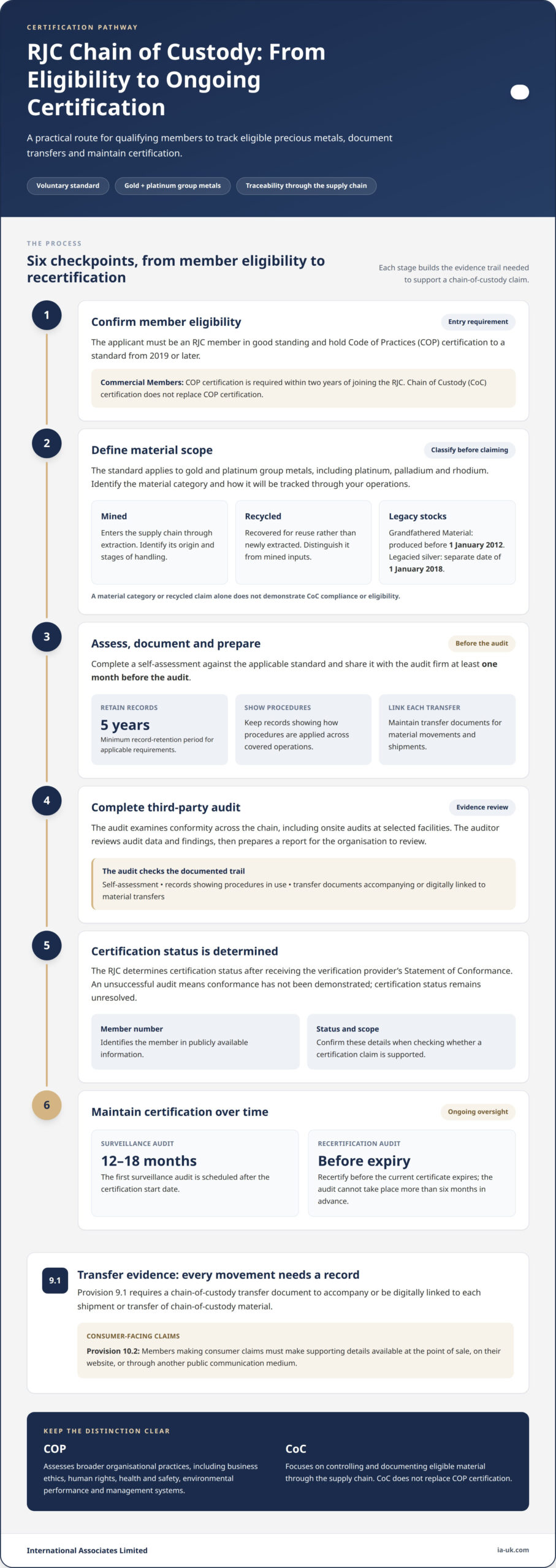
Commercial Members must meet the RJC Code of Practices (COP) requirements before seeking Chain of Custody (CoC) certification. They must obtain COP certification within two years of joining the RJC. A CoC applicant must be an RJC member in good standing and hold COP certification to a standard from 2019 or later.
The two standards address different parts of the RJC framework. COP certification assesses an organisation’s broader practices, including business ethics, human rights, health and safety, environmental performance and management systems. The CoC Standard focuses on controlling and documenting eligible material through the supply chain. CoC certification does not replace COP certification.
Begin preparation with a self-assessment against the applicable standard. Applicants must share their completed self-assessment with the audit firm at least one month before the audit. This gives the auditor a structured basis for planning and assessing how the organisation applies the requirements across its operations.
Records must support evidence of conformity. Entities covered by the CoC Standard must retain records for applicable requirements for a minimum of five years. Relevant audit documents include the completed self-assessment, records showing how procedures are applied, and chain-of-custody transfer documents accompanying or digitally linked to material transfers.
Third-party auditing examines conformity across the chain, including onsite audits at selected facilities. The auditor reviews audit data and findings, then prepares a report for the organisation to review. The RJC determines certification status after receiving the verification provider’s Statement of Conformance.
Certification also involves continued oversight. A surveillance audit is required during the certification period, with the first scheduled 12-18 months after the certification start date. Recertification must occur before the current certificate expires, and its audit cannot take place more than six months in advance. These checkpoints help assess whether the organisation continues meeting the applicable CoC requirements.
Eligible Mined, Recycled, and Legacy Materials: A Comparison
Material category affects how a business assesses eligibility under the RJC Chain-of-Custody Standard. Distinguish mined, recycled and legacy material before making a certification claim. The practical question is whether the material fits a recognised category and can be handled within the documented chain of custody.
Mined material enters the supply chain through extraction. A business handling mined metal should identify its origin and the stages it passes through. For example, a processor receiving mined gold needs a clear process for separating and tracking that input during its operations. The category describes the material’s origin, but does not by itself demonstrate compliance.
Recycled material comes from material recovered for reuse rather than newly extracted. The organisation needs to distinguish recycled inputs from mined inputs when receiving, processing, storing and transferring material. This helps maintain a clear account of what enters a product or shipment. A recycled claim alone does not prove Chain-of-Custody eligibility.
Legacy material has a specific historical threshold in the standard. Grandfathered Material is defined as existing stocks produced before 1 January 2012. Legacied silver has a separate date: 1 January 2018. These dates matter when classifying older stock; they should not be swapped or applied to other materials without support from the standard.
- Mined: classify the input by its extraction origin, then track its handling through relevant operations.
- Recycled: distinguish recovered inputs from newly mined material throughout processing and transfer.
- Grandfathered: assess whether existing stock was produced before 1 January 2012.
- Legacied silver: apply the specified 1 January 2018 date when assessing this category.
In a mine-to-retail chain, every handoff can affect how material is identified and represented. Separate categories at intake, then track each stream through processing and onward transfers. If stock combines categories, procedures should preserve the distinction rather than assume the entire batch qualifies. This helps identify classification decisions to resolve before making a responsible-sourcing claim.
RJC Chain of Custody Certification Implementation Dates
The applicable standard depends on the audit date and the member’s certification history. The 2024 RJC Code of Practices and Chain of Custody standards became effective on 1 January 2025. From 1 January 2026, audits against the 2019 Code of Practices and 2017 Chain of Custody Standard can no longer be conducted, subject to stated exceptions.
A separate process update followed on 1 July 2025, when the new RJC Member Certification Handbook and Certification Process Requirements for Certification Bodies and Auditors became effective. These dates concern different documents: the standards define requirements, while the handbook and process requirements govern certification procedures.
Laboratory-grown materials have additional transition dates. Members last certified to COP 2019 before 1 January 2024, and dealing in laboratory-grown materials, must complete a combined COP 2024/LGMS audit by 1 May 2026. Members last certified to COP 2019 after 1 January 2024, and dealing in those materials, must complete the combined audit by 31 December 2026.
For processed materials, map the applicable standard to the material and the member’s audit history. A company processing laboratory-grown materials should distinguish that activity from other material streams, then establish which transition date applies. Processing does not remove the need to follow the relevant standard or audit requirements.
No single certification completion period is stated here. Timing depends on preparation, audit scope and any findings that need resolution. A CoC certificate is dated to expire with the member’s COP certificate, even when its term is less than three years. Recertification audits must take place before expiry and no more than six months in advance.
These dates also matter when planning surveillance and recertification. Align the audit schedule with the applicable standard version, COP certificate expiry and any laboratory-grown materials transition. This helps ensure a processed-material operation is assessed against the appropriate audit basis.
Precious Metals Covered by RJC Chain of Custody Certification
The RJC Chain-of-Custody Standard covers gold and platinum group metals (PGMs), including platinum, palladium and rhodium. A business handling these metals should identify which materials it sources and traces, then distinguish covered metals from other substances in the same product or process.
This scope is narrower than the range of materials addressed across RJC standards generally. Diamonds and coloured gemstones appear within broader RJC certification standards, but diamonds were excluded from the 2012 CoC Standard pending further industry consultation. A diamond supply-chain claim therefore should not be treated as a CoC claim under that standard.
- Gold: within the CoC material scope, including gold handled through relevant supply-chain stages.
- Platinum: covered as a platinum group metal.
- Palladium: covered as a platinum group metal.
- Rhodium: covered as a platinum group metal.
- Diamonds and coloured gemstones: not included in the CoC Standard’s stated metal scope.
Other metals used in alloys, plating or coatings fall outside the stated scope. For example, if a gold item includes another metal in an alloy, do not automatically present both metals as equally covered. The same distinction applies to a precious-metal coating over a different base material. Assess scope for the specific sourced material, rather than inferring it from the finished item’s appearance.
For a practical assessment, map each input to its material identity and role. Separate gold, platinum, palladium and rhodium from non-covered metals in purchasing, processing and transfer records. This helps ensure a claim about a covered metal does not imply that an entire alloy, coating or gemstone is also within scope.
The deciding factor is the material named by the standard, not the product category sold to customers. A jewellery or watch business—such as Atoz Watch And Jewellery Repairs handling fine timepieces and precious metals—may work with several material types, but its CoC claim should stay within the gold and PGM scope. This makes clear which sourced materials can be represented through Chain-of-Custody certification and which need another basis for a responsible-sourcing claim.
How to Choose an RJC Chain of Custody Certification Pathway
Start with the sourcing claim your organisation needs to support. Identify the customer, product or transaction it relates to, then define where your responsibility begins and ends. A manufacturer selling finished jewellery may need a different operational boundary from a trader transferring material between suppliers and buyers.
Next, map the material’s actual flow through your business. Record which teams receive, handle, process, store or transfer it, and identify where responsibility passes between parties. Include outsourced activities and sites when they affect material control. This shows which operational areas an audit plan needs to address.
- Claim purpose: determine which customer-facing or business-to-business statement the certification must support.
- Supply-chain role: identify the operations and handoffs your organisation controls.
- Implementation readiness: assess whether responsibilities and material-handling processes are applied consistently.
Consider how your operation distinguishes material flows in daily work. For example, receiving, production and dispatch teams should use compatible identification and handover practices. Include any process that changes the material’s form or transfers responsibility in the operating map. This helps prevent gaps between written procedures and staff practice.
Readiness also depends on accountability. Identify who maintains operational records, approves procedural changes and resolves inconsistencies between sites or teams. If several locations or business units handle the same flow, establish how decisions and records stay aligned. These steps help define a workable assessment scope limited to activities relevant to the intended claim.
Finally, match the pathway to the organisation’s scale and operating model. A business with a straightforward flow can focus on controls for its own activities and handoffs. A business with multiple sites, processors or transfer points should account for those interfaces when planning implementation. The right pathway connects the intended claim to clear responsibilities, consistent processes and evidence across actual operations.
International Associates Limited
International Associates Limited provides independent assessment and certification services for organisations managing assurance requirements across their operations. If your RJC planning has highlighted wider social or management-system priorities, its relevant services include Social Accountability Audits and certification to ISO 9001, ISO 14001, and ISO 45001.
These services address distinct areas of organisational performance. A Social Accountability Audit focuses on social accountability, while ISO 9001, ISO 14001, and ISO 45001 address quality, environmental management, and occupational health and safety respectively. They are separate from the RJC Chain-of-Custody Standard, so they should be considered according to the specific assurance need they address.
For example, a jewellery business reviewing its social accountability controls may consider a Social Accountability Audit. An organisation assessing its environmental management system may consider ISO 14001 certification. These assessments can support broader oversight, but they do not establish that a particular metal is eligible for RJC chain-of-custody claims or replace the RJC’s applicable requirements.
The practical next step is to define what your organisation needs assessed. Identify whether the priority is social accountability, quality management, environmental management or occupational health and safety. Then determine which sites, activities and management-system processes fall within the assessment. A clear scope helps align the selected service with operational needs without confusing separate certification frameworks.
International Associates Limited’s Social Accountability Audits may be relevant where social accountability is a defined priority. For quality, environmental, or occupational health and safety systems, the corresponding ISO certification provides a distinct route for independent assessment. Selecting among these services depends on the management area requiring evaluation, not solely on a company’s interest in responsible sourcing.
If you are considering a relevant audit or certification service, contact International Associates Limited to discuss your organisation’s requirements.
Frequently Asked Questions
What is RJC Chain of Custody (CoC) certification?
RJC chain of custody certification gives eligible material a documented identity as it moves between participating businesses. Its practical value is that a sourcing statement can be linked to the material and the stages it covers, rather than interpreted as a claim about every feature of a finished item. Define precisely what a customer-facing statement refers to before using it.
What are the RJC Chain of Custody standard requirements?
Requirements are assessed against the applicable RJC standard, so preparation should begin with the correct version and an understanding of the organisation’s activities. The RJC supports implementation of its Code of Practices with Standards Guidance, an Assessment Manual, and tools and training. These resources can help teams interpret requirements consistently and prepare evidence for assessment, especially when several departments handle different parts of a material flow.
Which metals and materials are covered by RJC CoC certification?
The Chain of Custody material scope includes gold and platinum group metals, including platinum, palladium and rhodium. A mixed-material product therefore needs a carefully bounded claim: coverage of a qualifying metal does not automatically include every component. Describe the material to which the claim applies rather than relying on a broad product label such as “jewellery” or “watch.”
Who is eligible to apply for RJC CoC certification?
Eligibility applies to an organisation seeking certification, not automatically to every supplier in its network. The applicant must be an RJC member in good standing and have Code of Practices certification to a standard from 2019 or later. A business can use this distinction when deciding whether it needs certification for its own operations or instead needs to understand how certified material reaches it.
How does a business get RJC CoC certified, step by step?
For RJC chain of custody certification, start by defining the business activities and material flows covered by the intended claim. Complete the applicable self-assessment, provide it to the audit firm within the required timeframe, and prepare relevant sites for independent assessment. After the audit, address any findings through the applicable process. The RJC determines certification status after receiving the verification provider’s Statement of Conformance.