

Which root cause analysis technique should you use when an audit finding has several possible explanations? Choose a method that fits the evidence, complexity and scope of the issue. Applying root cause analysis techniques for audits carefully helps prevent corrective actions from addressing only a symptom, while keeping conclusions grounded in verifiable facts rather than assumptions.
A sound investigation distinguishes a correction, which resolves the immediate problem, from corrective action, which addresses its underlying cause and helps prevent recurrence. The reasoning should be traceable from the audit evidence to the identified cause and proposed action.
This guide explains how to select and apply practical methods, including the 5 Whys, fishbone diagrams and Pareto charts, based on the finding and evidence available. It also shows how to document the analysis and connect it to non-conformity handling. For minor non-conformities, a Root Cause Analysis and Corrective Action Plan are required within a defined timeframe. Major non-conformities must be addressed and verified before certification can proceed.
Key Takeaways
- Match the investigation method to the finding’s complexity, recurrence, available data and interacting factors.
- Use root cause analysis techniques for audits to structure your reasoning, not as substitutes for evidence or professional judgement.
- Compare the 5 Whys, fishbone diagrams, fault tree analysis and Pareto analysis to identify which approach best fits the issue.
- Keep the investigation within the audit criteria and available evidence, then document how the supported cause informs the proposed action.
- Understand how finding classification affects the steps that follow in the audit and certification process.
Why root cause analysis matters for audit findings
Correcting an observed failure can restore the immediate situation while leaving the condition that allowed it to happen unchanged. If that underlying cause remains, the issue may recur. A corrective action that addresses only the visible symptom may therefore leave the process weakness in place.
Audit-focused root cause analysis (RCA) is a structured investigation that links an audit finding to a cause supported by relevant evidence. Put simply: A symptom describes what went wrong; a root cause explains, with evidence, why it happened. RCA is not a search for someone to blame or a collection of possible explanations. It gives the organisation a reasoned basis for choosing an action proportionate to the finding.
For a broader overview of the method and its applications, see Root Cause Analysis on Wikipedia. In an audit, the analysis must remain tied to the applicable criteria and evidence for the specific finding. The goal is to make the reasoning traceable, not to present a plausible explanation as certain.
How an audit finding differs from its root cause
Consider a neutral example: a record expected as part of an audit sample cannot be located. The condition is the missing record; the evidence may include the sample, relevant files and what was observed during the audit. Personnel might explain that the record was misplaced, stored elsewhere or not created. These explanations are leads to investigate, not established causes.
More than one factor may have contributed. The record might not have been created because responsibilities were unclear. Alternatively, it might exist but be difficult to retrieve because of how records are organised. The evidence must help distinguish between these possibilities. This distinction also applies in social accountability audits, where the observed condition should be kept separate from assumptions about how it arose.
What a useful root cause analysis should establish
A credible cause is supported by relevant evidence, such as records, process information, observations or corroborated explanations. It should explain the finding without extending beyond what the investigation establishes. If the evidence supports only a contributing factor, document that limitation rather than presenting an unverified theory as the definitive cause.
The proposed corrective action should address the supported cause and be proportionate to the finding. Replacing a missing record may correct the immediate condition, but it does not necessarily explain why the record was unavailable. Set the scope and depth of RCA according to the nature and complexity of the finding and the evidence that can reasonably be examined. This keeps the response focused, defensible and connected to what the investigation shows.
Root cause analysis techniques for audits: four methods to know
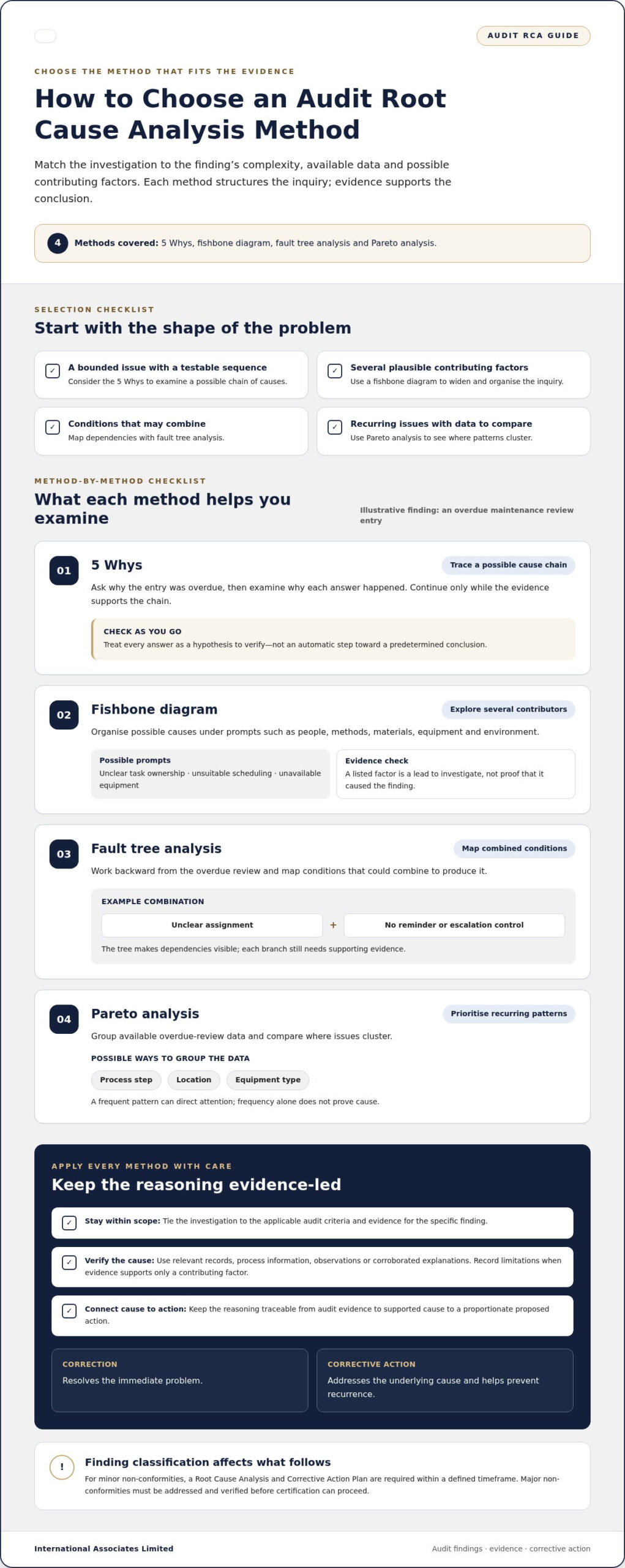
Four methods can structure an investigation, but they answer different questions. The 5 Whys traces a possible causal chain, a fishbone diagram broadens the search for contributing factors, fault tree analysis maps combinations of conditions, and Pareto analysis helps prioritise recurring patterns. The most suitable of these root cause analysis techniques for audits depends on the finding, available evidence and number of factors that may be involved.
Hypothetical finding used throughout: sampled maintenance records show that a review entry was overdue against the organisation’s own documented process. This example is illustrative and does not imply a requirement under any particular standard.
- 5 Whys: Ask why the entry was overdue, then test each answer by asking why it happened. For example, the review was late because it was not completed on schedule. The next question examines why the schedule was missed. Continue only while the evidence supports the chain. Treat each answer as a hypothesis to verify, not as an automatic step towards a predetermined conclusion.
- Fishbone diagram: Organise possible contributors under prompts such as people, methods, materials, equipment and environment. For the overdue review, prompts might include unclear task ownership, an unsuitable scheduling process or unavailable equipment. These categories help widen the inquiry; listing a factor does not prove it caused the finding.
- Fault tree analysis: Work backward from the overdue review and map the conditions that could combine to produce it. A missed schedule might involve both an unclear assignment and the absence of a reminder or escalation control. The tree makes dependencies visible, but each branch still needs supporting evidence.
- Pareto analysis: Group available overdue-review data by pattern, such as process step, location or equipment type, then compare where issues cluster. In an independent audit and certification context, including work undertaken by International Associates Limited, this can help direct attention to a recurring pattern without treating frequency as proof of cause.
5 Whys and fishbone analysis for tracing contributing causes
Use the 5 Whys when the issue appears bounded and a clear sequence can be tested. Choose a fishbone diagram when several plausible contributors need to be considered together. Neither method should stop at “an employee missed it.” Examine whether responsibilities, process design or controls contributed, then check each relevant explanation against records, observations or other available evidence.
Fault tree and Pareto analysis for complex or recurring issues
Fault trees suit findings where conditions may interact. Pareto analysis is useful when enough comparable issue data exists to reveal patterns. Prioritisation tells the team where to investigate first, not what caused the issue. Even when issues cluster in one process area, examine that process and its evidence before concluding that it was causal.
Choose a simple method for a bounded issue with a testable causal chain; use a structured method when causes interact or recurring data needs to be organised. All four approaches support reasoning, but they do not replace professional judgement or evidence. Their value is in making the investigation clearer and more traceable. For professionals developing audit skills, Lead Auditor Training provides a relevant next step.
How to choose the right audit RCA technique
Choose a method by identifying what the investigation needs to clarify: a direct causal sequence, a range of possible contributors, interacting conditions or patterns across repeated issues. The decision depends on causal complexity, recurrence, available evidence and the number of factors involved. You can also combine methods: use Pareto analysis to identify a recurring pattern, then apply a fishbone diagram or fault tree to examine possible causes.
The comparison below is a starting point, not a ranking. Each method organises the inquiry differently, and none is conclusive on its own.
5 Whys
Purpose: Trace a relatively direct causal chain.
Suitable conditions: A bounded finding with a sequence that can be tested.
Evidence needs: Records, observations or corroborated explanations at each step.
Limitation: Can oversimplify a problem with multiple contributors.
Fishbone analysis
Purpose: Organise plausible causes into categories for investigation.
Suitable conditions: Several potential contributors need to be considered.
Evidence needs: Information to assess each relevant factor.
Limitation: A listed possibility is not proof that it contributed.
Fault tree analysis
Purpose: Map combinations of conditions that could lead to an undesired outcome.
Suitable conditions: Interacting causes or dependencies require structured review.
Evidence needs: Information to test the conditions and links in the tree.
Limitation: The map can become complex and still requires verification.
Pareto analysis
Purpose: Prioritise patterns across available issue data.
Suitable conditions: Comparable records show repeated or clustered issues.
Evidence needs: Consistent data that can be grouped and compared.
Limitation: Frequency can guide attention, but does not establish cause.
Match the technique to the finding and evidence
Use the 5 Whys when the finding appears to follow a traceable sequence, and test every answer rather than accepting the first plausible explanation. Choose fishbone analysis when the team needs to consider multiple categories without assuming which one matters. For interacting conditions, fault tree analysis can make dependencies explicit. When issue data shows recurrence, Pareto analysis can help identify where further investigation may be most useful.
Combining methods can be proportionate. For example, a pattern identified through Pareto analysis may warrant a fault tree if records suggest that several conditions interact. Keep the second method focused on testing causes rather than expanding the investigation without a clear purpose.
Recognise common method-selection errors
Stopping at the first credible-sounding explanation risks confusing a hypothesis with a supported cause. A crowded fishbone diagram is not stronger evidence simply because it contains more possible factors. Likewise, a high-frequency category in a Pareto review indicates where to investigate, not what caused the issue. Document why selected causes are supported and why other plausible explanations were excluded or remain unresolved. This disciplined use of root cause analysis techniques for audits keeps the method proportionate to the evidence and finding.
How to apply root cause analysis to an audit finding
A defensible investigation shows a clear line from the audit criterion and observed condition to the evidence, supported cause and proposed action. Use this workflow to make the reasoning visible without drawing conclusions beyond the scope of the finding.
- Define the finding. State the applicable audit criterion, the condition observed and the evidence that supports the finding. Keep the wording factual and specific.
- Gather relevant evidence. Identify the records, observations, process information and personnel explanations that relate directly to the condition. Note any gaps that limit what can be concluded.
- Separate facts from hypotheses. Record confirmed information, possible explanations that require verification and unanswered questions distinctly. This prevents an initial assumption from becoming the accepted cause without examination.
- Test plausible causes. Use an appropriate method to compare potential causes with supporting and contradictory evidence. Consider relevant process or control factors as well as individual actions.
- Document the reasoning. Explain why the selected cause is supported, how it relates to the finding and whether material uncertainty remains. Where relevant, record why other plausible explanations were not adopted.
- Propose and review action. Link the corrective action to the supported cause, identify how implementation will be assessed and define how effectiveness will be evaluated. Keep the action proportionate to the finding and applicable audit criteria.
From audit evidence to a tested cause
For example, suppose an audit observes that a completed process check does not match the documented result. The mismatch is the finding’s condition; the relevant record and observation are evidence. A claim that the check was misunderstood is a hypothesis until supported. Compare it with other records, process instructions or corroborated explanations, and document evidence that supports or contradicts each plausible cause.
A defensible audit response links the observed condition to evidence, the evidence to a supported cause, and that cause to a proportionate corrective action. This evidence-to-cause-to-action chain is central to a sound investigation. Root cause analysis techniques for audits can organise the inquiry, but they cannot establish a conclusion independently of the evidence.
Translate the cause into a corrective action plan
Distinguish correction from corrective action. If a process check was recorded inaccurately, correcting that entry addresses the instance. If evidence shows that an unclear instruction caused the error, an action that clarifies and communicates the process addresses the identified cause. The organisation should define how it will verify implementation and assess whether the action has addressed the cause. Completion alone does not demonstrate effectiveness.
Make the proposed action specific enough to assess, and ensure its scope follows from the finding rather than from untested possibilities. For organisations considering certification, explore management system certification as part of an independent audit and certification process.
How RCA connects to audit non-conformities and certification
Root cause analysis turns a non-conformity from a recorded finding into a reasoned response. The technique alone does not determine the outcome: the cause must be supported, and the proposed Corrective Action Plan (CAP) must respond to it. The finding’s classification also affects what must happen before certification can proceed.
What happens after RCA identifies a non-conformity cause
For a minor non-conformity, International Associates Limited requires a Root Cause Analysis and CAP within a defined timeframe. The plan should connect the supported cause to the proposed action, rather than simply describe how the immediate instance will be corrected. Certification can proceed once the plan is accepted, subject to the independent certification decision process.
A major non-conformity is handled differently. It prevents immediate certification until corrective actions have been implemented and verified through a desktop review or targeted follow-up audit. Submitting an explanation or plan alone does not meet this requirement. The response must progress through implementation and verification before certification can proceed.
In either case, root cause analysis techniques for audits help organise the investigation, while the classification and applicable audit process guide the next steps. Make the relationship between the finding, cause and action clear enough to assess. Also distinguish immediate correction from measures intended to address the cause, so the response does not stop at resolving the visible instance.
Connect audit findings to the applicable audit service
The audit context determines which criteria are being assessed. For example, a social compliance finding must be considered against the applicable social accountability audit criteria, while a management system certification audit follows its relevant certification process. In either context, RCA should remain grounded in the finding and evidence. No single method or action is sufficient in every case.
International Associates Limited’s audit process comprises Stage 1 (Document Review & Readiness), Stage 2 (Operational Audit), and Reporting & Certification. Findings are handled according to their classification, and certification decisions are made independently by an independent certification decision body. This separation supports an impartial decision based on the audit outcome and the status of required actions.
Organisations preparing for a certification audit can explore management system certification as a relevant next step. Effective preparation includes showing how findings were investigated, how actions address supported causes, and how implementation and effectiveness are assessed. This strengthens the evidence trail without implying a particular certification outcome.
Make evidence-led audit readiness your next step
Use the next audit cycle to strengthen how findings are recorded, investigated and followed through. A consistent approach to root cause analysis techniques for audits helps teams make decisions that are traceable to evidence and connect corrective actions to the issues they are intended to address. That discipline supports clearer audit preparation and more considered responses when findings arise.
For organisations assessing their certification pathway, International Associates Limited provides independent audit, certification and assurance services worldwide. Its process moves through Stage 1 (Document Review & Readiness), Stage 2 (Operational Audit), and Reporting & Certification, with certification decisions made independently. Explore independent audit and certification services to discuss your organisation’s next step.
With a clear evidence trail and actions tied to supported causes, your organisation can approach its next audit with greater confidence and focus.
Frequently Asked Questions
What is root cause analysis in an audit?
In an audit, root cause analysis examines why a finding occurred so the response can address the conditions behind it. Keep the investigation focused on the finding: clarify its cause and relevant extent without broadening into an unrelated review of the organisation. Before collecting more information, identify which processes, records or activities are within scope and what question the analysis needs to answer.
Which root cause analysis technique is best for an audit finding?
No method is automatically best. Select root cause analysis techniques for audits according to the question that remains unresolved, not simply because a tool is familiar. As a practical check, ask whether the method can produce an answer that is testable with the information available. If it cannot, refine the investigation question or choose a different approach before building an action plan around the result.
How do auditors use the 5 Whys technique?
Auditors can use the 5 Whys as a written chain, recording each answer alongside the evidence that supports it. If one answer points to two distinct explanations, split the inquiry into separate branches rather than forcing both into one sequence. This makes it easier to see where the reasoning diverges and which line of inquiry has enough support to inform the response.
When should an auditor use a fishbone diagram?
A fishbone diagram is useful in a team discussion when participants need to organise potential lines of inquiry before deciding what to examine. To keep it practical, label each branch as a question to test and identify a relevant source of information. Do not treat the diagram as a list of established causes. This keeps the discussion focused and clarifies the next evidence-gathering step.
Can you use more than one root cause analysis technique for an audit?
Yes, provided each method has a distinct role in the investigation. One tool might help organise observations while another examines a particular causal pathway. Do not treat two outputs as independent confirmation if both rely on the same underlying records or interview. Note which evidence each method used so the analysis remains transparent and does not overstate the strength of the conclusion.
How do you verify that an identified root cause is supported by evidence?
Make the evidence traceable: note its source, relevant date or period, and the specific detail that supports the proposed cause. Where practicable, test whether the explanation fits other relevant instances or whether a comparison reveals a contradiction. Distinguish evidence that shows two conditions occurred together from evidence that demonstrates how one contributed to the other. This helps prevent a pattern or correlation from being treated as a causal link.
What happens if a root cause analysis does not identify the underlying cause?
If the cause remains unresolved, report that limitation plainly rather than assigning a definitive cause without support. Identify what evidence or access is still needed and whether further examination remains within the finding’s scope. Base any response on what is established, keeping uncertainty visible in the analysis and action records. The organisation can continue the investigation through its applicable non-conformity process without presenting an unverified explanation as fact.