
With nearly three million workers globally operating under the SA8000 framework, the transition to the 2026 standard represents a significant shift in how organizations demonstrate social accountability. It’s understandable that the move from the 2014 version to the risk-based management approach of SA8000:2026 causes concern for many compliance officers. The fear of audit failure isn’t just about the certificate; it’s about the potential loss of trust from global partners who demand rigorous ethical oversight. You need a clear path to translate these high-level regulatory updates into measurable factory-floor actions.
This article provides a professional sa8000 audit checklist and a decision-focused roadmap to help you master the latest requirements for social performance. We’ll outline the mandatory training deadlines, the necessity of the Social Performance Team, and how to implement a robust human rights due diligence system. By the end of this guide, you’ll have the technical clarity needed to conduct an effective internal audit and choose an accredited partner for your formal verification process. This methodical approach ensures your organization remains a stable and reliable link in the global supply chain through 2026 and beyond.
Key Takeaways
- Identify the evolution from basic compliance to the sophisticated, risk-based management approach mandated by the SA8000:2026 update.
- Apply a rigorous sa8000 audit checklist to verify operational adherence across the nine pillars of social accountability and human rights due diligence.
- Define the essential functions of the Social Performance Team (SPT) and the integration of grievance mechanisms into daily factory-floor operations.
- Recognize the timeline for transitioning from the 2014 standard to ensure continued access to key international contracts and markets.
- Evaluate certification bodies based on their SAAS accreditation and ability to provide independent, global verification services.
Understanding the SA8000:2026 Audit Requirements
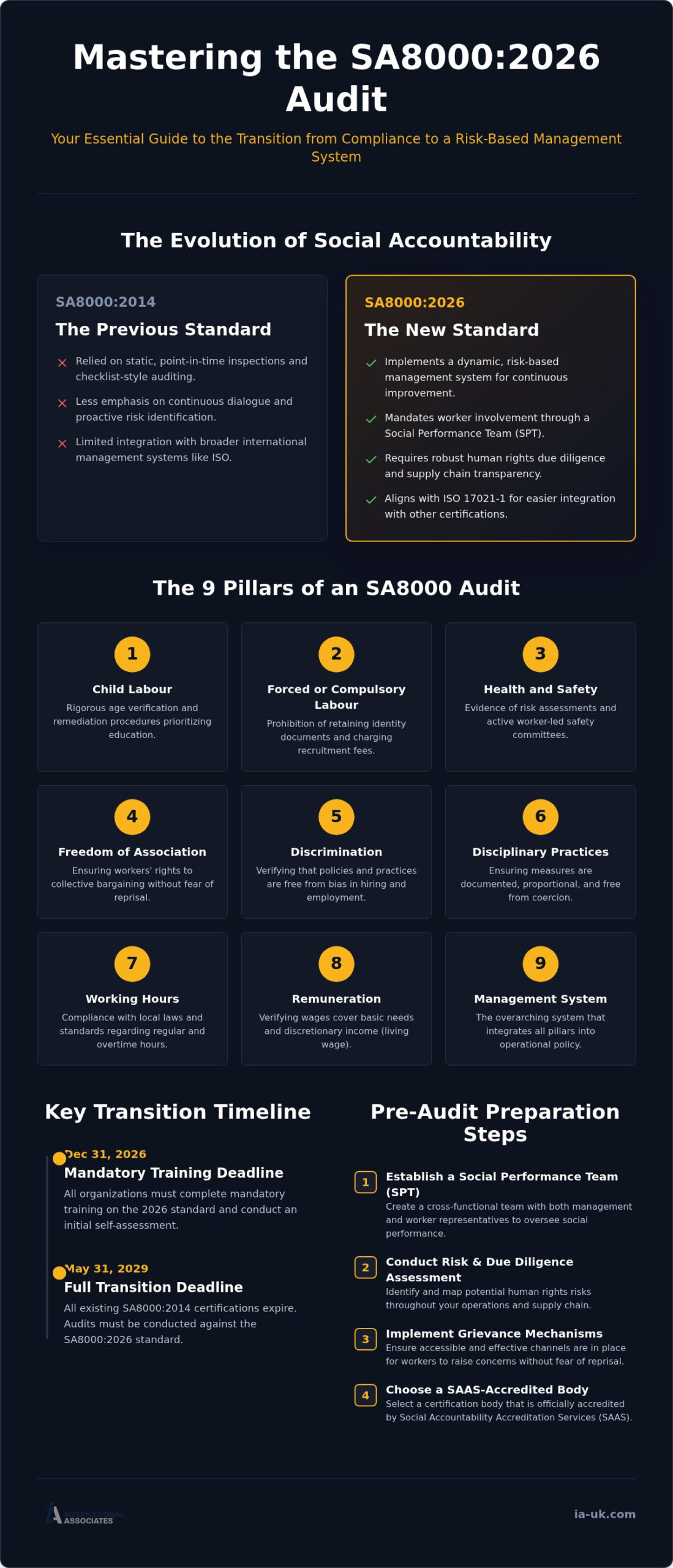
The SA8000:2026 standard represents the most significant update to social accountability frameworks in over a decade. It’s the premier global benchmark for ethical workplace practices, applicable across diverse industrial sectors regardless of geographic location. Unlike previous iterations, the 2026 revision necessitates a move away from static, point-in-time inspections toward a dynamic, risk-based management system. This shift ensures that fair treatment of workers isn’t merely a policy on paper but a measurable outcome of operational integrity. Organizations that rely on an informal sa8000 audit checklist must now transition toward formal, accredited certification to maintain their status in high-stakes international supply chains. The transition period for organizations currently certified to the 2014 version extends until May 31, 2029, yet the urgency is dictated by the December 31, 2026, deadline for mandatory training and self-assessment.
Key Changes in the 2026 Standard Revision
The 2026 update integrates ISO 17021-1 requirements, aligning social accountability with established international management system protocols. This alignment facilitates a more cohesive auditing process for firms already maintaining ISO 9001 or ISO 14001 certifications. Primary changes include:
- Worker Involvement: Mandatory establishment of a Social Performance Team (SPT) to facilitate continuous dialogue between management and the workforce.
- Risk Management: A transition from simple compliance checklists to a sophisticated management system that identifies and mitigates social risks.
- Due Diligence: Enhanced requirements for supply chain transparency and human rights reporting to meet evolving global standards.
These enhancements ensure that grievance mechanisms are both accessible and effective. They provide a vital bridge between central administration and the factory floor, allowing for real-time resolution of workplace concerns.
The Legal and Ethical Business Case for SA8000
Adopting the SA8000 standard provides a robust defense against the increasing regulatory scrutiny surrounding modern slavery and human rights violations. Global ESG mandates now require businesses to provide objective proof of ethical conduct to secure key contracts and institutional investment. By utilizing a comprehensive sa8000 audit checklist aligned with the 2026 requirements, companies can identify and mitigate risks before they escalate into legal liabilities. This proactive stance is essential for navigating the complex regulatory landscapes of the UK, EU, and beyond. For a broader perspective on these requirements, consult our Social Accountability Audits guide to understand how these standards apply to your specific regional operations.
The 9 Pillars of an SA8000 Audit Checklist
The nine pillars of the SA8000 standard represent the technical framework through which social accountability is verified. A robust sa8000 audit checklist must go beyond verifying the presence of policies to evaluate their operational efficacy. For child labour, auditors look for rigorous age verification systems and documented remediation procedures that prioritize the child’s education. Regarding forced labour, the focus lies on recruitment fee transparency and the absolute prohibition of original identity document retention. These measures prevent debt bondage and ensure workers’ freedom of movement remains intact.
Health and safety requirements necessitate evidence of comprehensive risk assessments and the active participation of worker-led safety committees. Freedom of association is verified by ensuring workers have the right to collective bargaining without fear of reprisal or restriction. Finally, the standard scrutinizes discrimination and disciplinary practices to ensure that internal policies align with actual factory-floor experiences. This involves checking that disciplinary measures are documented, proportional, and free from corporal or mental coercion. It’s not enough to have a policy; the evidence must show that the policy is practiced daily.
Wages and Benefits: Compliance with Living Wage Standards
Verification of wages requires auditors to determine if compensation covers basic needs and provides a margin for discretionary income. An effective sa8000 audit checklist includes a meticulous review of payroll records, overtime calculations, and confidential worker interviews to detect illegal deductions. Non-transparent pay slips or discrepancies between official records and worker testimony often indicate systemic failures in wage compliance. Auditors also verify that overtime is voluntary and paid at a premium rate, ensuring workers aren’t coerced into excessive hours to meet basic financial requirements.
Management Systems: The Foundation of Compliance
The 2026 revision emphasizes that a social accountability system is only as strong as its management framework. Transitioning from “box-ticking” to a functional system requires documented procedures, internal audit reports, and evidence of corrective actions. An academic evaluation of the standard’s impact suggests that organizations with integrated management systems achieve more sustainable social performance than those relying on isolated, checklist-style audits.
To ensure your framework meets these rigorous criteria, consider our Management System Certification Services as a primary step toward full social accountability. This systemic approach allows for the seamless integration of social standards with existing quality or environmental protocols. It provides a unified path to global regulatory adherence, ensuring that your organization’s social performance is both verifiable and continuous. By building a management-led culture of compliance, you protect your workers and your global reputation simultaneously.
Management Systems vs. Checklist-Style Auditing
A reliance on a static sa8000 audit checklist often results in audit failure because it treats social accountability as a binary state rather than a continuous process. Auditors in 2026 prioritize the “Social Performance” aspect of the SA8000 standard, which requires objective evidence of ongoing monitoring and corrective action. Preparation limited to ticking boxes often overlooks systemic risks that lead to major non-conformities during a formal assessment. To secure certification, your organization must demonstrate that social accountability is woven into the daily operational fabric through a functional management system.
For businesses already maintaining ISO 9001 or ISO 14001, the most strategic decision is to integrate social accountability into their existing management framework. This unified approach reduces administrative friction and ensures that social performance is governed by the same rigorous oversight as quality or environmental impact. International Associates utilizes an advanced IT infrastructure to facilitate this verification process. This modern approach allows for a streamlined review of digital records across global regional offices, ensuring that the audit is both thorough and efficient. The internal audit serves as the critical bridge here; it’s the mechanism that identifies gaps before they become liabilities during an accredited inspection.
Risk-Based Thinking in Social Compliance
The 2026 update mandates a proactive stance where you must identify high-risk areas specific to your industry or region. For example, a manufacturer in a high-migration corridor must prioritize recruitment transparency, while a service provider might focus on working hour limits. Documenting preventative actions proves to auditors that your system is designed to stop violations before they occur. This philosophy mirrors the structural requirements found in our Management System Certification Services, which emphasize risk mitigation as a core operational pillar for any global entity.
The Importance of Social Performance Teams (SPT)
The Social Performance Team (SPT) is the operational heart of the SA8000:2026 framework. It’s a mandatory requirement that ensures balanced representation between management and worker-elected representatives. The SPT is responsible for overseeing the implementation of the standard and conducting the initial risk assessments. Members must undergo specific training to understand their roles in monitoring the sa8000 audit checklist items and managing grievance mechanisms. This collaborative structure prevents the isolation of compliance duties within a single administrative department, fostering a culture of shared responsibility across the entire factory floor.
Pre-Audit Preparation: A Step-by-Step Guide
Systematic preparation follows a logical sequence to ensure that every operational niche complies with the SA8000:2026 revision. The process begins with a formal gap analysis. This exercise compares your existing management system against the new risk-based requirements of the 2026 standard. Following this, you must establish the Social Performance Team (SPT) and a functioning grievance mechanism. These structures aren’t just administrative requirements; they’re the primary evidence of worker-management dialogue. It’s critical to complete the mandatory “Getting Started with SA8000:2026 and Due Diligence” training by the December 31, 2026 deadline to remain eligible for certification.
Executing an internal audit using a technical sa8000 audit checklist allows you to identify vulnerabilities before the formal Stage 1 assessment. Management must then review these findings to address any non-conformities. The final step involves selecting a certification body that maintains accreditation from Social Accountability Accreditation Services (SAAS), ensuring the independence and global validity of your certificate. This methodical approach reduces the risk of audit failure and protects your access to sensitive international markets.
Conducting an Effective Internal Social Audit
An internal audit must mirror the rigor of a third-party inspection. This includes conducting confidential worker interviews using stratified sampling to ensure a representative cross-section of the workforce. Site inspections shouldn’t be limited to production floors; dormitories, canteens, and sanitary facilities must also meet the standard’s health and safety criteria. Professional competence is vital here. If your internal team lacks the necessary technical expertise, our Lead Auditor and Internal Auditor Training provides the specialized knowledge required to perform these complex evaluations.
Addressing Common Non-Conformities (NCs)
Systemic non-conformities are often more critical than isolated incidents. For example, a single missing fire extinguisher is an isolated failure, but a lack of fire safety training for new hires indicates a systemic management system failure. When an NC is identified, you must perform a root cause analysis rather than applying a superficial fix. Corrective Action Plans (CAPs) should include specific timelines and clear verification steps to prove that the failure won’t recur. This disciplined approach ensures that your system remains resilient under the scrutiny of an accredited auditor. To ensure your facility is fully prepared for a formal assessment, you can request our professional Social Accountability Audits to verify your compliance status before the final certification audit.
Choosing the Best SA8000 Certification Body for 2026
Selecting an accredited certification body is a critical strategic decision for organizations aiming to validate their ethical performance. The most significant decision signal is accreditation by Social Accountability Accreditation Services (SAAS). This accreditation ensures that the auditing body operates with the necessary independence and technical competence to verify your sa8000 audit checklist. It’s a common misconception that a single entity can provide both consultancy and certification. To maintain impartiality, an accredited certification body can’t be involved in the design or implementation of your management system. Choosing a partner that understands this boundary is essential for the integrity of your certification.
Regional presence across Europe, Asia, and the Middle East is another vital factor, particularly for businesses with complex, multinational supply chains. Local auditors possess the cultural and linguistic expertise required to conduct effective worker interviews and navigate diverse legal environments. Additionally, evaluating turnaround times for certificates and audit reports is necessary to avoid delays in contract negotiations. International Associates leverages a sophisticated IT infrastructure to ensure that certificates are issued promptly following a successful assessment. This efficiency allows you to present verified proof of compliance to stakeholders without unnecessary administrative friction.
The International Associates Auditing Process
The certification journey is structured into distinct phases to ensure thorough verification. Stage 1 involves a documentation review and readiness assessment. During this phase, auditors evaluate your management system’s design to confirm it meets the SA8000:2026 requirements. Stage 2 consists of an on-site verification of the management system’s implementation. Auditors conduct interviews, inspect the facility, and review records to ensure the sa8000 audit checklist is fully satisfied in practice. Once certification is granted, annual surveillance audits are conducted to ensure your social accountability status is maintained and that continuous improvement is documented.
Global Reach with Local Expertise
International Associates operates from a central administrative base in Glasgow, supported by an expansive network of international offices. This global-local duality allows us to provide institutional reliability while maintaining worldwide operational capacity. Our auditors are specialists in social accountability who understand the specific regulatory nuances of different industrial sectors. By leveraging this network, you ensure that your certification is recognized and respected in every market where you operate. For more information on our specific verification protocols, you can review our Social Accountability Audits guide, which details our approach to global compliance.
Securing Operational Integrity Through Social Accountability
Maintaining a competitive edge in global markets now requires a documented commitment to ethical workplace standards. By utilizing a comprehensive sa8000 audit checklist and transitioning to the risk-based management approach of the 2026 revision, your organization demonstrates a proactive stance on human rights. This methodical preparation ensures that social performance is integrated into your daily operations rather than treated as a secondary administrative task. Independent verification from an accredited body provides the necessary assurance to stakeholders that your facility meets the highest global benchmarks for worker welfare.
International Associates operates as an accredited certification body with a global network of regional offices, offering the independent verification and assurance required for high-stakes industrial sectors. Our modern IT-driven process ensures a streamlined path to certification without compromising on the rigor of the assessment. To secure your organization’s future in the international supply chain, you may Request a Professional SA8000 Audit Quote today. It’s a significant step toward sustainable growth and long-term operational stability.
Frequently Asked Questions
What is the main difference between SA8000:2014 and SA8000:2026?
The primary distinction lies in the transition from a compliance-only model to a risk-based management system approach. While the 2014 version focused on specific performance criteria, SA8000:2026 integrates ISO 17021-1 requirements and emphasizes human rights due diligence. Organizations must now demonstrate active worker-management dialogue through a Social Performance Team. This shift ensures that social accountability is a continuous operational process rather than a periodic inspection event.
How long does it take to get SA8000 certified in 2026?
The duration for certification varies based on the organization’s existing management system maturity. Typically, the process involves a Stage 1 documentation review followed by a Stage 2 on-site verification. For the 2026 standard, audits became available on a staggered basis starting June 1, 2026. Most organizations should allow several months for a thorough gap analysis and the mandatory self-assessment before scheduling their formal assessment with an accredited body.
Can a small business achieve SA8000 certification?
Small and medium-sized enterprises can successfully achieve certification because the standard is designed for organizations of any size or industry. While the technical requirements are rigorous, the management system approach is scalable to the facility’s operational complexity. Small businesses often find that implementing a formal sa8000 audit checklist improves internal efficiency and provides a stable foundation for securing contracts with larger, ESG-conscious international partners.
Is an SA8000 audit checklist enough to pass the certification?
A static sa8000 audit checklist is insufficient for passing the 2026 certification because auditors now focus on systemic efficacy. You must provide objective evidence of a functional management system, including risk assessments and active Social Performance Team participation. Simply ticking boxes doesn’t prove that your organization can identify or remediate social risks. A successful audit requires demonstrating that your policies are effectively practiced across all levels of the workforce.
What are the costs associated with an SA8000 audit?
Costs include mandatory training and quarterly royalty fees paid to Social Accountability International. For instance, the “Getting Started with SA8000:2026” course and self-assessment cost $300 as of January 1, 2026. Royalty fees are set at a minimum of $1,250 per quarter or specific rates per site. Audit fees themselves depend on the duration and complexity of the facility, which is determined by the number of workers and industrial risk level.
Does SA8000 certification expire?
Certification operates on a three-year cycle and does not remain valid indefinitely without ongoing oversight. Following the initial successful assessment, annual surveillance audits are mandatory to verify continued adherence to the standard. Organizations must undergo a full recertification audit every three years to maintain their status. It’s important to remember that transitioning to the 2026 version can only occur during a recertification audit, not a surveillance visit.
How does SA8000 compare to a SEDEX/SMETA audit?
SA8000 is an accredited certification standard, whereas SEDEX/SMETA is a social auditing methodology and reporting platform. While both focus on ethical trade, SA8000 requires a comprehensive management system and leads to a formal certificate of compliance. SMETA audits are typically requested by specific retailers for risk assessment purposes. Many global organizations choose SA8000 because it provides a higher level of independent assurance and institutional weight in international markets.
What happens if we find child labour during our internal audit?
If child labour is identified, the standard mandates the immediate implementation of a documented remediation policy. You must provide financial and other support to enable the child to attend and remain in quality education until no longer a child. This isn’t merely about termination; it’s about prioritizing the child’s well-being. Auditors will verify that your remediation procedures are robust and that the root cause of the recruitment failure has been addressed.