

A certificate is only useful when its scope reflects the organisation’s actual operations and sites. The SA8000 certification process therefore involves more than preparing for an audit: organisations need to understand the standard, define what the assessment covers and reach a certification decision through an appropriately accredited certification body.
If you’re weighing up certification, the key questions are practical: does SA8000 fit your organisation, which sites and activities should be included, and what should you look for in a certification body? The SA8000:2026 Standard brings together management systems, due diligence and governance with decent work principles and performance criteria, while maintaining nine core labour principles.
This guide explains who can seek certification, how to approach the certification-body selection and scope decisions, and what to expect through assessment and the certification decision. You’ll also see how the standard’s framework relates to workers’ rights and continual improvement, so you can plan the process around your organisation’s structure and sites.
Key Takeaways
- Assess whether your organisation’s activities fit the SA8000 certification scope and how the framework can support continual improvement.
- Define which operations and sites need to be included to create a clear, consistent certification scope.
- Understand why the certification body’s SAAS accreditation matters when selecting an audit partner.
- Prepare for the certification decision by aligning workplace practices, management systems and audit evidence with the standard.
- Learn how SAI Database registration and training fit into the certification pathway.
Which organisations can become SA8000 certified?
Organizations of any size and sector can pursue SA8000 certification, except industries listed in official published exclusions. The standard is relevant where employers need to manage workplace conditions, demonstrate respect for human rights, and provide buyers with evidence of social performance. Eligibility alone does not establish readiness: actual practices and management controls are assessed.
For employers, a documented management system can clarify responsibilities, surface workplace risks, and support improvement over time. Workers benefit when policies address issues such as health and safety, discrimination, working hours, and remuneration. Buyers can use certification as evidence of an organization’s social accountability approach. A management system certification approach can help connect documented controls with day-to-day operations.
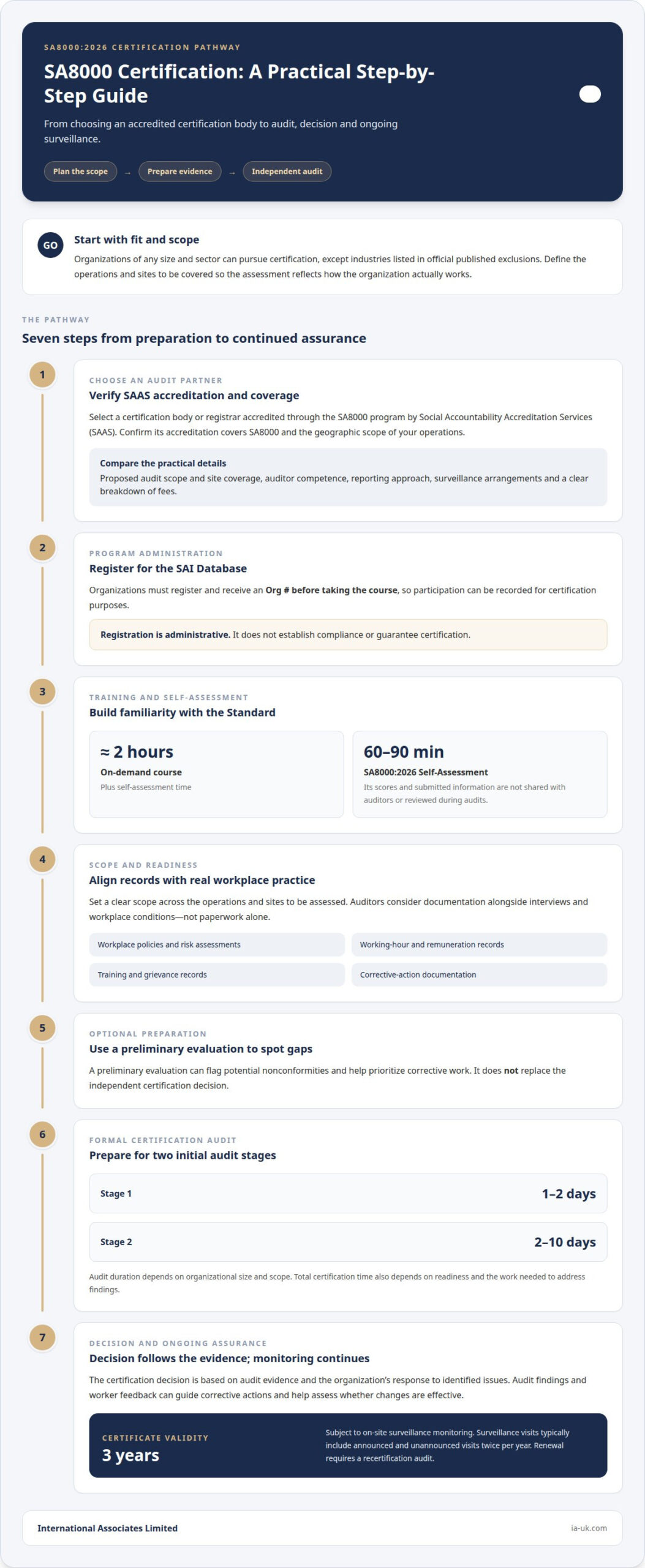
An SA8000 certificate is valid for three years, subject to on-site surveillance monitoring. Renewal requires a recertification audit; surveillance visits typically include announced and unannounced visits twice per year.
Audit records should show how policies work in practice. Useful evidence includes workplace policies, risk assessments, working-hour and remuneration records, training records, grievance records, and corrective-action documentation. Auditors consider these alongside interviews and workplace conditions, rather than treating paperwork alone as proof of conformity.
The audit has two initial stages: Stage 1 typically takes 1 to 2 days, and Stage 2 can take 2 to 10 days, depending on organizational size and scope. Total certification time depends on readiness, scope, and the work needed to address findings. Certification also involves surveillance monitoring after the initial decision.
Common nonconformities include gaps between documented controls and actual practice, such as incomplete working-hour records, remuneration issues, inadequate safety measures, or weak grievance handling. Discrimination, forced or child labour concerns, and ineffective management-system controls can also lead to serious findings. The certification decision is based on audit evidence and the organisation’s response to identified issues.
To support continual improvement, use audit findings and worker feedback to spot recurring problems, assign corrective actions, and assess whether changes are effective. This creates a structured way to strengthen workplace practices and gives workers and buyers clearer evidence of how social-accountability commitments are maintained.
Selecting a certification body or registrar
Choose a certification body accredited through the SA8000 program, rather than relying on a general auditing credential. Social Accountability Accreditation Services (SAAS) accredits certification bodies and registrars to audit and issue accredited SA8000 certificates. Their accreditation is relevant to stakeholders who rely on certificates as evidence of social performance.
Check that the body’s accreditation covers SA8000 and the geographic scope of your operations. Initial accreditation is granted within a limited geographic scope, so this matters when sites operate across borders. Certification bodies seeking SAAS accreditation must meet ISO/IEC 17021-1:2015 requirements. These criteria help distinguish program-specific authorization from broad experience with management-system audits. An accreditation overview explains how recognized credentials relate to independent assessment.
When comparing certification bodies, review the proposed audit scope, site coverage, auditor competence, reporting approach, and surveillance arrangements. The plan should reflect the organisation’s operations and employee conditions, not just its head office. A preliminary evaluation can flag potential nonconformities before the formal certification audit. It helps prioritise corrective work, but does not replace the independent certification decision.
It can help to distinguish program registration and training from formal certification and audit costs. Organizations must register for the SAI database and receive an Org # before taking the course, so participation can be recorded for certification purposes. The on-demand course introduces the SA8000:2026 Standard and Certification Program and takes approximately 2 hours, plus self-assessment time. The SA8000:2026 Self-Assessment takes 60-90 minutes. Its scores and submitted information are not shared with auditors or reviewed during audits.
Registration does not itself establish compliance or guarantee certification. It is an administrative step that supports participation in the program. Ask for a clear breakdown of registration-related charges, training costs, formal audit charges, and surveillance arrangements before committing. Formal Stage 1 and Stage 2 audits are charged to verify whether an organization meets the applicable standard. The amount depends on the organization and its audit scope, so avoid comparing headline fees without considering site coverage and audit requirements.
Confirm that the body can support the organisation’s locations and required certification timeline. Relevant considerations include current SAAS accreditation, geographic coverage, clear fee information, and an independent audit approach. Together, these help provide credible assurance to workers, buyers, and other stakeholders.
Certification decision
The certification decision turns on whether audit evidence shows that the organization has implemented and maintains a social accountability management system aligned with SA8000. Auditors examine workplace conduct, management controls, and actual practices against the Standard. A written policy alone cannot demonstrate how workers experience those practices day to day.
Evidence is assessed across the organisation’s defined scope. For example, auditors can compare working-hour records with employee accounts and observed workplace conditions. They can also assess grievance procedures alongside evidence that workers know how to raise concerns. Comparing these sources helps establish whether formal commitments are reflected in routine operations.
Under SA8000:2026, the assessment connects Management Systems: Due Diligence and Governance with Decent Work Principles and Performance Criteria. The Standard maintains nine core labour principles, covering areas such as health and safety, discrimination, working hours, and remuneration. Auditors consider how the organization identifies issues, assigns responsibility, responds to concerns, and uses findings to improve its controls.
Commitment is demonstrated through action, not statements alone. If an audit identifies a gap, the organisation’s response matters: evidence should show whether responsibilities were assigned, corrective action was implemented, and the change addressed the underlying problem. Revising a procedure without checking its effect on workers, for example, may leave the original risk unresolved.
The certification body reviews audit findings and supporting evidence before making its decision. The outcome depends on whether the organisation meets the applicable requirements across its scope, not on one document or isolated good practice. Consistent evidence from records, interviews, and workplace observations supports a reliable assessment.
Prepare by ensuring key personnel understand their responsibilities and that records reflect actual operations. Management should be ready to explain how worker concerns are escalated and how recurring issues inform improvement. Auditors can then consider workers’ accounts and workplace evidence alongside management records for a fuller view of implementation.
After certification, on-site surveillance monitoring supports continued oversight. The organisation remains responsible for maintaining its system and responding to changes in workplace conditions. This ongoing work helps ensure the certification decision reflects operational practices, not just readiness on audit day.
Certification program scope and site selection
Start by mapping the organisation’s activities, locations, and worker groups. For example, a manufacturer with a head office, production facility, and warehouse should identify each operation and its role. This gives the certification body a clear basis for planning the assessment and determining which sites the certification programme covers.
Define scope by considering where workers’ rights risks arise, not only where senior management is based. A warehouse may have different working arrangements from a factory, while a regional office may oversee recruitment or purchasing. Mapping activities by location shows where policies apply, who is responsible, and how practices are monitored across international operations.
For each site under consideration, document its relationship to the organisation and the work performed there. A practical scope map can record:
- Site location and main activities, such as manufacturing, storage, or administration.
- Worker groups and employment arrangements relevant to those activities.
- Local management responsibilities for implementing social-accountability controls.
- Shared functions, such as human resources, that support more than one location.
This information helps the certification body understand how the global management system operates across locations. If recruitment is managed centrally but workers are employed at several facilities, for instance, the assessment needs to consider both the central process and its local application. Consistent records and clear responsibilities support assurance across the defined scope.
International operations also require attention to differences between sites. Local workplace practices, languages, and legal contexts can affect how policies are understood and applied. Show how social-accountability controls apply in each setting and how site-level concerns reach people with authority to respond. This matters especially when workers at one location have limited access to central decision-makers.
Before finalising the audit plan, the certification body uses the proposed scope and site information to determine assessment coverage. Omitting an operation where workers face relevant risks can leave an incomplete picture. Including sites without clear operational links can make boundaries difficult to assess. Aim for a precise, evidence-based scope connecting the organisation’s activities, workers’ rights, and management responsibilities across its locations.
SA8000 standard and its social-accountability framework
Established in 1997, the SA8000 Standard advances workers’ rights through a management-systems approach to social performance. Its framework draws on the Universal Declaration of Human Rights, International Labour Organization conventions, and national laws. The emphasis is not a one-time checklist: organizations are expected to manage performance and pursue continual improvement.
The SA8000:2026 Standard has two sections: Management Systems: Due Diligence and Governance, and Decent Work Principles and Performance Criteria. It maintains nine core labour principles. These include areas such as child labour, forced or compulsory labour, health and safety, discrimination, working hours, and remuneration. The management-system element connects those workplace topics to governance and organizational accountability.
The assessment considers whether the organisation has implemented and maintains a social-accountability management system aligned with the Standard. Auditors examine how policies work in practice, how responsibilities are assigned, and how issues are addressed. A working-hours policy, for example, needs supporting records and evidence of implementation, not just an approved document. Findings can guide corrective action and ongoing improvement.
This approach connects social accountability with sustainability by making decent work part of routine organisational oversight. A system for identifying risks, assigning responsibility, and reviewing responses can help an organisation address workplace impacts over time. Treat the framework as an operating system for managing social performance, not a set of statements prepared only for an audit.
SA8000, SMETA, and ISO 45001 are not interchangeable assessment routes. SA8000 provides a social-accountability standard and certification framework, while ISO 45001 focuses on occupational health and safety; SMETA may address buyer-specific social-audit needs. The right comparison depends on whether the priority is certification, workplace safety management, or a particular buyer’s assessment expectations.
For organizations moving from the SA8000:2014 Standard, SA8000:2026 replaces that edition. A practical transition step is to compare existing policies and controls with the revised framework, then identify where governance or decent-work practices need attention. This keeps the assessment connected to actual operations and supports credible evidence of accountability.
Organizations seeking an independent evaluation of workplace social performance can explore Social Accountability Audits as a way to assess practices and identify improvement areas.
International Associates Limited: SA8000 Social Accountability
International Associates Limited offers SA8000 Social Accountability for organizations seeking formal assessment against the SA8000 framework. Its Social Accountability Audits provide a separate route for examining workplace practices and social-accountability controls. The appropriate service depends on the organization’s objective: pursuing certification against the standard or assessing social performance through an audit.
For a certification project, define the activities, locations, and workers within scope to establish what the assessment covers. Clear boundaries support audit planning across sites and operational functions. They also connect documented responsibilities with workplace practices, providing a structured basis for evaluating how social-accountability controls are applied.
A Social Accountability Audit can help an organisation examine its practices and identify areas needing attention. For example, an assessment may consider whether workplace procedures align with how operations are managed. This can support a review of workers’ rights, accountability, and ongoing improvement, but an audit is not a substitute for formal certification.
International Associates Limited also provides ISO 9001 Quality Management System Certification and ISO 14001 Environmental Management System Certification. These certifications address different management-system subjects: quality, environmental management, and social accountability. Organizations considering more than one standard can assess each requirement against its own objectives and operational priorities, rather than assuming one certification covers another’s scope.
Independent assessment, verification, and assurance can help organizations communicate how their systems are evaluated. For businesses operating across locations, a clearly defined scope helps connect the assessment to relevant activities and sites. The audit or certification route should match the intended outcome, whether that is formal SA8000 certification or a focused examination of social-accountability practices.
The next step is to identify the intended assessment, the operations involved, and the relevant sites. This gives the certification discussion a clear starting point and helps align the service with the organization’s needs. Contact International Associates Limited to discuss SA8000 Social Accountability or Social Accountability Audits.
Turn certification planning into sustained practice
As a next planning step, decide how social accountability will remain part of routine business decisions. Set review points around changes to operations, workforce arrangements, or supplier relationships so emerging impacts receive attention before they become embedded in established processes.
A well-managed SA8000 certification process can also connect accountability with business planning. Determine who will own follow-up, how concerns reach decision-makers, and how progress will inform management discussions. This creates continuity beyond the assessment and helps keep social performance visible as organizational priorities evolve.
International Associates Limited can help identify an appropriate assessment or certification route for your organization. Contact International Associates Limited to discuss your next step and move your planning forward with confidence.
Frequently Asked Questions
What is the SA8000 Standard?
The SA8000 Standard gives organizations a reference for evaluating how workplace responsibilities are managed. In practical use, translate its requirements into clear ownership: identify who handles recruitment, working time, grievances, and corrective actions, then determine how relevant evidence reaches management review. For a multi-site employer, this can make responsibilities easier to follow across facilities and reduce reliance on one person’s informal knowledge.
How can a company begin the certification process?
Appoint an internal lead to coordinate management, human resources, and site-level records. They can organise policies, operational evidence, and open issues in a working file, then identify questions requiring management decisions. This provides a practical starting point before formal assessment planning. Also account for SAI programme participation requirements, including database registration and the relevant course.
How does SA8000 certification support supply chain assurance?
For procurement teams, certification can inform assessments of a supplier’s social-performance controls. It provides a defined basis for discussing workplace accountability and follow-up. Buyers should also consider their supplier relationships, purchasing practices, and oversight needs. A certificate can inform a supplier review, for example, while separate engagement may be needed to understand risks beyond the organisation’s assessed scope.
What are the benefits of SA800?
A practical benefit is a clearer basis for assigning responsibility when workplace concerns arise. Use established review routines to identify recurring issues, determine who owns corrective action, and track whether responses address the cause. This can prevent each concern from being treated as an isolated incident. Workers may also benefit when reporting channels and response responsibilities are understood across departments.
What is SA8000 certification and what does it cover?
SA8000 certification is an independent assessment outcome relating to an organization’s social-accountability management system. Its practical reach depends on the activities and locations included in the assessment. For example, a certificate covering production operations does not automatically describe activities outside that defined scope. Buyers and internal teams should therefore read certification information alongside the stated organizational boundaries when applying it to supplier or operational decisions.
What are the eligibility requirements for SA8000 certification?
Organisations of any size or sector can seek certification, except for industries identified in SAI’s published exclusions. For an eligibility review, establish the organisation’s industry classification and the operations it intends to include. This helps determine whether the organisation falls within the programme’s exclusions, separately from whether its current practices are ready for assessment. Eligibility provides access to the programme; it does not mean the requirements have been met.
What are the steps in the SA8000 certification process?
The process involves defining the intended scope, preparing systems and evidence, completing programme participation requirements, and undergoing the certification body’s audit stages. The organisation then responds to findings as required, and the certification body evaluates the evidence before making its decision. A single action log with assigned owners, deadlines, and completed responses can help coordinate work across departments and locations.
How much does SA8000 certification cost in the United States?
There is no single SA8000 certification fee applicable to every United States organization. The quote reflects the assessment work required, including the organization’s size, workforce, operational complexity, number of sites, and applicable standard. Formal Stage 1 and Stage 2 audit charges cover verification activities. To compare proposals meaningfully, consider whether they address the same scope and required audit work, rather than comparing headline amounts alone.