
Treating the SA8000:2026 update as a simple checklist is the fastest way to fail your next social audit. The shift from snapshot compliance to a continuous management system approach means that traditional preparation methods are no longer sufficient. Understanding the updated SA8000 certification requirements is now a critical necessity for any organization operating within a global supply chain. As of January 1, 2027, all new certifications must adhere to this rigorous standard, which places unprecedented emphasis on human rights due diligence and value chain accountability.
It’s understandable if the complexity of these 2026 revisions feels daunting. Managing sub-supplier compliance while maintaining operational efficiency requires a methodical and structured approach. This guide provides a clear roadmap to help you master the technical and management requirements necessary for a successful audit. You’ll learn how to navigate the transition before the May 2029 deadline and understand exactly how SA8000 differs from other social frameworks. By implementing these practical decision factors, you can achieve certification with minimal non-conformities and reinforce your status as a reliable global partner.
Key Takeaways
- Navigate the mandatory transition from the 2014 version to the SA8000:2026 standard, focusing on enhanced transparency and human rights due diligence.
- Identify the specific SA8000 certification requirements across eight core performance criteria, including updated protocols for workplace risk assessments.
- Evaluate the strategic differences between SA8000 certification and SMETA or WRAP audits to select the most appropriate framework for your global supply chain needs.
- Establish a high-functioning Social Performance Team (SPT) to move beyond static checklists toward a dynamic, leadership-driven management system.
- Follow a structured roadmap through the Stage 1 and Stage 2 audit phases to secure your certification with minimal operational friction and high procedural integrity.
The SA8000:2026 Framework: Core Social Accountability Requirements
The SA8000:2026 standard stands as the premier global framework for social accountability management systems. This revision, which officially replaced the 2014 version on January 1, 2026, signals a decisive shift toward heightened transparency and proactive risk management. Unlike static auditing methods, the 2026 update requires organizations to demonstrate an integrated management system that actively protects workers’ human rights. This framework is not an isolated set of rules; it maintains rigorous alignment with International Labour Organization (ILO) conventions and the Universal Declaration of Human Rights. For those researching the standard’s evolution, the SA8000 Wikipedia page details the historical development of these performance criteria.
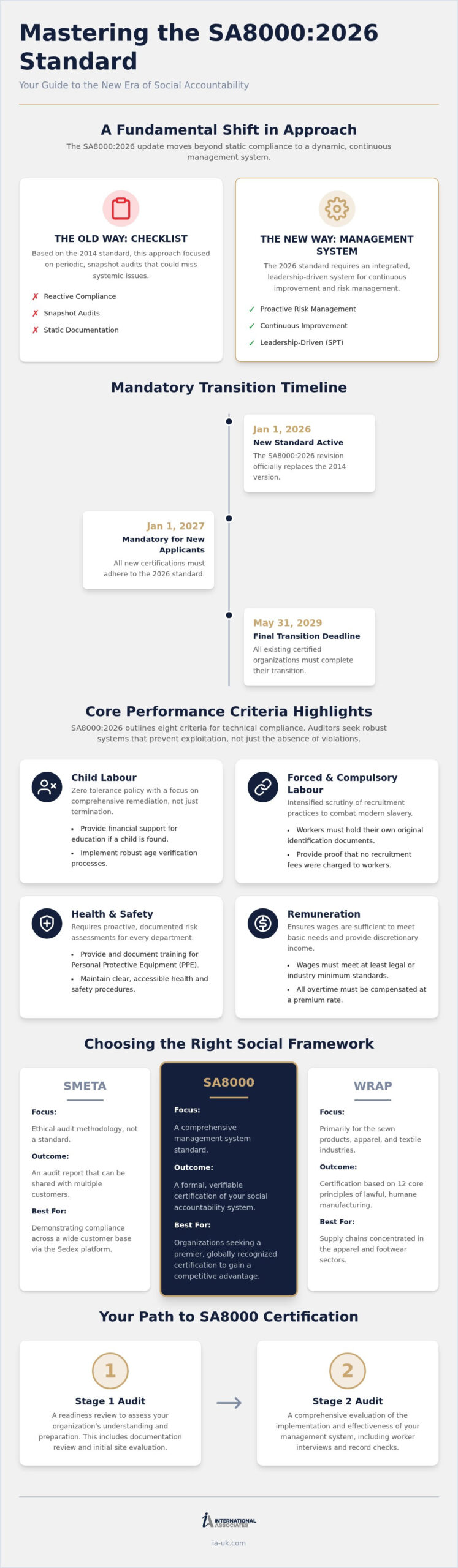
Meeting the SA8000 certification requirements involves more than passing a periodic inspection. It demands a commitment to continuous improvement and systemic oversight. Organizations must transition to this new standard by May 31, 2029, to maintain their certified status. For new applicants, the 2026 requirements become mandatory as of January 1, 2027. This timeline ensures that the global supply chain moves toward a unified, high-transparency model that prioritizes ethical performance over mere documentation.
Why SA8000 is Critical for Global Supply Chains in 2026
Rising pressure from ESG (Environmental, Social, and Governance) mandates has transformed social compliance from a voluntary initiative into a commercial necessity. Global buyers increasingly require verifiable proof of ethical labor practices before awarding contracts. Achieving certification provides a significant competitive advantage during international tendering by demonstrating a mature approach to social risk. International Associates facilitates this through independent social accountability audits, providing the administrative rigor needed to satisfy complex regulatory demands across diverse jurisdictions.
The Decent Work Principles at a Glance
The core of the standard is the concept of “Decent Work,” which establishes a universal baseline for labor conditions. These principles apply to every industry and country, regardless of whether local laws meet these high standards. This ensures a level playing field for organizations operating in regions with varying degrees of legal oversight. Decent Work serves as the non-negotiable baseline for all SA8000 audits. By focusing on these principles, companies move beyond basic compliance toward sustainable social performance.
The 8 Performance Criteria: Technical Compliance Standards
The core of the standard consists of eight performance criteria that define the technical expectations for workplace conduct. Meeting these SA8000 certification requirements necessitates a shift from passive compliance to active verification. Auditors don’t merely look for the absence of violations; they seek evidence of robust systems that prevent exploitation. This approach aligns with the ILO guidance on social responsibility, which emphasizes that decent work is a fundamental pillar of sustainable corporate operations. Each criterion serves as a specific benchmark for ethical performance across your entire operational footprint.
Child Labour and Forced Labour: Zero Tolerance Policies
Zero tolerance for child and forced labour is a non-negotiable cornerstone of the standard. For child labour, the focus extends beyond simple age verification to include comprehensive remediation plans. If a child is discovered in the workforce, the organization must provide financial support for their education rather than simply terminating their employment. Regarding forced labour, the 2026 update intensifies the scrutiny of recruitment practices to combat modern slavery. Auditors require original identification documents to be held by the workers themselves, never the employer. You’ll need to provide clear documentation proving that all employment is voluntary and that no recruitment fees were charged to the workers during the hiring process.
Health, Safety, and Remuneration: Practical Audit Evidence
Technical compliance in health and safety requires a proactive risk assessment for every department. Auditors will verify that personal protective equipment (PPE) is not only provided but that comprehensive training records exist for its correct use. In terms of remuneration, SA8000 is distinct because it requires a “living wage” rather than just the local legal minimum. This wage must cover the basic needs of workers and their families while providing a small amount of discretionary income. To satisfy these requirements, your payroll systems must accurately track regular hours and ensure that overtime is both voluntary and compensated at premium rates. Transparent record-keeping is the only way to demonstrate that your financial practices meet these global benchmarks.
The remaining criteria include Freedom of Association, where the right to collective bargaining must be respected, and strict prohibitions against discrimination and abusive disciplinary practices. Working hours are capped at 48 regular hours per week, with a mandatory one day of rest for every seven worked. If you’re preparing for an upcoming assessment, reviewing our detailed guide on social accountability audits can help you identify specific gaps in your current documentation before the auditor arrives. Maintaining these standards ensures your organization remains a stable and ethical link in the global supply chain.
SA8000 vs. SMETA and WRAP: Choosing the Right Social Audit
Choosing between social audit frameworks is a strategic decision that impacts global market access and operational overhead. While SMETA (Sedex Members Ethical Trade Audit) is widely recognized as a reporting methodology, SA8000 remains the premier global certification standard. The primary difference lies in the management system approach. Unlike SMETA, which provides a snapshot of compliance at a specific point in time, SA8000 requires an integrated management system to ensure continuous adherence. This distinction is vital when evaluating SA8000 certification requirements against sector-specific options like WRAP, which focuses exclusively on the apparel and sewn products industry. SA8000’s multi-sector applicability makes it the more versatile choice for diversified manufacturing entities.
The 2026 standard emphasizes that social performance must be embedded within the corporate structure. This is achieved through the mandatory Social Performance Team (SPT), a requirement that doesn’t exist in the SMETA or WRAP frameworks. By establishing this internal oversight body, organizations move away from “audit-day” preparation toward a state of constant readiness. This proactive stance reduces the risk of major non-conformities during unannounced visits and strengthens the overall integrity of the supply chain. For a detailed breakdown of how these frameworks align with your specific operational needs, our comparison and certification guide provides the necessary technical analysis.
When to Choose SA8000 Over SMETA or SEDEX
Decision-makers often favor SA8000 when a formal, third-party certificate is required to satisfy international tendering conditions. While a SMETA report is shared via the Sedex platform to meet buyer-specific requests, an SA8000 certificate serves as a universal badge of ethical excellence. It’s important to note that these are generally not interchangeable; a buyer specifically requesting SMETA will rarely accept SA8000 in its place. However, the robust management system required for SA8000 makes passing a SMETA audit significantly easier. The SA8000 cycle also operates on a three-year basis with annual surveillance, providing more stability than the frequent re-auditing often requested by SMETA-reliant brands.
Cost vs. Credibility: Evaluating the ROI of SA8000
The initial investment in an SA8000 management system is often higher than a one-off audit because it requires structural changes and leadership commitment. However, the long-term return on investment is significant. By meeting the rigorous SA8000 certification requirements, organizations gain access to high-value global markets that prioritize ESG performance. This certification effectively reduces “audit fatigue” by serving as a recognized equivalent for multiple brand-specific codes of conduct. Instead of undergoing separate audits for every new client, a single, credible certification demonstrates your commitment to ethical labor practices across all jurisdictions. This administrative efficiency is a key driver for organizations seeking to streamline their compliance portfolio.
Implementing the SA8000 Management System: Beyond the Checklist
The 2026 standard dictates that social accountability is a continuous management process rather than a periodic event. Meeting the SA8000 certification requirements involves embedding specific oversight structures within the organizational hierarchy. Central to this is the Policy Commitment, which must be signed by top leadership to ensure that social performance is prioritized alongside financial objectives. This commitment isn’t just a document; it’s the foundation for the Risk Assessment process. In the 2026 context, these assessments must move beyond internal operations to evaluate the social impacts of the entire value chain, identifying vulnerabilities before they manifest as non-conformities.
The Social Performance Team (SPT) and Worker Involvement
The Social Performance Team (SPT) serves as the operational heart of the management system. To comply with 2026 standards, the SPT must maintain a balanced composition of management representatives and worker-elected representatives. This balance ensures that the “worker voice” is integrated into decision-making. Auditors expect to see meticulous documentation of SPT meetings, including minutes that record both management initiatives and worker feedback. Effective grievance mechanisms are also mandatory; these channels must allow for anonymous reporting and provide a clear, documented path to resolution. Verification of these mechanisms often involves auditor interviews to confirm that workers trust and understand the process.
Supply Chain Management and Sub-Supplier Control
A significant hurdle in managing SA8000 certification requirements is extending accountability to sub-suppliers and contractors. The 2026 revision requires organizations to implement a robust due diligence process for their own supply base. This involves mapping out high-risk sub-contractors and conducting technical assessments to ensure they meet the standard’s baseline. To ensure compliance when working with independent contractors in Europe, you can learn more about scaliify and their specialized risk-minimization solutions. It’s no longer enough to rely on verbal assurances; you must demonstrate active monitoring and support for supplier improvement. This level of oversight ensures that your certification isn’t compromised by the actions of third-party partners. For a broader understanding of how these requirements align with international legal frameworks, reviewing our resources on regulatory compliance provides critical context for global operations.
If you’re ready to transition your management system to the 2026 standard, contact International Associates to schedule your SA8000 social accountability audit today.
Achieving the standard requires a disciplined, four-step progression. This process ensures that the SA8000 certification requirements are not just documented but fully operational within your facility. International Associates provides independent verification through our expansive global network, combining Glasgow-based administrative rigour with localized auditing expertise. By choosing an accredited body, organizations secure a certificate that carries institutional weight across international borders, providing the security needed to navigate complex global supply chains.
The journey begins with an internal review. This self-assessment allows you to identify gaps before the formal Stage 1 audit commences. During Stage 1, our auditors perform a technical documentation review to verify that your policies and the Social Performance Team structure are aligned with the 2026 standard. This is followed by the Stage 2 audit, which focuses on practical implementation. Once certification is granted, it’s maintained through a three-year cycle of surveillance audits and a final recertification assessment. This structured approach ensures that ethical standards are upheld consistently over time.
What to Expect During the Stage 2 On-Site Audit
The Stage 2 audit is the most rigorous phase of the assessment process. Auditors utilize a representative sampling methodology for confidential worker interviews, ensuring that staff can speak freely without management presence. These discussions are cross-referenced with payroll records and physical site inspections of production floors, canteens, and dormitories. In the 2026 audit environment, common non-conformities often stem from inaccurate living wage calculations or insufficient oversight of sub-supplier risks. Addressing these gaps promptly is essential for maintaining your certified status and demonstrating a genuine commitment to worker welfare.
Maintaining Compliance: The Role of Surveillance Audits
Surveillance audits typically occur every 6 to 12 months to ensure that the management system remains effective. These visits prevent the common pitfall of compliance decay, where standards slip between major assessments. A robust Management System Certification provides the structural continuity needed to navigate these periodic reviews successfully. At the end of the three-year term, a full recertification audit is required to extend the validity of your certificate. To begin your path toward global social accountability, Contact International Associates for a professional assessment and secure your place as a leader in ethical business practices.
Securing Your Global Standing for the 2026 Transition
Transitioning to the SA8000:2026 standard is a strategic necessity for organizations seeking to maintain a competitive edge in the global supply chain. This update moves focus from static compliance to a dynamic, risk-based management system that prioritizes worker voice and human rights due diligence. By establishing a robust Social Performance Team and implementing effective grievance mechanisms, you ensure that your operations are resilient against the evolving demands of international ESG mandates. It’s an opportunity to embed transparency directly into your corporate culture and demonstrate long-term ethical stability.
Adhering to the updated SA8000 certification requirements provides a clear roadmap for achieving ethical excellence while reducing the burden of audit fatigue across your value chain. International Associates serves as a reliable partner in this process. Our UK-based auditing body offers Glasgow-led administrative excellence combined with an expansive global reach. We are fully accredited for social accountability and management systems, providing the independent verification required to satisfy high-stakes technical sectors. Secure your SA8000 certification with International Associates to demonstrate your commitment to a fair and transparent workplace. We look forward to guiding your organization through a successful audit and toward sustainable international growth.
Frequently Asked Questions
What is the main difference between SA8000:2014 and SA8000:2026?
The primary shift is the transition from a checklist-style audit to a continuous management system approach. The 2026 standard places much higher emphasis on human rights due diligence and accountability across the entire value chain. Existing certificate holders must complete their transition by May 31, 2029. New applicants must adhere to the updated SA8000 certification requirements starting January 1, 2027, to secure their certified status.
How long does it typically take to achieve SA8000 certification?
Achieving certification generally requires six to twelve months depending on your organization’s current maturity. This period includes the initial gap analysis, the implementation of the management system, and the mandatory two-stage audit process. Our Glasgow-based administrative team utilizes advanced IT infrastructure to ensure efficient processing once the technical implementation is verified. This timeline allows for the necessary structural changes to be fully embedded before the final assessment.
Can a small business with fewer than 50 employees get SA8000 certified?
Yes, the standard is designed for multi-sector applicability regardless of organization size. Small businesses often find the implementation of social performance teams more straightforward due to their direct management structures. The certification focuses on the effectiveness of the system rather than headcount. We provide independent verification for small enterprises and large global firms alike, ensuring that the same rigorous standards of social accountability are met across all scales. For smaller operations looking for guidance on ethical production, you can discover Little Eco Me for specialized resources and consulting tailored to sustainable handmade business owners.
While not a legal customs requirement, certification is frequently a mandatory commercial condition for accessing EU and UK markets. Many global retailers and government bodies require proof of social accountability during the tendering process. Meeting the SA8000 certification requirements serves as a credible badge of ethical excellence. It provides the stability and assurance needed to navigate complex ESG mandates that dominate modern international trade agreements.
What happens if a non-conformity is found during an SA8000 audit?
Non-conformities are categorized as either major or minor depending on their severity. A major non-conformity prevents the issuance of a certificate until the issue is fully corrected and verified by an auditor. Minor non-conformities require the submission of a corrective action plan (CAP) within a defined timeframe. Our auditors maintain an air of impartiality throughout this process, focusing on objective evidence to ensure that all corrections lead to sustainable performance improvements.
How does SA8000 handle sub-supplier compliance in the supply chain?
The 2026 standard requires organizations to extend their social accountability due diligence to their own suppliers and sub-contractors. You must actively monitor high-risk partners and maintain records of their compliance with the standard’s baseline principles. This systemic approach prevents unethical practices in your value chain from compromising your certified status. It moves beyond simple self-reporting, requiring a proactive management system that identifies and mitigates social risks at every level of production.
Does SA8000 certification expire, and how do I renew it?
An SA8000 certificate is valid for three years from the date of issuance. To maintain this status, organizations must undergo annual or semi-annual surveillance audits to verify continued adherence to the management system requirements. A full recertification audit is required at the end of the three-year cycle to renew the certificate. This disciplined schedule ensures that your social performance remains consistent and evolves alongside changes in international labor regulations and frameworks.
Is SA8000 compatible with ISO 9001 or ISO 45001 management systems?
SA8000 is highly compatible with ISO management systems because they share a common high-level structure. Principles such as leadership commitment, documentation control, and continuous improvement are foundational to both frameworks. Integrating these systems reduces administrative friction and allows your Social Performance Team to leverage existing operational protocols. We offer certification across multiple standards, helping businesses build a unified and efficient global compliance strategy that addresses quality, safety, and social accountability.