

A lower quote may not represent better value if it covers a different audit scope. Surveillance audit fees reflect the work required to verify continued conformity, as well as administration such as maintaining certificate records and updating the global registry.
To compare fees fairly, first identify the certification programme, audit stage and scope covered by each quote. Employee numbers, sites and process complexity may also affect the assessment, depending on the programme.
This guide explains what surveillance fees may cover, which organisational details can affect a tailored assessment, and how to compare quoted work with your audit scope. It also outlines practical budgeting steps, including how to plan for periodic audit activity and certificate administration. The aim is to help you build a scope-specific budget instead of relying on a headline figure that may not reflect the work required.
Key Takeaways
- Review the work included in a quote before deciding whether a recurring fee fits your budget.
- Surveillance audit fees depend on the certification programme and the scope being assessed.
- Separate periodic surveillance from initial assessment and recertification so you budget for the correct audit stage.
- Prepare your standard, certificate scope, sites and upcoming audit stage to support a tailored fee assessment.
- Compare fee information on a like-for-like basis, including the stated audit work and administration.
What Do Surveillance Audit Fees Cover?
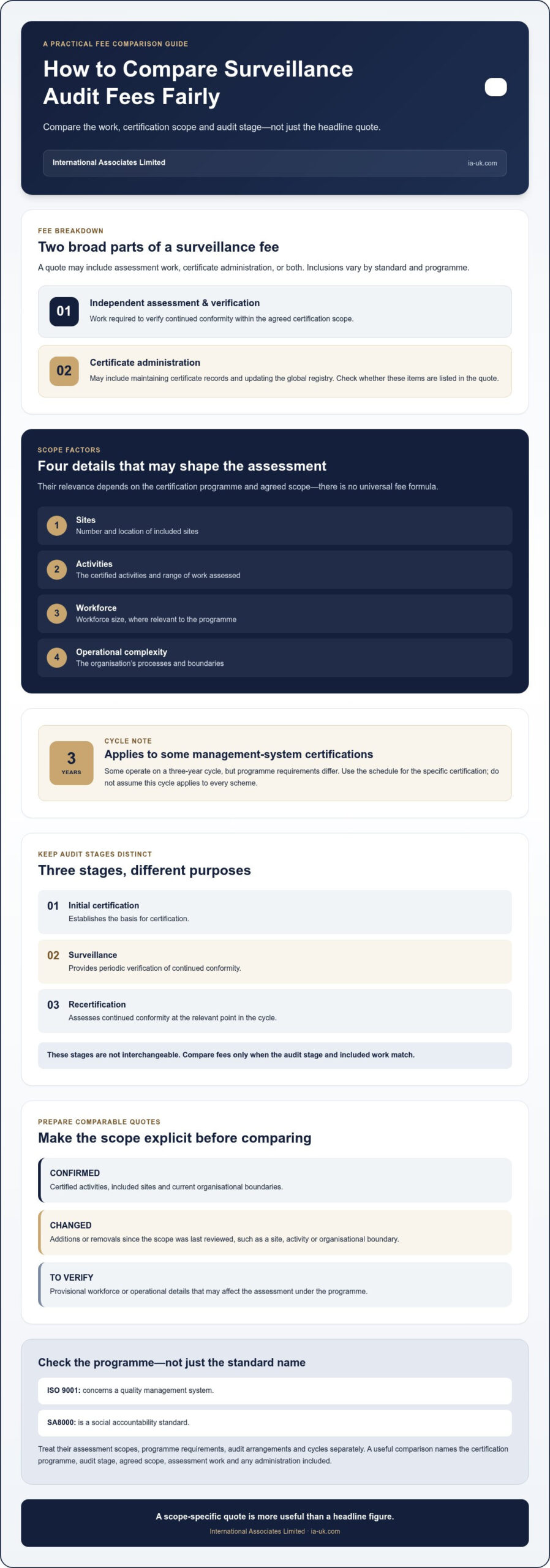
Before comparing recurring charges, identify the work each fee covers. Surveillance audit fees can include assessment activity and administration associated with maintaining certification. A quote is easier to evaluate when it names the applicable programme, agreed scope and included work rather than giving only a single figure.
A surveillance audit periodically verifies whether an organisation continues to conform to the requirements of its certification. The general concept of surveillance involves observation or monitoring. In certification, the purpose is more specific: assess continued conformity against the applicable standard or programme. It is not simply a routine certificate renewal.
For budgeting, separate two broad categories: independent assessment and verification, and certificate administration. The assessment relates to the certified scope. Administration may cover certificate records and global-registry updates. This distinction helps you see whether a quoted charge includes audit activity, administrative processing or both. Do not assume every programme includes the same items.
Which activities may be reflected in a surveillance fee?
The assessment component covers the work required to verify continued conformity within the agreed scope. Certificate maintenance and administrative processing are separate considerations, even when they appear together on a fee schedule. Inclusions vary by standard and programme, so compare the stated activities with the certification being assessed. Check for a description of the scope, audit work and any listed administrative items.
How surveillance fees fit into a certification cycle
Initial certification establishes the basis for certification, surveillance provides periodic verification, and recertification assesses continued conformity at the relevant point in the cycle. Some management-system certifications operate on a three-year cycle, but programme requirements differ. The relevant management system certification and its applicable cycle determine which stage is being priced.
This distinction matters when planning a recurring budget. A surveillance fee relates to a periodic assessment, while initial assessment and recertification are different stages with different purposes. Do not treat these charges as interchangeable or assume they cover identical work. If a programme follows a three-year cycle, use the schedule for that certification rather than applying the pattern to every scheme.
When reviewing a fee schedule, look for a clear description of assessment work, certificate administration and registry updates, alongside the standard, programme and scope each item applies to. If the quote groups these elements together, check that its description still explains what the recurring charge covers. This gives you a sound basis for comparing it with fees for another audit stage.
Which Factors Can Change Surveillance Audit Fees?
An accurate fee assessment starts with the certification programme and the scope to be assessed. Two organisations certified to the same standard may have different assessment requirements if their activities, sites or organisational boundaries differ. Treat these as details to describe accurately, not as a universal formula for calculating a fee.
How organisational scope can affect the assessment
The certificate scope defines the activities and organisational boundaries relevant to an assessment. The number and location of sites, range of activities, workforce size and operational complexity may be relevant, depending on the standard and programme. For example, an organisation operating across several locations may present a different assessment scope from one with a single site. The fee implications depend on the applicable programme and agreed scope.
Build a reliable fee request by separating confirmed information from assumptions. Start with what the certificate currently covers, then note changes since the last assessment, such as a new location, activity or organisational boundary. Label estimated workforce figures or site details as provisional. Current, precise information gives the certification body a clearer basis for a tailored assessment.
- Confirmed: certified activities, included sites and current organisational boundaries.
- Changed: additions or removals since the scope was last reviewed.
- To verify: workforce or operational details that may affect the assessment under the relevant programme.
This approach prevents a budget from relying on broad assumptions, such as treating every site or activity as equivalent. It also makes fee comparisons more useful because the scope being priced is explicit.
Why standards and audit programmes matter
Similar terminology does not make different certifications interchangeable. ISO 9001 concerns a quality management system, while SA8000 is a social accountability standard. Consider their assessment scopes and programme requirements separately. Establish the relevant factors, audit arrangements and cycle for the specific certification instead of inferring them from another scheme.
For social accountability work, an organisation’s activities and applicable programme scope help frame the assessment. International Associates conducts social accountability audits, with each assessment shaped by the relevant requirements and agreed scope. For management-system certifications, the standard and certified activities provide the corresponding context.
Before preparing or comparing a budget, identify the exact standard or programme, the current certificate scope and any changes to that scope. Keep confirmed details distinct from assumptions, and do not use another programme’s audit frequency or effort as a proxy. This gives a fee assessment a clearer basis and helps explain why a scope-specific quote may differ from a general estimate.
For a tailored view of management-system certification requirements and scope, review management-system certification options alongside your organisation’s certificate details.
Surveillance vs Initial and Recertification Fees: What Is Different?
Surveillance is not simply an administrative renewal charge. It can include assessment work to verify continued conformity, while certificate administration may be a separate part of the fee. Initial assessment, surveillance and recertification serve different purposes. Compare the audit stage and the scope each fee covers, rather than assuming a fixed price relationship.
| Assessment stage | Purpose | Fee context |
|---|---|---|
| Initial assessment | Evaluates the organisation’s management system or programme against the applicable requirements as a basis for certification. | Relates to the initial assessment scope and applicable programme arrangements. |
| Surveillance | Periodically verifies continued conformity within the certified scope. | May include assessment activity and certificate administration; stated inclusions depend on the programme. |
| Recertification | Assesses continued conformity at the relevant point in the certification cycle. | Relates to the recertification scope and programme requirements, rather than following a universal fee ratio. |
The table explains purpose, not price. Scope and programme-specific requirements determine the actual work. A quote for one stage cannot be compared fairly with another unless you account for differences in assessment purpose, covered activities and stated inclusions. Do not assume a fixed proportion between surveillance and initial or recertification fees.
How initial assessment differs from surveillance
Where a certification process uses stage 1 and stage 2, these are parts of the initial assessment, not recurring surveillance. They contribute to the evaluation for initial certification. Surveillance instead involves periodic checks of continued conformity after certification. Requirements and fee structures vary, so apply this distinction to the specific standard or programme.
For budgeting, identify the stage named in the proposal and check that its purpose matches the work being priced. Do not compare an initial assessment fee directly with a surveillance charge as though both cover the same assessment task.
When recertification enters the budget
Recertification is a distinct assessment point within the applicable certification cycle. It evaluates continued conformity at that stage, while surveillance provides periodic verification during the cycle. Cycle length, terminology and assessment requirements depend on the programme. Confirm them for the certification in question rather than applying another scheme’s pattern.
For an ISO 9001 project, consult ISO 9001 certification cost considerations as a related budgeting resource. Use it alongside the audit stage and scope under review. To assess whether a fee aligns with the work, compare the quoted stage, certification scope and included assessment or administrative items on a like-for-like basis. This makes surveillance audit fees easier to evaluate without relying on a generic estimate or assumed relationship to other stages.
How to Budget for Surveillance Audit Fees with Fewer Surprises
A useful budget starts with a precise description of the certification and assessment being priced. Use the same scope when reviewing fee information, and record changes that could affect the assessment. This helps distinguish a genuine difference in quoted work from a difference in what each fee covers.
Information to assemble before requesting a fee
Prepare the core certification details first. Describe the current scope clearly and include only the information needed to assess the fee.
- Identify the standard or programme. Record the exact certification the assessment relates to.
- Set out the current certificate scope. Summarise the activities and organisational boundaries covered.
- List the relevant sites. Note which locations fall within the certified scope and identify any changes.
- Specify the upcoming audit stage. State whether the requirement concerns surveillance, initial assessment or recertification.
- Record organisational changes. Note additions or removals to sites, activities, workforce or structure since the scope was last assessed, where relevant to the programme.
Separate confirmed details from estimates. For example, distinguish a location already included in the certificate from a planned site change that has not yet been incorporated into the scope. This makes the assessment basis clear and reduces the risk of budgeting against assumptions.
How to review a surveillance fee against its scope
Compare fee information using the same certification, audit stage and organisational scope. A like-for-like comparison should account for the sites and activities covered, as well as the stated inclusions. If the scope or stage differs, the figures may represent different work and should not be treated as directly comparable.
If the fee is itemised, review assessment activity separately from certificate administration. If charges are grouped, use the accompanying description to understand what is covered. Keep a record of the scope used for each assessment and update it when organisational changes occur. A current scope summary gives the certification body a practical basis for a tailored assessment.
Before setting a budget, check that it reflects the applicable programme requirements and the organisation’s current certified scope. Do not assume a previous cycle’s fee will remain applicable if locations, activities or other relevant details have changed. Nor should you infer expected assessment work from a different standard or programme.
For organisations reviewing management-system certification needs, consider management system certification services alongside the standard, audit stage and scope under consideration. This provides a relevant starting point for a scope-specific fee assessment.
Plan Your Surveillance Audit with International Associates
A tailored fee assessment begins with a clear picture of the certification and work involved. International Associates Limited is a UK-based independent auditing and certification body serving organisations globally. Matching the applicable standard or programme with the audit stage and certified scope helps frame the assessment around your organisation’s requirements, rather than a generic estimate.
Surveillance audit fees relate to the applicable assessment and associated administration. The basis for a project-specific fee is the certification being maintained, the scope under review and the stage in its audit cycle. Providing current information helps distinguish surveillance from initial assessment or recertification and supports a clearer understanding of the fee schedule.
Match the audit enquiry to the certification need
Start by identifying whether the requirement concerns social accountability or a management-system certification. These are separate service areas, each with its own programme context. For organisations assessing a social accountability pathway, International Associates Limited conducts social accountability audits. For management-system requirements, identify the exact standard and certified activities so the enquiry relates to the correct certification.
This distinction matters because scope and assessment requirements depend on the programme. A clear description of your certification need helps avoid treating different schemes as interchangeable when preparing an audit enquiry.
Request a scope-specific fee assessment
Provide the core details that define the work. A concise summary is easier to assess than an unstructured description:
- Standard or programme: name the certification the organisation holds or is pursuing.
- Certificate scope: describe the activities and organisational boundaries covered.
- Sites: identify the locations included in the scope.
- Audit stage: state whether the request concerns surveillance, initial assessment or recertification.
- Relevant changes: note any scope or organisational changes that may affect the assessment.
These details give the fee assessment a defined basis. If information is provisional, label it clearly so assumptions are not confused with the current certified scope. The assessment can then be aligned with the applicable programme and required work, without implying a standard fee or predetermined certification outcome.
For management-system requirements, review management-system certification services in relation to your standard and scope. To discuss your organisation’s surveillance audit requirements, share the relevant certification, audit stage, sites and scope with International Associates Limited.
Set a Clear Basis for Your Next Audit
Make the next step a planning decision: align your internal calendar with the certification cycle and assign responsibility for keeping relevant records current. A consistent process helps your team prepare for future assessments with fewer last-minute uncertainties.
International Associates Limited provides independent auditing and certification services. Use your organisation’s audit plan to identify the support that fits its certification needs, and include surveillance audit fees in ongoing certification planning.
Explore certification options and take a considered next step toward your organisation’s upcoming audit.
Frequently Asked Questions
How much do surveillance audit fees depend on the audit scope?
There is no universal figure because the assessment basis varies by programme and certified scope. For a useful budget, request a fee based on one clearly defined scope, then note possible changes separately rather than blending them into the baseline. This makes it easier to see how a revised assessment basis could affect the budget without treating an estimate as a standard rate.
What is included in a surveillance audit fee?
Inclusions depend on the relevant certification programme, so use the fee schedule or proposal to establish what the stated charge covers. For budget tracking, record quoted items under consistent labels, such as assessment-related charges and certificate administration where these are shown separately. This helps finance teams compare the planned amount with the final invoice and identify whether a difference reflects changed scope or a different stated item.
Are surveillance audit fees lower than initial certification fees?
There is no fixed fee relationship between surveillance and initial certification. For a sound comparison, review the full fee schedule for the certification cycle rather than judging one stage in isolation. Keep the same certified boundaries in view and distinguish recurring charges from assessment stages that occur at different points. This supports annual forecasting without assuming a surveillance charge will always be lower or represent a set share of initial fees.
How often are surveillance audits required?
The required frequency depends on the applicable standard and programme. Use the certification documentation and programme schedule to identify the next due assessment, then record that date in your organisation’s compliance calendar. If you hold multiple certifications, maintain a separate schedule for each, since one programme’s timetable cannot reliably serve as a reminder for another. This helps prevent budgeting against an assumed audit date.
Can changes to sites or operations affect surveillance audit fees?
They can affect assessment planning if a change alters the basis on which certification is assessed, subject to the programme’s rules. Maintain a change log with the date, description and status of each relevant change. This provides a traceable record for the next planning discussion and helps distinguish an implemented operational change from a proposal that has not taken effect.
What information should I provide to receive a surveillance audit fee assessment?
Alongside the standard, current scope, sites and audit stage, include the certificate reference or a copy of the current certificate if available. Point out changes since the last assessment and indicate which details are confirmed or provisional. A concise, dated summary is easier to assess than scattered notes and gives both parties a shared reference when discussing the fee basis.
What happens if our certification scope changes before surveillance?
Keep a dated record of the change and provide an updated scope summary before assessment planning is finalised. Identify what changed, when it took effect and whether it is temporary or ongoing. The applicable programme determines how to handle the change and whether it affects the planned assessment. Early documentation gives the assessment a current reference point and reduces reliance on an outdated scope description.