

Human rights due diligence is not a general legal requirement for UK businesses. However, the UK Modern Slavery Act requires relevant companies to report annually on steps taken to prevent and mitigate modern slavery in their operations and supply chains. The United Nations Guiding Principles on Business and Human Rights provide a broader framework for identifying, addressing and communicating human rights impacts. This UK mandatory human rights due diligence business compliance guide explains how that framework relates to current UK duties and proposed legislation.
Distinguishing legal obligations from recognised good practice can be difficult, especially when operations and supply chains cross borders. This guide explains what due diligence involves, how workers can raise concerns through accessible grievance mechanisms, and which UK and international laws may affect a business. It also outlines why proposed human rights and environmental due diligence legislation matters, and how risk assessment, action, tracking and transparent communication fit together.
Key Takeaways
- Understand how human rights due diligence identifies, addresses and tracks impacts on people across business operations and supply chains.
- Learn why accessible grievance channels and worker input can help surface concerns and inform effective responses.
- See how enforcement and potential penalties differ across legal frameworks, including the EU’s CSDDD.
- Compare UK requirements with international laws that may affect businesses operating across borders.
- Consider how proposed UK human rights and environmental due diligence legislation could shape future compliance planning.
What is human rights due diligence?
Human rights due diligence is an ongoing process for identifying, preventing and addressing actual or potential harm to people. In the UK, it is established good practice, while specific reporting and legal duties depend on the law and business context. This UK mandatory human rights due diligence business compliance guide sets out how supply-chain exposure and reporting duties fit within that process.
Supply-chain Scope and Risk Indicators
Supply-chain scoping maps the entities, activities and business relationships connected to a company’s operations, products and services. A credible risk assessment depends on understanding where goods and services originate, not just listing direct suppliers. Map subsidiaries, contractors and suppliers, then note locations, recruitment practices, materials and working conditions that may indicate modern slavery or other harm. Prioritise follow-up when potential harm could be severe.
Risks Across Supply-chain Tiers
Human rights risks can occur throughout supply chains, including beyond direct, Tier 1 suppliers. Raw materials, subcontracting and labour recruitment can involve businesses further upstream, where visibility may be limited. Forced-labour risks may therefore remain hidden if a review stops at the first supplier. Trace high-risk products and materials through successive tiers, using supplier information and worker perspectives to understand potential impacts connected to the company’s own operations, products or services.
Transparency and Modern Slavery Reporting
Transparency means explaining how a business identifies and addresses human rights impacts, including modern slavery risks in its supply chain. The UK Modern Slavery Act requires companies to report annually on steps taken to prevent and mitigate modern slavery in their operations and supply chains. UK businesses have no single general human-rights due-diligence turnover or employee threshold; proposed UK legislation would set a £36 million annual worldwide turnover threshold for subject companies. The European Union describes the CSDDD’s current scope as covering large EU companies with at least 1,000 employees and more than €450 million in net worldwide turnover, alongside some non-EU companies. Reporting should clarify which entities and business relationships are covered, including relevant ownership and value-chain boundaries.
Steps for Conducting Due Diligence
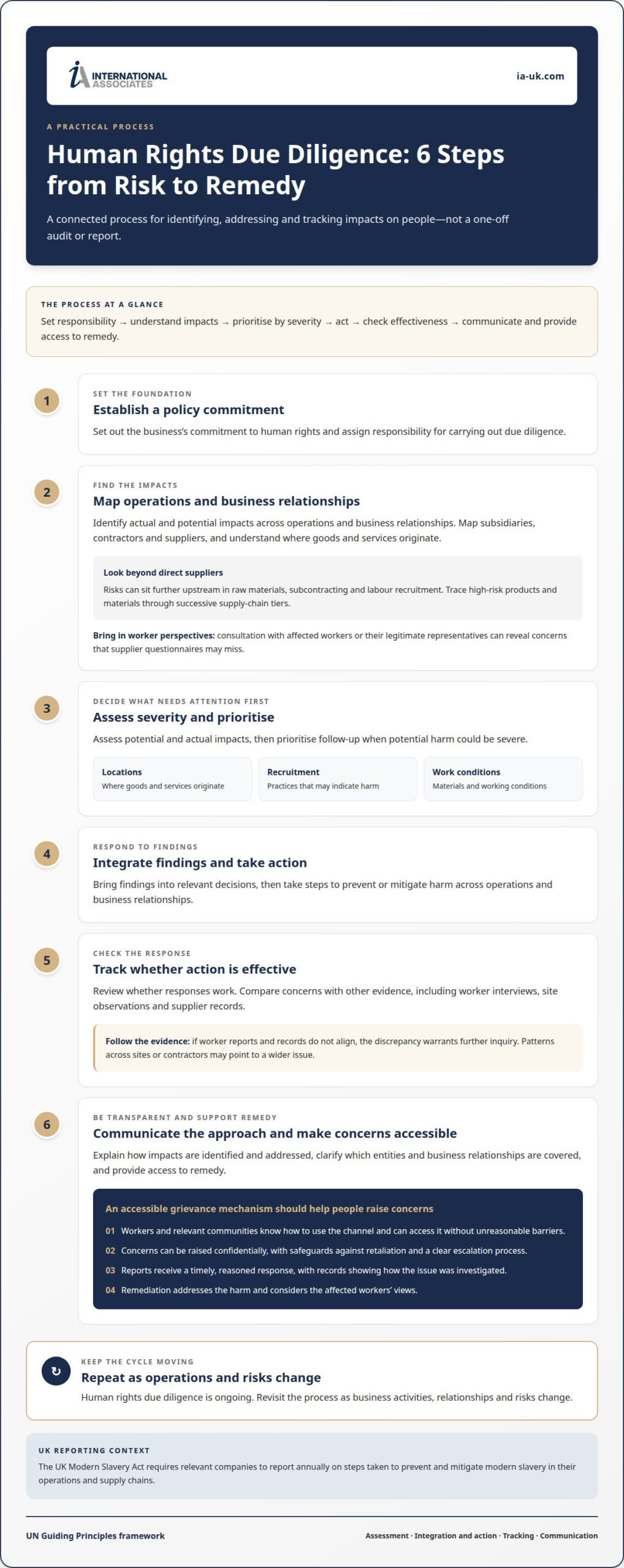
Human rights due diligence is a connected process, not a single audit or report. Start by establishing a policy commitment and assigning responsibility. Identify actual and potential impacts across operations and business relationships, consulting affected workers where possible. Assess severity to prioritise action, integrate findings into relevant decisions, and prevent or mitigate harm. Track whether responses are effective, communicate the approach, and provide access to remedy. Repeat the process as operations and risks change.
The United Nations Guiding Principles describe this as assessment, integration and action, tracking, and communication. They also call for policies and processes suited to each business’s size and circumstances. A practical compliance guide should distinguish this ongoing process from a one-off audit or report. Businesses mapping their obligations can use regulatory compliance resources to understand how requirements relate to operations and supply chains.
Worker voice and accessible grievance mechanisms
Workers may identify harm before it appears in formal records. Human rights due diligence should therefore include direct consultation with affected workers or their legitimate representatives, where possible and appropriate. Their feedback can reveal issues such as recruitment fees, withheld wages, unsafe conditions or retaliation that supplier questionnaires may miss.
An accessible grievance mechanism gives workers and affected communities a way to raise concerns, receive a response and contribute to remediation. Practical design matters: workers need to understand how to use the channel, communicate in a suitable language and raise issues without relying only on a supervisor who may be implicated. The mechanism should also explain how concerns are assessed and what happens after a report.
International guidance treats worker voice as part of identifying impacts and tracking whether responses work. A proposed UK human rights and environmental due diligence bill would require reasonable due diligence to include an effective grievance mechanism in line with United Nations Guiding Principle 31. That proposal points to a wider compliance principle: a reporting channel should help people affected by business activities, including those who are not direct employees.
Businesses can assess a grievance mechanism by asking whether:
- Workers and relevant communities know how to raise concerns and can access the channel without unreasonable barriers.
- Reports can be made confidentially, with safeguards against retaliation and a clear process for escalation.
- Each concern receives a timely, reasoned response, with records showing how the issue was investigated.
- Remediation addresses the harm experienced and considers the affected workers’ views.
These checks link grievance handling to due diligence review. A company can compare reported concerns with other evidence, such as worker interviews, site observations and supplier records. If workers report recruitment charges while records show no fees, the discrepancy warrants further inquiry. Reviewing patterns across sites or contractors can also show whether an individual report points to a wider failure.
Transparency matters after a concern is identified. Businesses should explain how workers can raise issues, how reports are considered and how remediation is followed up, while protecting personal information. Feedback from workers and affected stakeholders can help assess whether responses are effective, rather than relying only on internal performance measures. For organizations reviewing worker-related controls, a social accountability audit can provide an independent assessment relevant to workplace practices.
Enforcement bodies, penalties, and civil liability
Enforcement depends on the applicable law, the company’s activities and the conduct under review. The UK has no general legal requirement for every business to conduct human rights due diligence. However, specific reporting duties and laws governing goods can carry distinct compliance consequences. Businesses should distinguish voluntary alignment with the UN Guiding Principles from binding duties under relevant legislation.
For UK trade, the Court of Appeal’s June 2024 judgment in R (on the application of World Uyghur Congress) v National Crime Agency confirmed that anyone importing or selling goods in the UK, while knowing or suspecting they are products of forced labour, may face criminal investigation and prosecution. This makes knowledge and suspicion relevant risk factors. Due diligence records can help show what information was assessed and what action followed, but they don’t remove legal exposure where an offence is suspected.
In the European Union, the CSDDD provides for fines of up to 5% of net worldwide turnover. This is a substantial potential penalty, but it belongs to a different legal framework from current UK reporting duties. Some mandatory human rights due diligence laws also provide for administrative penalties or civil liability. Their enforcement arrangements and consequences differ, so international businesses need to identify which rules apply to each entity and activity.
Proposed UK amendments to the Modern Slavery Act would allow financial penalties for non-compliance of up to the greater of 1% of a reporting entity’s total turnover and £1 million. These are proposed penalties, not a general penalty applicable to every UK company. Separating enacted requirements from proposed measures helps avoid treating policy developments as current legal duties.
Enforcement can involve more than a fine. An oversight body may examine whether a company identified risks, took preventive action, monitored its response and reported accurately. A useful internal review links each identified impact to evidence, a responsible decision-maker and follow-up. For example, a forced-labour warning linked to a supplier should prompt a documented assessment and proportionate response, not just a sustainability statement.
For compliance teams, distinguish three outcomes:
- Regulatory action: an authority investigates or applies a penalty under the relevant law.
- Criminal exposure: conduct involving suspected forced-labour goods may lead to investigation and prosecution.
- Civil liability: applicable laws may provide a route to legal claims, separate from administrative penalties.
The UN Guiding Principles emphasise preventing and addressing adverse impacts, while legal penalties depend on the applicable statute. Keep evidence of decisions, escalation and remediation. This helps leadership explain what the business knew, how it responded and whether that response was reviewed.
Human rights and forced-labour laws in other jurisdictions
UK-based businesses may face human rights and forced-labour rules where they operate, sell goods or source materials. Laws differ in scope: some require due diligence, while others focus on public reporting or restrict imports. Map relevant entities, destination markets and supply-chain relationships before assessing which obligations apply.
In Germany, the Supply Chain Due Diligence Act applies to companies with more than 1,000 employees in Germany. It requires human rights and environmental due diligence across supply chains. Non-compliance can attract fines of up to 2% of average annual global turnover, and companies may be excluded from public tenders for up to three years. These consequences make employee location and procurement exposure important scoping factors.
France’s Duty of Vigilance Law applies to large companies with at least 5,000 employees in France or 10,000 employees globally. It requires covered companies to implement and report on human rights due diligence. Norway’s Transparency Act applies to large enterprises with more than 50 employees and more than €7 million in turnover. It requires due diligence and reporting on human rights in supply chains. The different thresholds show why a single global employee count may not answer every jurisdictional question.
Canada’s Fighting Against Forced Labour and Child Labour in Supply Chains Act requires covered entities to report annually on steps taken to prevent and reduce risks. A private entity must meet at least two of three thresholds in at least one of its two most recent financial years: CAD $20 million in assets, CAD $40 million in revenue, or an average of 250 employees. Reporting scope therefore depends on financial and workforce measures, not turnover alone.
US rules also address forced-labour goods through import controls. The US Tariff Act prohibits importing goods made, mined or farmed by forced labour, including goods containing materials produced through forced labour. The Uyghur Forced Labour Prevention Act directs US Customs to treat goods made, mined or farmed in China’s Xinjiang region as products of forced labour. Businesses serving US markets need traceability for relevant goods and inputs.
Australian reporting obligations offer another example: the Australian Modern Slavery Act requires subject companies to report annually on due diligence across their operations and supply chains. For businesses operating internationally, a practical review should record each country’s covered entities, threshold tests, reporting cycle, required disclosures and enforcement approach. Connect those requirements to supplier records, purchasing decisions and escalation processes. This comparison can show where one disclosure supports several regimes and where local rules require additional evidence.
Proposed mandatory human rights and environmental due diligence
The UK has no general legal requirement for every business to conduct human rights due diligence. Proposed legislation could introduce broader duties, so businesses should distinguish current reporting obligations from proposals. This UK mandatory human rights due diligence business compliance guide explains how proposals may affect compliance planning.
Proposed Human Rights and Environmental Duties
Proposed mandatory human rights and environmental due diligence would require covered businesses to assess and address adverse impacts connected to their operations and business relationships. The Commercial Organisations and Public Authorities Duty (Human Rights and Environment) Bill was introduced in the House of Lords on June 17. It would require subject companies with annual worldwide turnover of at least £36 million to report annually.
The proposal would also permit fines of up to 10% of a subject company’s global turnover. Its approach extends beyond modern slavery reporting, linking human rights and environmental analysis with preventive action and public accountability. Businesses should monitor the bill’s progress and examine whether its proposed scope could capture their entities, turnover or business relationships. This guide can help frame that assessment around proposed duties, rather than treating them as current law.
Environmental duties may also develop through separate legislation. The UK government aims to require businesses in Great Britain with annual turnover of more than £1 million, using forest-risk commodities and wood products, to conduct due diligence. Defra indicated that implementing legislation for UK deforestation measures is expected in 2027. This is a distinct proposal, not the same duty as the human rights bill.
UK Requirements for Mandatory Due Diligence
Human rights due diligence is not currently a general legal requirement in the UK, although the United Nations Guiding Principles on Business and Human Rights establish it as accepted good practice. The UK Modern Slavery Act requires relevant companies to report annually on steps taken to prevent and mitigate modern slavery in their operations and supply chains. These reporting duties are not the same as a comprehensive mandatory due diligence law.
For decision-making, separate the requirements into three categories: current reporting duties, proposed human rights and environmental duties, and other enacted rules affecting specific products or sectors. For example, the Environment Act 2021 establishes a framework restricting regulated persons from using forest-risk commodities or derived products in UK commercial activities unless relevant local laws are met. The proposed UK measures would add further due diligence obligations, subject to legislation and implementation.
A practical analysis can map each proposal against existing controls: identify potentially covered entities, assess relevant supply-chain and environmental risks, and record how findings inform decisions. This helps leadership prepare without treating proposals as current law. If strengthening environmental management is part of that preparation, consider ISO 14001 Environmental Management System Certification as a structured management-system option. Certification supports environmental management, but it does not replace legal due diligence or reporting.
International Associates Limited: ISO 22301 Business Continuity
International Associates Limited provides ISO 22301 Business Continuity certification for organisations seeking independent assessment of their business continuity management system. It may be relevant when a business wants to strengthen its approach to disruptions that could affect critical operations, suppliers or service delivery. Certification supports continuity planning; it does not replace human rights due diligence or legal reporting.
For concerns focused on workplace practices and worker welfare, Social Accountability Audits offer a more directly relevant assessment. The appropriate service depends on whether the priority is continuity management or social accountability. These activities can support wider governance, but businesses remain responsible for their legal duties and remediation decisions.
Build a more resilient compliance approach
Use this guide to make mandatory human rights due diligence a practical compliance priority: connect identified risks with clear ownership, evidence and decisions. As operations and business relationships change, review relevant controls and ensure worker concerns inform how responses are assessed. This approach helps organisations prepare for evolving expectations while keeping attention on the people affected by their activities.
International Associates Limited offers Social Accountability Audits, ISO 9001 Quality Management System Certification and ISO 14001 Environmental Management System Certification. These services address different assurance needs and do not replace legal advice or your organisation’s responsibility to meet applicable duties. Select the assessment that aligns with the management system or workplace practices you want independently evaluated.
Discuss your organisation’s needs and next steps with International Associates Limited. A considered, evidence-led approach can help make responsible business practice part of everyday decision-making.
Frequently Asked Questions
How is HRDD different from ESG?
HRDD focuses on how a business may affect people; ESG covers a broader range of environmental, social and governance topics. Keep the evidence trail distinct for practical reporting: an emissions metric or board-governance disclosure does not show how a labour concern was investigated. A company can include HRDD findings in its social reporting while recording the affected groups, decisions and follow-up behind each material issue.
What does due diligence mean?
Here, due diligence means a reasoned process for identifying and addressing possible or actual harm linked to business activity. It involves more than collecting supplier declarations. If a supplier’s records conflict with worker feedback, for example, the business should document the discrepancy, assess its significance and decide on appropriate further action. The process should produce evidence of decisions, not merely a completed questionnaire.
Why is worker engagement important in HRDD?
Worker engagement helps test whether formal records reflect people’s experience. A business can compare confidential worker feedback with recruitment documents, wage records and site observations. Conflicts between those sources may reveal a risk missed in management reporting. Engagement also helps establish whether proposed remediation addresses workers’ concerns. Workers should be able to share their views without relying solely on supervisors or channels controlled by the subject of a complaint.
Which UK laws require human rights due diligence or related reporting by businesses?
The UK has no general human-rights due diligence duty applying to every business. The Modern Slavery Act 2015 creates an annual reporting requirement for relevant companies, while the Environment Act 2021 establishes a framework for regulated forest-risk commodities. The practical distinction is between a company-wide due diligence duty and targeted obligations tied to reporting or particular commodities. Businesses should map duties to the legal entity, activity and goods involved.
What does the UK Modern Slavery Act 2015 require companies to report?
Relevant companies must report annually on steps taken to prevent and mitigate modern slavery in their operations and supply chains. A useful statement makes the reporting period and organisational scope clear, then describes actions in an understandable way. For example, distinguish supplier screening from follow-up when concerns are identified. Clear descriptions help stakeholders assess the company’s approach without implying that reporting alone eliminates modern-slavery risks.
What human rights risks and supply-chain activities should UK businesses assess?
Businesses should examine risks to people connected to their operations, products, services and business relationships. Consider recruitment arrangements, subcontracting, working conditions and the origins of high-risk materials. A direct supplier’s compliance statement may not reveal conditions at a labour provider or upstream producer. Record how each activity connects to the business, what evidence informs the assessment and which potential harms need attention based on severity.
What are the penalties and enforcement risks for non-compliance with UK human rights reporting laws?
Consequences depend on the applicable law and conduct. Proposed Modern Slavery Act amendments would allow financial penalties of up to the greater of 1% of a reporting entity’s total turnover and £1 million; these remain proposed measures. Separately, the June 2024 Court of Appeal judgment concerning the National Crime Agency confirms potential criminal investigation and prosecution risks for relevant forced-labour goods. Keep reporting evidence and escalation records distinct from proof that an offence did not occur.
How do UK requirements compare with the EU Corporate Sustainability Due Diligence Directive?
The UK’s general framework relies on targeted reporting and other specific laws, while the EU CSDDD establishes due diligence duties for companies within its defined scope. The European Union describes that scope as including large EU companies with at least 1,000 employees and more than €450 million in net worldwide turnover, alongside some non-EU companies. A group operating in both markets should map which legal entities and activities fall under each framework rather than assuming one report satisfies both.