

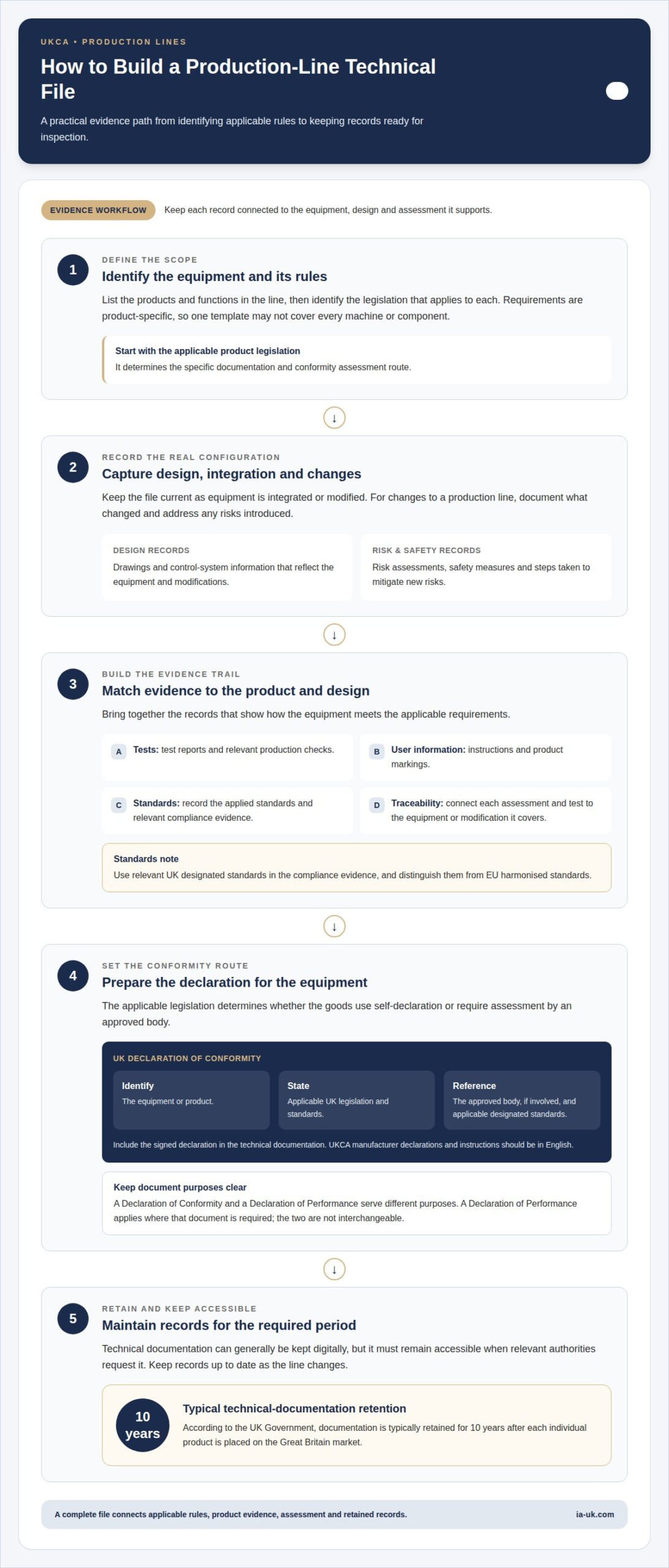
A production line’s UKCA technical file should show how the equipment meets the legislation that applies to it, including relevant design information, risk assessments and test evidence. The UKCA technical file requirements depend on the product’s applicable legislation, and according to the UK Government, technical documentation is typically retained for 10 years after each individual product is placed on the Great Britain market.
That can make documentation for an integrated line more involved than a file for a single machine. Modifications, control systems and safety measures may all need to be addressed. The UK Declaration of Conformity should also identify the equipment and state the applicable regulations and standards.
This guide explains what to include in a production-line technical file, what the declaration should cover and how to organise retained records. It also explains how assessment and certification can support a structured approach to product compliance.
Key Takeaways
- Build the production-line file around the legislation that applies to the equipment, with design records, risk assessments, test evidence and relevant production checks.
- Document control-system changes, safety measures and risks introduced by modifications so the file reflects the integrated line as it operates.
- Prepare a UK Declaration of Conformity that identifies the equipment and states the applicable UK regulations, standards and any approved body involved.
- Use relevant UK designated standards in the compliance evidence, and distinguish them from EU harmonised standards when documenting conformity.
- According to the UK Government, technical documentation is typically retained for 10 years after each individual product is placed on the Great Britain market.
UKCA Marking Production Lines: What Should Your Technical File Contain?
A production-line technical file brings together evidence showing how equipment meets the legislation that applies to it. The contents depend on the products and functions involved, so an integrated line may need records covering modified equipment, control systems and safety measures.
Manufacturer Documentation Duties
The manufacturer is responsible for compiling and retaining documentation that explains how the product meets its applicable essential requirements. For production lines, keep records current as equipment is integrated or modified, rather than waiting until a market surveillance request to assemble the evidence.
In Great Britain, technical documentation is typically kept for 10 years after each individual product is placed on the market, according to the UK Government. The Product Safety and Metrology (Amendment) Regulations 2024 allow businesses to use recognised EU requirements and conformity assessment processes for Fast-Track UKCA marking in Great Britain, according to the UK Government.
Demonstrating Compliance Through Documentation
Technical documentation demonstrates compliance by connecting product design and production evidence to the applicable legislation. A production-line file may include drawings, risk assessments, test reports, applied standards, instructions, product markings and relevant checks carried out during or after manufacture.
For example, if a line has modified control systems, its records should explain the changes and address any risks they introduce. A certificate alone may not show how the complete equipment meets requirements. Supporting test results and design evidence make the assessment traceable.
Technical Documentation and Technical Files
“Technical documentation” and “technical file” refer to the records used to demonstrate product compliance. The applicable legislation determines the specific contents. The file may be maintained digitally, bringing design records, evidence and declarations together.
UKCA manufacturer declarations and instructions should be in English. Technical files can generally be kept digitally, but the documentation must remain accessible when relevant authorities request it.
Product-Specific Documentation Requirements
The applicable product legislation determines which records belong in a file, so one production-line template may not cover every machine or component. First identify the equipment and relevant rules, then assemble the required design, risk, testing and user information for each product or integrated system.
UKCA technical documentation is similar in content to EU MDR/IVDR technical documentation, with minor differences. The relevant product regime still determines the specific evidence required. For imported non-machinery equipment, Great Britain importers need to be able to supply an actual copy of the technical file and must also hold a copy of the Declaration of Conformity.
If a requested file is incomplete or unavailable, the manufacturer or importer may be unable to demonstrate compliance through the required documentation. This can leave a market surveillance inquiry without the evidence needed to assess the product.
For organisations applying these requirements to products placed on the Great Britain market, regulatory compliance services provide a related route for addressing regulatory obligations.
UK Declaration of Conformity
A UK Declaration of Conformity records the manufacturer’s statement that a product meets applicable UK legislation. For a production line, the declaration must correspond to the complete equipment and any applicable conformity assessment route.
Declarations of Conformity and Performance
A Declaration of Conformity identifies the product and states its conformity with relevant legislation. A Declaration of Performance records declared product performance where that document applies. They serve different purposes and are not interchangeable. For a production line, determine which declaration the applicable product legislation requires, then include the signed document in the technical documentation.
Self-Declaration and Conformity Assessment
Some UKCA goods use self-declaration, while others require third-party conformity assessment by an approved body. The applicable product legislation determines the route, so establish it before finalising the declaration. If an approved body has assessed conformity, the declaration should identify the body and reference the applicable designated standards.
Assessment does not mean every technical file must routinely be submitted. Retain the file and make it available to market surveillance authorities on request. Provide documentation to an approved body when the applicable assessment process requires it. This distinction helps manufacturers prepare evidence without confusing retention with formal submission.
Risk and Conformity Assessment Records
Risk and conformity records show how hazards were assessed and how evidence supports the manufacturer’s declaration. For a modified line, records may include the risk assessment, revised design drawings, test reports, control-system information and measures taken to mitigate new risks.
Keep the records connected: each assessment should identify the equipment or modification it covers, and test evidence should correspond to the relevant design. If an approved body participates, retain its assessment information alongside the declaration and supporting technical evidence.
For each complete machine in a production line, include a signed Declaration of Conformity. Under the Supply of Machinery (Safety) Regulations, each incorporated partly completed machine requires a signed Declaration of Incorporation. The declaration for complete machinery should identify the equipment, its type, batch or serial number, manufacturer and the person authorised to compile the technical file.
A declaration should state the relevant UK legislation and applicable designated standards, rather than relying on EU references alone. It should also identify any approved body involved in conformity assessment. For example, the UK Electromagnetic Compatibility Regulations 2016 apply to electromagnetic compatibility products, so the declaration should reflect the legislation relevant to the equipment.
Use the product’s applicable legislation to determine whether self-declaration or third-party assessment applies, then align the declaration with the resulting evidence. A focused regulatory compliance review can help organisations assess which regulatory requirements apply to their products.
Designated and harmonised standards
For UKCA documentation, distinguish UK designated standards from EU harmonised standards. The applicable product regulations determine which standards matter and whether using a designated standard is voluntary or mandatory. A standard can support the compliance case, but connect it to the product’s design and evidence rather than listing a reference without explanation.
In Great Britain, designated standards are generally voluntary under most UK product regulations. Construction products are an exception: designated standards operate on a mandatory basis under the 2013 framework. This difference matters when compiling a file, since the applicable rules determine whether the manufacturer may choose another route or must follow the designated standard.
UKCA declarations should identify relevant UK regulations and UK specified standards, rather than rely on EU regulations and standards referenced in the Official Journal of the European Union. For example, BS EN ISO 13857 shows a British Standard prefix used when referring to a UK Designated Standard. The reference should match the product’s actual design and the legislation governing its placement on the Great Britain market.
Build a practical evidence trail for each standard cited. Record:
- The product, machine or system to which the standard applies.
- The design feature or safety issue addressed by that standard.
- The test report, drawing, calculation or inspection record supporting the claim.
- Any limitation where the standard covers only part of the equipment.
For machinery, this approach helps distinguish standards applied to the complete line from those used for an individual machine or modified control system. A line may combine equipment with different functions, so one standard reference should not be treated as evidence for every component. Connect each reference to the relevant drawings, control schematics, risk assessment or test result.
Market surveillance can examine whether the technical file supports the conformity claim in the declaration. Keep standard references consistent across the file, instructions and declaration. If an authorised representative delivers technical documentation to authorities for a manufacturer outside the relevant jurisdiction, clear references help identify the evidence linked to each product.
Economic operators should distinguish a standard’s status from its use as technical evidence. A harmonised standard does not become a UK designated standard simply because its technical content is familiar or similar. For UKCA records, identify the applicable UK regulation and the UK standard reference used. Retain separate EU references only where they support conformity documentation for the relevant market.
Before finalising the file, check each reference against the product category and applicable legislation. For example, a construction product and a machinery control system may follow different standards rules, even when they appear in the same production line. This helps prevent a standard from being presented as mandatory when the regulations make its use voluntary.
Retention period for technical files
Reliable retention depends on retrieving the correct record, not simply keeping a folder for a set duration. Assign a document owner for each product family and define who can approve changes to archived records. A controlled index, for example, can show the record owner, storage location, current status and relationship between product configurations.
Keep separate records for different revisions instead of overwriting earlier files. When a production line changes, preserve a clear link between the previous and revised configurations. A revision log can record the change identifier, approval status and affected product versions, helping staff select evidence that matches the equipment under review.
Use consistent file names and identifiers across the document system. A naming convention might combine a product model, document type and revision code, helping staff distinguish a drawing from an instruction or assessment. Keep the convention stable when responsibility moves between teams or records transfer to another storage platform.
Plan for format continuity. Digital records should remain readable and usable as software and storage systems change. Periodically test whether archived files open, linked records remain accessible and authorised staff can retrieve them. A file that exists but cannot be opened or located has limited practical value during an inquiry.
- Maintain an index that points to controlled records rather than relying on individual staff memory.
- Restrict editing of approved versions while preserving access for authorised users.
- Keep revision history so earlier product configurations remain distinguishable.
- Test retrieval using a product identifier and a sample document reference.
Retention planning should cover operational continuity, too. Assign a backup owner for records if the primary document controller changes role, and document how access is transferred. If a supplier provides supporting material, record its source and the related product configuration so the evidence remains understandable when project personnel change.
For a production line with several configurations, organise the archive by product family and configuration, not by project name alone. Project folders often contain unrelated commercial or engineering material that can obscure records needed for a particular product. A product-centred index makes retrieval more direct and reduces the risk of selecting obsolete documentation.
Review the archive structure when document systems or product identifiers change. A simple retrieval exercise can reveal broken references, duplicate files or unclear ownership before a formal request arrives. These controls help preserve the integrity and accessibility of technical records throughout their applicable retention period.
Information included in the UK DoC
A UK Declaration of Conformity should let an authority identify the product and understand the basis of its conformity claim. For a complete machine, include the equipment name, type, batch or serial number, manufacturer and the person authorised to compile the technical file. These details connect the declaration to the machine and its supporting records.
The declaration should state that the product complies with the relevant UK legislation and identify applicable UK specified standards. Use the British Standard references relevant to the product, rather than citing EU regulations and standards as the UK basis. For example, a declaration for electromagnetic compatibility equipment should reference the Electromagnetic Compatibility Regulations 2016.
Include the details needed to trace the conformity assessment:
- Product identity, including its type and batch or serial number where applicable.
- The manufacturer’s name and address, alongside the authorised technical-file compiler.
- The relevant UK regulations and applicable UK specified standards.
- The approved body’s details when one participated in conformity assessment.
- The signed declaration associated with the product’s technical documentation.
The declaration fields should match the technical file. If a declaration identifies a particular machine type, its drawings, test reports and risk assessment should relate to that same equipment. Consistent identifiers reduce ambiguity when a production line contains multiple machines or modified components.
If a UK Approved Body participates, identify it and reference its role in the conformity assessment. Some goods use self-declaration; others require third-party assessment. The applicable product legislation determines the route, so the declaration should reflect the assessment actually completed, not a generic statement used for every product.
A UK Declaration of Conformity should be available to market surveillance authorities on request. Keep a copy with the technical documentation and ensure the product identification matches the marking and related records. For imported products, the importer must also hold a copy of the declaration. An authorised representative may deliver technical documentation to authorities when acting for a manufacturer outside the relevant jurisdiction.
For a UKCA-marked production line, include a signed Declaration of Conformity for each complete machine. Where incorporated partly completed machines are subject to the Supply of Machinery (Safety) Regulations, each requires a signed Declaration of Incorporation. Keep these declarations distinct: they describe different conformity stages and should not replace one another.
Prepare the declaration in English and align it with the equipment’s documentation, applicable standards and completed assessment. A declaration does not replace evidence: it identifies the conformity claim, while the technical file supports that claim through relevant records. Organisations working through product regulatory obligations can review regulatory compliance requirements alongside their documentation process.
International Associates Limited: Social Accountability Audits
International Associates Limited provides Social Accountability Audits for organisations assessing social accountability practices across their operations and supply chains. These audits address a different assurance need from UKCA product documentation, but may be relevant when production-line compliance forms part of broader governance priorities.
Organisations seeking structured management-system assurance can also consider ISO 9001 Quality Management System Certification, ISO 14001 Environmental Management System Certification or ISO 45001 Occupational Health and Safety. Each addresses a distinct management-system area and does not replace product-specific conformity assessment or technical documentation.
Choose a Social Accountability Audit when independent assessment of social accountability is your priority. Contact International Associates Limited to discuss how an audit can support your organisation.
Build compliance into production-line change control
Keep compliance ownership active as production-line designs and processes evolve. Assign responsibility for maintaining records, connect relevant changes to internal review, and make sure decision-makers can trace why documentation was revised. This makes file maintenance part of routine governance, rather than a task that begins only when an authority requests evidence.
Align design, production and quality teams around clear document ownership. A controlled review process can help identify when a change affects product compliance evidence and which records need attention. Applying UKCA technical file requirements consistently is easier when review responsibilities form part of established change-control practices.
International Associates Limited’s assurance services may also support wider organisational priorities, while remaining distinct from product conformity assessment. For a considered discussion about your organisation’s needs, contact International Associates Limited. A disciplined approach can help your team maintain confidence as production requirements change.
Frequently Asked Questions
What do businesses need to know?
Define which products and configurations the compliance process covers before managing records. For a production line, distinguish the complete system from individual machines and document who controls updates when equipment changes. A product register linking each configuration to its responsible team and review status is a practical starting point. It clarifies scope when production, engineering and compliance teams use different records.
What are the differences in technical documentation for EU MDR and UKCA?
Manage documentation by intended market rather than assuming one file version serves every jurisdiction. A controlled master file can support market-specific versions, with separate declarations and regulatory references where required. For example, a document register can identify records supporting Great Britain placement and those supporting EU placement. This helps prevent teams from applying a market-specific declaration or reference to products intended for another market.
What is the UKCA mark?
The UKCA mark is a conformity marking for goods placed on the Great Britain market when applicable product rules require it. For production-line operators, a useful control is to align the marked product identity with the configuration released for use. The marking does not replace the underlying conformity evidence. Goods placed on the Northern Ireland market use a different marking arrangement.
Who is responsible for a product’s technical documentation?
The manufacturer is responsible for the product’s technical documentation. For an integrated production line, however, the end user is responsible for applying UKCA marking to the integrated system. This distinction matters when one manufacturer supplies individual machines that another organisation assembles into a line. Before commissioning, define who controls the final system’s marking and associated records so responsibilities are clear across supply and integration stages.
What documents must a UKCA technical file contain?
UKCA technical file requirements depend on the product legislation, so a practical file structure should make the relevance of each item traceable. Instead of collecting documents without context, use an index that connects evidence to the product configuration and compliance claim it supports. For example, identify a test report by the equipment or design version assessed. This makes the file easier to interpret when products share components but differ in configuration.
Which UK regulations and designated standards apply to UKCA technical documentation?
The product’s function and legal category determine which UK regulations and standards are relevant. For example, electrical equipment may fall under the Electrical Equipment (Safety) Regulations 2016, while radio equipment is covered by the Radio Equipment Regulations 2017. Use the product’s intended function to identify the applicable framework, then keep its regulatory references distinct from those for other products or systems made on the same line.
Who is responsible for compiling and maintaining the UKCA technical file?
The manufacturer compiles and maintains the technical file, while importer responsibilities depend on how goods enter the Great Britain market. An organisation bringing products from the EU into Great Britain becomes the importer. A buyer purchasing through a GB distributor is not the importer; the distributor or relevant GB office holds that role. Identifying the correct economic operator helps assign responsibility for document access and product records.
How long must manufacturers retain a UKCA technical file?
In Great Britain, technical documentation is typically kept for 10 years after each individual product is placed on the market, according to the UK Government. For practical administration, record the placement date against the relevant product identifier, not just the production run or project name. A retention register can then show which records remain within their applicable period and support orderly archive reviews.