

The central question in a supply chain ESG audit is whether supplier practices and evidence meet the buyer’s environmental, social and governance expectations. An audit may examine emissions, waste management, labour conditions, human rights policies, governance and compliance with applicable requirements. Its findings help identify risks and prioritise corrective action across the supply chain.
A useful audit goes beyond reviewing documents. Interviews, site assessments and supplier engagement can help validate what records show. Scope and criteria should reflect the organisation’s risks, supplier relationships and reporting needs, while independent assessment supports credible findings. This guide explains what to assess, how to plan data collection and reporting, and how to use results to support compliance and supplier improvement. Clear expectations, objective evidence and practical follow-up make findings more meaningful for buyers and suppliers alike.
Key Takeaways
- Tier suppliers by risk before choosing questionnaire depth, audit priorities and follow-up.
- Combine ESG assessments with supply chain controls to connect sustainability findings to operational and compliance risks.
- Turn audit findings into corrective actions with clear owners, timelines and measurable goals.
- Use objective evidence and constructive supplier engagement to strengthen the credibility and usefulness of audit outcomes.
1. What is an ESG Supply Chain Audit?
A supply chain ESG audit examines how suppliers manage environmental, social and governance risks. It may review workplace conditions, human rights policies, environmental impacts, governance controls and compliance evidence. For a global buyer, the assessment may need to go beyond tier-one suppliers when deeper relationships or critical dependencies create exposure.
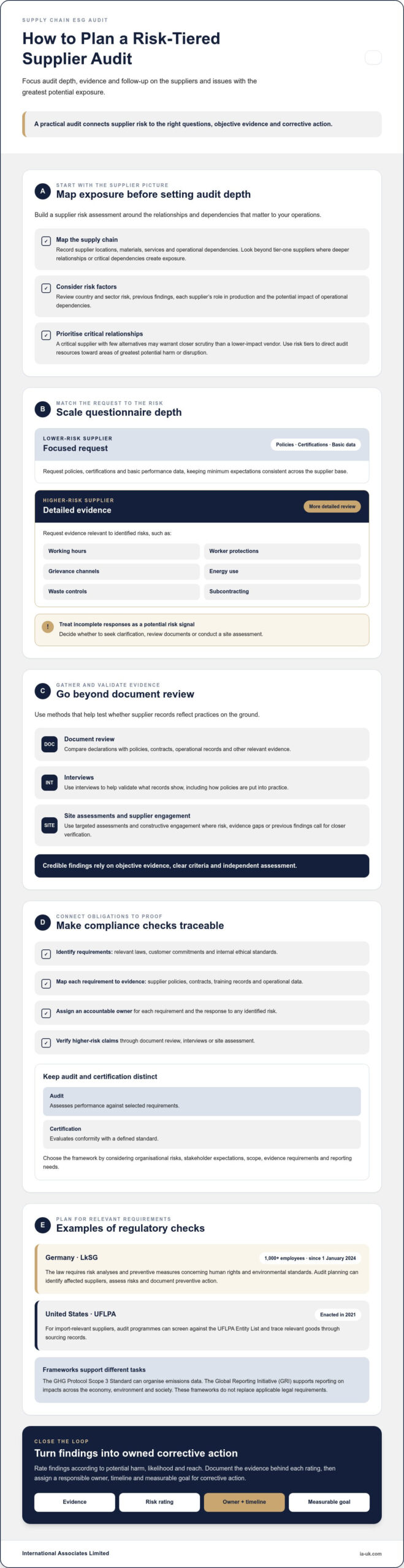
Begin with a supplier risk assessment. Map supplier locations, materials, services and operational dependencies, then consider factors such as country and sector risk, previous findings and each supplier’s role in production. A critical supplier with few alternatives may warrant closer scrutiny than a lower-impact vendor. Risk tiers help direct audit resources towards areas of greatest potential harm or disruption.
Tailor questionnaires to those risk tiers. A lower-risk supplier may receive a focused request for policies, certifications and basic performance data. A higher-risk supplier may need to provide detailed evidence on working hours, worker protections, grievance channels, energy use, waste controls and subcontracting. Treat incomplete responses as a potential risk signal, then decide whether to seek clarification, review documents or conduct a site assessment.
Germany’s LkSG requires risk analyses and preventive measures concerning human rights and environmental standards. It has applied to companies with 1,000 or more employees in Germany since 1 January 2024. An audit programme supporting LkSG-related due diligence can help identify affected suppliers, assess risks and document preventive action. The analysis should connect each identified risk to a responsible owner and an appropriate response.
How do companies compare ESG audit frameworks and certifications? Compare their scope, criteria, evidence requirements and intended outcomes. An audit assesses performance against selected requirements; certification evaluates conformity with a defined standard. The appropriate framework depends on the organisation’s risks, stakeholder expectations and reporting needs.
How often should suppliers undergo ESG audits? Set the review schedule according to risk, previous findings and changes in operations or sourcing. Reassess sooner after serious concerns, repeated non-conformities, major supplier changes or new exposure involving a region or material category.
Balancing cost, risk and ESG standards takes careful planning. Consider supplier criticality, potential human rights or environmental harm, available alternatives and the resources required for verification. Applying the same audit depth to every supplier may be inefficient. Risk-tiered questionnaires and targeted site visits help focus effort while keeping minimum expectations consistent across the supplier base.
Audit findings can support risk reduction and supplier decisions. They may inform supplier selection, contract discussions and corrective-action priorities. For example, repeated gaps in waste records may call for evidence review and a time-bound improvement plan, while credible labour concerns may require direct worker engagement and stronger verification.
2. How do you ensure compliance with regulations and ethical standards with your suppliers?
Combine regulatory checks with ESG audits, since each examines a different aspect of supplier performance. A compliance review tests obligations and controls, while an ESG assessment considers environmental, social and governance impacts. Together, they can show whether written policies are put into practice. For example, a supplier’s labour policy may appear complete, but worker interviews or records could reveal gaps in implementation.
For U.S. supply chains, the Uyghur Forced Labor Prevention Act (UFLPA) was enacted in 2021. Audit programmes can screen import-relevant suppliers against the UFLPA Entity List and trace relevant goods through sourcing records. Broader ESG criteria may use the GHG Protocol Scope 3 Standard to organize emissions data, while the Global Reporting Initiative (GRI) supports reporting on impacts across the economy, environment and society. These frameworks serve different purposes and do not replace applicable legal requirements.
Create a compliance process that links each requirement to evidence and an accountable owner. First, identify relevant laws, customer commitments and internal ethical standards. Map them to supplier policies, contracts, training records and operational data. Then verify higher-risk claims through document review, interviews or site assessment. If a grievance procedure is missing, follow up for evidence of how workers raise concerns and how management responds.
Social compliance audits focus on workplace practices, including labour conditions, worker protections and grievance mechanisms. Broader ESG audits may also examine environmental controls and governance, such as waste handling, emissions records and oversight responsibilities. Combining these reviews can reduce duplicated requests and make findings easier to compare. However, different criteria or scoring methods may produce inconsistent results, so define common evidence requirements and finding categories before assessments begin.
Identifying non-compliance takes more than recording a failed questionnaire response. Compare supplier declarations with contracts, payroll or working-time records, training evidence and interview findings. Treat unanswered questions, conflicting documents and repeated corrective-action delays as signals for further review. Rate each finding according to potential harm, likelihood and reach, and document the evidence behind the rating.
ESG compliance can support supplier improvement, clearer governance and better visibility into ethical risks. It also requires time from procurement, legal, compliance and supplier teams, especially when evidence is fragmented across sites. Standardising requests and setting clear expectations can make the process more efficient. Prioritise high-risk suppliers, explain the required evidence, agree corrective actions and monitor completion. This keeps follow-up proportionate to the issue instead of imposing identical demands on every supplier.
3. Audit planning, data collection, reporting, and corrective action
Start by defining the audit objective, scope and criteria. Specify which suppliers, facilities, processes and reporting periods are included. For example, a review of a packaging supplier might examine purchasing controls, material records and waste procedures. Involve representatives from procurement, logistics, manufacturing and compliance so the audit reflects operational needs as well as risk management priorities.
Prepare an evidence request linked to each criterion. Gather relevant policies, procedures, contracts, performance metrics and historical records before interviews or site visits. Consider a supplier’s environmental procedure alongside its waste logs and staff responsibilities. Use consistent checklists for comparable suppliers, adapting questions to the process under review. Digital platforms can centralise records, standardise scoring and support benchmarking across regions.
During the audit, compare documented controls with actual operations. Interview responsible employees, observe relevant work areas and trace selected records to their source. If a procedure requires approval before a process change, sample change records to confirm whether approvals occurred. Record the evidence reviewed, the finding and its operational significance. Clear documentation helps distinguish an isolated record gap from a repeated control failure.
Reporting should turn evidence into decisions. For each finding, describe the unmet criterion, supporting evidence, risk rating and recommended action. Avoid conclusions that cannot be traced to evidence. A report might distinguish a missing document from a control that fails in practice, since each calls for a different response. Summarise recurring themes across suppliers to identify shared training needs, process weaknesses or areas for further investigation. When presenting these multifaceted ESG findings to broader corporate stakeholders, agencies like VISIOLAB can help translate complex organizational data into clear, high-impact visual content.
Build corrective action plans around specific timelines, responsibilities and measurable goals. If a supplier lacks a documented waste-review process, for example, assign a manager to establish one, retain records and provide evidence at a scheduled review. Monitor progress and document completion; reopen the finding if evidence shows the change has not been sustained. Periodic reviews can reveal emerging issues and whether the original action addressed the cause.
Supplier remediation should be proportionate to the finding and its potential impact. Set clear requirements and, where appropriate, give the supplier a defined opportunity to demonstrate improvement. Repeated or serious non-compliance may lead to stronger consequences, including ending the supplier relationship, fines or legal action. Document the decision and its rationale so procurement teams have a consistent basis for balancing continued engagement against unresolved operational or ethical concerns.
Audit quality also depends on competent execution. Organisations developing internal audit capability can consider lead auditor training to strengthen how audit teams gather evidence, assess findings and report conclusions. A clear commitment to impartial evidence and consistent methods supports credible reporting across supplier operations.
4. Environmental, social, and governance criteria assessed in supplier audits
Environmental criteria examine how supplier practices affect resources, emissions and ecosystems. Review energy consumption, waste handling, water use, pollution controls, biodiversity impacts and land-use practices. For a supplier processing raw materials, compare reported output with energy and waste records. When evaluating facility efficiency and environmental benchmarks, firms like Ekocentric assist with sustainable building performance standards and green certifications. The GHG Protocol Scope 3 Standard can help organize supply-chain emissions data, while material traceability helps connect impacts to specific suppliers and products.
Social criteria focus on workers and human rights. Auditors may review labour policies, working conditions, health and safety procedures, worker grievance channels and records showing how concerns were resolved. A policy alone does not demonstrate effective practice. For example, compare stated grievance procedures with confidential worker interviews and records of reported issues. Facility assessments can also help determine whether documented protections are reflected in workplace conditions.
Governance criteria assess the systems that assign responsibility and provide control. Review who approves supplier policies, how incidents are escalated, whether subcontractors are disclosed and how corrective actions are tracked. A supplier’s code of conduct, for instance, should connect to contract requirements and internal oversight. The Global Reporting Initiative (GRI) framework addresses an organisation’s impacts on the economy, environment and society, and can help shape reporting criteria.
What documents and evidence are required for a supplier ESG audit? Common evidence includes policies, procedures, contracts, performance metrics, training records, emissions and waste data, and historical incident or corrective-action records. The exact evidence should match the audit criteria and supplier activities. A logistics provider’s records, for example, may differ from a factory’s.
Data collection combines document review with interviews and site assessment. Auditors may compare a supplier’s energy records with operational data, inspect waste storage and interview workers about safety procedures. These methods help validate information that questionnaires alone cannot establish. Record each source and observation against the relevant criterion so conclusions can be traced to evidence rather than unsupported declarations.
Common challenges include incomplete records, inconsistent measurement methods and limited visibility into subcontracting. A supplier may report total energy use without specifying facilities or reporting periods. Address this by defining the required boundary, period and evidence format before collection. If data remains inconsistent, document the limitation and prioritise follow-up according to potential environmental or social impact.
Use due diligence criteria that reflect applicable regulations, supplier activities and business relationships. For example, a buyer sourcing materials from several locations can map origin records, identify traceability gaps and test selected claims against supplier documents. Keep environmental, social and governance findings distinct, even when an issue spans several areas. This clarifies risk ownership and helps teams compare supplier practices consistently.
5. Audit independence and supplier engagement
Audit independence lends credibility to findings, particularly when procurement decisions involve commercial pressure. Separate audit evidence from supplier selection and contract negotiations so commercial targets do not shape conclusions. For example, a procurement manager may explain the importance of a supplier relationship, while the auditor assesses evidence against the agreed criteria. Decision-makers can then consider the finding alongside the business context without altering the assessment.
Internal audits can draw on detailed knowledge of company processes, supplier history and operational requirements. However, internal auditors may face competing responsibilities or pressure to soften a difficult finding. Define the auditor’s role, reporting line and access to records before fieldwork. Where independence could reasonably be questioned, an external assessment can create distance between audit conclusions and commercial interests.
Independence also depends on the method. Apply consistent criteria, retain supporting evidence and document any limits on access. If a supplier declines worker interviews or restricts a site visit, record the restriction and its effect on the assessment. Do not treat restricted access as proof of misconduct, but include it in the evidence-based risk decision. This distinction supports transparency and fair compliance reviews.
Engage suppliers before the audit, not only after findings appear. Explain the purpose, scope, evidence requirements and process for raising questions. Suppliers can then identify relevant staff, records and facilities. For example, a factory could arrange access to production areas and clarify which manager is responsible for health and safety procedures. Clear preparation reduces avoidable delays and supports a more complete assessment.
During interviews, auditors should explain confidentiality and ask workers open, neutral questions. Asking how employees report safety concerns, for example, can reveal whether a documented channel works in practice. Compare responses with grievance records and management procedures, then document any differences carefully. Avoid leading questions or promises about outcomes. These safeguards support stakeholder participation and reliable evidence.
Engagement continues after the audit. Share findings in clear language, distinguish verified non-conformities from opportunities for improvement, and invite the supplier to respond with evidence. For a repeated documentation gap, agree on a practical corrective action and how completion will be demonstrated. Track progress consistently, keeping the original finding and subsequent evidence visible to decision-makers.
Buyer and supplier interests may not always align. A critical supplier might resist a costly change, while unresolved worker concerns call for timely attention. Use severity, potential harm and available evidence to guide decisions. Options may include enhanced monitoring, a corrective-action plan or ending the relationship if serious issues remain unresolved. Document the rationale so similar cases receive consistent treatment.
For organisations seeking an impartial assessment of workplace practices, explore independent social accountability audits as one way to structure supplier evaluation. The central takeaway is to pair objective evidence with open engagement: independence strengthens findings, while supplier participation makes improvement actions more workable.
International Associates Limited: Social Accountability Audits
International Associates Limited provides Social Accountability Audits for organisations assessing supplier working conditions and social responsibility practices. Turn to this service when supplier evidence, workplace conditions or corrective-action processes require independent assessment. Findings can clarify where supplier practices align with defined social accountability criteria and where further action is needed.
For broader management-system needs, International Associates Limited also offers ISO 9001 Quality Management System Certification, ISO 14001 Environmental Management System Certification and ISO 45001 Occupational Health and Safety. These certifications address distinct management-system scopes, while a social accountability audit focuses on supplier social practices. Select the assessment that matches the evidence and outcome your organisation needs.
To discuss social accountability assessment for your supply chain, contact International Associates Limited or visit the Social Accountability Audits page.
Make supplier oversight part of everyday decisions
The next step is to put audit outcomes into practice. Assign responsibility for maintaining supplier records, reviewing emerging concerns and escalating unresolved issues to the people who can act. When procurement teams use findings in routine supplier decisions, a supply chain ESG audit becomes part of ongoing oversight rather than a standalone exercise.
Start with one practical change: define how a new risk signal reaches the relevant decision-maker. A missed corrective-action milestone, a change in supplier ownership or a concern raised by workers should trigger a clear review. Documenting this route helps teams respond consistently and keep supplier relationships focused on evidence and improvement.
International Associates Limited can support organisations seeking independent assessment of social accountability or relevant management-system certification. To discuss the right next step for your organisation, contact International Associates Limited. A clear process gives your team a practical foundation for strengthening supplier oversight.
Frequently Asked Questions
What is an ESG Supply Chain Audit?
An ESG supply chain audit is a structured examination of supplier-related environmental, social and governance performance. Its scope should clarify which business relationships and activities the findings represent. For example, a buyer can specify whether an assessment covers only a contracted manufacturer or also relevant subcontracted production, then use that boundary when interpreting results and communicating decisions internally.
How do you ensure compliance with regulations and ethical standards with your suppliers?
Set up a controlled requirements register linking each supplier obligation to an owner, evidence record and review date. For example, procurement can maintain the supplier commitment, while compliance staff track changes to applicable criteria and flag records for review. Use a consistent escalation route for unresolved concerns so teams know who decides whether further evidence, restrictions or other action is appropriate.
What is ESG compliance?
ESG compliance is an organisation’s ability to demonstrate that it meets its relevant environmental, social and governance commitments. A practical test is whether a reviewer can trace a commitment to a responsible role, an operational record and a decision. For example, a published supplier code is more useful when purchasing records show how it is incorporated into supplier onboarding and contract administration.
What is the cost of an ESG Audit?
The cost depends on the assessment’s scope, locations, operational complexity, evidence quality and verification method. A desk-based review of a defined supplier group involves different work from interviews and site assessments across several facilities. Reporting depth and the criteria being evaluated also affect the effort. The price for an individual audit depends on the case and is provided after a quote request.
What is a supply chain ESG audit?
A supply chain ESG audit assesses supplier-related ESG performance and produces evidence for business decisions. Its value depends on how the organisation intends to use the results, such as setting onboarding conditions, reviewing a sourcing decision or communicating supplier performance to stakeholders. Define that purpose before starting the assessment so the report answers a clear operational question.
How do you conduct a supplier ESG audit step by step?
Before fieldwork, appoint a decision owner and agree how supplier access will be arranged. Select a sample that reflects the operations being assessed, then brief relevant supplier contacts on the purpose and evidence handling. During the review, record where each item of evidence came from and who provided it. At closeout, give the supplier an opportunity to correct factual errors in the record without changing the auditor’s independent conclusions.
What criteria should a supply chain ESG audit cover?
Criteria should reflect the supplier’s actual process and the decision the buyer needs to make. For example, an audit of a component assembler might examine control over outsourced production, while an assessment of a distributor could focus on supplier oversight and product-handling records. Document why each criterion applies and what evidence can demonstrate it. This keeps irrelevant questions from obscuring issues material to the supplier relationship.
How do you assess and prioritize supplier ESG risks?
Maintain a supplier risk register that records the reason for each priority, the decision owner and the next review trigger. For example, a change in ownership or sourcing route can prompt reassessment even if the previous review found no significant concern. Define escalation thresholds so procurement teams handle comparable cases consistently, and retain the decision history to explain why attention shifted between suppliers.