
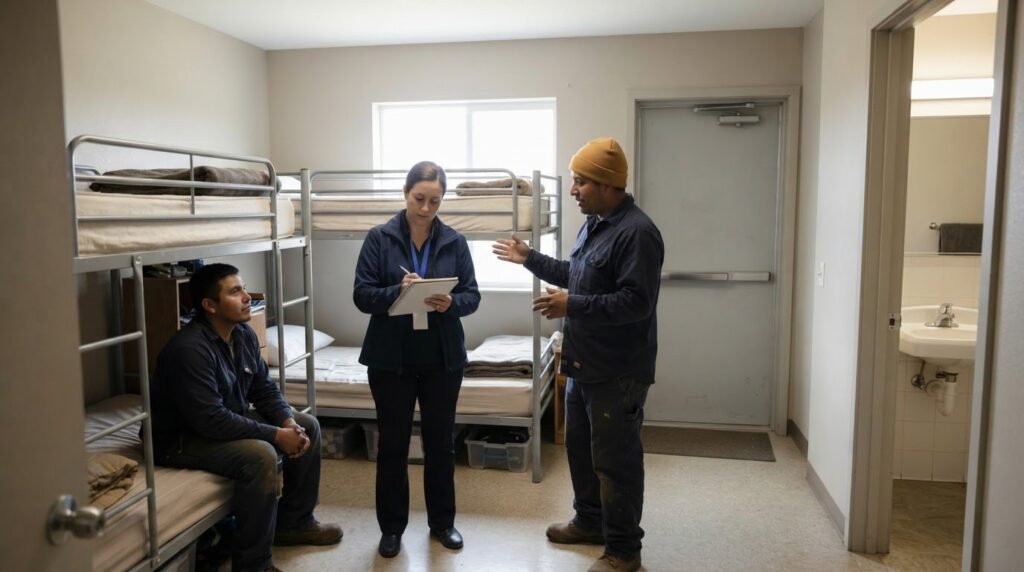
A clean file is not the same as a responsible workplace. What auditors look for in a social audit is evidence that working conditions and employment practices align with applicable requirements, including records, worksite observations and employee feedback. They assess areas such as workers’ rights, health and safety, wages, working hours, and risks of forced or child labor.
It’s reasonable to expect an audit to reveal whether workplace practices meet relevant standards. Its findings, however, reflect the evidence gathered at a particular point in time, so the quality of that evidence matters. Records need to be considered alongside what auditors observe and what workers can share safely.
This article explains what auditors look for in a social audit, including the main areas assessed, the documents and other evidence they may review, and how findings can guide corrective action and ongoing monitoring. It also explains how preparation supports a credible assessment and responsible practices across workplaces and supply chains.
Key Takeaways
- Assess workplace practices against the requirements that apply to the site, including workers’ rights, employment conditions, and health and safety.
- Auditors build findings from objective evidence, bringing records together with worksite observations and worker feedback.
- Clear audit criteria and appropriate evidence help distinguish documented procedures from practices actually in use.
- Organised records, access to relevant people, and preparation for sensitive interviews can support a more reliable assessment.
- Useful findings identify issues and support corrective action, while continued monitoring helps track progress across workplaces and supply chains.
How do social audits support compliance with laws like the CSDDD?
Social audits compare workplace evidence with applicable laws, codes and standards, helping organizations identify gaps and document findings. In supply-chain due diligence, including the context of the Corporate Sustainability Due Diligence Directive (CSDDD), an audit can inform risk assessment and improvement, but it does not replace a company’s broader responsibilities.
Audit Report Quality and Recommendations
A useful audit report links each finding to the relevant evidence, criterion and workplace or process assessed. It explains what auditors observed, why it matters, and which records or interviews support the conclusion.
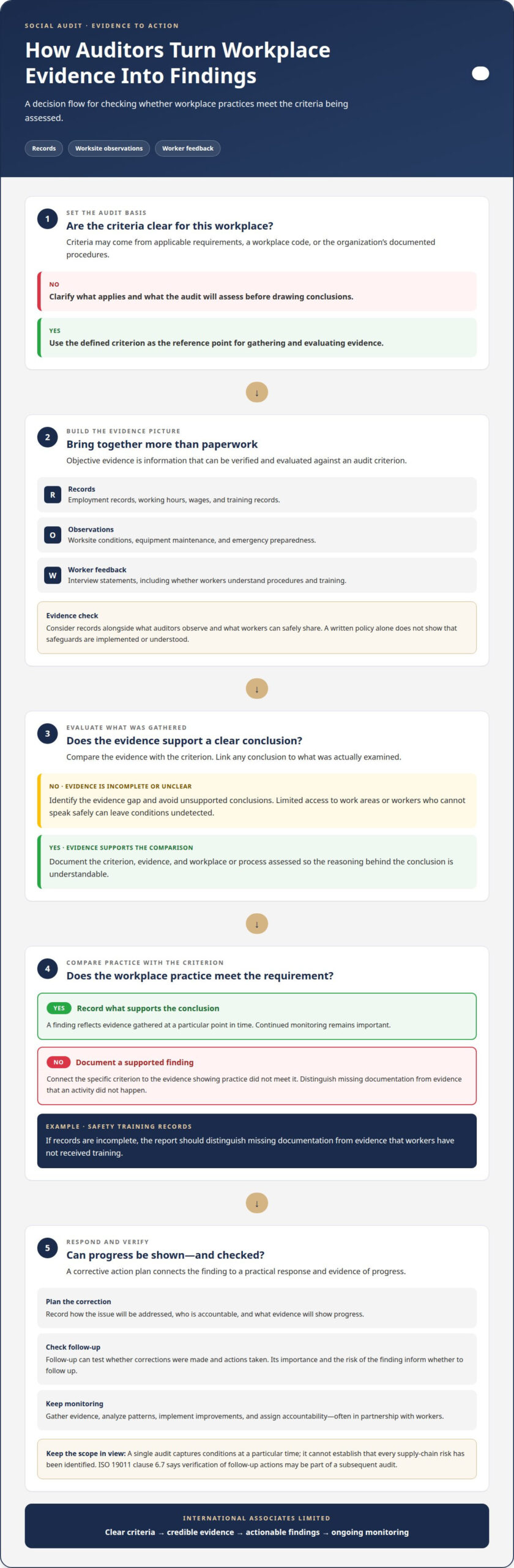
Actionable recommendations identify a practical response and who is responsible for progressing it. For example, a finding about incomplete safety training records should distinguish missing documentation from evidence that workers have not received training. This detail helps an organization prioritize issues and communicate them clearly to internal teams or business partners.
Analytics tools can organize findings across sites, suppliers and audit periods. Filters for issue type, location, severity or corrective-action status can reveal recurring patterns, such as training gaps across several facilities. These patterns help direct attention to higher-risk areas. A dashboard supports analysis, but does not replace the records, auditor observations or worker feedback that substantiate a finding.
Corrective Action and Follow-Up Reporting
A corrective action plan records how an organization will address a finding, who is accountable, and what evidence will show progress. Each action should link to the original finding, helping managers distinguish a completed task from an effective correction.
Follow-up can test whether corrections were made and corrective actions taken. ISO 19011 clause 6.7 says verification of follow-up actions may be part of a subsequent audit. The decision to follow up is based on the importance and risk of the finding. Clear status reporting also helps responsible teams track overdue actions and recurring issues.
Monitoring should be continuous: gather evidence, analyze patterns, implement improvements and assign accountability, often in partnership with workers. A single audit captures conditions at a particular time; it cannot establish that every supply-chain risk has been identified. Social audits can miss serious abuses, especially when workers cannot speak safely or access to relevant work areas is limited. Weak evidence or rushed fieldwork can leave harmful conditions undetected.
Labor Laws and Workplace Safety Checks
For a U.S. workplace, relevant labor requirements depend on the work, location and workforce assessed. Auditors compare practices and records with applicable legal criteria and the organization’s own procedures. The assessment may cover employment records, working hours, wages, worker interviews, and procedures addressing forced or child labor.
Safety checks examine workplace conditions, emergency preparedness, equipment maintenance and training records. An auditor may compare a written emergency procedure with site conditions and ask workers how they would respond. A policy alone does not show that safeguards are implemented or understood.
Social audit findings can support compliance management, but should be considered alongside other due-diligence information. Under U.S. auditing standards, an auditor may disclose Key Audit Matters in an independent auditor’s report only when specifically engaged to do so. Key Audit Matters belong to that reporting context; they are not a standard section of every social audit report. Distinguishing the report’s purpose, evidence and follow-up status makes its conclusions more useful to decision-makers.
Audit definitions and objective evidence
ISO 19011:2018 defines an audit as a systematic, independent and documented process. Auditors obtain and evaluate evidence against defined criteria. Understanding what auditors look for in a social audit starts with identifying those criteria and how they apply to the workplace being assessed.
Audit Definitions and Standards
The audit criteria establish what the auditor will assess, such as a workplace code, applicable requirements or an organization’s documented procedure. ISO 19011:2018 guides the audit process, while the selected social standard or code provides subject-specific criteria. Keeping these roles distinct helps organizations understand what the engagement covers and how its conclusions should be interpreted.
For example, a procedure may require employees to receive particular training. The audit examines whether records and other evidence support that requirement. A process audit considers whether activities follow predetermined instructions or standards; a system audit examines whether relevant management-system elements are documented and implemented.
Objective and Supporting Evidence
Objective evidence is information that can be verified and evaluated against an audit criterion. It may include records, direct observations, measurements or interview statements. A non-conformity should connect a specific criterion with evidence that practice did not meet it. This makes the finding understandable and distinguishes a supported conclusion from an assumption.
Consider a requirement to maintain training records. An auditor could review those records against the relevant procedure. If information is missing, the finding should identify the requirement and evidence examined, rather than make an unsupported claim about every worker. If interview feedback differs from documentation, the auditor can investigate and record the basis for the conclusion.
Audit Fieldwork and Evidence Gathering
Fieldwork involves understanding organizational processes and checking whether controls operate as intended. Auditors may inspect workspaces and equipment, review payroll or other documents, interview workers, and measure environmental conditions. Evidence from different sources can provide a clearer picture than a single record alone.
For example, an equipment inspection shows its condition during the visit, while maintenance records document servicing. Interviews may explain how procedures work in practice. Auditors compare these sources with applicable criteria, investigate inconsistencies and document the evidence supporting their findings. Knowing what auditors look for in a social audit also means understanding how each conclusion relates to the scope and evidence reviewed.
Organizations seeking an independent assessment can explore Social Accountability Audits to assess workplace practices against relevant criteria.
Audit preparation, documentation, and training
A social audit moves from defining its scope to gathering evidence, assessing findings and reporting results. Preparation establishes the criteria, records and access needed for an effective engagement; training equips auditors to handle sensitive evidence appropriately.
Before fieldwork, the audit team establishes which site, processes and requirements are in scope. The organization provides relevant records, requested information and access to people as needed to gather evidence. A clear schedule helps coordinate document review, workplace observation and interviews without confusing audit activity with routine operations.
The audit process can be understood through these connected stages:
- Set the scope: identify the workplace, processes and applicable criteria, such as a code of conduct or standard.
- Plan evidence gathering: determine which records, observations and interviews can address each criterion.
- Review documentation: examine relevant records, including payroll information or training documentation where these relate to the audit scope.
- Conduct fieldwork: observe work areas and speak with people who can explain how procedures operate in practice.
- Assess and report: compare evidence with criteria, document findings and communicate conclusions to the audit client.
These stages cover the process from preparation through reporting. Their sequence helps the audit team connect each conclusion to the scope and evidence collected.
Documentation supports an audit when it can be related to actual practice. A written procedure may describe a workplace process, while records and observations show how it is applied. Auditors compare relevant sources and record inconsistencies for assessment. This helps distinguish evidence of implementation from a document describing an intended process.
Planning also affects the value of site observations. Audits scheduled during periods when violations are more likely can reveal conditions that routine periods may not show, such as harvest time in agriculture or maximum production in manufacturing. Unannounced visits can help auditors observe typical worksite conditions. Timing and access shape what the auditor can assess directly.
Worker interviews require more preparation than a question list. Auditors need procedures for handling sensitive situations involving children and adult victims of exploitation. Interviews should take place where workers can speak safely and openly, not in front of managers. Where children may be involved, auditors need to interact appropriately and take age-appropriate measures on their behalf.
Training develops auditors’ ability to conduct interviews, assess evidence and respond to disclosures without compromising independence. Protocols should explain how to respond when a worker describes possible exploitation and how to involve qualified individuals or organizations in providing immediate care. These procedures help the audit team handle sensitive information consistently and raise urgent concerns through suitable channels.
Reporting closes the engagement by presenting findings against the agreed criteria and evidence. A concise report identifies the assessed area, evidence considered and conclusion reached. If records are incomplete or interview accounts differ, that context should be documented, not concealed. Clear reporting helps the organization understand what the audit established and which findings need attention.
What is a social audit and what standards or frameworks do auditors use?
A social audit compares workplace practices with applicable laws, codes and standards concerning human rights, labor rights and environmental rights. Its assessment criteria depend on the workplace, the organization’s commitments and the audit’s purpose.
What the assessment covers
At a worksite, an assessment can examine employment practices, workers’ conditions and effects on local communities. Auditors compare actual practices with applicable legal requirements, international standards, best practice and the organization’s sustainability goals.
A social audit reflects conditions at a particular point in time. It does not provide continuous assurance about every workplace or supply-chain relationship. The report addresses the scope and evidence examined, not every possible risk beyond the assessment.
Social compliance assessments commonly consider working conditions, employee rights, health and safety, fair wages, working hours, and forced or child labor. The selected criteria determine how each topic is assessed. For example, a working-hours review may compare workplace records and practices with the requirements used for the engagement.
How frameworks differ
Frameworks have different scopes and outputs, so their results are not interchangeable. Some assessments focus on labor standards and health and safety; broader approaches may also cover environmental performance and business ethics. The scope should make clear which subjects and criteria were included.
International Labour Organization conventions can inform social audit criteria. Convention No. 87 concerns freedom of association, while Convention No. 98 concerns the right to collective bargaining. Conventions Nos. 29 and 105 concern eliminating forced labor, and Nos. 138 and 182 concern abolishing child labor. These subjects can be assessed alongside workplace requirements and applicable standards.
A framework’s purpose shapes what its findings demonstrate. An assessment may provide evidence about workplace practices against defined criteria, while another process may collect and verify social and labor data without issuing a certification or facility score. Identify the intended output before interpreting results.
Selecting relevant criteria
The appropriate criteria depend on what the organization needs the assessment to establish. A buyer may request a specific scope, while a company may want to assess its own code or sustainability goals. These purposes can overlap, but the audit scope and reporting outcome should remain clear.
For example, a facility reviewing labor conditions may need criteria covering working hours, worker rights, and health and safety. A wider assessment may also examine environmental performance or business ethics. Naming a standard alone does not show what was examined; the scope and selected criteria should be clear in the report.
Before using the results, identify whether the output is an audit report, verified data or a certification assessment. This distinction clarifies what the findings demonstrate and how they relate to the organization’s social responsibility objectives.
International Associates Limited: Social Accountability Audits
International Associates Limited provides Social Accountability Audits for organizations assessing workplace practices against relevant social accountability criteria. An audit can identify where evidence indicates conformity, where findings need attention, and what requires follow-up. It can be a practical next step when a buyer requests an assessment, a business reviews supplier conditions, or an organization needs an independent view of its workplace practices.
For teams developing auditing capability, Lead Auditor Training supports learning in audit methods and evidence assessment. The right route depends on whether you need an external assessment or training for your personnel.
Contact International Associates Limited to discuss Social Accountability Audits or Lead Auditor Training for your organization.
Make Your Next Social Audit a Practical Step Forward
Use the audit process as a starting point for strengthening social responsibility management over time. Knowing what auditors look for in a social audit can help your organization set priorities, identify the evidence needed and decide how findings will inform future decisions. Connect assessment objectives with the workplaces, suppliers or business practices that matter most to your organization.
International Associates Limited provides Social Accountability Audits for organizations seeking an independent assessment. Where broader management-system priorities apply, it also offers ISO 9001 Quality Management System Certification and ISO 14001 Environmental Management System Certification. Selecting the right assessment depends on the outcomes your organization needs to address, from social accountability to quality or environmental management.
Discuss the appropriate next step with International Associates Limited. A clearly defined objective can help your organization move forward with confidence and purpose.
Frequently Asked Questions
What do social audits assess and why do they matter?
Social audits assess whether workplace practices align with defined social responsibility criteria, including labor rights, working conditions, health and safety, and relevant environmental or community concerns. Findings help organizations prioritize workplace issues and evaluate suppliers. For example, a company onboarding a new supplier can use site-specific evidence to identify areas needing attention before relying on broader supply-chain assumptions.
How often should a company carry out social audits?
Audit frequency should reflect the organization’s risk profile, location, customer requirements and changes in its operations or supply chain. A new supplier relationship, a serious labor-related complaint or a significant production change may prompt an assessment sooner than a routine schedule. Set a risk-based cadence, then reassess it when workplace conditions or business expectations change.
What’s the main purpose of a social audit?
The main purpose is to evaluate workplace practices against defined social responsibility criteria and provide evidence for decisions. An audit can help a company understand conditions at a supplier site or assess whether its own commitments are reflected in operations. It is one input to broader due diligence, not a replacement for ongoing responsibility. For instance, a buyer can use findings to guide supplier engagement and improvement priorities.
What records and documents do social auditors review?
Auditors select records relevant to the assessment scope. These may include payroll and working-time records, employment policies, safety procedures, maintenance logs, training documentation and grievance records. Comparing written policies with operational evidence helps assess how they work in practice. For example, a training procedure can be considered alongside attendance records and worker accounts when relevant to the audit criteria.
How do auditors assess wages, working hours, overtime, and benefits?
Auditors compare relevant pay and time records with the assessment criteria, then consider whether workplace practices are consistent with those records. Payroll and working-time records can be examined together, while employee interviews may add context about overtime or benefits. Discrepancies need further assessment before supporting a finding. Applicable criteria depend on the workplace and audit scope.
How do social audits evaluate child labor, forced labor, and human trafficking risks?
Auditors examine relevant employment records, worksite conditions and worker feedback for indicators of exploitation. Interviews should allow workers to speak safely and privately. Audits can miss serious abuses when workers cannot report freely or auditors lack access to relevant areas. If a child or adult victim of exploitation is identified, auditors should have procedures to arrange immediate care through qualified individuals or organizations.
How do auditors assess discrimination, harassment, and freedom of association?
Auditors assess relevant workplace practices and worker feedback against criteria for fair treatment, harassment and worker rights. Interview conditions matter: employees should be able to share concerns without managers present. The assessment may also consider whether workers can exercise freedom of association. Confidential worker feedback, for example, may reveal concerns that written policies do not capture, prompting further examination of relevant processes and records.
What are common social audit findings and noncompliance issues?
Findings may involve workplace safety, emergency preparedness, equipment maintenance, training, pay, working hours or labor rights. A report should link each issue to the applicable criterion and evidence. For example, incomplete maintenance documentation may prompt auditors to examine equipment condition and related procedures before determining the scope of a finding. Grouping issues by type or site can help organizations identify recurring concerns and set improvement priorities.