
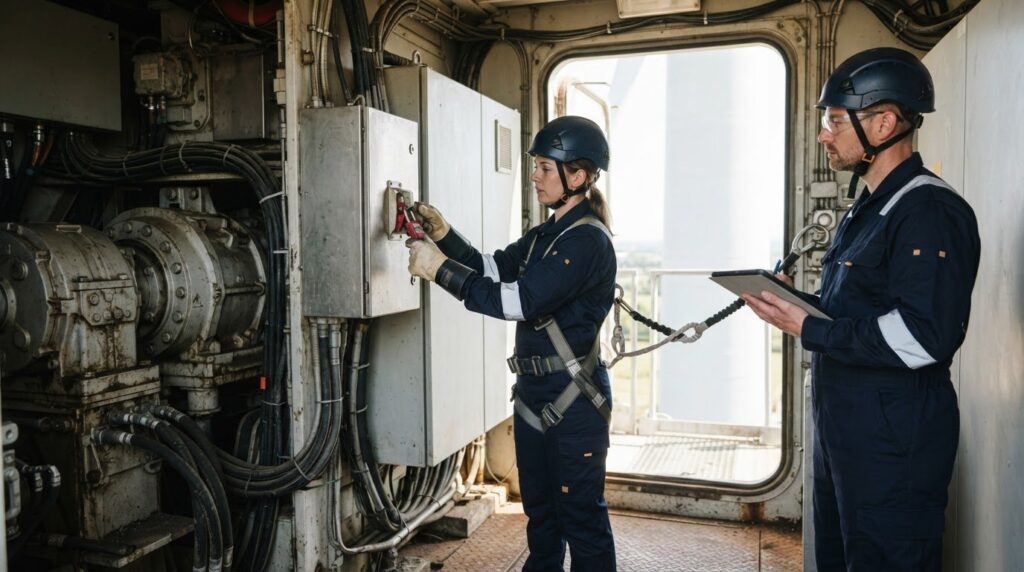
Does OSHA require a drug test before a wind technician climbs a turbine? Neither OSHA 29 CFR 1910.269 nor 29 CFR 1926 Subpart V requires drug testing, and no standalone federal OSHA or Department of Energy rule creates a drug-testing mandate specifically for wind turbine technicians. Understanding wind turbine technician safety standards means separating regulatory safety requirements from an employer’s testing policy.
Drug testing may still be a condition of employment or site access under an operator’s written policy. Separate DOT testing requirements under 49 CFR Part 382 apply when a technician’s duties include operating a commercial motor vehicle that meets the relevant weight or hazardous-materials thresholds.
Clear safety procedures matter as much as knowing which rules apply. This guide explains how training, electrical precautions, fall protection, safe approach boundaries, communication and emergency planning shape turbine work. It also shows where employer policies fit, helping you distinguish legal requirements from site-specific conditions and understand the protections technicians need before climbing or starting maintenance.
Key Takeaways
- Match safety requirements to the task: construction, maintenance, electrical work and site access can involve different rules and policies.
- Use personnel qualifications, electrical hazard controls and appropriate protective equipment to guide decisions around energized systems.
- Build fall protection and clear communication into work procedures before crews climb or begin maintenance.
- Assess whether training covers the hazards technicians will face, and understand how testing requirements may differ by job duties and employer policy.
- Define approach boundaries and emergency response arrangements so workers know how to maintain safe distances and summon help.
How to Choose Wind Turbine Technician Safety Standards
Define the work, location and hazards before choosing a standard by name. Requirements can differ between turbine construction and maintenance, and electrical work may involve risks that general site procedures do not address. For international projects, identify the country and jurisdiction first. Then distinguish legal requirements from company procedures, site-access conditions and technical standards that guide safe work.
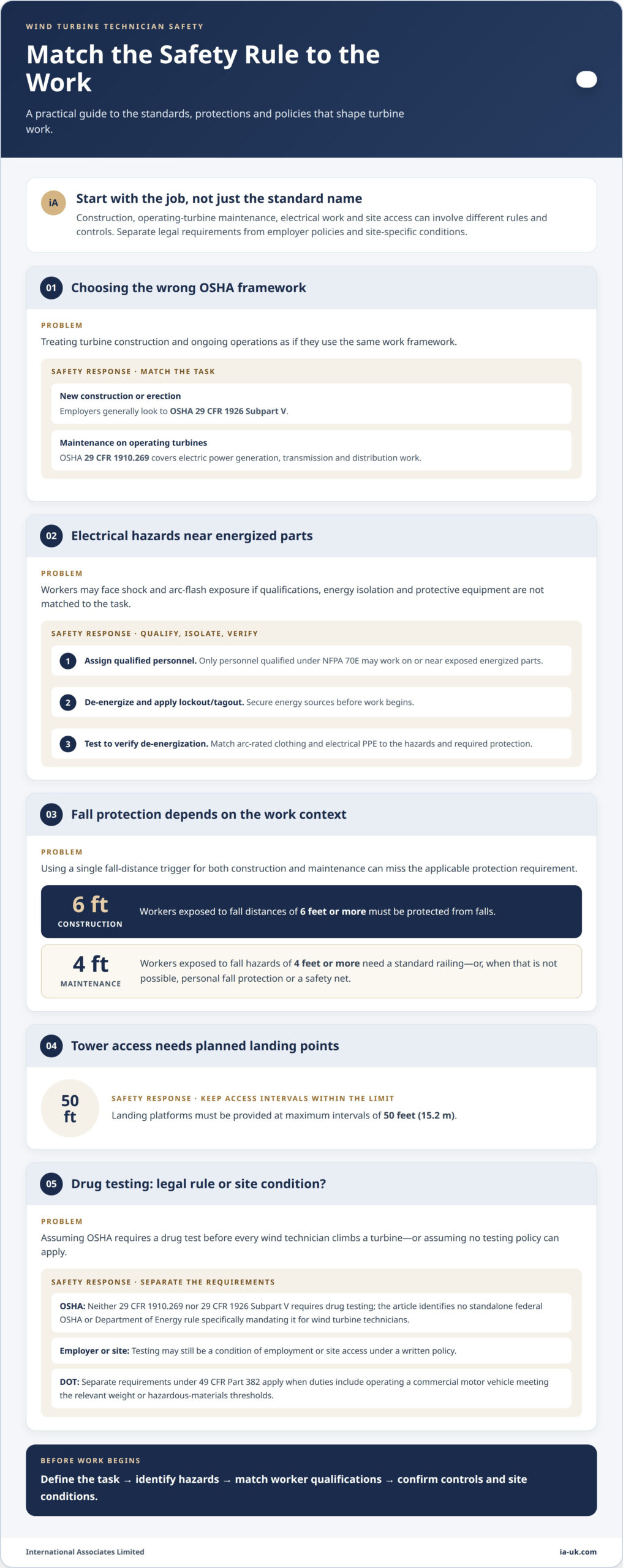
In the United States, the task helps determine which OSHA framework is relevant. OSHA 29 CFR 1910.269 covers electric power generation, transmission and distribution work, and is used for maintenance on operating turbines. For new turbine construction or erection, employers generally look to OSHA 29 CFR 1926 Subpart V. These provisions address different work contexts, so the distinction between construction and ongoing operations should be clear in the work plan.
Use these practical criteria to organize the decision:
- Task: Separate construction, routine maintenance, electrical troubleshooting and work on rotating components. Each activity can present a different combination of hazards and controls.
- Exposure: Identify electrical energy, falls, moving machinery, stored energy, lifting operations and the conditions of the work site before assigning procedures.
- Personnel: Match worker qualifications and training to the actual task, especially where exposed energized parts or specialized equipment are involved.
- Controls: Confirm that procedures address energy isolation, access, protective equipment, communication and emergency response as relevant to the planned work.
Translate the applicable requirements into practical work documents: training criteria, task risk assessments, equipment checks, permit or authorization processes, and clear stop-work conditions. The wind turbine technician safety standards selected for a job should relate directly to its hazards and responsibilities, not serve as a generic checklist. Review controls when the task, equipment, site conditions or applicable rules change. This helps employers determine what applies, communicate expectations to crews and identify gaps before work begins.
Qualified personnel and electrical safety training
Electrical qualifications, task-specific training and protective controls help determine who may work near turbine electrical hazards. OSHA requirements also distinguish between construction and maintenance.
Electrical qualifications and training
NFPA 70E is a workplace electrical safety reference, and only personnel qualified under NFPA 70E may work on or near exposed energized parts. Training should prepare workers to recognize electrical hazards, select controls and respond to incidents. For U.S. maintenance on operating turbines, OSHA 29 CFR 1910.269 applies; employers generally look to OSHA 29 CFR 1926 Subpart V for new construction or erection.
For fall protection, OSHA requires protection for construction workers exposed to fall distances of 6 feet or more. In maintenance, workers exposed to fall hazards of 4 feet or more must be protected by a standard railing or, when that isn’t possible, personal fall protection or a safety net.
Arc-rated clothing and electrical PPE
Arc-rated clothing and electrical PPE are protective equipment selected for the electrical hazards workers may encounter. Equipment labels should identify potential risk, incident energy level and required PPE, helping crews match protection to the hazard. NFPA 70E provides a reference for electrical safety training and PPE selection; Texas Tech University’s policy cites NFPA 70E Table 130.7(C) (16) for face protection and protective clothing characteristics.
Before a climb, also account for tower access. According to the Occupational Safety and Health Administration, landing platforms must be provided at maximum intervals of 50 feet (15.2 m).
Lockout procedures and shock hazards
Lockout/tagout isolates and secures energy sources before work begins. De-energize electrical equipment, apply lockout/tagout, then use testing instruments to verify that it is de-energized. This sequence reduces exposure to shock and arc-flash hazards, though stored energy and other systems can still pose risks during turbine work.
Inside turbines, potential confined-space hazards include restricted access and electrical or mechanical energy. OSHA’s 29 CFR 1910.146(a) definition is identified as applying to the turbine structure; assess conditions and establish suitable entry controls before work. Falls and electrical incidents are critical fatality hazards, while moving parts can cause serious injuries.
Safety procedures and communication protocols
Worksite procedures coordinate hazard controls, crew roles and communication before turbine operations begin. Clear reporting routes help teams respond consistently when site conditions change.
Worksite safety procedures
Worksite safety procedures define how crews assess hazards, coordinate tasks and communicate changes during wind-farm operations. They matter because a missed handoff can leave workers exposed to moving equipment, falls or electrical hazards. In the United States, construction workers on wind farms exposed to fall distances of 6 feet or more must be protected from falls, according to the Occupational Safety and Health Administration.
Before work, review the task plan with the crew, identify who controls the operation and agree on stop-work signals. Use radios or agreed hand signals where turbine noise or distance makes speech unreliable. Texas Tech University’s policy provides a site-specific example: climbers maintain 100% tie-off while on or in a turbine, and only one climber uses the ladder during maintenance and research operations.
For work near rotating parts, Texas Tech University requires a security bolt to be mounted and locked in the disc brake before anyone enters the nose cone or works on rotating components. This makes the isolation control explicit before access begins.
Hazard and injury reporting duties
Hazard and injury reporting procedures explain how workers communicate unsafe conditions and how employers respond. Workers should promptly report hazards, near misses and injuries through the designated supervisor or site channel. Employers should provide a clear reporting route, assess reports and document corrective action. These steps help prevent unresolved issues from affecting the next crew or operation.
For example, a worker who finds a damaged access component should stop the affected task, notify the supervisor and specify its location. The employer can restrict access, arrange an assessment and communicate the control before work resumes. Injury reports should describe the event, task and known hazards, giving investigators useful information without delaying urgent medical assistance.
Agree on communication checks before climbing: confirm radio contact, identify who coordinates the operation and establish how to signal a stop. Record changes to the work plan and relay them to everyone affected. A brief, shared procedure makes hazard reporting part of daily operations, not an afterthought.
Wind technician training and education
Training should reflect wind-farm work, including electrical hazards, climbing, lifting and emergency response. Course completion alone is not enough: practical assessment and relevant testing help show whether workers can apply procedures to real tasks. Instruction should connect the relevant safety framework to each technician’s assigned duties.
Wind technician safety training can cover high- and low-voltage equipment operation, lifting and rigging, fire safety, lockout/tagout, confined spaces and hazardous-material handling. A program can combine classroom instruction with supervised practice, such as inspecting climbing equipment, identifying a hazard and demonstrating a safe response. Refresher training should address changes to equipment, procedures or assigned duties.
Testing can assess both technical knowledge and safety judgment. For example, mechanical systems make up 25% of the NFPA WTT-I exam, while hydraulic systems make up 15%. Those exam areas sit alongside the broader task-specific preparation needed on site. Results can help identify where further instruction is needed before a technician performs the relevant work.
General safety courses offer another layer of preparation. The OSHA-10 general-industry course includes 1 mandatory hour on walking-working surfaces and fall protection. General construction safety courses can include instruction on common hazards and personal protective equipment, including fall-arrest systems. These course components can support, but don’t replace, training specific to turbine tasks and site procedures.
Offshore wind requirements differ through their regulatory and operating context. Offshore wind safety regulations are cataloged under Title 30, Chapter II, and the American Clean Power Association’s Offshore Compliance Recommended Practices provide industry-based safety guidance. Training plans should address the applicable offshore rules and the emergency and communication arrangements for the specific operation.
Employers can use training records to link each worker’s role with relevant instruction, assessment and authorization. A technician assigned to electrical work needs training matched to that exposure, while a climber needs climbing and rescue preparation. For technicians seeking specialized tower climbing, rigging, or height safety instruction across related industrial sectors, resources like dangleacademy.com provide practical training courses. Recording completed training and test results helps employers review qualifications when work assignments change.
Approach boundaries and safe distances
Electrical approach boundaries define how close a worker may come to exposed energized parts. The applicable distance depends on the electrical conditions and the boundary being applied, so crews must use the governing procedure rather than estimate clearance by sight. NFPA 70E distinguishes restricted and prohibited approach boundaries, which support different levels of control around live electrical equipment.
Texas Tech University’s electrical safety policy sets approach-boundary requirements for live parts operating at 50 Volts or more. It cites NFPA 70E, Table 130.2(C) for restricted approach boundaries and NFPA 70E Table 130.1(C) (a) for the prohibited approach boundary. These references help determine the limits for a specific electrical exposure; they are not interchangeable with a turbine’s physical access or fall-protection distances.
Before approaching an exposed part, identify its operating condition and the boundary specified by the applicable assessment. Mark or communicate the restricted area, control access and ensure workers understand which tasks are permitted there. For example, a technician inspecting equipment near an exposed energized component must follow the established boundary and qualification requirements, rather than estimate a safe clearance by eye.
Safe-distance practices also apply above ground. Texas Tech University’s wind turbine policy sets the minimum drop-zone radius at one foot for every two feet of working height. This calculation scales the exclusion area to the task height, helping crews protect the area below workers handling tools or components.
Keep these distances distinct in the work plan:
- Electrical boundary: Use the relevant NFPA 70E boundary for the energized-part hazard and the applicable assessment.
- Drop zone: Set the ground exclusion radius using the stated height-to-radius relationship.
- Access control: Communicate who may enter each controlled area and how workers will be notified if conditions change.
Reassess boundaries if the task, equipment condition or work position changes. A worker moving from an external inspection to work near exposed live parts may face a different approach limit. Clear markings, briefings and controlled access make the required distance practical throughout the operation.
Emergency planning
A wind-farm emergency plan should explain how crews summon assistance, report an incident and coordinate access to the affected turbine. These arrangements are especially important at remote sites if a worker cannot descend or responders need directions. Record the access route, site location, communication method and response roles so crews can use the same information under pressure.
Set the response sequence before work begins. Identify who raises the alarm, who coordinates the incident and who relays updates between the turbine and ground teams. Specify what to communicate, including the turbine location, the nature of the emergency and any immediate access restrictions. Clear roles reduce uncertainty when several teams are involved.
Plan for a climber who is unable to descend, and make rescue arrangements clear to workers before ascent. Texas Tech University’s policy directs responders to call 911 and request climb-certified EMS and Lubbock Fire Department Heavy Rescue Team personnel when a climber is stuck or injured inside a turbine. This is a site-specific example; the plan should identify the applicable response resources and contact process for its location.
Fire procedures need defined evacuation boundaries. For a fire in or near a wind turbine, Texas Tech University’s policy calls for a minimum evacuation and roped-off radius of 1640 ft. (500 m). That distance belongs to the university’s policy, so site plans should set out the applicable fire response arrangements rather than assume one radius applies everywhere.
- Before work: Brief crews on alarm methods, access information, response roles and the location of emergency equipment.
- During an incident: Communicate the turbine and worker’s location, follow the site response sequence and keep access routes clear for responders.
- After response: Account for personnel and share any hazards that could affect further access or recovery work.
Use planned exercises to assess whether workers can follow the response sequence. A scenario involving a climber unable to descend can test alarm communication, location reporting and coordination between ground and turbine teams. Record issues identified during the exercise, and update site information when access routes, response contacts or equipment arrangements change. This keeps emergency procedures aligned with actual wind-farm operations.
International Associates Limited: GWO (Global Wind Orgaisation)
International Associates Limited offers GWO certification as a relevant next step for organisations working in the wind sector. After identifying the safety controls and training needs applicable to turbine work, an organisation may also need certification that supports its wider approach to industry requirements. GWO certification complements, but does not replace, site procedures, legal duties or task-specific safety controls.
Consider GWO certification when it aligns with your organisation’s wind-sector needs. The appropriate next step depends on the requirement you are working toward and how it connects with existing processes. Clear objectives help keep the discussion focused, whether you need to address a specific GWO requirement or broader assurance priorities.
Other relevant offerings address distinct organizational priorities. Social Accountability Audits focus on social accountability, while ISO 9001 Quality Management System Certification and ISO 14001 Environmental Management System Certification address their respective management-system standards. These services may be relevant where an organization is also working on quality, environmental or social responsibility objectives. They are separate from operational controls for climbing, electrical work and emergency response.
For organizations pursuing ISO 9001 or ISO 14001 certification, formal stage 1 and stage 2 audits are used to verify whether requirements of the selected international standard are met. This provides a defined assessment pathway for the chosen management-system standard. It does not replace the need to identify and apply safety requirements that govern turbine work in the relevant jurisdiction.
Before choosing a service, define the issue to address, the applicable standard or GWO-related need, and the outcome the organization is seeking. This distinction helps direct the next discussion toward the correct scope, rather than treating every wind-sector safety concern as a certification question. International Associates Limited can support organizations seeking GWO, social accountability audits, or ISO 9001 and ISO 14001 certification.
Contact International Associates Limited to discuss the relevant service for your organization.
Frequently Asked Questions
Does OSHA 1910.269 or 1926 Subpart V require a drug test before a technician climbs a turbine?
No. Neither OSHA 29 CFR 1910.269 nor 29 CFR 1926 Subpart V requires drug testing specifically for turbine technicians. A site operator or employer may set a separate pre-access or employment testing policy, and a technician’s previous test with another employer doesn’t automatically meet a new site’s requirement. DOT testing is a separate track, applying when the technician operates a commercial motor vehicle that meets relevant weight or hazardous-materials thresholds.
How Do Developers and Owners Ensure the Safety of Wind Energy Projects?
Owners and developers should assign responsibility for site safety measures and ensure those controls are provided and maintained. The independent power producer, meaning the company or individual that owns and operates the wind farm, is responsible for measures such as lifting equipment, security technology, firefighting equipment, safety signs and surge protection. Responsibilities should cover both project setup and ongoing operation, with operators maintaining turbines in line with applicable requirements.
What OSHA standards apply to wind turbine technicians in the United States?
OSHA requirements depend on the work phase and the hazard. In addition to rules for construction and electrical work, 29 CFR 1910.140 addresses personal fall protection systems, while 29 CFR 1910.146(a) provides the confined-space definition referenced for turbine structures. These provisions address different risks, so an employer’s hazard assessment should identify whether the task involves construction, maintenance, fall exposure or potential confined-space conditions.
What training and certifications are required for wind turbine technicians, including GWO standards?
Training and credentials should match the technician’s tasks and the site’s requirements; GWO may be relevant to wind-sector training needs. Equipment specifications can also guide preparation: the cited training equipment list specifies ANSI Z359 (2007) for full-body harnesses and ANSI Z89 (2003) for helmets. These are equipment standards, not proof by themselves that a worker is qualified for every turbine task or site.
What lockout/tagout procedures are required when servicing wind turbines?
Isolation must account for every energy source involved in the task, not only electrical supply. Hydraulic tool pumps in a turbine tower or nacelle can operate at pressures of 650 bar or more, making stored pressure a significant consideration. The work plan should identify relevant hydraulic, pneumatic, mechanical and electrical sources, specify how they are isolated, and establish how workers confirm the equipment is safe for the planned service.
What electrical safety standards apply to wind turbine maintenance?
NFPA 70E is a workplace electrical safety reference, and OSHA 29 CFR 1910.269 covers electric power generation, transmission and distribution work. Turbine electrical systems can involve different operating points: generators typically produce between 500 and 700 V AC, while the grid connection at each tower is in the range of 36,000 V AC. Work procedures should account for the specific equipment and electrical exposure involved.
What PPE is required for wind turbine technicians working at heights and around machinery?
PPE depends on the exposure and the applicable task assessment. For height work, equipment specifications in a cited training list include a full-body harness meeting ANSI Z359 (2007) and a helmet meeting ANSI Z89 (2003). Electrical tasks may require additional protection selected for the assessed hazard, while machinery work calls for controls suited to moving or stored energy. No single equipment set addresses every turbine task.
What rescue and emergency response plans are required for wind turbine sites?
Plans should set out rescue roles, communication arrangements, site access details and the capability needed for a turbine-climb rescue. Texas Tech University’s policy requires at least two university employees with Competent Wind Turbine Climber and Rescue Certification to be on site for climbs, except under its stated certified-contractor exception. This is a site-specific policy example that illustrates why rescue coverage should be assigned before a climb.