
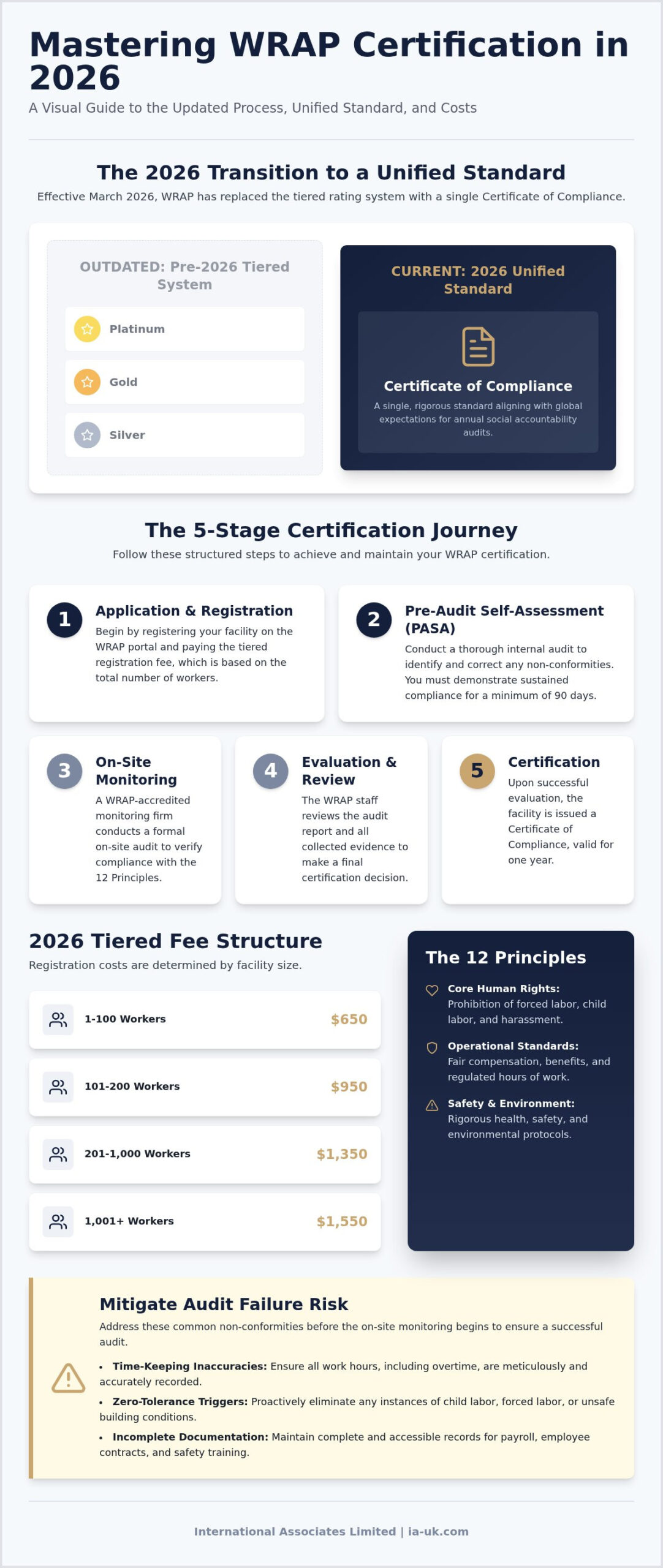
If you’re still structuring your compliance strategy around achieving a Platinum rating, your approach is already outdated for the current regulatory environment. As of March 2026, the WRAP certification process has transitioned to a unified Certificate of Compliance, aligning with global expectations for annual social accountability audits. This shift replaces the previous tiered levels with a standardized, rigorous assessment that leaves no room for ambiguity in your supply chain operations.
It’s understandable that the complexity of the 12 Principles and the updated tiered fee structure, which is now based on worker counts, can create significant administrative friction. You need a reliable method to identify potential non-conformities before a monitoring firm arrives on-site. This guide provides the technical clarity required to master the WRAP certification process from your initial application through the Pre-Audit Self-Assessment to the final evaluation. We’ll outline the exact steps to secure your certification, manage the 2026 costs, and maintain the high-level expertise needed to satisfy global buyer requirements with quiet confidence and procedural integrity.
Key Takeaways
- Master the updated 2026 WRAP certification process by following a structured five-stage journey from initial registration to the final evaluation.
- Identify your specific registration costs by using the tiered fee structure based on worker counts, ensuring accurate budgeting for your compliance goals.
- Understand the transition to the standardized Certificate of Compliance, which replaces the previous Silver, Gold, and Platinum tiers to align with global annual audit standards.
- Mitigate the risk of audit failure by addressing common non-conformities, such as time-keeping inaccuracies and zero-tolerance triggers, before the on-site monitoring begins.
- Learn how to successfully complete the mandatory Pre-Audit Self-Assessment (PASA) to demonstrate sustained adherence to the 12 Principles for the required 90-day period.
Understanding the WRAP Certification Framework in 2026
The Worldwide Responsible Accredited Production (WRAP) organization serves as the primary certification body for the global sewn products industry. In 2026, the WRAP certification process has evolved from a simple compliance exercise into a strategic necessity for facilities seeking to maintain their status within international supply chains. As retailers increasingly prioritize Environmental, Social, and Governance (ESG) reporting, this framework provides a structured methodology to verify that apparel, footwear, and textile manufacturing occurs under ethical and lawful conditions. It’s no longer sufficient to merely claim compliance; buyers now demand independent verification of workplace standards. This is particularly relevant for manufacturers in the apparel and footwear sectors, where labor practices are under intense scrutiny from both regulators and consumers.
The 12 Principles of WRAP Compliance
The framework is built upon twelve fundamental principles that align with local laws and international labor standards. These aren’t just suggestions; they’re the benchmarks used during every audit to ensure institutional integrity and global reliability.
- Core Human Rights: These principles mandate the strict prohibition of forced labor, child labor, and workplace harassment or abuse. Compliance here is non-negotiable and forms the foundation of the social accountability audits conducted globally.
- Operational Standards: These requirements focus on compensation, benefits, and hours of work. Auditors verify that employees are paid fairly and aren’t subjected to excessive overtime, which remains a common challenge in high-volume production environments.
- Safety and Environment: Facilities must demonstrate adherence to rigorous health and safety protocols alongside environmental regulations. This ensures that the physical workspace is secure and that the factory’s ecological impact is managed responsibly.
Strategic Benefits for Apparel Manufacturers
Achieving certification offers more than just a badge for your factory wall. It streamlines operations by significantly reducing audit fatigue. Instead of undergoing multiple proprietary audits for different individual buyers, manufacturers can use one universally recognized standard. This efficiency is critical for facilities managing tight production schedules and complex logistics.
Ethical management also yields tangible internal results. When workers operate in a safe, respectful environment, factory morale often improves. This shift typically leads to higher retention rates and increased productivity, providing a clear competitive edge in the global market. Having a robust social compliance system in place makes it much easier to integrate other management systems, such as ISO 9001 or ISO 14001; this creates a holistic approach to factory excellence. Since transparency is now a prerequisite for trade, mastering the WRAP certification process ensures your facility remains a preferred partner for major Western brands; to further strengthen your supply chain in Asia through specialized quality control, you can visit The Inspection Company.
The 5 Stages of the WRAP Certification Process
The WRAP certification process is a rigorous, five-stage progression designed to verify that a facility operates in full alignment with international ethical standards. This journey requires meticulous preparation and a commitment to institutional integrity. Facilities must complete each phase within a defined timeframe to ensure their application remains valid. Achieving a Certificate of Compliance signifies a facility’s dedication to global reliability and operational excellence in an increasingly scrutinized market.
Step 1 & 2: Application and Self-Assessment
The process begins with registration on the WRAP website and the payment of a tiered registration fee. For 2026, these fees are strictly determined by worker count. Facilities with 100 or fewer workers pay $650; those with 101 to 200 workers pay $950; facilities with 201 to 1,000 workers pay $1,350; and those with over 1,001 workers pay $1,550. Once registered, the facility enters the Pre-Audit Self-Assessment (PASA) phase. The PASA serves as the critical internal audit phase where management identifies and corrects operational gaps before the formal inspection occurs.
A successful PASA requires the facility to demonstrate compliance with the 12 Principles for at least 90 days. This internal verification is essential because it builds the foundation for long-term supply chain transparency. Facilities that rush this stage often encounter avoidable non-conformities during the actual audit. It’s a period for honest reflection and procedural adjustment that ensures all systems are robust enough for independent verification.
Step 3 & 4: Choosing an Auditor and the On-Site Audit
After completing the self-assessment, the facility must select an accredited monitoring firm to conduct the independent audit. This selection is a strategic decision. You should prioritize firms with a proven global presence and deep technical expertise. The audit must be successfully passed within six months of the initial fee payment to avoid application expiration. Choosing an experienced partner like International Associates Limited ensures that the assessment is handled with the impartiality and professional depth required for global trade.
The on-site audit follows a predictable and structured sequence. It begins with an opening meeting to outline the audit scope, followed by a detailed facility tour to observe working conditions first-hand. Auditors conduct confidential employee interviews and perform a comprehensive review of payroll and time-keeping records to ensure legal compliance. The process concludes with a closing meeting. During this session, the auditor presents their findings and identifies any non-conformities that require corrective action. This stage is about objective verification, ensuring your facility meets the high-stakes requirements of modern retail.
The final phase involves the auditor submitting a formal report to WRAP headquarters for review. WRAP staff evaluate the evidence provided and determine if the facility meets the necessary requirements for certification. If successful, the facility is issued a Certificate of Compliance. This certificate is valid for one year, reflecting the 2026 industry shift toward annual social accountability assessments to maintain constant standards of safety and ethics.
WRAP Certification Levels: Navigating the 2026 Transition to a Unified Standard
The 2026 regulatory environment has necessitated a significant streamlining of the WRAP certification process. As of March 1, 2026, WRAP transitioned away from the multi-tiered Silver, Gold, and Platinum system. All facilities successfully completing an audit now receive a unified Certificate of Compliance. This shift ensures that every certified facility adheres to the same high baseline of social accountability, reflecting a broader industry move toward annual verification as the global standard. While legacy Platinum certificates remain valid until their original expiration dates, new applicants must focus on achieving the single, rigorous standard that now defines the program.
Silver vs. Gold: Understanding the Compliance Baseline
In the legacy framework, Silver certification was a six-month credential issued to facilities demonstrating substantial compliance with minor non-conformities. It served as a vital stepping stone for new factories. Gold certification was the one-year standard for facilities fully compliant with all 12 Principles. Under the current 2026 requirements, the distinction between these levels has been removed to eliminate ambiguity for international buyers. Facilities that would have previously qualified for Silver must now implement comprehensive Corrective Action Plans (CAPs) to reach the unified standard before a certificate is issued. This change prioritizes institutional reliability over incremental progress, ensuring that any facility holding a WRAP certificate meets the full requirements of social accountability audits without exception.
The Path to Sustained Excellence and the 2026 Standard
Platinum status was previously the pinnacle of the WRAP certification process, awarded to facilities that maintained Gold compliance for three consecutive years. It offered a two-year certification cycle as a reward for sustained excellence. In the current landscape, however, the demand for academic research on forced labor and supply chain transparency has led to a preference for annual audits. This yearly cadence provides buyers with more recent data on a facility’s ethical performance.
Maintaining a ‘zero-tolerance’ record remains the most critical factor for any facility. Triggers for immediate decertification, such as forced or child labor, have not changed. Even without the Platinum label, the operational maturity required to achieve that level of performance is exactly what modern retailers expect from the 2026 Certificate of Compliance. Facilities must demonstrate a meticulous, ethical approach to management systems to ensure their certification is renewed annually. This predictable, methodical approach to auditing builds the necessary trust between manufacturers and global brands, acting as a steady hand in a complex regulatory world.
Preparing for Success: Avoiding Common Audit Non-Conformities
Success in the WRAP certification process depends on shifting from reactive adjustments to a robust management system. Audit failure often stems from systemic documentation gaps rather than single physical errors. Auditors prioritize institutional reliability; they look for patterns of adherence rather than isolated ‘quick fixes’ that lack procedural support. Facilities that fail often do so because their internal records don’t align with observed workplace practices. Identifying these friction points during your Pre-Audit Self-Assessment (PASA) is the most effective way to ensure a seamless independent verification.
Addressing Zero-Tolerance Issues
Zero-tolerance issues represent the most significant risk to your certification status. Forced labor, child labor, and harassment are immediate decertification triggers that leave no room for corrective action. To prevent child labor, you must implement a robust age-verification system that includes cross-referencing government-issued identification with personnel files. Voluntary labor must be evidenced through transparent contract management, ensuring every worker understands their terms of employment without coercion. It’s also vital to establish a clear whistle-blower policy. This provides a secure channel for employees to report harassment or abuse, ensuring your facility remains a safe and ethical environment.
Mastering Working Hours and Compensation
Inaccurate time-keeping and excessive overtime are among the most frequent non-conformities identified during Social Accountability Audits. You must align your operations with both local labor laws and WRAP’s 60-hour maximum work week, which includes at least one day of rest every seven days. Auditors meticulously compare time-clock data against payroll records to ensure every hour worked is compensated accurately. Any discrepancy between these sets of data is a red flag that suggests a lack of transparency.
To avoid such discrepancies and ensure financial transparency, facilities often benefit from third-party oversight. Utilizing a specialized CPA and advisory firm like imerseadvisory.com can help businesses align their payroll practices with the rigorous documentation requirements of a social accountability audit.
Physical safety failures also remain a common pitfall. Issues such as blocked emergency exits, missing fire extinguishers, or the non-usage of Personal Protective Equipment (PPE) can derail your progress. These are often symptoms of a weak safety management culture. Rather than simply clearing exits before an audit, you should implement daily floor checks and documented safety training. This methodical approach ensures that compliance is a permanent state rather than a temporary performance. To ensure your facility is prepared for an independent assessment, you can contact our global team to discuss how an independent audit provides the stability your international buyers require.
Why Partner with IA-UK for Your WRAP Audit in 2026?
IA-UK operates as a global auditing body with a central administrative base in Glasgow and an expansive network of regional offices across Europe, Asia, and the Middle East. This structure allows us to provide independent assessment and verification on a worldwide scale while maintaining deep local expertise in diverse regulatory environments. Our advanced IT infrastructure is specifically designed to facilitate efficient audit turnarounds, ensuring that your Certificate of Compliance is processed without unnecessary administrative friction. By selecting an auditor with these capabilities, you ensure that your WRAP certification process is managed with the procedural integrity required by high-stakes technical sectors.
The IA-UK Advantage: Professionalism and Precision
Our methodical approach to management system certification is defined by technical precision and institutional weight. We prioritize reducing friction through transparent communication and rigorous technical reviews. This ensures that every finding is objective and documented according to international standards, providing the stability your business needs to grow. Facilities seeking a steady hand in the world of corporate compliance benefit from IA-UK Regulatory Compliance Services, which provide a sophisticated bridge between complex global regulations and your operational reality.
Beyond WRAP: Building a Total Quality Management System
A social audit is most effective when it functions as a foundational pillar of a broader ESG strategy. IA-UK offers integrated audit capabilities, allowing facilities to align their social accountability requirements with other international standards such as ISO 9001 for quality or ISO 45001 for occupational health and safety. This holistic view prevents the fragmentation of management systems and promotes long-term operational stability. It’s a strategic move that transforms compliance from a static checklist into a dynamic system for improvement.
To support this integration, we provide specialized Lead Auditor Training to empower your team with the technical skills needed to maintain compliance independently. Our commitment to impartial and rigorous auditing ensures that your facility doesn’t just pass an inspection; it achieves a status of global reliability that satisfies the most demanding international buyers. Your participation in the WRAP certification process with IA-UK acts as a clear signal of competence to the global market. We provide the meticulous oversight necessary to handle high-stakes certifications for sensitive industrial sectors, ensuring your facility remains a preferred partner in the global supply chain.
Securing Your Global Market Position in 2026
Success in the modern supply chain requires more than just meeting local regulations; it demands a commitment to international ethical standards that your buyers can trust. The 2026 transition to a unified Certificate of Compliance has simplified the landscape, but it also means the WRAP certification process now requires a higher baseline of operational excellence from day one. By mastering the five-stage journey and proactively addressing non-conformities during your self-assessment, you position your facility as a reliable partner in the global apparel and footwear sectors.
International Associates Limited acts as an accredited monitoring firm for WRAP, providing the independent verification necessary to navigate these high-stakes requirements. With our global network of experienced social auditors and advanced IT infrastructure, we ensure a fast turnaround for certification reports without compromising on procedural depth. It’s a strategic step that builds institutional reliability for your brand. You can schedule your WRAP Audit with International Associates today to begin your journey toward verified social compliance. We look forward to supporting your facility’s international growth through meticulous auditing and earned confidence.
Frequently Asked Questions
How much does the WRAP certification process cost in 2026?
Registration fees for the WRAP certification process in 2026 are tiered based on the facility’s worker count. Facilities with 100 or fewer workers pay $650; those with 101 to 200 workers pay $950. Larger operations with 201 to 1,000 workers are charged $1,350, while facilities with over 1,001 workers pay $1,550. These registration fees are paid directly to WRAP and don’t include the separate audit fees billed by your chosen monitoring firm.
How long does it take to get WRAP certified from application to certificate?
The timeline typically spans several weeks to six months depending on your facility’s readiness. You must successfully pass the independent audit within six months of paying your initial registration fee. The actual duration is influenced by the time needed to complete the self-assessment and the efficiency of the auditor’s report turnaround. IA-UK utilizes advanced IT infrastructure to ensure fast reporting, helping you secure your certificate as efficiently as possible.
Can a facility be decertified by WRAP after receiving a certificate?
Yes, WRAP can revoke a certificate at any time if a facility fails to maintain the 12 Principles. All certified facilities are subject to unannounced post-certification audits to verify ongoing compliance. If an auditor discovers a zero-tolerance violation or a significant lapse in safety protocols during these visits, the certificate may be revoked immediately. This ensures the standard maintains its reputation for global reliability and institutional integrity.
What is the difference between a WRAP audit and a SMETA audit?
WRAP is a formal certification program specifically for the sewn products industry that results in an official Certificate of Compliance. SMETA is an audit methodology used by SEDEX to produce a report, but it doesn’t issue a certificate. While SMETA is used across multiple sectors, WRAP is the preferred standard for many global apparel retailers. Your choice depends on whether your buyers require a specific report or a recognized certification status.
Is WRAP certification mandatory for apparel exporters?
WRAP certification isn’t a legal requirement imposed by governments, but it’s often a commercial mandate from major international brands. Many retailers in the US and Europe won’t onboard a supplier without a valid social compliance certificate. It acts as a necessary prerequisite for doing business in a market that prioritizes ESG reporting. Holding this certification provides a clear competitive edge by demonstrating your commitment to ethical manufacturing standards.
What are the ‘Zero Tolerance’ issues that lead to immediate failure?
Zero-tolerance issues include forced labor, child labor, physical abuse, and harassment. Attempting to bribe an auditor or presenting fraudulent records also results in immediate failure and denial of certification. These violations represent a total breach of institutional ethics and lead to automatic decertification. Facilities must maintain a clean record in these critical areas to participate in the program and maintain trust with their global trading partners.
Do I need to hire a consultant to pass the WRAP audit?
You aren’t required to hire an external consultant to navigate the WRAP certification process successfully. The program is designed for facilities to manage compliance internally through the Pre-Audit Self-Assessment (PASA). A diligent management team can identify and correct gaps by following the 12 Principles without outside help. IA-UK provides the independent auditing services needed to verify your compliance but doesn’t offer consultancy to ensure our assessments remain impartial.
How many workers do I need to have to apply for WRAP?
There’s no minimum worker requirement to apply for WRAP certification. The program is accessible to manufacturing facilities of all sizes, from small boutique workshops to massive industrial complexes. The tiered fee structure specifically accommodates smaller operations by offering a lower cost for facilities with 100 or fewer employees. This inclusivity ensures that even smaller exporters can demonstrate their adherence to global social accountability standards to secure international contracts.