

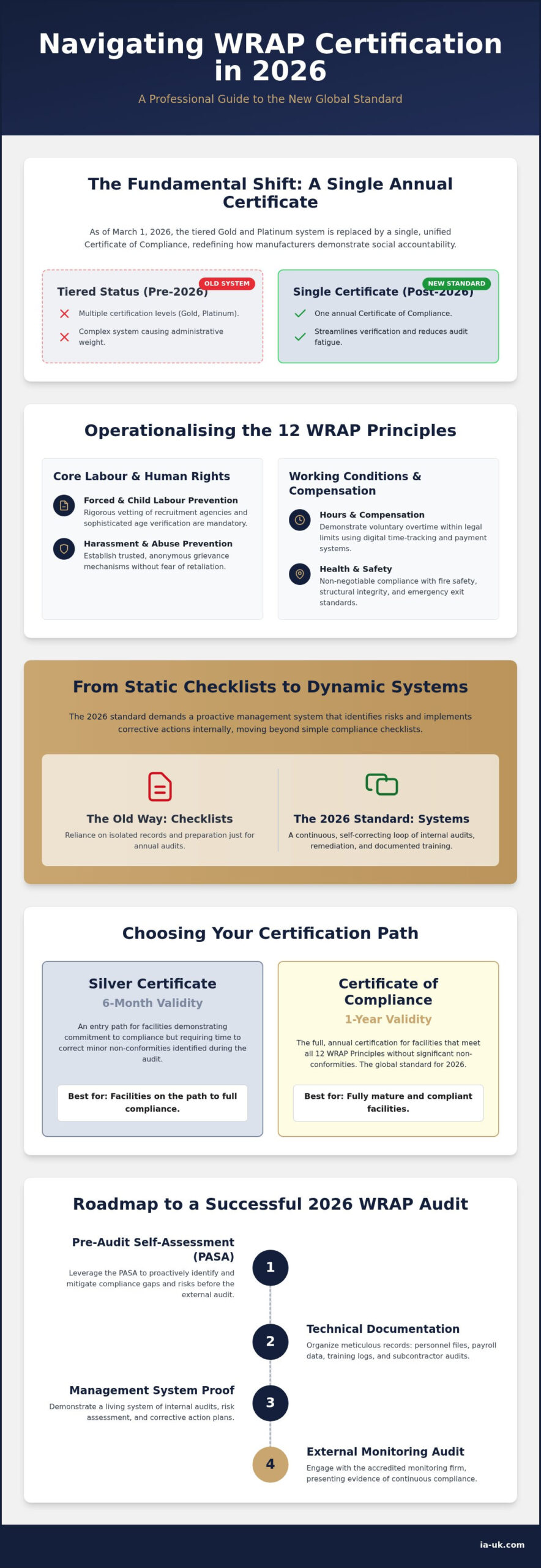
The distinction between Gold and Platinum status is no longer the mark of a top-tier apparel supplier. As of March 1, 2026, the transition to a single, annual Certificate of Compliance has fundamentally redefined how manufacturers demonstrate social accountability. You’re likely managing the administrative weight of multiple audit frameworks while facing the persistent risk of a failed inspection. Mastering the updated WRAP certification requirements is now a critical step for facilities that prioritize technical precision and global reliability.
This guide provides a professional roadmap to help you navigate the 12 Principles and the tiered registration fee structures currently in effect. We’ll examine the decision factors that determine your facility’s audit readiness and how these standards align with 2026 ESG reporting expectations. You’ll gain the clarity needed to secure your position as a trusted partner in the international apparel supply chain through a methodical and disciplined approach to compliance.
Key Takeaways
- Learn how to operationalise the 12 Principles as measurable benchmarks to ensure your facility meets the rigorous labour standards required in 2026.
- Understand the transition from basic checklists to management systems and how internal self-correction is essential to satisfy modern WRAP certification requirements.
- Evaluate the strategic choice between the six-month Silver entry path and the full annual Certificate of Compliance based on your facility’s operational maturity.
- Follow a structured preparation roadmap that leverages the Pre-Audit Self-Assessment (PASA) to identify and mitigate risks before the external monitoring firm arrives.
- Discover how to leverage a single certification to reduce audit fatigue and satisfy the prerequisite demands of major US and EU retailers.
Operationalising the 12 Principles of WRAP Certification in 2026
The 12 principles established by Worldwide Responsible Accredited Production (WRAP) aren’t merely theoretical guidelines. They function as precise operational benchmarks that define a facility’s eligibility for global contracts. In 2026, meeting WRAP certification requirements involves integrating these principles into daily management systems rather than treating them as annual audit preparation. This shift ensures that compliance is a continuous state, providing the stability and reliability that international buyers demand from their supply chain partners. For facilities seeking to maintain these high standards, social accountability audits provide the necessary verification of procedural integrity.
Forced and child labour prohibitions have reached a new level of scrutiny. Sophisticated audits now examine the entire recruitment lifecycle to eliminate debt bondage risks. You must implement rigorous vetting for all third-party recruitment agencies to ensure no worker pays for their employment. Environmental compliance under Principle 11 has also become a focal point. Auditors now assess how facilities manage hazardous waste and energy consumption, ensuring local operations align with both regional laws and broader international standards like those set by the ILO. This global-local duality ensures that your facility remains compliant with the specific legal nuances of its home country while meeting the high-stakes expectations of the worldwide apparel market.
Core Labour Standards and Human Rights
Protecting human rights starts with verifiable recruitment transparency. It’s essential to maintain detailed records of recruitment agency audits to prevent forced labour. Child labour prevention requires sophisticated age verification protocols that cross-reference multiple government-issued documents. Additionally, your facility must establish anonymous grievance mechanisms. These systems only work if employees trust they can report harassment or abuse without fear of retaliation. A steady, methodical approach to these standards builds the institutional weight necessary for successful certification.
Working Conditions and Compensation
Compensation and working hours are high-risk areas during peak production seasons. You’ll need to demonstrate that overtime is voluntary and stays within legal limits through digital time-tracking records. Digital payment systems are now the industry standard for ensuring wage transparency and accurate benefit distribution. Health and safety requirements remain non-negotiable. Fire safety systems, structural integrity assessments, and emergency exit accessibility are scrutinized with technical precision. These elements are fundamental to satisfying WRAP certification requirements and maintaining a secure environment for all personnel.
Technical Documentation and Management System Requirements
The 2026 auditing environment demands a transition from static checklists to integrated management systems. You can’t rely on isolated records anymore. Auditors now prioritize how your facility identifies risks and implements corrective actions independently. Meeting WRAP certification requirements means proving that your facility maintains a self-correcting loop. This involves regular internal audits that mirror the external assessment process. If you find a non-conformity, you must document the remediation steps taken. This proactive approach demonstrates institutional stability and a commitment to international standards.
Training records provide the necessary evidence that workers understand their rights and safety protocols. It isn’t enough to have a policy on the wall. You’ll need to show attendance logs and curriculum details for fire safety drills, chemical handling, and grievance procedures. Proving worker awareness is a core pillar of the verification process. Similarly, your facility is responsible for the compliance of subcontracted services. You must establish a supplier oversight program that audits your own vendors. This ensures that the social accountability standards you uphold aren’t compromised by third-party partners; unauthorized subcontracting remains a primary cause for audit failure.
Critical Documentation Checklist
A successful audit depends on the meticulous organization of three primary record categories. Your personnel files must contain signed contracts, valid age proof, and transparent disciplinary records for every employee. Payroll data requires granular detail; auditors will cross-reference time sheets with pay slips and social security contributions to ensure legal compliance. Finally, safety certificates must be current. This includes:
- Building occupancy permits and structural integrity reports.
- Fire equipment inspection logs and evacuation drill records.
- Updated chemical inventories and Material Safety Data Sheets (MSDS).
Management System Implementation
Policy development is the foundation of your compliance framework. You’ll need clear, written social compliance policies that are accessible to all workers in their native languages. Appointing a dedicated Compliance Officer is equally vital. This individual needs the authority and budget to implement changes without unnecessary administrative delays. Tracking continuous improvement is the final step. By maintaining a log of corrective actions from previous assessments, you show auditors that your facility is committed to long-term excellence. Establishing a robust management system certification framework ensures your facility remains audit-ready throughout the year.
Choosing Your Path: Silver, Gold, or Platinum Certification?
The landscape of WRAP certification requirements underwent a fundamental transformation on March 1, 2026. While suppliers previously navigated a tiered system of Silver, Gold, and Platinum levels, the program has transitioned to a unified, annual Certificate of Compliance for all new certifications. This change reflects a broader industry movement toward consistent, yearly social due diligence and alignment with global ESG reporting standards. Understanding how these legacy tiers influenced current standards is vital for suppliers managing existing certificates or entering the program for the first time. Our Glasgow-based technical team provides the oversight necessary to ensure your facility meets these evolving criteria with precision.
Silver certification historically served as a six-month entry point for facilities demonstrating substantial compliance but requiring further monitoring of minor non-conformities. Gold was the one-year industry standard, while Platinum represented sustained excellence with a two-year validity. In the current 2026 market, your primary focus should be the annual Certificate of Compliance, which consolidates these requirements into a single, rigorous benchmark. This streamlined approach simplifies the decision process for buyers while maintaining the high-level expertise expected from global apparel suppliers. It ensures that every certified facility operates under a steady, methodical verification process that leaves no room for ambiguity.
WRAP vs SA8000 vs SEDEX: Which Audit is Best for You?
Choosing the correct framework depends on your specific market access needs and the regional origins of your client base. While WRAP maintains a sector-specific focus on apparel and footwear, SA8000’s management system rigor is often preferred for multi-sector industrial compliance. For suppliers serving diverse retail categories, social accountability audits like SEDEX provide a broader platform for data sharing. The 2026 market increasingly recognizes the equivalence between these standards, yet many US-based retailers still mandate WRAP specifically for its deep immersion in garment manufacturing regulations and its ethical standing.
Strategic Selection Criteria
Decision-making in 2026 is driven by buyer mandates and the cost-benefit of annual cycles. Although the two-year Platinum cycle was attractive for reducing audit frequency, the shift to annual certification ensures your facility remains aligned with rapidly evolving supply chain legislation. You must evaluate your current infrastructure to see if it supports the yearly verification now required. Major retailers in the EU and North America frequently specify their preferred audit type in vendor manuals. Aligning with these requirements is the most direct path to securing high-value contracts and demonstrating your status as a reliable, globally-minded partner.
Roadmap to a Successful WRAP Audit: A 2026 Preparation Guide
Navigating the audit process requires a disciplined, step-by-step approach to ensure all WRAP certification requirements are met with technical precision. The journey begins with formal registration and the completion of the Pre-Audit Self-Assessment (PASA). This internal diagnostic tool allows your facility to identify and correct potential non-conformities before an external monitor arrives. Once the PASA is finalized, you’ll select an accredited monitoring firm to conduct the on-site visit. This selection is a critical decision; you need a partner that combines local operational knowledge with institutional reliability.
The on-site audit follows a hierarchical structure, starting with an opening meeting to establish the scope and ending with a closing meeting to discuss findings. Our Glasgow-based technical oversight ensures that every audit conducted by our international network meets the highest standards of impartiality. If the auditors identify gaps, the remediation phase begins immediately. You’re typically required to implement a Corrective Action Plan (CAP) within a specific timeframe, often 60 to 90 days, to address any findings. The final stage is the technical review, where WRAP’s central office examines the audit report for accuracy. This methodical sequence ensures that certification is only granted to facilities that demonstrate a steady, ethical management style. To begin this process with an accredited partner, you can request a WRAP certification audit from our global team.
Avoiding Zero-Tolerance Issues
Zero-tolerance “Red Flag” issues lead to immediate audit failure and potential decertification. These include forced labour, child labour, and physical abuse. Falsifying records is equally damaging. If an auditor discovers two sets of payroll books, the facility’s reputation is compromised instantly. Honest reporting is always the safer path; it’s better to show a minor non-conformity with a clear remediation plan than to hide a violation. Transparency is the bedrock of global trust and is essential for satisfying 2026 WRAP certification requirements.
Audit Day Logistics
Preparation for the physical audit involves more than just cleaning the facility. You must ensure all safety signage is clearly visible and translated into the workers’ native languages. During the walk-through, auditors will check for unobstructed exits and operational fire suppression systems. Worker interviews are conducted in private to ensure confidentiality; you should prepare your staff by explaining the purpose of the audit without coaching their answers. The closing meeting is your opportunity to negotiate the CAP and clarify any technical misunderstandings before the final report is submitted for certification review.
The Strategic Value of WRAP Certification in Global Markets
Achieving WRAP certification is a strategic decision that extends far beyond immediate audit success. In 2026, many major retailers in the United States and European Union treat this standard as a mandatory prerequisite for market entry. By satisfying the technical WRAP certification requirements, your facility gains access to high-value contracts that are otherwise inaccessible. The transition to a single, annual Certificate of Compliance ensures your facility remains aligned with the latest industry expectations. This widely recognised standard effectively reduces audit fatigue. Instead of undergoing redundant inspections for every individual buyer, you maintain a unified compliance record that satisfies a broad spectrum of international stakeholders.
Independent, accredited verification builds the institutional trust necessary for long-term growth. When your facility aligns with these principles, it naturally supports your broader Management System Certification goals. This alignment creates a cohesive framework where social accountability and operational efficiency work together. Satisfying 2026 WRAP certification requirements ensures a transparent view of your facility’s ethical standing. This is increasingly vital for businesses seeking to improve their global ESG scores and attract sophisticated investment partners who prioritise stability and reliability.
Future-Proofing Your Supply Chain
The apparel industry is moving toward greater transparency through digital product passports and mandatory ESG disclosures. WRAP data serves as a foundational component of these digital records, ensuring your facility is prepared for upcoming transparency laws in major markets. Maintaining strict Regulatory Compliance is the most effective way to secure long-term buyer relationships. Facilities that demonstrate this level of disciplined oversight often benefit from more favourable financing and insurance terms. Lenders view certified facilities as lower-risk entities due to their proven adherence to international labour and safety standards.
Partnering with International Associates
International Associates provides the steady hand needed to manage these complex regulatory landscapes. Our global network of regional offices ensures that local auditing expertise is always backed by Glasgow-based technical oversight. We leverage advanced IT infrastructure to provide an efficient certification turnaround, allowing your business to move from registration to final issuance without unnecessary friction. Whether you are seeking Lead Auditor Training to build internal expertise or require a full facility audit, our professionals provide the institutional weight and reliability your business needs to thrive in the 2026 global supply chain.
Securing Your Competitive Advantage in the 2026 Apparel Market
The transition to a single, annual Certificate of Compliance marks a new era for apparel manufacturers. Success in 2026 depends on moving beyond basic checklists to implement robust, self-correcting management systems that align with global ESG standards. By mastering the technical WRAP certification requirements, your facility demonstrates the institutional stability required by the world’s most demanding retailers. It’s no longer about passing a one-time test; it’s about maintaining a culture of continuous improvement through disciplined oversight.
International Associates provides the steady hand needed to navigate these complex regulations. Our Glasgow-based technical team offers authoritative oversight combined with a global auditing reach across Europe, Asia, and the Middle East. We specialize in the apparel and footwear sectors, ensuring a quick turnaround on your certification reviews through our advanced IT infrastructure. You can request a WRAP audit quote from International Associates to begin your journey toward verified excellence. We look forward to supporting your international growth with procedural integrity and professional confidence.
Frequently Asked Questions
How much does WRAP certification cost in 2026?
The total cost involves a tiered registration fee paid directly to WRAP and a separate professional fee for the on-site audit. Registration fees are structured based on the facility’s total workforce size, with different rates for small, medium, and large production units. You’ll need to account for both the administrative registration and the technical auditing process when budgeting for your annual certification cycle.
How long does it take to get WRAP certified from start to finish?
The certification process typically spans between two and six months depending on your facility’s initial readiness. This timeline includes the registration phase, the completion of the Pre-Audit Self-Assessment, and the on-site monitoring visit. If the audit identifies non-conformities, the duration extends to allow for the mandatory remediation and technical review phases before the final certificate is issued.
Can a facility be decertified by WRAP after the audit?
Yes, WRAP maintains the authority to revoke certification if a facility fails to uphold the 12 Principles during the certification period. Decertification often occurs due to zero-tolerance violations or a failure to address identified non-conformities during unannounced post-certification audits. Maintaining your status requires a disciplined management system that ensures continuous adherence to all safety and labour standards throughout the year.
What is the difference between WRAP and SEDEX SMETA audits?
WRAP is a specific certification program for individual production units, while SEDEX is a collaborative platform for sharing SMETA audit data. A WRAP certificate provides a formal mark of compliance for apparel and footwear facilities, whereas SEDEX focuses on supply chain transparency across various industries. Buyers often prefer WRAP for garment manufacturing due to its deep immersion in sector-specific labour and environmental regulations.
How do I prepare for a WRAP pre-audit self-assessment?
You should begin by conducting a comprehensive internal gap analysis using the 12 Principles as your operational benchmark. This involves reviewing all personnel files, payroll records, and safety certificates to ensure they satisfy current WRAP certification requirements. Identifying and correcting documentation errors during this self-assessment phase significantly reduces the risk of audit failure and demonstrates a proactive approach to management system integrity.
Is WRAP certification mandatory for apparel exporters to the USA?
While the US government doesn’t legally require WRAP certification, it’s a standard commercial prerequisite for most major North American retailers. Brands often include WRAP compliance in their vendor manuals as a non-negotiable condition for doing business. Obtaining certification is the most direct way to secure market access and prove to US buyers that your facility operates with global reliability.
Does WRAP certification cover multiple production sites?
No, WRAP certification is granted only to individual production units and doesn’t extend to other sites or parent companies. Every facility within a corporate group must undergo its own independent registration, self-assessment, and on-site audit. This site-specific approach ensures that the unique labour conditions and safety protocols of each production environment are verified with technical precision and impartiality.
What are the zero-tolerance issues in a WRAP audit?
Zero-tolerance issues include forced labour, child labour, physical abuse, and the deliberate falsification of records or books. Discovery of any “Red Flag” violation leads to an immediate audit failure and can result in a permanent ban from the program. Transparency is critical; it’s essential to report all operational data honestly rather than risking the severe institutional consequences of a failed integrity check.