

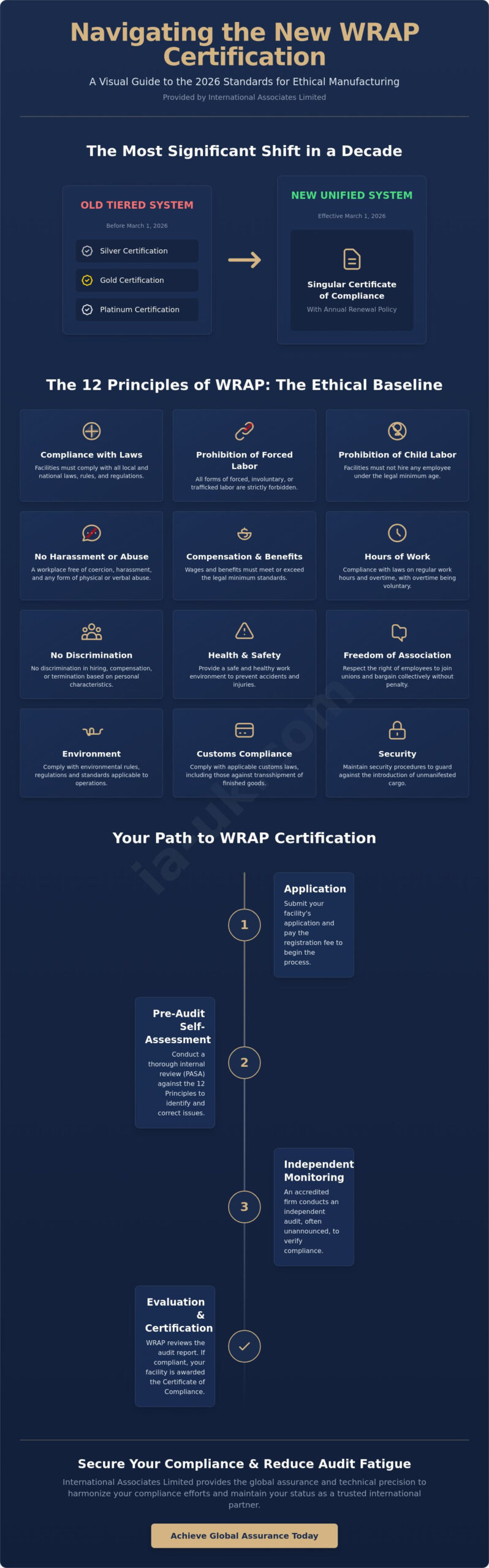
Is your apparel facility prepared for the most significant shift in social compliance standards in over a decade? As of March 1, 2026, the tiered system of Silver, Gold, and Platinum was replaced by a singular Certificate of Compliance, a move that demands immediate attention from the 400 facilities currently operating under this framework. You likely feel the weight of audit fatigue from managing overlapping requests for SEDEX and SA8000 while fearing the implications of zero-tolerance issues during unannounced inspections. We understand that maintaining global reliability requires a stable, predictable path toward compliance.
This guide provides the technical precision needed to secure your wrap certification under the new annual renewal policy. You’ll gain a clear understanding of the 12 WRAP principles and a structured roadmap that moves your facility from the initial application to full assurance. International Associates Limited ensures your business remains a trusted and international partner in the supply chain through a methodical approach to social accountability.
Key Takeaways
- Identify how the 12 Principles provide a rigorous framework for ethical manufacturing by aligning your facility with international labor standards.
- Differentiate between industry-specific standards and general social accountability audits to determine the most effective path for your specific production needs.
- Learn the technical requirements for the Pre-Audit Self-Assessment (PASA) to ensure your facility is prepared for unannounced independent monitoring.
- Secure your wrap certification by following a structured roadmap that addresses current documentation standards and annual renewal protocols.
- Utilize professional assurance services to harmonize your compliance efforts across global manufacturing hubs and reduce the burden of audit fatigue.
What is WRAP Certification? Defining Global Apparel Standards
In the complex landscape of international trade, Worldwide Responsible Accredited Production (WRAP) stands as the primary objective framework for the sewn products sector. It’s essential to distinguish this standard from the “Wellness Recovery Action Plan” used in mental health; in the context of global manufacturing, a wrap certification is a rigorous validation of a facility’s commitment to ethical labor practices. Since its establishment in 2000, the organization has functioned as an independent, non-profit entity dedicated to promoting safe, lawful, and humane manufacturing across the globe. It’s now the largest program of its kind, covering more than 0.4 million workers in over 400 certified facilities as of May 2026.
The 25-year history of WRAP reflects a steady evolution from a basic compliance checklist to a sophisticated management tool. Major retailers in the United States and Europe prioritize this accreditation because it provides a uniform standard that transcends local regulatory inconsistencies. International Associates Limited facilitates this global alignment from our Glasgow headquarters, providing the technical oversight and independent verification required to maintain institutional trust. We act as a professional bridge, ensuring that manufacturers in Asia and the Middle East meet the exacting demands of Western retail markets through methodical auditing and impartial reporting.
The Scope of WRAP in 2026
While the program’s origins are rooted in apparel manufacturing, its scope in 2026 encompasses the broader sewn products industry, including footwear, accessories, and luggage. This specialization allows for a deeper focus on the specific risks inherent to textile production, such as chemical management and fire safety. Unlike general social accountability audits that apply to all industries, WRAP is tailored to the operational realities of high-volume garment factories. This sector-specific approach ensures that the audit process identifies risks that a broader assessment might overlook, providing a higher level of assurance for brand owners and stakeholders alike.
The Business Value of Accreditation
Securing a wrap certification is a strategic move that opens doors to high-value tenders and restricted supply chains. Many global brands now mandate this accreditation as a prerequisite for any new manufacturing partnership. By adhering to this single, widely accepted standard, facilities can significantly reduce audit fatigue. Instead of preparing for dozens of individual brand inspections, a facility can present its WRAP credentials to multiple clients. This efficiency allows management to focus on operational improvements rather than constant audit preparation. Through our global network of auditors, International Associates Limited provides the stability and precision necessary for businesses to navigate these complex regulatory requirements without friction.
The 12 Principles of WRAP: A Comprehensive Breakdown
The 12 Principles of WRAP serve as the mandatory ethical baseline for any facility seeking to achieve or maintain a valid wrap certification. These standards provide a structured framework that ensures manufacturing operations are conducted in a lawful, humane, and ethical manner. By aligning directly with the core conventions of the International Labour Organization (ILO), the principles establish a universally recognized set of expectations that transcend local borders. Detailed documentation on these requirements is available on the Official WRAP Website, which serves as the primary repository for compliance updates.
Sustaining these standards requires more than a simple checklist; it demands a robust management system approach. We’ve observed that facilities that integrate ethical principles into their broader quality management structures achieve significantly higher levels of consistency during unannounced audits. This systematic approach mirrors the logic found in other international standards, ensuring that social accountability isn’t a secondary consideration but a core component of operational excellence. It’s this methodical integration that separates compliant facilities from those that struggle with recurring non-conformities.
Labour and Human Rights Requirements
The framework places heavy emphasis on the protection of worker rights through strict prohibitions on forced, child, and involuntary labour. Compliance requires facilities to implement rigorous age-verification processes and ensure that all employment is entered into voluntarily. Beyond basic rights, the standard mandates fair compensation and benefits, ensuring workers receive at least the legal minimum wage and all required premiums. Freedom of association and collective bargaining rights must also be respected, allowing employees to engage with management regarding their working conditions without fear of reprisal or discrimination.
Health, Safety, and Environmental Standards
Physical safety remains a critical pillar of the audit process, particularly concerning fire safety and building integrity in high-density manufacturing environments. These requirements closely align with the principles of ISO 45001, focusing on systematic hazard identification and risk mitigation. Facilities must also demonstrate environmental stewardship by maintaining valid permits and following strict waste management protocols. This integration of environmental and social compliance ensures that the facility’s impact on its local community is minimized while protecting the workforce from occupational hazards. For those seeking to harmonize these various standards, our team provides the technical assurance necessary to navigate complex global regulations with confidence.
WRAP vs. SA8000 and SEDEX: Strategic Comparison
Navigating the landscape of social compliance requires a technical understanding of how different frameworks interact. While a wrap certification is a specific credential for the sewn products sector, other systems like SA8000 and SEDEX serve different strategic purposes. SA8000 is a broad, multi-industry certification based on international human rights. In contrast, SEDEX is not a certification at all; it’s a data-sharing platform that utilizes the SMETA audit methodology. For many facilities, the structural foundation for these audits is ISO 9001. A robust quality management system ensures that the documentation and procedural rigor required for social accountability are already embedded in the facility’s operations.
Deciding between these standards often depends on the requirements of your primary export market. US-based retailers historically favor WRAP due to its industry-specific focus and unannounced audit protocols. European buyers frequently request SEDEX reports to facilitate transparency across their supply chains. Since the policy update on March 1, 2026, which consolidated WRAP’s tiers into a single Certificate of Compliance, the choice has become more streamlined. Manufacturers don’t need to navigate the complexities of Silver or Gold status; they simply maintain a unified standard of excellence that is recognized globally.
Choosing the Right Ethical Framework
The cost-benefit analysis of pursuing a wrap certification is often more favorable for medium-sized apparel manufacturers than more generalized standards. Registration fees are clearly defined based on workforce size, ranging from $650 for facilities with 100 or fewer workers to $1,550 for those with over 1,001 employees. This transparency allows for precise financial planning. It’s also vital to evaluate zero-tolerance policies. WRAP’s unannounced audits are rigorous, but they provide a level of market trust that general self-reported platforms cannot match. This objective validation is essential for maintaining access to high-value global contracts.
Streamlining Multi-Standard Compliance
Audit fatigue is a significant operational risk that can be mitigated through methodical management system alignment. Instead of managing each standard in isolation, we recommend conducting a unified gap analysis to identify overlapping requirements between WRAP, SEDEX, and SA8000. International Associates Limited provides the technical expertise to harmonise these audits across global production hubs. By linking your social compliance efforts to a centralized management system, you ensure that your facility remains a Trusted and International partner in the global supply chain. This approach reduces redundant documentation and allows your team to focus on achieving actual operational improvements. For manufacturers supplying products to markets in the Middle East and Southeast Asia, understanding the requirements of halal certification alongside social compliance standards can further strengthen your facility’s position as a comprehensive and reliable global supplier.
The WRAP Certification Process: A Step-by-Step Roadmap
The journey toward achieving a wrap certification follows a logical and methodical sequence designed to ensure institutional integrity. It begins with the formal application and registration phase. Facilities must submit a registration fee, which is tiered based on workforce size as of January 1, 2024. Facilities with 100 or fewer workers pay $650; those with 101 to 200 pay $950; those with 201 to 1,000 pay $1,350; and facilities with 1,001 or more workers pay $1,550. This initial step establishes the administrative foundation for the subsequent technical evaluation. Once registered, the facility must demonstrate its compliance through a rigorous independent monitoring process.
Following registration, the facility enters a period of self-evaluation. This stage is critical for identifying and rectifying non-conformities before an external auditor arrives on-site. Independent monitoring firms then conduct unannounced audits to verify that the facility’s operations align with the 12 Principles. These auditors examine physical conditions, review technical documentation, and conduct private interviews with workers to ensure an impartial assessment of the workplace environment. For manufacturers seeking a steady hand in this process, we provide professional audit services that bridge the gap between complex requirements and successful accreditation.
Mastering the Pre-Audit Self-Assessment (PASA)
The Pre-Audit Self-Assessment (PASA) is the most vital preparatory phase. Facilities must conduct a meticulous review of internal documents, including payroll records, time logs, and occupational health and safety certificates. It’s essential to perform mock interviews with staff members to ensure they understand their rights and can communicate openly with auditors. This internal transparency prevents the discovery of zero-tolerance issues during the formal inspection. The PASA is a facility’s formal declaration of its readiness for a full audit.
The 2026 Certification Framework
A significant policy shift occurred on March 1, 2026, which altered the certification landscape. Historically, facilities progressed through Silver, Gold, and Platinum tiers based on their compliance history and the length of their certification. The Platinum level was previously reserved for facilities that demonstrated three consecutive years of Gold-level compliance, resulting in a two-year certificate. However, under the new 2026 policy, these tiers have been replaced by a single Certificate of Compliance. All new certifications issued after March 1, 2026, are valid for one year and require annual renewal. While existing Platinum certifications remain valid until their specified expiration date, all facilities must now prepare for annual surveillance to maintain their status. This change ensures a consistent, high-level standard of social accountability across the global supply chain. Maintaining this wrap certification requires constant vigilance and the regular conduct of unannounced Post-Certification Audits (PCAs) to verify ongoing adherence to ethical standards.
Global Assurance with International Associates
International Associates operates as a sophisticated bridge between complex global regulations and the apparel manufacturers that must adhere to them. From our headquarters in Glasgow, we provide the technical oversight necessary to support manufacturing hubs across Asia and the Middle East. Achieving a wrap certification requires a level of procedural integrity that only an experienced, independent auditing body can provide. Our methodical approach ensures that every aspect of the social accountability framework is quantified and verified, providing a steady hand for businesses seeking to strengthen their supply chain resilience.
The efficiency of our certification process is supported by advanced IT infrastructure, which allows for rapid data processing and streamlined certificate turnaround times. As global brands increasingly require robust data governance alongside ethical manufacturing credentials, facilities that also hold ISO 27001 information security management certification demonstrate a comprehensive commitment to institutional trust that resonates with Western retail partners. We prioritize a comprehensive review of technical documentation before the final on-site audit occurs. This proactive step identifies potential friction points in the compliance journey, ensuring that facilities are prepared for unannounced inspections. By providing this high-level expertise, we help our clients navigate the sensitive sectors of global trade with stability and confidence. Our focus on precision reduces the administrative burden on your management team, allowing for a more focused approach to production.
Trusted Auditing Across Global Jurisdictions
Our network of local offices in regions such as India and Italy provides deep regional compliance insights that are essential for navigating localized labor laws. Impartial, third-party verification remains the foundational pillar of our service, as it builds the stakeholder confidence required to secure high-value contracts. We work with organizations to move beyond basic compliance, aiming instead for a state of operational excellence where ethical standards are embedded into the daily management system. This global-local duality ensures that our clients benefit from British institutional reliability while maintaining operational capacity on the ground. This approach creates an atmosphere of security for brands that require absolute certainty in their supply chain ethics.
Enquire About Your WRAP Journey
The path to accreditation is most effective when it begins with a structured evaluation of current systems. We offer preliminary gap analyses conducted by our social accountability experts to identify specific areas for improvement before the formal audit. Professional training is also provided for internal compliance officers to ensure they possess the technical knowledge required to maintain standards year-round. This logical sequence of support ensures that your facility achieves its regulatory goals without unnecessary ambiguity. By partnering with a Trusted and International body, you ensure that your facility meets the highest global standards for ethical production.
Contact International Associates to begin your WRAP certification process
Achieving Long-Term Social Accountability in Global Apparel Production
The transition to a unified certification standard represents a significant step toward harmonizing global apparel production. By adhering to the 12 Principles, facilities establish a foundation of trust that’s essential for maintaining relationships with major retailers. A wrap certification acts as more than a compliance badge; it serves as a strategic asset that validates your facility’s commitment to humane and lawful manufacturing. As an independent UK-based auditing body with global reach, International Associates provides the technical expertise required to navigate these evolving requirements.
Our meticulous approach to social accountability ensures that your technical documentation is robust and your operations are audit-ready. We act as a steady hand for businesses seeking to achieve operational excellence across international borders. By utilizing our global network of specialists, you can move from a reactive compliance posture to a proactive state of supply chain resilience. This methodical progression ensures that your business remains competitive in an increasingly transparent global market.
Secure Your Global Supply Chain with a WRAP Audit
We look forward to supporting your facility as it reaches new heights of ethical production and global competitiveness.
Frequently Asked Questions
What is the main difference between WRAP and SEDEX SMETA audits?
WRAP is a specific certification program tailored for the sewn products sector, whereas SEDEX is a global data-sharing platform that utilizes the SMETA audit methodology. A wrap certification provides a formal credential that validates a facility’s compliance for a one-year period. In contrast, SEDEX allows manufacturers to share audit findings with multiple retailers through a central database without issuing a specific certification or pass/fail result.
How much does WRAP certification cost for a small facility?
The registration fee for a facility with 100 or fewer workers is $650 as of January 1, 2024. This administrative fee is paid directly to WRAP during the application phase to initiate the process. It’s important to note that this registration cost is separate from the fees charged by independent third-party monitoring firms for the actual on-site audit and technical evaluation.
Is WRAP certification mandatory for exporting apparel to the USA?
While the US government doesn’t legally mandate this accreditation for imports, it’s a commercial requirement for the majority of major US retailers. Most high-volume brands won’t enter into a manufacturing agreement unless a facility can demonstrate ethical compliance through a recognized standard. Achieving this certification is a strategic necessity for accessing restricted global supply chains and securing high-value contracts with Western buyers.
How long does the WRAP certification process typically take?
The timeline from initial application to final approval generally spans between six weeks and six months. This duration depends heavily on the facility’s internal readiness and the time required to complete the Pre-Audit Self-Assessment (PASA). Once the registration is processed, the facility must be prepared for an unannounced audit within a specified window, followed by a technical review of the auditor’s report.
What are the “Zero Tolerance” issues that lead to immediate decertification?
Zero-tolerance issues include the discovery of child labor, forced labor, or evidence of physical abuse and harassment. Other critical violations that result in immediate failure include the presentation of fraudulent records, such as “double books” for payroll, or any attempt to bribe an auditor. These findings lead to the immediate revocation of any existing certificate and can result in a permanent ban from the program.
Can a facility lose its WRAP certification once it is granted?
A facility can lose its status if it fails an unannounced Post-Certification Audit (PCA). WRAP maintains the integrity of its standard by conducting these random inspections to verify that ethical practices are sustained throughout the year. If a major non-compliance is identified during a PCA, the certificate is revoked, and the facility must undergo the entire application and audit process again to regain its standing.
What is the difference between Gold and Platinum WRAP status?
As of the policy change on March 1, 2026, the tiered system of Silver, Gold, and Platinum has been replaced by a single Certificate of Compliance. Previously, Platinum status was awarded for three consecutive years of full compliance, resulting in a two-year certificate. Under the current 2026 framework, all certifications are valid for one year and require annual renewal to ensure continuous adherence to the 12 Principles.
Does International Associates provide training for WRAP internal auditors?
International Associates provides professional Lead Auditor Training designed to equip internal compliance officers with the technical skills required for rigorous social accountability assessments. While we don’t provide management system consultancy, our training programs focus on the objective interpretation of international standards. This ensures your internal team can accurately identify gaps and maintain the high level of documentation required for a successful wrap certification audit.