

As of February 2, 2026, the FDA’s Quality Management System Regulation has officially integrated the international iso 13485 standard into the federal framework for medical device oversight. This transition marks a definitive shift toward a unified global language for quality management. Certification is now recognized as a practical necessity for any manufacturer seeking entry into the United States or European markets. You likely recognize that aligning internal processes with the overlapping requirements of the MDR, UKCA, and ISO frameworks presents significant technical challenges. The complexity of risk management documentation and the persistent risk of audit non-conformities often create friction in the product lifecycle.
Selecting a certification body involves evaluating their technical competence in specific medical device categories. A body with a global auditing network provides a significant advantage for companies targeting multiple regions, such as the EU, UK, and Middle East. To find a partner that meets these criteria, you can explore Certification & Verification Services options that offer specialized auditing and compliance support. It’s important to understand the three-year certification cycle, which includes the initial audit followed by annual surveillance audits. These periodic checks ensure the QMS remains effective and continues to meet the evolving requirements of iso 13485 over time.
This guide provides the technical expertise required to master iso 13485 and ensure your operations remain compliant with current global regulations. We’ll examine the specific requirements of the 2016 version, detail the impact of the QMSR on international trade, and provide a methodical roadmap for achieving certification. You’ll gain the clarity needed to select an independent certification body and secure your position in the global medical device market.
Key Takeaways
- Learn the fundamental requirements for maintaining system effectiveness, including the structured development of a Quality Manual and the Medical Device File.
- Identify the technical distinctions between the regulatory safety mandate of iso 13485 and the broader business excellence goals of standard quality management.
- Establish a clear roadmap for implementation through a systematic gap analysis that identifies specific operational deficiencies before the formal audit process begins.
- Understand how to utilize a global network of auditing professionals to facilitate seamless entry into key international markets, including the EU and the Middle East.
- Develop the specialized documentation expertise required to manage high-stakes regulatory landscapes with confidence and procedural integrity.
What is ISO 13485 and Why is it Essential in 2026?
ISO 13485 is the internationally recognized standard for quality management systems within the medical device industry. It’s designed specifically to address the rigorous regulatory requirements of the medical sector, distinguishing it from more general quality frameworks. In 2026, the standard serves as the primary mechanism for demonstrating compliance with safety and quality mandates across diverse jurisdictions. It isn’t merely a set of guidelines. It’s a comprehensive framework that ensures every device reaching a patient is safe, effective, and manufactured under controlled conditions.
The global regulatory environment has undergone a significant shift. The FDA’s finalized Quality Management System Regulation (QMSR), which took effect on February 2, 2026, explicitly incorporates the 2016 version of the standard by reference. This harmonization means that for manufacturers targeting the United States, adherence to iso 13485 is no longer optional. Beyond legal mandates, certification is often a de facto requirement for participating in global tenders and securing partnerships within the supply chain. It protects brand reputation by minimizing the risk of adverse events and product recalls. These events can be catastrophic in a highly regulated industry.
The Scope of the Standard
The standard’s applicability extends far beyond the factory floor. It encompasses the entire product lifecycle, from initial design and development through to installation, servicing, and eventual decommissioning. Manufacturers are the primary adopters, but service providers, distributors, and importers also find certification essential for operational integrity. It plays a critical role for those serving as an EU authorised representative vs UK responsible person. These entities use the framework to verify that the manufacturers they represent maintain the necessary technical documentation and quality controls required by regional authorities.
ISO 13485:2016 vs. Future Revisions
Despite being a decade old, the 2016 version remains the global benchmark in 2026. Its focus on risk management and regulatory alignment has allowed it to remain relevant as technology evolves. The standard is robust enough to cover Software-as-a-Medical-Device (SaMD) and complex digital health platforms. It also aligns with the Medical Device Single Audit Program (MDSAP). This alignment allows a single audit to satisfy the quality system requirements of multiple regulators simultaneously. While future revisions may eventually emerge, the current framework continues to provide the stability and precision needed for global market access.
Core Requirements: The Pillars of Medical Device Quality
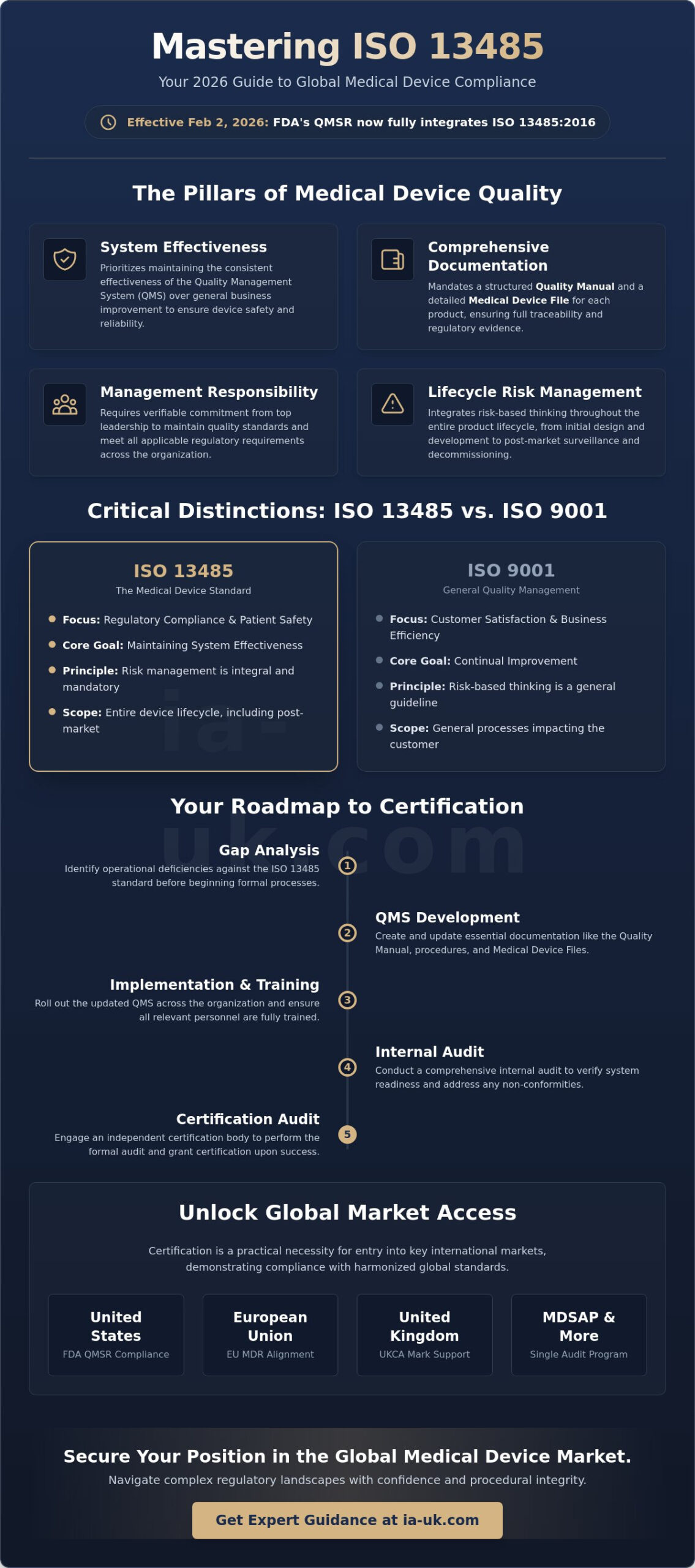
The transition from general quality management to the specialized requirements of the medical sector involves a fundamental shift in philosophy. While standard frameworks often prioritize “continual improvement” for business efficiency, iso 13485 focuses on maintaining the effectiveness of the quality management system. This stability ensures that medical devices consistently meet both customer requirements and applicable regulatory standards. This distinction is critical in 2026, as the FDA’s harmonization with ISO 13485 has officially aligned US federal requirements with this global benchmark. Manufacturers must now demonstrate that their systems are robust enough to withstand the scrutiny of international audits without compromising safety.
Documentation serves as the objective evidence of this effectiveness. Two foundational documents are required: the Quality Manual and the Medical Device File. The Quality Manual outlines the scope of the system and the structure of the procedures, while the Medical Device File contains the technical specifications and records for each device model. These files provide a comprehensive history of the product, ensuring that every manufacturing decision is traceable and justified. Organizations seeking to expand their reach often rely on global certification services to verify that these records meet the precise expectations of international regulators.
Management responsibility is another essential pillar. It requires leadership to provide a verifiable commitment to regulatory compliance. This commitment manifests in the allocation of resources, including the employment of competent personnel and the maintenance of specialized infrastructure. For devices requiring controlled environments, resource management includes the rigorous monitoring of sterile conditions to prevent contamination. Without this top-down commitment, the technical aspects of the QMS cannot be sustained over time.
Risk Management and ISO 14971 Integration
Risk management isn’t a peripheral activity; it must be embedded in every QMS process from initial design to post-market surveillance. The standard requires manufacturers to document risk throughout the entire product life cycle. By aligning iso 13485 with the ISO 14971 standard, companies can ensure that clinical safety remains the primary focus. This integration requires a systematic approach to identifying hazards, estimating risks, and implementing controls that reduce those risks to acceptable levels. A thorough understanding of the iso 13485 requirements for risk-based documentation is essential for manufacturers building a compliant quality management system from the ground up.
Design Control and Traceability
Design controls require a methodical approach to product development, including rigorous verification and validation of design inputs and outputs. Traceability is equally vital. The implementation of Unique Device Identification (UDI) allows for global tracking of devices, which is essential for managing field safety corrective actions. Furthermore, manufacturers must maintain strict quality assurance over all outsourced processes. Supplier quality isn’t just a procurement concern; it’s a critical component of the manufacturer’s own regulatory responsibility. For organizations managing complex global supply chains, integrating a robust sa8000 social accountability audit framework alongside device quality controls can further strengthen supplier oversight and demonstrate a comprehensive commitment to ethical manufacturing standards.
ISO 13485 vs. ISO 9001: Understanding the Critical Differences
While many professionals assume that compliance with one standard implies readiness for the other, the technical divergence between these frameworks is substantial. ISO 9001 serves as a broad foundation for quality management across any industry. It prioritizes business excellence and market-driven improvements. In contrast, iso 13485 is a specialized instrument designed for the medical device sector. Its primary mandate is regulatory safety and clinical efficacy. This distinction is clearly articulated in guidance from the FDA on Quality Management Systems, where the focus shifts from subjective customer preferences to objective clinical outcomes.
One notable difference is the exclusion of customer satisfaction monitoring in the medical standard. In a general business context, customer feedback drives product evolution. Within the medical device field, however, a product’s success is measured by its adherence to validated specifications and its impact on patient health. Subjective surveys are replaced by rigorous post-market surveillance and complaint handling. This shift ensures that safety is never compromised by market trends or non-technical feedback. The standard assumes that if a device is safe and performs as intended, the regulatory objective is met, regardless of subjective user satisfaction levels.
The documentation intensity also varies significantly. While ISO 9001 allows for a degree of flexibility in record-keeping to suit different business models, iso 13485 requires exhaustive documentation for every phase of the product life cycle. Every design change, manufacturing batch, and sterilization cycle must be recorded with precision. These records provide the evidentiary trail required during regulatory inspections and audits. This level of detail is necessary to ensure that any potential failure can be traced back to its root cause, facilitating targeted recalls or corrective actions when necessary.
Effectiveness vs. Continual Improvement
The concept of “improvement” is handled differently in these two standards. ISO 9001 encourages constant changes to enhance efficiency and market position. However, in a validated medical process, frequent changes can introduce unforeseen risks. Therefore, the medical standard prioritizes maintaining the effectiveness of the system over constant iteration. Manufacturers often use ISO 9001 as an initial stepping stone. It builds a fundamental culture of quality before the organization transitions to the more rigid and prescriptive requirements of medical device production.
Regulatory Prescriptiveness
The full title of the standard includes the phrase “for regulatory purposes.” This signals its role as a legal tool rather than just a management guide. It contains highly specific requirements for sterile and implantable devices that are entirely absent from general quality standards. Understanding what is iso 13485 in a legal context is vital for manufacturers. It serves as the framework through which companies satisfy the technical files required by global health authorities, ensuring that products are legally fit for market entry.
The Roadmap to Certification: A Practical Implementation Guide
Achieving certification requires a disciplined, multi-stage approach that begins long before an external auditor arrives on-site. The process is inherently methodical, designed to ensure that every aspect of the quality management system is both documented and functional. While the timeline can vary based on organizational complexity, the journey to iso 13485 compliance typically spans four to six months for established firms. This progression ensures that the system isn’t just a set of documents but a stable framework for daily operations.
The implementation sequence follows a logical path toward verification:
- Step 1: Gap Analysis – A comprehensive review of current operations against the standard’s specific clauses. This phase identifies the technical delta between existing processes and regulatory expectations.
- Step 2: Documentation Development – The creation of Standard Operating Procedures (SOPs), the Quality Manual, and the Medical Device File. These documents serve as the foundation of the QMS.
- Step 3: Implementation – Personnel are trained on new procedures, and the organization begins recording real-world data to provide objective evidence of compliance.
- Step 4: Internal Audit – A final verification of system readiness conducted by independent personnel.
- Step 5: External Certification Audit – The formal assessment by a certification body, divided into Stage 1 (documentation review) and Stage 2 (on-site process evaluation).
For manufacturers aiming to secure global market access, choosing a partner with international reach is essential. You can initiate your journey by securing a formal ISO 13485 Medical Devices Certification through an accredited body that understands the specific nuances of your device category.
Conducting a Robust Internal Audit
The internal audit serves as a critical “dress rehearsal” for the formal certification process. The standard requires that auditors be independent of the work being performed to ensure an impartial assessment. Common non-conformities often appear in training records, CAPA (Corrective and Preventive Action) documentation, and supplier evaluation files. Resolving these issues through a formal Management Review meeting allows leadership to verify the system’s effectiveness before the external Stage 1 audit begins. Organizations looking to build this internal capability should consider investing in iso 13485 lead auditor training to equip their personnel with the technical expertise required to conduct rigorous and impartial assessments.
Choosing the Right Certification Body
Selecting a certification body involves evaluating their technical competence in specific medical device categories. A body with a global auditing network provides a significant advantage for companies targeting multiple regions, such as the EU, UK, and Middle East. It’s important to understand the three-year certification cycle, which includes the initial audit followed by annual surveillance audits. These periodic checks ensure the QMS remains effective and continues to meet the evolving requirements of iso 13485 over time.
Global Market Access with International Associates
Securing an iso 13485 certificate is the primary mechanism for manufacturers to demonstrate their commitment to quality on a global scale. This standard provides the foundational language for compliance in the European Union under MDR, the United Kingdom under UKCA, and various Middle Eastern regulatory bodies. International Associates operates from a central administrative base in Glasgow while maintaining an expansive network of international offices. This global-local duality ensures that manufacturers receive institutional reliability combined with localized auditing capacity. It’s this structure that allows businesses to navigate complex regional requirements without unnecessary friction.
The technical documentation review process is often a point of significant ambiguity for manufacturers. IA-UK streamlines this process through a methodical approach to verification. By aligning a quality management system with broader ISO standards for medical devices, organizations achieve a more cohesive approach to international adherence. This strategic combination reduces the administrative burden during market entry and facilitates smoother transitions between different regional jurisdictions. It ensures that the technical file remains a living document that accurately reflects the current state of the product and the quality system.
Beyond the Certificate: Strategic Partnership
IA-UK acts as a meticulous guardian of standards, supporting manufacturers through evolving regulatory landscapes. Beyond the initial audit, the firm provides specialized representative functions, including serving as an EU and UK Authorised Representative. These roles are essential for maintaining continuous market compliance and handling legal communications with health authorities. Organizations also have the opportunity to enhance their internal expertise through Lead Auditor Training for ISO 13485 medical device professionals. This training ensures that the personnel responsible for the QMS are equipped with the technical knowledge required to maintain procedural integrity.
Ready to Start Your Certification Journey?
The long-term ROI of a robust iso 13485 system is found in sustained global market access and the mitigation of regulatory risk. It’s a strategic investment in the stability and reputation of the organization. A well-implemented system reduces the likelihood of non-conformities and ensures that every device produced meets the highest safety benchmarks. Manufacturers ready for a professional and independent assessment can request a formal quote to begin the certification cycle. To secure your position in the international medical device market, contact International Associates today for an ISO 13485 assessment.
Securing Your Position in the Global Medical Device Market
The integration of the iso 13485 standard into global regulatory frameworks represents a significant advancement in medical device safety and interoperability. By prioritizing the stability of quality systems over subjective market improvements, organizations ensure their products consistently meet the highest clinical standards. This methodical alignment is essential for navigating the technical complexities of MDR and UKCA requirements while maintaining a robust risk management profile throughout the product lifecycle. A well-implemented system doesn’t just satisfy a checklist; it builds a foundation of trust with regulators and patients alike.
Achieving certification requires a partner with a deep understanding of international legal frameworks and a global network of technical auditors. International Associates provides a UKAS accredited perspective that ensures your quality system is verified with institutional weight and impartiality. Whether you’re targeting the EU, UK, or Middle Eastern markets, our expertise in high-stakes technical sectors provides the steady hand needed for corporate compliance. You can take the next step toward global market access by requesting a Professional ISO 13485 Certification Quote. We look forward to supporting your organization’s international growth through rigorous and ethical auditing.
Frequently Asked Questions
Is ISO 13485 certification mandatory for all medical device manufacturers?
Certification is technically a voluntary standard, but it functions as a practical requirement for global market access. Many regulatory bodies, including those in the EU and the UK, recognize the standard as a primary means to demonstrate compliance with legal safety mandates. As of February 2, 2026, the FDA also incorporates these requirements into its federal oversight through the Quality Management System Regulation. Manufacturers find that holding a certificate is often a contractual necessity for participating in international supply chains.
How long does it typically take to achieve ISO 13485 certification?
The journey to achieving iso 13485 certification typically spans four to six months for organizations with established processes. This timeline includes the initial gap analysis, documentation development, and the required period of recording real-world data before the external assessment. More complex manufacturing operations or those starting without a formal management system may require additional time to ensure procedural integrity. The duration depends heavily on the organization’s readiness and the complexity of its device categories.
Can a small startup with only a few employees get ISO 13485 certified?
Organizations of all sizes can achieve certification, including startups with fewer than ten employees. The standard is designed to be scalable, focusing on the effectiveness of the quality management system rather than the size of the workforce. Small businesses must still document their processes and maintain a Medical Device File, but the scope of the system will reflect their specific operational scale. Independent auditors evaluate whether the system meets the standard’s requirements regardless of company size.
What is the difference between ISO 13485 and the EU MDR?
ISO 13485 is an international standard for quality management systems, while the EU MDR is a comprehensive legal regulation for medical devices sold in the European Union. The standard provides the framework for the quality system that the MDR requires. While the standard focuses on organizational processes and documentation, the MDR includes broader legal obligations for clinical evaluations, post-market surveillance, and specific device classifications. Adherence to the standard is a key step in satisfying MDR requirements.
Does ISO 13485 certification expire?
Certification does not remain valid indefinitely and follows a three-year cycle. After the initial assessment and issuance of the certificate, the organization must undergo annual surveillance audits to verify continued compliance. At the end of the three-year period, a full recertification audit is required to maintain the certificate’s validity. This cycle ensures the quality management system remains effective and continues to meet the evolving requirements of the medical device industry.
Can I integrate ISO 13485 with my existing ISO 9001 system?
You can integrate iso 13485 with an existing ISO 9001 system to create a unified management framework. While both standards share foundational quality principles, the medical standard introduces more prescriptive requirements for risk management and regulatory documentation. Integration allows companies to streamline their audits and reduce administrative duplication while meeting the specific safety mandates of the medical sector. It’s a common strategy for manufacturers that produce both medical and non-medical products.
What are the most common non-conformities found during an ISO 13485 audit?
Technical auditors frequently identify non-conformities in areas such as Corrective and Preventive Action (CAPA) procedures and supplier quality management. Other common issues include incomplete training records and inadequate documentation within the Medical Device File. These findings often stem from a failure to record objective evidence of process validation or a lack of independent internal oversight. Addressing these gaps during the internal audit phase is essential for a successful external certification assessment.
How much does ISO 13485 certification cost in 2026?
The cost of certification varies based on the size of the organization, the complexity of the medical devices, and the number of operational sites. Factors such as the scope of the audit and the technical category of the devices will influence the final fee structure. Organizations also need to account for ongoing costs associated with annual surveillance audits. It’s best to request a formal assessment from an accredited body to receive a precise quote tailored to your specific regulatory and operational needs.