

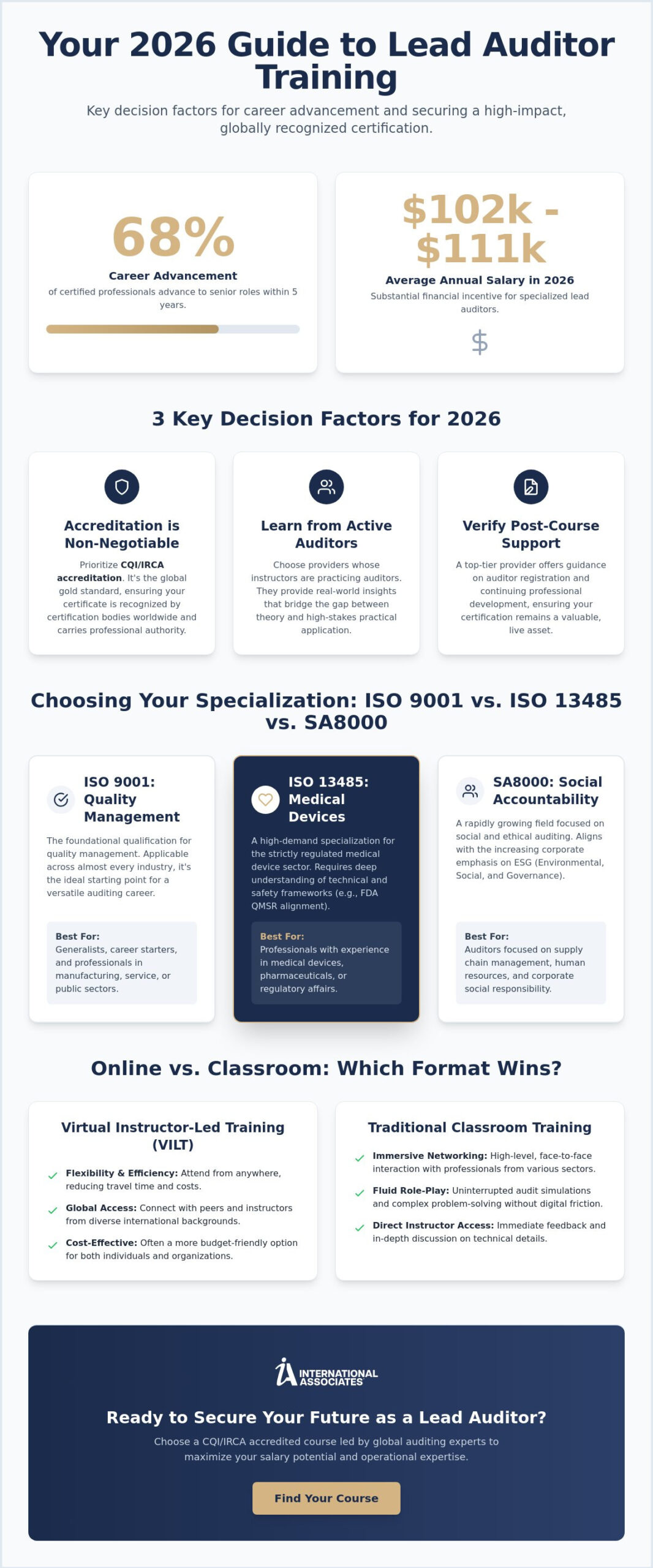
Did you know that 68% of quality professionals who complete formal lead auditor training advance to more senior roles within five years? As the average annual salary for lead auditors in 2026 ranges between $102,886 and $111,492, the professional incentive to specialize is substantial. However, with the current regulatory landscape introducing significant shifts like the ISO 9001:2026 climate amendments and the FDA QMSR alignment for ISO 13485, selecting the right course is no longer just about obtaining a certificate. It’s about securing a technical skill set that remains relevant in a high-stakes environment.
It’s natural to feel concerned about the high cost of certification or the complexity of choosing between various accreditation bodies. You need a path that guarantees both global recognition and practical leadership skills. This guide compares the leading training paths and delivery formats to help you find the high-impact course that fits your 2026 career objectives. We’ll examine accreditation standards, industry-specific requirements, and the real-world ROI of different certifications. This structured approach ensures you have the necessary information to choose a program that maximizes your salary potential and operational expertise.
Key Takeaways
- Identify the essential accreditation standards, such as CQI/IRCA, that ensure your credentials carry global weight and professional authority.
- Evaluate the strategic advantages of Virtual Instructor-Led Training (VILT) compared to traditional classroom settings to optimize your training budget.
- Determine whether a foundational ISO 9001 course or a specialized path like ISO 13485 better aligns with your sector’s regulatory demands.
- Assess the long-term career impact of lead auditor training through updated global salary benchmarks and leadership progression data.
- Discover how to select a training provider that utilizes active, global auditing expertise to bridge the gap between theoretical standards and high-stakes practical application.
Key Decision Factors for Lead Auditor Training in 2026
Selecting a professional path in the auditing sector requires a strategic evaluation of how a specific course aligns with international benchmarks. To understand the full scope of the role, one might ask, What is a Lead Auditor? In essence, it’s a designation that requires a combination of technical knowledge, leadership capability, and a deep understanding of specific ISO standards. For 2026, the primary differentiator between a high-impact career and a stagnant one is the quality of the initial lead auditor training.
Accreditation and Global Recognition
CQI/IRCA accreditation remains the definitive gold standard for auditing professionals. This recognition ensures that the training program has undergone rigorous verification by an independent body, confirming its adherence to strict educational and technical criteria. Many providers offer “awareness” workshops, but these lack the institutional weight required for certification body recognition. Without formal accreditation, your certificate might not be accepted when applying for auditor registration or when leading third-party audits. You can verify the standing of a provider by reviewing our accreditations, which reflect a commitment to international excellence and regulatory adherence.
Matching Standards to Career Paths
Choosing between a generalist and a specialist path is a critical career decision. ISO 9001 serves as a foundational qualification, applicable across nearly every industrial sector. However, the 2026 market shows a sharp increase in demand for niche expertise. For instance, the medical device sector relies heavily on ISO 13485, while the rise of social accountability and ESG auditing has made SA8000 a high-demand specialization. Before enrolling, you should evaluate the technical complexity of the standard. Specialized standards often require prior industry experience to ensure the auditor can effectively interpret complex regulatory frameworks.
The value of lead auditor training is significantly enhanced when instruction is led by active, practicing auditors. These professionals bring real-world technical expertise that transcends theoretical knowledge, offering insights into how standards are applied in sensitive, high-stakes environments. Post-course support is equally vital. A reputable provider should offer guidance on registering with international bodies and maintaining your professional status through continuing professional development. This ensures your certification remains a live asset rather than a static document. Professionals who are earlier in their journey and want a comprehensive overview of the certification pathway should review our detailed guide on how to become a lead auditor, which covers IRCA versus Exemplar Global pathways and mandatory audit day requirements.
Online vs. Classroom Lead Auditor Courses: Which Format Wins?
The landscape of professional development has undergone a significant transformation, with Virtual Instructor-Led Training (VILT) now standing as a primary delivery model in the auditing industry. When evaluating lead auditor training options, the decision between a physical classroom and a digital environment often hinges on specific organizational needs and the desired level of peer interaction. Both formats must adhere to a rigorous Lead Auditor Course Curriculum to ensure participants master audit program management and team leadership. The shift towards VILT reflects a global move toward efficiency, yet the traditional classroom remains a powerful tool for certain high-stakes technical specializations.
The Case for Traditional Classroom Learning
Immersive, face-to-face sessions provide unique advantages that are difficult to replicate entirely in a digital space. These environments foster high-level networking opportunities where professionals from diverse industrial sectors can share nuanced regulatory challenges. Immersive role-play scenarios occur without the friction of digital interfaces, allowing for a more fluid exchange of ideas during complex audit simulations. Participants benefit from direct, immediate access to instructors, which is particularly valuable when addressing the technical intricacies of standards like ISO 13485 or the climate amendments introduced in ISO 9001:2026. This format is often preferred by those who value the psychological focus that an off-site, dedicated learning environment provides.
The Rise of High-Performance Online Training
High-performance online training has evolved beyond simple video conferencing to include sophisticated engagement tools. Modern VILT platforms utilize breakout rooms and real-time collaborative documents to ensure that peer-to-peer learning remains a cornerstone of the experience. This format allows global teams to synchronize their professional development across multiple time zones without the substantial logistical costs and environmental impact associated with international travel. For organizations seeking to maintain a consistent standard of excellence across global offices, lead auditor training delivered through digital channels provides a scalable and efficient solution. You can explore various delivery options through our comprehensive auditor training programs to find the fit that best suits your team’s schedule.
Integrity remains a non-negotiable factor regardless of the chosen format. In 2026, technology employs advanced remote proctoring and identity verification systems to maintain the security of the examination process. This ensures that a certificate earned online carries the same institutional weight and professional authority as one obtained in a traditional classroom setting. The choice ultimately depends on whether your priority lies in the networking depth of in-person interaction or the logistical agility of a high-performance digital environment. Both paths, when properly accredited, lead to the same globally recognized credentials required to lead complex audit teams.
Choosing Your Specialisation: ISO 9001 vs. ISO 13485 vs. SA8000
Selecting a specialisation is a strategic decision that determines your professional reach and long-term earning potential. While ISO 9001 remains the foundational standard for quality management across all industrial sectors, the 2026 market increasingly rewards those with niche technical expertise. Achieving a certified lead auditor designation in a specialised field allows you to navigate complex regulatory frameworks that generalist auditors cannot address. This technical depth is particularly vital in sectors where compliance is tied to legal market access and international trade agreements.
High-Stakes Auditing: Medical Devices and Social Compliance
The medical device industry operates under some of the world’s most stringent regulations. For professionals in this sector, ISO 13485 lead auditor training is indispensable for ensuring MDR compliance. This training has become even more critical following the FDA’s alignment with ISO 13485 through the Quality Management System Regulation (QMSR), which takes full effect on February 2, 2026. Auditors must now be proficient in both the international standard and the specific modules required by the FDA’s updated framework. Medical device manufacturers looking to build internal audit competency should also consider an internal auditor course for ISO 13485 to ensure their teams can effectively identify risk-based non-conformities before formal surveillance. Organisations operating in the UK market should also evaluate their choice of ISO 13485 certification body UK carefully, as auditor shortages in 2026 have significantly impacted lead times and certification costs.
Simultaneously, the demand for transparency in global supply chains has surged. Professionals focusing on social accountability audits are now tasked with evaluating ethical labour practices under the revised SA8000:2026 standard. This update, published on January 1, 2026, introduces new requirements for supply chain transparency that auditors must master by the end of the year. Becoming a multi-standard lead auditor by combining quality management expertise with social compliance creates a powerful professional profile that appeals to multinational corporations seeking to mitigate reputational risk.
Transitioning Standards for 2026
Many auditors begin their careers with ISO 9001 but eventually bridge into specialised environmental or energy management systems. This transition is often driven by regional market requirements or corporate ESG goals. For example, the ISO 45001 lead auditor certification path offers a clear trajectory for those wanting to lead occupational health and safety teams in high-risk industrial environments. When selecting your next lead auditor training, consider these decision factors:
- Strategic Alignment: Does the standard match your organisation’s long-term compliance and growth goals?
- Technical Complexity: Do you possess the prerequisite industry experience to effectively interpret the standard’s nuances?
- Market Demand: Is there a documented need for this specific certification in your target geographical or industrial market?
By focusing on high-demand standards like ISO 13485 or SA8000, you position yourself as a specialized expert rather than a generalist. This choice directly impacts your ability to lead complex audit teams and provides the technical authority required for senior-level auditing roles. It’s about finding the intersection between your existing experience and the emerging regulatory needs of 2026.
Evaluating the ROI: Is Lead Auditor Training Worth the Investment?
Investing in professional development requires a clear understanding of the fiscal and career-based returns. In 2026, the demand for qualified auditors has reached a critical point; this makes the financial commitment to lead auditor training a strategic asset for both individuals and their employers. The return on this investment is measured not just in the acquisition of a certificate, but in the long-term development of leadership authority and technical precision. Professionals who successfully complete these programs often find themselves at the forefront of corporate governance and operational excellence.
Career Progression and Salary Potential
The “Auditor Shortage” of 2026 has created a competitive market where certified professionals are essential for maintaining global trade links. Many professionals use this certification to transition from internal auditing roles to high-level positions within external certification bodies or international regulatory agencies. Professionals who attain this certification often see their earning potential reach upwards of $140,893 as they progress into senior-level roles. Those who want to understand the full career trajectory and salary progression milestones should consult our comprehensive resource on how to become a lead auditor in 2026, which outlines the precise steps from initial training through to senior certification body roles. Maintaining Continuous Professional Development (CPD) and IRCA registration status ensures that your credentials remain valid as standards evolve, securing your marketability in a shifting economic landscape. This persistent relevance is what transforms a one-time course into a lifelong career foundation.
Organisational Benefits of In-House Lead Auditors
From an institutional perspective, developing internal expertise significantly reduces reliance on external consultancy fees. In-house auditors possess a deeper understanding of the company’s operational nuances, which leads to more effective regulatory compliance and streamlined internal processes. This internal verification capability improves the overall success of management system certification, as the organization is better prepared for third-party assessments. It’s a proactive approach that saves time and resources during formal audits. Organisations planning to pursue or renew their quality credentials should also review the cost of ISO 9001 certification UK to build an accurate budget across the full three-year audit cycle.
Building stakeholder trust is another critical outcome of having a certified team. When a firm demonstrates that its quality and safety standards are verified by its own certified lead auditors, it signals a high level of institutional maturity and commitment to ethical practices. This internal rigor mitigates the risk of non-conformities during formal inspections, protecting the organization’s reputation and ensuring operational continuity. It’s about creating a culture of stability where every process is backed by verified expertise.
You can begin your professional advancement by exploring our accredited lead auditor training courses to find the specialisation that matches your 2026 goals.
Why International Associates is the Professional Choice for 2026
International Associates functions as a sophisticated bridge between complex international regulations and the organisations that must adhere to them. Our lead auditor training programs are developed to meet the rigorous demands of the 2026 industrial landscape, where technical precision is a prerequisite for market access. By combining institutional reliability with a deep immersion in international standards, we provide a learning environment that mirrors the orderly and disciplined nature of a professional inspection. Every aspect of our delivery is designed to reinforce your status as a meticulous guardian of standards.
Active Auditor Instruction
A significant differentiator for our program is the calibre of our instructors. Many training providers utilize theorist trainers who possess only an academic understanding of management systems. In contrast, our courses are delivered by active certification body auditors who conduct high-stakes inspections across various technical sectors every day. This ensures that the instruction remains rooted in real-world application. Candidates engage with practical case studies drawn from actual 2026 audit findings, providing them with the skills to identify and navigate complex non-conformities. This hands-on approach prepares you for the high-pressure environment of leading an audit team in sensitive, highly regulated industries.
Global Reach with a Methodical Approach
We maintain an expansive network of regional offices across Europe, Asia, and the Middle East, providing a unique blend of institutional reliability and worldwide operational capacity. This structure allows us to support multinational organisations seeking consistent lead auditor training across diverse geographical borders. Our methodical approach ensures that every participant receives the same high level of expertise, regardless of their location. This global-local duality is essential for businesses navigating the fragmented regulatory landscapes of 2026. It ensures that while the standards are global, the context remains relevant to your specific operational environment.
Our commitment to excellence is supported by a modern approach that utilizes advanced IT infrastructure for seamless training delivery. This ensures that the educational experience is efficient, professional, and free from logistical friction. Upon successful completion of our courses, participants gain a direct path to influential professional memberships and networks. These connections provide a foundation for ongoing career growth and professional verification, ensuring you remain at the forefront of the auditing and assurance industry. We act as the steady hand in your professional development, guiding you toward the final result of global recognition and career advancement.
Securing Your Professional Future in Global Auditing
Choosing the correct lead auditor training path is a foundational decision that dictates your trajectory within the certification and assurance industry. As we’ve examined, the transition toward specialized standards like ISO 13485 and SA8000 reflects a global demand for technical precision and ethical transparency. Prioritizing CQI/IRCA accredited programs ensures that your credentials maintain institutional weight across international borders. Selecting a format that balances logistical efficiency with rigorous instruction remains paramount for achieving a high-impact return on investment.
International Associates remains committed to professional excellence through a global network of active professional auditors who bring real-world technical expertise to every session. From our Glasgow-based head office, we maintain worldwide operational capacity to support your career growth or your organization’s compliance objectives. Our methodical approach to verification and adherence provides the stability you need to lead complex audit teams with confidence. We invite you to explore our 2026 lead auditor training schedule to align your skills with the evolving regulatory landscape. It’s a strategic investment in a career defined by ethical rigor and global reliability.
Frequently Asked Questions
What is the difference between an internal auditor and a lead auditor course?
An internal auditor course focuses on conducting assessments within your own organisation to ensure internal compliance and process improvement. In contrast, lead auditor training provides the technical authority to lead audit teams and conduct third-party audits for certification bodies. The lead auditor program is more rigorous, covering the full management of the audit cycle and the leadership skills required to manage complex audit teams.
Is IRCA accreditation mandatory for lead auditor training?
IRCA accreditation isn’t legally mandatory, but it functions as the global benchmark for professional recognition. Most certification bodies and international employers require CQI/IRCA or Exemplar Global accredited training to ensure an auditor’s competence meets international standards. Holding an accredited certificate facilitates easier registration with professional bodies and ensures your credentials carry institutional weight in the global market.
How long does a lead auditor certificate remain valid?
A lead auditor training certificate technically doesn’t expire, but its professional relevance is tied to the current version of the standard. When a standard undergoes a major revision, such as the ISO 9001:2026 update, auditors must complete transition or upgrade training to maintain their professional standing. This ensures your technical knowledge remains aligned with the latest regulatory requirements and industry practices.
Can I take the lead auditor exam online in 2026?
Yes, you can take the lead auditor exam online in 2026 through Virtual Instructor-Led Training (VILT) platforms. These digital environments utilize advanced remote proctoring and identity verification systems to ensure the security and integrity of the assessment. This format allows you to achieve the same globally recognised credentials as a classroom session without the logistical costs of travel.
What are the prerequisites for attending a lead auditor training course?
Participants should possess a foundational understanding of the relevant ISO standard’s requirements before enrolling. While not always a strict requirement for entry, having practical experience in a management system environment is highly beneficial. This prior knowledge allows you to better grasp the complex technical interpretations and leadership scenarios presented during the lead auditor training.
How much does lead auditor training typically cost in the UK?
The financial investment for training in the UK varies depending on the delivery format and the specific standard selected. Classroom-based sessions generally require a higher investment due to facility and logistical overheads, whereas virtual instructor-led options provide a more efficient alternative. Whether you are looking for auditing courses or trade-specific certifications from an accredited provider like YTA Training, you should consult with training centers to obtain current rates tailored to your specific requirements.
What happens if I fail the lead auditor exam?
If you fail the lead auditor exam, most accredited providers allow for one resit within a specific timeframe, typically 12 months. You’ll usually only need to retake the examination portion, provided you successfully passed the continuous assessment conducted during the course. It’s advisable to review the specific resit policy of your training provider before enrolment to understand any potential administrative requirements.
Which ISO standard should I choose for my first lead auditor course?
ISO 9001 is the recommended choice for a first lead auditor course because it establishes the foundational principles of quality management. These principles are applicable across almost all industrial sectors and provide a logical framework for understanding other specialised standards. Once you’ve mastered the ISO 9001 framework, you can more easily transition into niche areas like medical devices or environmental management.