
A GWO certificate is no longer a luxury for wind energy training providers. As of September 2026, it is the mandatory entry requirement for any organization seeking to participate in Tier 1 offshore projects within a global supply chain valued at USD 117.6 billion. You likely recognize that the GWO certification process is inherently rigorous, often creating a technical bottleneck between your operational capacity and global market access. The complexity of aligning your internal management systems with the latest BST Version 20 or BTT Version 11 standards can feel overwhelming, especially when the fear of a failed Stage 2 audit looms over your documentation process.
This guide provides a definitive roadmap to mastering these requirements, ensuring your facility moves from initial WINDA registration to full accreditation without unnecessary friction. We’ll demystify the transition from training standards to management system adherence and provide the clarity needed to upload valid records to the global registry. By following this expert breakdown of the audit lifecycle, you’ll gain the stable foundation required to secure your status as a trusted, compliant training provider in an increasingly competitive international sector.
Key Takeaways
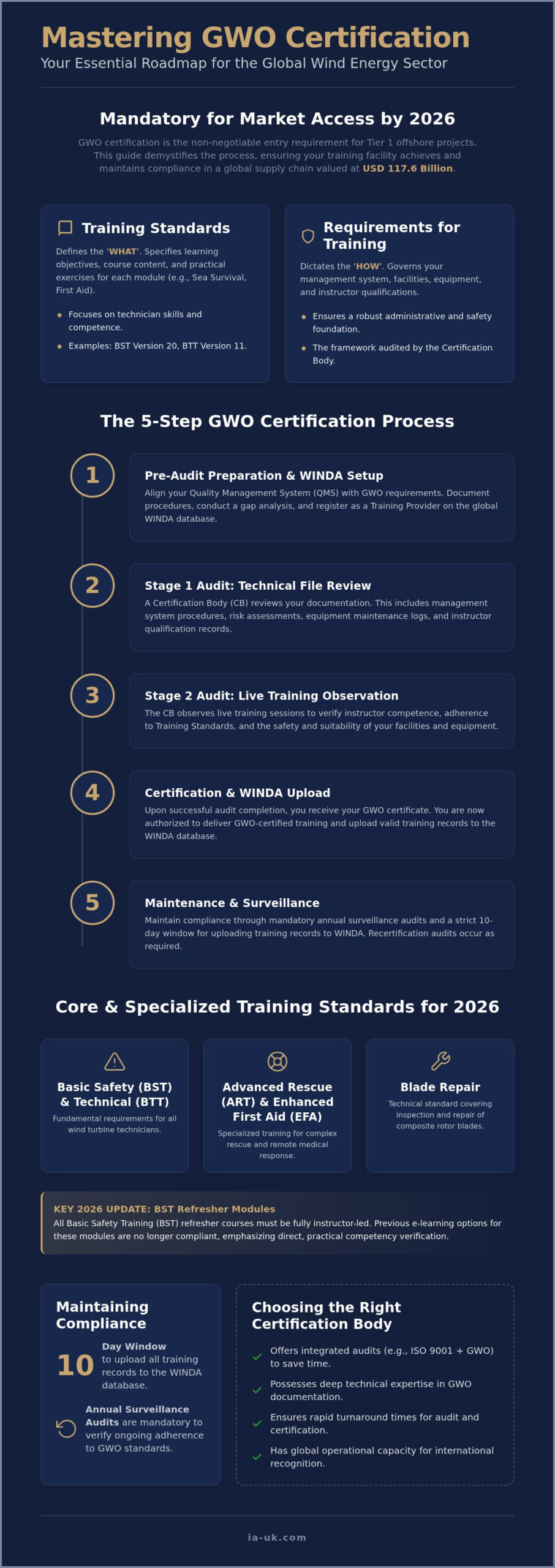
- Distinguish between individual ‘Training Standards’ and the ‘Requirements for Training’ to align your management system with global safety protocols.
- Master the 5-step GWO certification process, moving from initial gap analysis and WINDA registration to final certificate issuance.
- Successfully navigate Stage 1 technical file reviews and Stage 2 live training observations to verify instructor competence and equipment safety.
- Maintain compliance through mandatory annual surveillance audits and strict 10-day training record upload windows in the WINDA database.
- Evaluate certification bodies based on their ability to offer integrated audits, technical documentation expertise, and rapid turnaround times.
Understanding the GWO Certification Framework: Roles and Standards
The Global Wind Organisation (GWO) is a non-profit body founded by leading wind turbine manufacturers and owners to establish universal safety training standards. For any entity seeking to enter the wind energy sector, the GWO certification process is the definitive mechanism for demonstrating compliance with these international benchmarks. These standards ensure that technicians possess the necessary skills to mitigate risks in high-stakes environments, making certification a mandatory requirement for providers serving the global wind turbine market.
It is essential to distinguish between ‘Training Standards’ and the ‘Requirements for Training’. While Training Standards specify the learning objectives and practical exercises for specific modules, the Requirements for Training document dictates the management system, facility safety, and instructor qualifications your organization must maintain. This dual-layered framework ensures that the quality of instruction is supported by a robust administrative foundation.
The Core GWO Training Standards for 2026
The 2026 training landscape emphasizes modularity and technical depth. Basic Safety Training (BST) and Basic Technical Training (BTT) remain the fundamental requirements for any technician. However, the industry has expanded into specialized areas to address complex operational needs:
- Advanced Rescue Training (ART): Focuses on specialized rescue operations from the hub, nacelle, and tower.
- Enhanced First Aid (EFA): Provides advanced medical response skills for remote wind farm locations. For those looking to benchmark their emergency medical curriculum against international providers, check out First Medical Training Ltd.
- Blade Repair: A technical standard for the inspection and repair of composite rotor blades. As drone-based inspections become integral to identifying damage in these structures, you can learn more about Caswell Aviation Ltd for specialized UAS maintenance and support.
Current updates, such as BST Version 20 and BTT Version 11, have integrated initial and refresher training requirements. A significant shift in 2026 is the requirement for all BST refresher modules to be instructor-led; this change eliminates previous e-learning options for these specific modules to ensure practical competency is maintained through direct observation.
The Role of the Certification Body
A Certification Body (CB) serves as the independent verifier of your compliance. Their role is to conduct a neutral assessment of your management systems, equipment maintenance logs, and instructor performance. Because GWO is an industry-led initiative, the trust of Original Equipment Manufacturers (OEMs) depends entirely on the integrity of the audit conducted by the CB.
Selecting an auditor with global operational capacity is a strategic decision. It ensures that your certification carries weight across different regional markets and jurisdictions. The CB facilitates the final steps of the GWO certification process by verifying that your organization is capable of uploading accurate training records to the WINDA database. This digital registry is the sole source of truth for technician qualifications globally, and its accuracy is paramount for maintaining the safety of the wind energy workforce.
The 5-Step GWO Certification Process for Training Providers
Achieving accreditation requires a methodical progression through five distinct phases. This structured GWO certification process ensures that every training provider, regardless of geographic location, operates with the same level of safety and technical integrity required by the wind energy industry.
Pre-Audit Preparation and WINDA Setup
The initial phase focuses on gap analysis. You must align your existing Quality Management System (QMS) with the GWO ‘Requirements for Training’. This involves documenting procedures for equipment maintenance, risk assessments, and student record-keeping. Simultaneously, you’ll need to register as a ‘Training Provider’ on the WINDA platform. This digital registration is a prerequisite for any formal audit activity and establishes your organization’s global identity.
Instructor competency is a critical factor during this setup. You must verify that your staff meets both technical GWO standards and pedagogical requirements. Whether you operate a fixed facility or a mobile training unit, your physical site must be fully prepared to handle the specific modules you intend to teach, such as Sea Survival or Blade Repair. Every piece of safety equipment must have a verifiable maintenance log that aligns with the manufacturer’s specifications.
The Path to Final Accreditation
Once your documentation is ready, the formal audit sequence begins. This typically spans a timeline of 3 to 6 months, depending on the complexity of your operations and the readiness of your management system.
- Stage 1 Audit: A technical documentation review where the auditor verifies your manuals, safety procedures, and staff qualifications. This stage identifies any non-conformities before you move to live training.
- Stage 2 Audit: An implementation verification. The auditor observes live training sessions to ensure your instructors perform according to GWO standards and that equipment is used safely in realistic scenarios.
- Certification Issuance: After successful verification, the certificate is issued. You then have the authority to upload training records to WINDA, which must be completed within 10 business days of course completion.
Avoiding common pitfalls, such as incomplete instructor training logs or inadequate equipment inspection records, is essential for a smooth audit. Engaging with a global partner for management system certification often helps identify these documentation gaps before the formal Stage 1 review begins. This proactive approach minimizes delays and ensures your facility is ready for the rigors of Stage 2 implementation, ultimately accelerating your ability to serve the wind energy market.
Stage 1 and Stage 2 Audits: What to Expect During Verification
The verification phase represents the most critical juncture of the GWO certification process. During this period, the lead auditor acts as an independent bridge between your operational claims and the Global Wind Organisation’s rigorous standards. International Associates Limited utilizes a sophisticated IT infrastructure to streamline this reporting, ensuring that technical reviews are conducted with precision and that turnaround times remain competitive for training centers. This digital approach allows for a more transparent tracking of non-conformities, facilitating a smoother path toward final accreditation.
Stage 1: Technical Documentation Review
Stage 1 serves as the theoretical verification of compliance. During this phase, the auditor performs a granular review of your technical files to ensure they meet the latest requirements, such as the BST and BTT standards mentioned earlier. Key documents under scrutiny include your risk assessments, site-specific emergency plans, and detailed equipment maintenance logs. Every piece of safety equipment must have a verifiable maintenance log that aligns with the manufacturer’s specifications. The auditor also verifies that instructor professional development records and certificates are current and valid. This desk-based assessment identifies any critical gaps in your management system before resources are committed to the practical audit.
Stage 2: Practical Implementation Audit
The Stage 2 audit focuses on the real-world application of your documented procedures. This typically involves an on-site visit where the auditor inspects physical training zones, such as height safety platforms and fire awareness areas, to ensure they align with GWO safety specifications. The core of this stage is the observation of a live training module. The auditor evaluates the instructor’s ability to deliver content effectively while maintaining participant safety and equipment integrity. Whether the delivery is for actual students or mock participants, the performance must mirror the high standards expected in the wind energy sector.
The process concludes with a formal closing meeting. Here, the lead auditor presents their findings and discusses any non-conformities that require remediation. These findings are categorized by their impact on safety and management integrity, providing a clear checklist for your team. If the implementation is successful, a recommendation for certification is made. For organizations managing complex global operations, having an auditor with accredited expertise provides the necessary assurance that your facility is prepared for the technical demands of the 2026 wind energy market. This methodical verification ensures that once you are listed in the WINDA database, your training records are beyond reproach.
Maintaining Your GWO Certificate: Surveillance and Recertification
Initial accreditation isn’t the final step in your journey. The GWO certification process is built upon a three-year cycle that demands continuous adherence to evolving safety standards. Central to this maintenance is the management of the WINDA database. Training providers are strictly required to upload valid training records within 10 business days of a course’s conclusion. If these deadlines are missed or if the management system fails to reflect current operations, WINDA rights can be suspended. This suspension effectively halts your ability to issue recognized qualifications, leading to significant commercial disruption and potential certificate withdrawal.
Standard updates represent another critical pillar of maintenance. When GWO releases new versions of modules, such as the integration of initial and refresher training in BST Version 20 or the module changes in BTT Version 11, providers must update their lesson plans and equipment accordingly. Compliance isn’t a static state; it requires a proactive approach to technical documentation and instructor training to ensure your facility remains aligned with the global wind energy supply chain’s expectations.
Annual Surveillance Audit Requirements
Mandatory annual surveillance audits focus on the continued integrity of your management system. These assessments verify that the high standards observed during initial certification haven’t eroded over time. Auditors specifically examine participant feedback, internal audit results, and any corrective actions taken during the year. Changes to your training staff, such as the hiring of new instructors, or the introduction of new safety equipment must be verified to ensure they meet the minimum pedagogical and technical requirements. This systematic review provides the institutional weight needed to maintain trust with Original Equipment Manufacturers (OEMs).
Recertification at Year Three
Every three years, a full reassessment of the training provider’s capabilities is performed. This process is comprehensive, involving a deep dive into both documentation and practical delivery similar to the original Stage 1 and Stage 2 audits. It’s recommended that you begin planning for this milestone three to six months before your current certificate expires. Early engagement ensures that any identified non-conformities can be remediated without a lapse in your accredited status. You can learn more about our annual surveillance fees to better plan your long-term compliance strategy.
Maintaining a global standard requires a partnership with a certification body that understands the technical nuances of the wind sector. To secure your facility’s future operations, you can contact our technical team to schedule your next surveillance audit and ensure your WINDA uploads remain uninterrupted.
Choosing the Right Certification Body for Global GWO Operations
Selecting a Certification Body (CB) is the final strategic decision in your path to accreditation. This choice determines the long-term stability of your training operations and your ability to scale within the global wind energy market. You must evaluate potential partners based on three primary criteria: global operational reach, specialized technical expertise, and certificate turnaround speed. A CB that operates with a global-local duality provides the institutional weight of a central administrative base while leveraging regional offices to ensure local regulatory nuances are addressed. This structure is essential for training providers who serve multinational Original Equipment Manufacturers (OEMs) across varying jurisdictions.
Advanced IT infrastructure is another critical differentiator. A modern auditing partner uses digital platforms to manage the GWO certification process, which significantly reduces the administrative burden on your staff. Automated reporting and transparent tracking of non-conformities allow you to remediate issues faster; this ensures your WINDA rights remain active and uninterrupted. By prioritizing a partner with high-level technical immersion, you gain more than just a certificate. You gain a steady hand in the world of corporate compliance.
Integrated Management System Benefits
Many training providers face audit fatigue when managing multiple sets of international standards. You can achieve significant operational efficiency by aligning the GWO certification process with existing management systems. Integrating your GWO requirements with ISO 9001 or ISO 45001 allows for a streamlined documentation approach where safety procedures and quality controls serve multiple compliance goals simultaneously.
- Reduced Audit Duration: Integrated audits often require less total time than separate assessments.
- Unified Documentation: A single management system handles risk assessments and equipment logs for all standards.
- Enhanced Safety Culture: Aligning GWO with global health and safety benchmarks reinforces a rigorous safety mindset.
For providers looking to maximize their safety credentials, you can explore our ISO 45001 certification services to see how an integrated approach simplifies multi-standard compliance.
The International Associates Limited Advantage
International Associates Limited provides a unique combination of UK-based reliability and worldwide operational capacity. With a head office in Glasgow and an expansive network of regional offices, we act as a sophisticated bridge between complex global regulations and your local training facility. Our auditors are specialists in technical documentation review, ensuring that your Stage 1 and Stage 2 assessments are thorough, ethical, and impartial. This meticulous approach builds immediate trust with the industry’s largest turbine manufacturers.
Efficiency is a foundational pillar of our service. We prioritize a quick turnaround for certificates, which allows your training center to become operational and begin uploading records to WINDA as fast as possible. This speed to market is a competitive advantage in a sector valued at over USD 117 billion. If you’re ready to secure your status as an accredited provider, contact us for a formal GWO audit quote to begin your verification journey.
Securing Your Future in the Global Wind Energy Sector
Compliance with these international benchmarks represents the definitive bridge to high-stakes offshore projects and Tier 1 supply chain access. By mastering the GWO certification process, your facility transforms from a local training center into a globally recognized safety partner. Success in this landscape requires more than just technical instruction; it demands a robust management system that withstands the scrutiny of annual surveillance and the discipline of digital record management. Aligning your operations with these benchmarks ensures your instructors and facilities meet the rigorous, ongoing expectations of the world’s leading turbine manufacturers.
International Associates Limited provides the independent assessment and UKAS accredited management system expertise needed to navigate these regulatory complexities with confidence. Our advanced IT infrastructure facilitates a rapid certificate turnaround, allowing your organization to scale operations without unnecessary administrative delays. Request a GWO Certification Audit Proposal today to secure your position within the international wind energy supply chain. We’re ready to act as the steady hand in your journey toward technical excellence and global compliance.
Frequently Asked Questions
How long does the GWO certification process take for a new training provider?
The GWO certification process typically spans three to six months from the initial application to the final issuance of the certificate. This timeline depends on your organization’s readiness and the technical complexity of the modules you intend to offer. The progression includes a Stage 1 documentation review followed by a Stage 2 practical audit. Delays usually occur if there are gaps in technical files or if facility equipment doesn’t meet specific safety requirements.
What is the cost of becoming a GWO certified training provider in 2026?
Costs for certification are divided between GWO administrative fees and independent auditing fees. You must refer to the official GWO portal for the latest 2026 WINDA registration fee structure and annual membership costs. Auditing fees vary based on the number of modules, the location of your facilities, and whether you choose to integrate GWO with other management standards. Independent bodies charge for technical reviews and on-site verification activities separately.
Can I conduct GWO training remotely or online?
Most GWO modules require physical, instructor-led training due to the high-stakes nature of the practical skills involved. As of March 10, 2026, the updated standards specify that BST refresher training must be instructor-led; e-learning is no longer permitted for these specific modules. While some theoretical components may utilize digital learning, the final assessment of competency for modules like Sea Survival or Manual Handling must occur at a verified, accredited training site.
Is ISO 9001 mandatory before applying for GWO certification?
ISO 9001 is not a mandatory prerequisite, but it provides a significant advantage during the GWO certification process. The GWO Requirements for Training are built upon management system principles that align closely with ISO standards. Many providers choose to undergo an integrated audit to combine these certifications. This approach reduces audit fatigue and ensures your quality management system is robust enough to handle the rigorous documentation requirements of the global wind industry.
What happens if a training provider fails a Stage 2 audit?
Failing a Stage 2 audit results in the identification of non-conformities that must be remediated before certification is granted. Major non-conformities, such as safety violations or inadequate instructor performance, require a follow-up visit or additional evidence of correction. Minor non-conformities may only require a documented corrective action plan. Certification is only recommended once the lead auditor verifies that all critical requirements of the training standard have been fully met.
How often does a GWO certified training provider need to be audited?
Training providers operate on a three-year certification cycle that includes mandatory annual surveillance audits. These yearly check-ups ensure your management system continues to adhere to GWO requirements and that any changes in staff or equipment are properly documented. At the end of the third year, a full recertification audit is required to renew your status. This consistent oversight maintains the integrity of the global safety standards and ensures ongoing compliance with technical updates.
What is a WINDA ID and why do I need one for my organisation?
A WINDA ID is a unique identifier within the Global Wind Industry Training Records Database. Your organization needs a ‘Training Provider’ profile to upload course completion records for technicians. Without this registration, you can’t legally issue GWO qualifications. The database acts as a single source of truth for employers to verify that a technician has successfully completed required modules like Basic Technical Training or Advanced Rescue before they enter a site.
Do instructors need separate GWO certification to teach?
Instructors don’t receive a specific GWO certification; instead, their competency is verified by the Certification Body during the audit. You must provide evidence that your instructors meet the minimum pedagogical and technical requirements outlined in the GWO standards. This includes professional development records and proof of technical experience in the wind sector. The auditor observes these instructors during the Stage 2 audit to confirm they can deliver training safely and effectively.