

Is your facility treating social compliance as a box-ticking exercise or a strategic gateway to the global market? Many manufacturers view the annual assessment cycle as a source of audit fatigue, yet top-performing production hubs are now leveraging these frameworks to achieve verified scores exceeding 92 percent. Transitioning from reactive data entry to a proactive, auditor-ready mindset is the key to differentiating your operations in 2026.
We recognize that the shift to CAF v1.7 scoring updates and the pressure of maintaining diverse client relationships can create significant administrative friction. It’s frustrating to manage redundant brand requests when you’d rather focus on production quality. This guide, supported by the global auditing expertise of International Associates Limited, provides the specialized insights required to master the higg fslm verification process. You’ll learn how to secure a high verified score and unlock the efficiency of a single, shareable report that satisfies all global partners.
We’ll examine the technical nuances of the 2026 compilation cycle, moving from initial data gathering to the final verification stage. This methodical approach ensures your facility remains a steady, reliable link in the global supply chain while reducing the burden of corporate compliance.
Key Takeaways
- Understand the industry transition from proprietary brand audits toward a unified social labor assessment framework to eliminate redundant reporting cycles.
- Establish internal readiness by mapping critical documentation, including wage records and health and safety logs, before initiating data entry on the Higg FSLM platform.
- Secure global market access by completing a formal higg fslm verification that transforms self-reported data into a trustworthy, shareable asset for international clients.
- Avoid scoring delays by ensuring strict consistency between digital HR systems and physical logs while mastering the technical distinctions in CAF v1.7 question levels.
- Integrate verified social performance data into a broader regulatory strategy to support institutional objectives for ISO 9001 and ISO 45001 certifications.
Why Higg FSLM Verification is the 2026 Global Supply Chain Standard
The global apparel and textile sector is undergoing a fundamental restructuring of its social oversight mechanisms. Proprietary brand audits, which once dominated the landscape of vendor evaluation, are being systematically replaced by the Social & Labor Convergence Program (SLCP). This industry-wide shift centralizes data through the Higg Index suite of tools, specifically the Facility Social & Labor Module (FSLM). By 2026, the higg fslm verification has emerged as a critical requirement for manufacturers seeking to align with the EU Corporate Sustainability Due Diligence Directive (CSDDD) and other emerging global mandates.
The relationship between Cascale, the industry alliance formerly known as the SAC, and accredited data gateways creates a streamlined ecosystem for social performance tracking. Instead of managing ten disparate audits for ten different clients, facilities now utilize a converged model. A single verified report can be shared across the entire industry network. This approach significantly reduces administrative overhead and eliminates the redundant cycles of assessment that previously led to widespread audit fatigue.
Higg FSLM vs. Traditional Social Audits
Traditional Social Accountability Audits often functioned as rigid pass/fail assessments, providing a static snapshot of compliance at a single point in time. In contrast, the FSLM focuses on continuous improvement metrics and granular performance data. Brands are prioritizing this module in 2026 because it offers deeper supply chain mapping capabilities. Verified scores are now a prerequisite for high-level procurement decisions rather than a secondary consideration, as global manufacturers seek more reliable and comparable data points.
The Role of the Converged Assessment Framework (CAF v1.7)
The technical foundation of the FSLM is the SLCP’s Converged Assessment Framework. The current CAF v1.7, which was updated on April 10, 2025, introduces enhanced risk intelligence features designed to reflect actual facility performance more accurately. This version moves beyond simple checklist verification to evaluate the efficacy of management systems. It ensures that data quality remains high as the program expands its reach.
The scoring methodology in CAF v1.7 is strictly aligned with international labor standards and the ILO Core Conventions. This alignment is vital for maintaining Regulatory Compliance in high-stakes markets. As SLCP verifications expand into 44 new countries, the framework provides a standardized language for social performance. International Associates Limited acts as a sophisticated bridge between local operational realities and the rigorous expectations of global stakeholders, ensuring that facility data is both credible and actionable.
Step-by-Step Higg FSLM Compilation: Navigating the 2026 Process
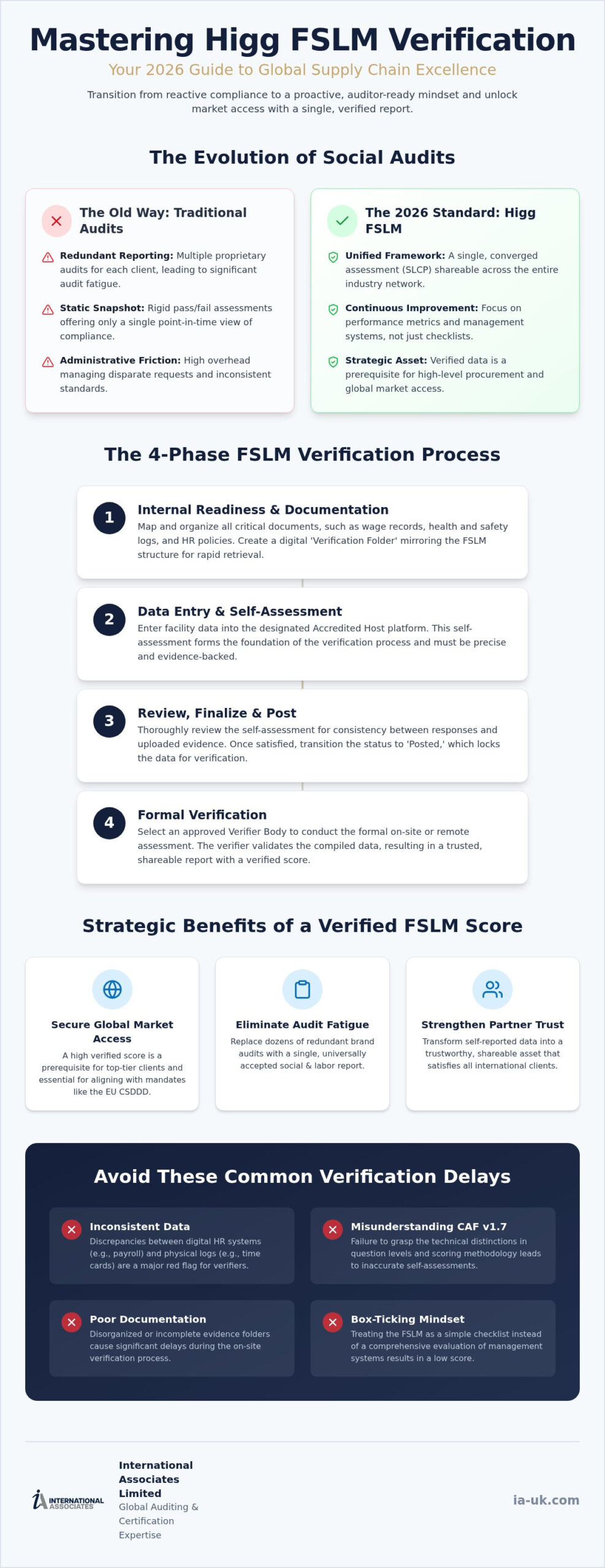
Successful higg fslm verification depends on the precision of the preparatory phase. It is not merely a digital exercise but a systematic audit of your facility’s social and labor management. The workflow is divided into four distinct phases that ensure data integrity and auditor readiness. First, internal readiness involves mapping all documentation, including wage records and health and safety logs. Second, data is entered into the designated accredited host platform. Third, the self-assessment is reviewed for consistency to ensure that all uploaded evidence supports the responses provided. Finally, the facility selects an approved verifier body to conduct the formal assessment and validate the compiled data.
Organizing Your Internal Documentation
Efficiency is achieved by creating a digital ‘Verification Folder’ that mirrors the FSLM section structure. This allows for rapid retrieval during the on-site or remote verification, reducing the time spent searching for evidence. Responsibility should be decentralized by assigning specific section owners within the facility. For example, the HR department should manage wage and hour data, while the Facilities team oversees health and safety protocols. Once a facility transitions its self-assessment to ‘posted’ status, the data is locked and becomes the final foundation for the subsequent verification process. This ‘posted’ status serves as the definitive point of no return for self-assessment changes.
Technical Compilation Tips for 2026
The updated CAF v1.7, effective as of April 10, 2025, requires meticulous attention to detail regarding overtime and benefit calculations. Facilities must ensure that their digital HR systems align perfectly with physical time logs to avoid discrepancies that could lower the final score. Utilizing platform-provided offline tools for bulk data preparation allows teams to identify errors before the final upload. This methodical preparation ensures that your social data is consistent with broader Management System Certification standards, such as ISO 45001 or ISO 9001. Such alignment demonstrates a high level of operational maturity to potential brand partners.
Consistency across these compliance frameworks builds a narrative of institutional reliability. When your internal records are structured logically, the verification process becomes a confirmation of excellence rather than a search for errors. For manufacturers operating across multiple regions, partnering with an experienced verifier like International Associates Limited can help streamline this final transition and ensure global market access. This professional oversight ensures that your data is not only accurate but also meets the rigorous expectations of the 2026 global supply chain.
Self-Assessment vs. Verification: Maximizing Your Social Labor Score
While completing a self-assessment is a necessary first step, unverified data carries limited weight in 2026 procurement decisions. Global brands now demand high-integrity data to satisfy their own due diligence requirements and supply chain mapping objectives. The transition to a verified status, or vFSLM, is what transforms a facility from a passive participant into a preferred partner. Once you submit your assessment on the accredited host platform, the higg fslm verification process begins, moving beyond simple data entry into a rigorous validation of operational reality.
The verification process is meticulously structured to ensure impartiality and accuracy. After the self-assessment is submitted, the verifier body conducts an initial desk review to assess the completeness of the documentation provided. This is followed by an on-site visit where auditors triangulate information from three primary sources: management interviews, thorough document evidence, and confidential worker interviews. This triangulation is the hallmark of a high-quality assessment, ensuring that the final score is an accurate reflection of the facility’s social and labor environment. Verifiers like International Associates Limited utilize this dual-track approach to validate that internal policies are effectively translated into daily practice.
The return on investment for verification is measurable across multiple business dimensions. Facilities with verified modules are often granted access to premium status with major retailers, which typically involves longer-term contracts and more stable pricing structures. Furthermore, identifying potential labor risks during verification allows management to implement corrective actions proactively. This reduces the likelihood of legal disputes or safety incidents that could damage your corporate reputation or increase insurance premiums.
The vFSLM Status: A Competitive Advantage
Verified status significantly enhances your facility’s visibility on the industry gateway, making it easier for global brands to identify high-performing suppliers that meet their ethical standards. These verified scores are also increasingly integrated into corporate ESG reporting and sustainability disclosures required by international financial institutions. For facilities looking to compare these modules with other international standards, our SA8000 Social Accountability Audit guide provides a detailed breakdown of how these frameworks intersect to build a robust compliance profile.
Choosing Your Verifier Body (VB)
Selecting the right partner is a strategic decision that affects the credibility and turnaround time of your higg fslm verification. Factors such as geographic reach, industry expertise, and technical capacity are paramount for multi-site operations. A UK-based auditor with a global network of regional offices offers a unique blend of institutional reliability and local operational capacity. You can review our standing in the industry by visiting the IA-UK Accreditations page to ensure your chosen verifier meets the highest standards of independence and technical competence.
5 Common Compilation Mistakes That Delay FSLM Verification
Mistakes during the initial compilation phase frequently lead to significant delays or depressed scores during the final higg fslm verification. These errors are often procedural rather than intentional; however, they create unnecessary friction during the auditor’s review. One of the most prevalent issues is the existence of inconsistent records between digital HR systems and physical time logs. When automated attendance data doesn’t align with manual punch cards or gate logs, it raises critical questions about data integrity that auditors must investigate before they can validate the module.
Another common pitfall involves a fundamental misunderstanding of the ‘Essential’ versus ‘Advanced’ question levels within the CAF v1.7 framework. Facilities sometimes focus their resources on providing data for advanced metrics while failing to provide sufficient evidence for essential baseline requirements, such as core health and safety protocols or basic freedom of association policies. Documentation for small-scale or seasonal labor contracts is also frequently incomplete. This lack of transparency regarding temporary workers is a high-risk area for verifiers who prioritize the protection of vulnerable labor groups. Finally, technical errors, such as failing to correctly link an Accredited Host account to the SLCP Gateway, can halt the data transfer process entirely. This prevents the verifier from even beginning the formal assessment, leading to missed brand deadlines.
Overcoming Data Discrepancies
To mitigate these risks, facilities should conduct a comprehensive ‘pre-audit’ check of all FSLM responses before the final posting. This internal review must verify that wage calculations, including overtime premiums and social insurance contributions, perfectly match the local legal requirements for the 2026 cycle. Discrepancies here are typically non-negotiable and will negatively impact the final verified score. Maintaining this level of detail ensures strategic alignment with findings from other social frameworks, as explored in our definitive guide to SLCP vs SA8000.
Managing the Verification Timeline
Strategic scheduling is essential to avoid the bottlenecks that occur during peak auditing seasons, which typically align with quarterly brand reporting cycles. Facilities should aim to book their higg fslm verification during periods of lower demand to ensure a quick turnaround and access to the most experienced auditors. When a verifier issues a ‘clarification request’ within the platform, responding with precise, documented evidence immediately prevents the process from stalling. For many major apparel brands, the industry-recommended deadline for posting FSLM modules is April 30, 2026, to allow for the full verification cycle to conclude before year-end sustainability reporting begins.
If you’re concerned about data discrepancies in your current assessment, you can contact our global auditing team at International Associates Limited to ensure your facility is fully prepared for a successful and efficient verification process.
Strategic Compliance: Leveraging Verified FSLM for Global Market Access
Adopting the Higg FSLM framework should be viewed as a foundational component of a comprehensive Regulatory Compliance strategy. In the current global trade environment, social performance data is no longer siloed from quality or safety management. Instead, verified social scores serve as a cross-functional indicator of a facility’s operational health. By achieving a high verified score, manufacturers demonstrate to global stakeholders that their internal controls are robust enough to withstand the scrutiny of international labor standards and due diligence mandates.
The evolution of social labor reporting is moving rapidly toward real-time transparency. Accredited data gateways now provide brands with an aggregated view of social risk across their entire supply chain. This shift means that an annual higg fslm verification is the baseline for participation in high-value markets. Facilities that maintain high standards throughout the year, rather than just during audit windows, are positioned to benefit from this move toward continuous monitoring. This transparency builds a level of trust that proprietary, private audits simply cannot replicate.
FSLM as a Foundation for Integrated Management
There is a significant technical overlap between the FSLM modules and formal management systems. For example, the health and safety sections of the FSLM directly support the objectives found in ISO 45001. When a facility aligns these frameworks, it creates a unified approach to risk management. This integration often leads to tangible financial benefits, such as access to ESG-linked loans where verified social performance data can secure lower financing rates. Maintaining this level of excellence requires ongoing professional Training for internal teams to ensure that compliance remains a daily operational reality rather than a periodic exercise.
Your Path to Global Trust
International Associates Limited acts as a sophisticated bridge between complex global regulations and the manufacturers that must adhere to them. With our central administrative base in Glasgow and an expansive network of international offices, we provide the institutional reliability required for high-stakes higg fslm verification. Our auditors possess the technical immersion in international standards necessary to handle sensitive industrial certifications with precision. To begin your assessment, you can request a formal quote and schedule your verification through our global headquarters. This methodical process ensures your facility achieves the final result required for continued international growth.
Next Steps: Contact International Associates Limited for your Higg FSLM Verification to secure your facility’s standing in the 2026 global supply chain.
Future-proof Your Social Compliance Strategy
Achieving a verified status is no longer just a client request; it’s a fundamental requirement for maintaining global market access in 2026. By following a methodical compilation process and avoiding common data discrepancies, your facility can transform compliance from an administrative burden into a competitive asset. Securing a high verified score requires a partner capable of bridging the gap between local operations and international standards.
International Associates Limited provides independent assessments as a UK-based global certification body with deep expertise in CAF v1.7 and SLCP frameworks. Our advanced IT infrastructure ensures a rapid turnaround for your reports, allowing you to meet brand deadlines without unnecessary friction. Take the final step in your higg fslm verification journey today to ensure your facility remains a trusted link in the global supply chain.
Book Your 2026 Higg FSLM Verification with International Associates Limited. We look forward to supporting your institutional reliability and long-term growth.
Frequently Asked Questions
What is the difference between Higg FSLM and SLCP?
The Higg FSLM is the specific module hosted on the Worldly platform, while the Social & Labor Convergence Program (SLCP) is the organization that developed the Converged Assessment Framework (CAF). In practical terms, the FSLM is the tool used to complete an SLCP-aligned assessment. The data collected is identical, but the FSLM branding is used specifically within the Higg Index ecosystem.
How long does the Higg FSLM compilation process take for a medium-sized facility?
A medium-sized facility typically requires four to six weeks to complete the internal compilation process. This timeframe allows for thorough document mapping across HR and facilities departments before final data entry on the Worldly platform. Facilities with established digital record-keeping systems often complete the self-assessment phase more rapidly than those relying on manual logs.
Can I use my SA8000 audit to help complete the Higg FSLM?
You can utilize your SA8000 audit documentation to significantly streamline the compilation process. While the two frameworks have different scoring methodologies, the core evidence required for SA8000, such as wage records and health and safety logs, overlaps with the requirements for higg fslm verification. This alignment reduces administrative redundancy and ensures data consistency across your compliance profile.
What is a ‘good’ Higg FSLM score in 2026?
A verified score above 85 percent is generally recognized as a high-performance benchmark by global brands in 2026. Because the framework focuses on continuous improvement rather than a pass or fail result, top-tier suppliers often aim for scores exceeding 90 percent. These higher scores demonstrate that a facility has moved beyond baseline compliance into advanced management system maturity.
How often do I need to re-verify my Higg FSLM module?
Verification must be conducted on a rolling 12-month cycle to remain valid for global brand partners. This annual requirement ensures that the social and labor data shared with clients reflects current operational realities and adheres to the latest CAF v1.7 updates. Most retailers require a verified module from the current or previous year to maintain active status in their supply chain.
Is Higg FSLM verification mandatory for all apparel suppliers?
Verification is not a legal requirement, but it has become a commercial mandate for suppliers working with major international retailers. Most global apparel brands now prioritize verified data over unverified self-assessments to meet their own human rights due diligence obligations. Facilities without verified modules may find themselves excluded from preferred vendor programs or premium contract tiers.
What happens if a verifier finds a discrepancy during the FSLM assessment?
The verifier will adjust the facility’s response in the module to align with the evidence discovered during the on-site visit. This adjustment is documented in the final report and may result in a lower verified score than the initial self-assessment. Facilities should treat these discrepancies as an opportunity for corrective action to improve their management systems for the next cycle.
How much does Higg FSLM verification cost with International Associates?
The total investment for higg fslm verification varies based on facility size, total employee headcount, and the physical location of the production site. We provide customized quotes that reflect the specific technical requirements of your audit to ensure a transparent and efficient process. Our global network of regional offices helps minimize travel-related expenses for multi-site manufacturers.