
By 2026, the era of voluntary social disclosure has ended; businesses now face a legal mandate to provide objective proof of ethical conduct throughout their entire supply chain. You likely recognize that the Corporate Sustainability Reporting Directive (CSRD) and its counterparts have made transparency non-negotiable, yet the lack of visibility into Tier 2 and Tier 3 suppliers remains a significant vulnerability. Mastering the technical sa8000 audit requirements is no longer a peripheral goal but the primary mechanism for transforming your ESG due diligence into a verifiable shield against supply chain risk.
International Associates Limited provides the global reliability and independent oversight necessary to navigate this increasingly complex regulatory landscape without friction. We’ll show you how to move beyond superficial checks to achieve a resilient operational framework free from labor rights violations. This guide establishes a clear roadmap for compliance, ensuring your organisation possesses the verifiable data required for rigorous ESG reporting. We’ll preview the nine technical pillars and the methodical auditing process that define the standard for trusted and international social accountability.
Key Takeaways
- Understand why the 2026 regulatory shift under CSRD and CSDDD transforms social accountability from a voluntary benchmark into a legal requirement for ESG reporting.
- Identify the technical sa8000 audit requirements across nine pillars to establish a verifiable shield against labor rights violations in deep supply chains.
- Distinguish between standard social audits and operational ESG due diligence to better quantify and mitigate risks within Tier 2 and Tier 3 supplier networks.
- Learn the methodical steps for conducting a gap analysis and preparing the necessary documentation for a successful Stage 1 certification audit.
- Leverage the global reach and local expertise of an independent certification body to achieve rigorous, objective assurance across international jurisdictions.
The Evolution of SA8000 Audit Requirements in the ESG Era
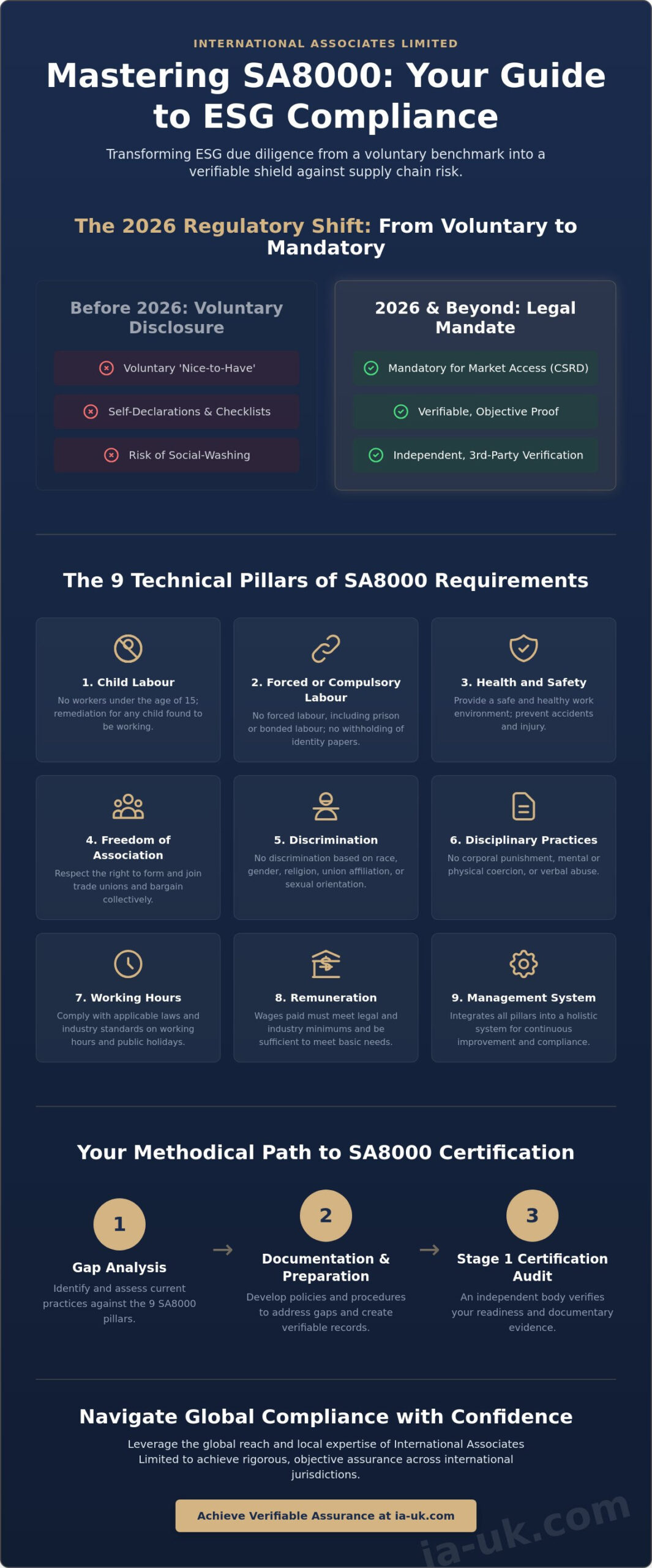
SA8000 audit requirements are the technical criteria used to verify an organisation’s adherence to international human rights and labour laws. This standard functions as a methodical verification of social accountability claims. It requires businesses to prove compliance through rigorous management systems rather than simple checklists. In 2026, the regulatory environment has shifted significantly. For UK and EU firms, surface-level checks are no longer just inadequate. They’re a legal liability. The implementation of the Corporate Sustainability Reporting Directive (CSRD) and the Corporate Sustainability Due Diligence Directive (CSDDD) necessitates a transition from simple social monitoring to a full SA8000 management system audit. This SA8000 overview shows how the standard provides a framework for identifying and mitigating social risks before they escalate into legal crises.
The technical sa8000 audit requirements ensure that every claim made by a supplier is backed by documented evidence and on-site verification. This methodical approach is designed to uncover hidden risks that traditional monitoring might overlook. It’s about establishing a culture of continuous improvement and transparency across the entire value chain. It provides the procedural integrity necessary to satisfy modern regulatory scrutiny.
Myth #1: Social Accountability is a Voluntary ‘Nice-to-Have’
The codification of social accountability via the CSDDD has permanently altered the corporate landscape. Compliance is now a mandatory prerequisite for market access. There’s a clear trickle-down effect where the structural discipline of ISO 9001 quality expectations is being applied to social standards. SMEs are increasingly required to demonstrate strict alignment with these protocols to secure international contracts. Large multinational corporations now demand verifiable proof of ethical labour practices from every tier of their supply chain. Without this assurance, businesses face exclusion from high-value procurement opportunities.
The Shift from Voluntary to Mandatory Assurance
Self-declarations and internal reports are viewed with skepticism by institutional investors in 2026. They demand independent, third-party verification to avoid the risks of social-washing. International Associates Limited serves as a trusted and international bridge, providing the objective assurance necessary to quantify social performance. Our methodical approach moves beyond backward-looking ESG reporting toward active, forward-looking due diligence. By focusing on technical sa8000 audit requirements, we help organisations move from vague promises to verifiable data. This transition ensures that social accountability is treated with the same level of professional rigour as financial auditing or quality management. It provides a stable foundation for businesses to achieve sustainable growth without unnecessary friction.
Decoding the 9 Technical Pillars of SA8000 Requirements
The official SA8000 Standard is built upon nine distinct pillars that form a comprehensive framework for social accountability. Unlike basic ESG software that relies on self-reported data, the sa8000 audit requirements demand physical evidence and worker interviews to verify compliance. These pillars include child labour, forced or compulsory labour, health and safety, freedom of association, discrimination, disciplinary practices, working hours, remuneration, and the management system itself. Each element is interconnected; for instance, poor health and safety often correlates with excessive working hours or inadequate remuneration. This holistic view prevents businesses from fixing one issue while ignoring another.
Collective bargaining and freedom of association are often the most technically challenging areas for global firms to audit. Auditors must verify that workers can form or join trade unions of their choosing without fear of reprisal. This involves examining meeting minutes, interviewing union representatives, and checking for any discriminatory practices against union members. Remuneration accuracy is equally vital, requiring a methodical review of payroll records to ensure that wages meet or exceed legal or industry standards and are sufficient to meet the basic needs of workers and their families.
Labour Rights and Ethical Recruitment Standards
Age verification is a critical component of the audit process. Auditors perform a meticulous review of identification documents to ensure no child labour is present within the facility or its immediate supply chain. Recruitment fee transparency has also become a focal point in 2026. SA8000 requires companies to go beyond local law if it falls below ILO standards. This ensures that migrant workers aren’t burdened by debt bondage, which is a common indicator of forced labour. Quantifying these risks requires a trusted and international perspective that understands local cultural nuances while maintaining global standards of sa8000 audit requirements.
The Management System: The Heart of the Audit
The final pillar, the Management System, is the engine that drives continual improvement. It requires a formal policy commitment, a Social Performance Team, and a robust risk assessment process. A simple checklist can’t capture the effectiveness of a grievance mechanism or the level of worker involvement in safety committees. Integrating these social protocols with an existing ISO 45001 management system creates a powerful synergy for occupational health and safety. This integrated approach allows for more efficient data collection and a more resilient operational framework. For businesses seeking to achieve this level of integration, International Associates Limited offers expert auditing services to ensure your systems are both compliant and effective.
ESG Due Diligence vs. Standard Social Audits: Myth-Busting the Differences
Many organizations treat ESG due diligence as a high-level financial or strategy exercise. This is a significant mistake in the current regulatory environment. In 2026, true due diligence has evolved into an operational auditing discipline that demands the technical precision found in sa8000 audit requirements. It’s no longer sufficient to rely on abstract risk scores or self-reported questionnaires. 2026 regulations hold companies liable for non-conformities in Tier 2 and Tier 3 suppliers. This legal shift means that ‘invisible’ risks in the deep supply chain are now your direct responsibility. Achieving a verifiable shield against these risks requires a methodical transition from simple monitoring to rigorous, independent assurance.
Myth #2: Software Can Replace the Human Auditor
While automated risk-scoring platforms provide a preliminary overview, they can’t replace the nuanced judgment of a professional auditor. AI often fails to detect subtle governance gaps or the atmospheric indicators of labor coercion on-site. Professional ‘boots on the ground’ remain the gold standard for verification in high-risk jurisdictions. The most effective approach combines modern IT infrastructure with the methodical expertise of a trusted and international auditing body. This synergy ensures that data isn’t just collected but is accurately interpreted within its local context. Our auditors use their expertise to quantify social performance, providing a level of security that software alone can’t achieve.
Myth #3: Tier One Supplier Visibility is Sufficient
Limiting oversight to direct suppliers creates a false sense of security that doesn’t hold up under legal scrutiny. Legal precedents regarding ‘Duty of Care’ in international trade now extend deep into the value chain. Comprehensive social accountability audits provide a clear trail of due diligence that satisfies both regulators and institutional investors. To effectively manage these risks, businesses should adopt the following strategies:
- Utilise a hierarchical auditing structure that prioritises suppliers based on geographic and sector-specific risk profiles.
- Establish a technical file for each tier of the supply chain to track sa8000 audit requirements compliance.
- Implement worker-driven grievance mechanisms that provide real-time feedback from the factory floor to corporate headquarters.
Mapping and auditing these deeper layers is a complex task. It requires a structured approach to identify where your current systems fall short. By quantifying social performance at every level, businesses achieve a resilient supply chain free from the threat of ‘social-washing’ accusations. This methodical rigor is what separates industry leaders from those vulnerable to regulatory friction. It’s about building a stable foundation for international growth through independent certification.
Practical Implementation: Preparing for an SA8000 Audit
Preparing for a social accountability audit requires a methodical and disciplined approach. The process begins with a comprehensive gap analysis to identify where existing management systems diverge from the established sa8000 audit requirements. This stage is critical for quantifying operational risks before the formal audit begins. Once shortfalls are identified, the focus shifts to training internal teams and suppliers. Everyone in the value chain must understand the social accountability expectations to ensure consistent compliance across all jurisdictions. A functional grievance mechanism is also essential; it must be trusted by workers and provide a clear channel for reporting non-conformities without fear of retaliation. This worker-centric approach ensures that the management system is responsive to real-time issues on the factory floor.
Technical Documentation and Management System Readiness
Auditors require access to a meticulously organized technical file during the Stage 1 audit. This documentation serves as the primary evidence of your organisation’s commitment to social standards. Key items include payroll records, time sheets, and valid health and safety certificates. Auditors will also look for documented board-level commitment to ensure that social accountability is integrated into the core business strategy. Implementing these ‘Adequate Procedures’ provides a robust defense against greenwashing litigation by demonstrating a verifiable history of compliance. It’s about achieving a level of transparency that satisfies both internal and external stakeholders. The technical file should also include evidence of risk assessments and the corrective actions taken to address identified gaps.
On-Site Verification and Stakeholder Engagement
The Stage 2 audit moves beyond documentation to on-site verification. This involves site inspections and confidential worker interviews to confirm that the policies described in the technical file are being practiced on the factory floor. Auditors observe physical conditions and verify that the sa8000 audit requirements are being met in daily operations. Successful completion of this stage leads to certification, but the process doesn’t end there. Annual surveillance audits are required to maintain your ‘defensible’ position and ensure continuous improvement. International Associates streamlines this global process through our network of local offices, providing the necessary expertise to navigate diverse regulatory environments from Glasgow to Asia. Our methodical approach ensures that your certification remains a stable pillar of your ESG strategy. If you are ready to begin this process, contact International Associates to schedule your initial SA8000 audit.
Navigating Global Compliance with International Associates
International Associates operates as a sophisticated bridge between complex global regulations and the businesses that must adhere to them. Our methodical approach to ESG verification ensures that every stage of the process is handled with technical precision and impartiality. We understand that achieving sa8000 audit requirements is a rigorous undertaking, which is why we provide a structured pathway to certification that minimizes friction. From our headquarters in Glasgow to our expansive network of offices across the Middle East and Asia, we offer a unique global-local duality. This allows us to provide local context audits while maintaining British institutional reliability.
Engaging with us for your 2026 compliance journey follows a logical, disciplined sequence. It begins with a formal application and technical review of your existing systems. We then move through the Stage 1 and Stage 2 auditing phases as described previously, culminating in the issuance of an accredited certificate. This process doesn’t just check a box; it provides the verifiable data required for high-level ESG reporting and institutional investor confidence. Our auditors focus on quantifying performance, ensuring that your social accountability claims are backed by objective evidence.
The Advantage of a UK-Based Global Certification Body
Choosing an independent certification body with recognized accreditation is vital for ensuring the worldwide validity of your certificate. This independent oversight confirms that our auditing processes meet the highest international standards of competence and impartiality. We combine this high-level legal expertise with regional knowledge in sensitive supply chain hubs. It’s this combination that allows us to act as a guardian of standards, helping you achieve a resilient supply chain free from labor rights violations. Our status as a trusted and international entity provides the security you need to expand into new markets with confidence.
Integrating SA8000 with Other Global Standards
Total management system efficiency is achieved when various standards are aligned under a single, cohesive framework. We assist organizations in integrating sa8000 audit requirements with other critical certifications such as ISO 9001 certification for quality, ISO 14001 for environmental management, and ISO 45001 for occupational health and safety. This integrated approach reduces redundancy in data collection and streamlines the surveillance audit process. Working with a single, trusted partner for all global certification needs ensures consistency in reporting and technical review. It provides a steady hand in the world of corporate compliance, allowing you to focus on international growth while we handle the complexities of assurance. Contact International Associates to begin your SA8000 and ESG assurance journey.
Securing Supply Chain Integrity for 2026 and Beyond
The transition from voluntary social claims to mandatory ESG due diligence demands a shift toward methodical, independent assurance. By adhering to the technical sa8000 audit requirements, businesses move beyond superficial checks to establish a legally defensible management system. This process secures your operations against labor rights violations while providing the verifiable data demanded by modern regulatory frameworks. International Associates serves as a UKAS Accredited Certification Body with a global network of regional offices spanning Europe, Asia, and the Middle East. We’re specialists in social accountability audits and technical documentation review, offering the precision needed to navigate today’s complex environment. Our global-local duality ensures that your certification is both internationally recognized and locally relevant. You don’t have to face these high-stakes requirements without a steady hand.
Request a Technical Consultation for SA8000 and ESG Due Diligence today to align your supply chain with the highest global standards. We look forward to supporting your organisation’s international growth through rigorous, ethical assurance.
Frequently Asked Questions
What is the difference between an ESG rating and an SA8000 audit?
An ESG rating is typically a score based on public disclosures and desktop research, whereas an SA8000 audit is a rigorous, on-site verification of management systems. While ratings provide a high-level overview, the audit offers a higher level of objective assurance through direct worker interviews and technical file reviews. This methodical approach ensures that social performance isn’t just reported but is independently verified against international standards.
Is SA8000 certification mandatory for UK companies in 2026?
SA8000 isn’t a direct statutory requirement under UK law; however, meeting sa8000 audit requirements is increasingly essential for firms within the scope of the EU’s CSDDD. UK companies operating in European supply chains or seeking institutional investment find that certification is the most effective way to satisfy these legal due diligence obligations. It serves as a verifiable shield against the risk of social-washing accusations in a tightening regulatory landscape.
How long does a typical SA8000 audit take to complete?
The duration of an audit depends on the size, location, and complexity of the organisation. A typical on-site verification for a medium-sized facility might range from three to five days, excluding the initial Stage 1 document review. Larger enterprises with extensive supply chains or multiple sites will require a longer, more detailed assessment to ensure all technical pillars are thoroughly evaluated and quantified by the auditing team.
Can SA8000 requirements help in achieving ISO 45001 certification?
The health and safety pillar of the standard aligns closely with the framework of ISO 45001. Organisations that implement sa8000 audit requirements for workplace safety often find that much of the documentation and risk assessment structure needed for ISO 45001 is already established. This synergy allows for a more efficient integration of management systems, providing a stable foundation for both social accountability and occupational health and safety.
What happens if a supplier fails an SA8000 audit requirement?
Non-conformities identified during the process require a formal corrective action plan to be implemented within a defined timeframe. While minor issues might allow for a conditional certification pending verification, major non-conformities, such as evidence of child labour, result in audit failure. The supplier must then demonstrate that the root causes have been addressed through a full re-audit before a certificate of compliance can be issued.
How does SA8000 differ from SEDEX or SMETA audits?
SA8000 is a certifiable management system standard, while SEDEX and its SMETA methodology are reporting platforms and audit formats. SMETA provides a snapshot of workplace conditions at a specific point in time, but SA8000 requires the ongoing implementation of a management system dedicated to continuous improvement. This distinction makes SA8000 a more robust tool for businesses seeking independent accreditation and long-term supply chain resilience.
What are the 9 core elements of the SA8000 standard?
The standard is built upon child labour, forced or compulsory labour, health and safety, freedom of association, discrimination, disciplinary practices, working hours, remuneration, and the management system itself. These elements provide a comprehensive framework for quantifying social performance and ensuring adherence to international human rights laws. Each pillar must be supported by documented evidence and verified through on-site inspections to achieve successful certification.
How often should SA8000 surveillance audits be conducted?
Surveillance audits are typically conducted every six months to ensure that the management system remains effective and compliant. These regular checks are a mandatory requirement for maintaining the validity of the certificate and demonstrating an ongoing commitment to social accountability. This methodical frequency ensures that any emerging risks in the supply chain are identified and mitigated before they escalate into significant regulatory or reputational liabilities.