
With 2,994,360 workers currently covered under its framework across 72 industries, the sa8000 standard remains the definitive benchmark for ethical labor practices. You likely recognize the mounting pressure from global stakeholders for transparent supply chains, yet the complexity of managing overlapping audits often creates operational friction. It’s difficult to maintain confidence in your compliance status when operating in high-risk regions where regulatory expectations are constantly shifting.
International Associates Limited provides the objective assurance you need to transform these challenges into a structured management system. This article explains how the SA8000:2026 update, published on January 1, 2026, introduces a more nuanced scoring methodology and a rigorous risk-based approach to due diligence. You’ll learn how this gold standard compares to alternatives like SEDEX or WRAP, and you’ll receive a clear roadmap to meet the mandatory training deadline of December 31, 2026. We’ll show you how to achieve a streamlined path to certification that reinforces your status as a trusted international partner.
Key Takeaways
- Distinguish between a management system approach and traditional checklist audits to ensure sustainable social performance and continuous improvement.
- Compare sa8000 against frameworks such as SEDEX and WRAP to determine which standard provides the necessary rigour for your specific industry requirements.
- Quantify the strategic benefits of certification, including the reduction of audit fatigue and the enhancement of confidence among global stakeholders.
- Implement a structured five-step roadmap to certification that begins with a thorough gap analysis and an objective documentation readiness check.
- Partner with a trusted international certification body to leverage global expertise and achieve a seamless transition to the latest regulatory standards.
Understanding SA8000: The Global Benchmark for Ethical Workplaces
Established by Social Accountability International, SA8000 stands as the first auditable social certification designed to ensure ethical workplace conditions across global supply chains. It’s grounded in the United Nations Declaration of Human Rights and various International Labour Organization (ILO) conventions. This foundational alignment provides a universal language for human rights that transcends national borders, making it an essential tool for businesses operating in diverse regulatory environments. Unlike region-specific initiatives, this standard provides a globally recognized framework that facilitates trust between international partners.
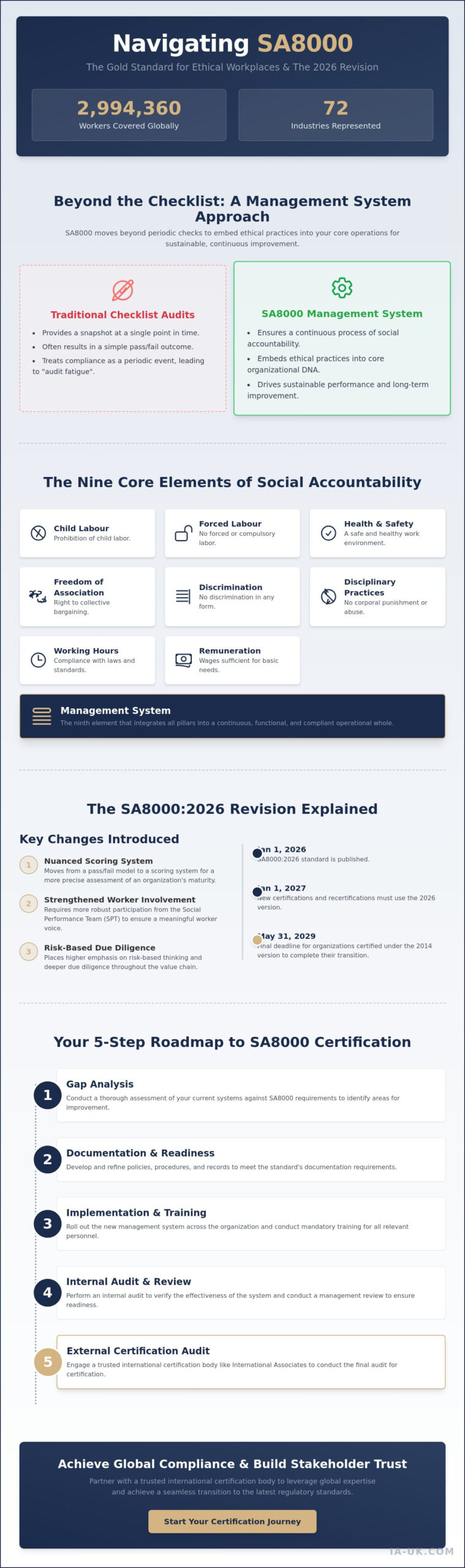
A defining characteristic of the sa8000 standard is its management system approach. While many social audits rely on a checklist to provide a snapshot of compliance at a single point in time, this framework requires organizations to embed ethical practices into their core operational DNA. This transition from “check-the-box” compliance to a holistic management system ensures that social accountability is not a periodic event but a continuous process. The recent publication of the SA8000:2026 version on January 1, 2026, reinforces this commitment to continual improvement by introducing more sophisticated methods for quantifying social performance.
The Eight Performance Pillars of Social Accountability
The standard is built upon eight specific performance criteria that organizations must satisfy to achieve certification. These pillars include the prohibition of child labour and forced or compulsory labour, the maintenance of rigorous health and safety standards, and the protection of freedom of association and the right to collective bargaining. Additionally, the standard mandates strict adherence to non-discrimination policies, the elimination of abusive disciplinary practices, and compliance with regulations regarding working hours and remuneration. While these eight pillars define the ethical requirements, a ninth element, the Management System, binds them together into a functional whole. The Management System serves as the organizational brain that coordinates policies and procedures to ensure the eight performance pillars remain functional and compliant through every level of the workforce.
What is New in the SA8000:2026 Revision?
The SA8000:2026 update introduces several critical changes that reflect the evolving landscape of global trade and worker welfare. A primary focus of this revision is the strengthened requirement for worker involvement and stakeholder engagement. Organizations must now demonstrate more robust participation from the Social Performance Team (SPT) to ensure that workers have a meaningful voice in the management of social risks. This update also shifts the audit methodology from a traditional pass/fail model to a more nuanced scoring system, allowing for a more precise assessment of an organization’s maturity in social accountability.
The timeline for this transition is clearly defined. While the standard was published on January 1, 2026, all new certifications and recertifications must adhere to the 2026 version starting January 1, 2027. Organizations currently certified under the 2014 version have until May 31, 2029, to complete their transition. This revision also places a higher emphasis on risk-based thinking, requiring companies to conduct deeper due diligence throughout their entire value chain to identify psychosocial risks and emerging human rights challenges.
SA8000 vs. SEDEX, WRAP, and BSCI: Which Standard Suits Your Supply Chain?
The landscape of international trade is governed by various social accountability frameworks, each offering different levels of assurance. Choosing the correct standard depends on the required rigour, specific industry focus, and the degree of stakeholder recognition your organization seeks. While initiatives like BSCI or SEDEX provide transparency through shared data, the SA8000® Standard represents a formal certification of a management system. This distinction is critical when developing a long-term strategy for social accountability audits. Businesses must evaluate whether they require a membership-based reporting tool or a rigorous, third-party accredited certification to meet their compliance objectives.
SA8000 vs. SEDEX (SMETA)
SEDEX is not a certification body. It’s a membership organization that utilizes the SMETA (Sedex Members Ethical Trade Audit) methodology. It functions primarily on an “audit sharing” model, which is highly effective for consumer goods companies that must distribute a single report to multiple retail clients. In contrast, the sa8000 standard requires the implementation of a permanent, internal management system. Heavy manufacturing, engineering, and professional services sectors often prefer this because it provides a more robust framework for quantifying risk. You can review our social accountability checklist to identify specific areas where SMETA requirements and sa8000 protocols intersect. The choice often rests on whether your customers demand a data-sharing platform or a verified management system.
SA8000 vs. WRAP and RJC
Industry-specific standards like WRAP (Worldwide Responsible Accredited Production) for the apparel sector or RJC certification for the jewellery supply chain offer targeted compliance for specific segments. These are valuable for businesses operating in niche markets where specialized knowledge is required. However, the sa8000 standard is widely regarded as the “gold standard” because its management system requirements are more comprehensive and universally applicable. It provides a high-level framework that often exceeds the requirements of sector-specific audits. Organizations seeking to achieve a higher level of global reliability often choose this standard to demonstrate an ethical commitment that transcends industry boundaries. International Associates can assist in determining which audit type best supports your international growth while maintaining the highest levels of professional integrity.
The Business Case: Why SA8000 Certification is a Strategic Investment
Organizations often hesitate when assessing the initial costs of implementing a formal social accountability system. However, quantifying the return on investment requires looking beyond the initial audit fee and considering the long-term commercial advantages. While the perceived cost of implementation is a common objection, the sa8000 standard serves as a strategic asset that mitigates the financial burden of “audit fatigue.” By maintaining a single, globally recognized certification, businesses can satisfy the requirements of multiple international clients who might otherwise demand individual, redundant social audits. This consolidation of compliance efforts significantly reduces the annual expenditure associated with hosting various auditing teams throughout the calendar year. Facilities looking to further reduce duplicative assessments may also benefit from understanding how the SLCP Converged Assessment Framework eliminates redundant social audits across multiple business partners.
The ability to secure large-scale international tenders is increasingly dependent on verified social performance. In 2026, major procurement bodies and government agencies prioritize suppliers who can demonstrate adherence to a rigorous social compliance standard. This is particularly relevant as the global social audit services market is projected to reach $22.7 billion by the end of 2026. Furthermore, certification directly influences ESG (Environmental, Social, and Governance) investment ratings. As regulations like the EU’s Corporate Sustainability Due Diligence Directive (CSDDD) become more stringent, having an accredited management system provides the high-level assurance that investors and lenders require to verify ethical supply chain practices.
Risk Mitigation and Supply Chain Resilience
A primary benefit of the sa8000 framework is its capacity to identify hidden labour risks before they escalate into legal liabilities. By institutionalizing risk-based thinking, the standard helps organizations detect issues such as unauthorized subcontracting or psychosocial risks within the workforce. This proactive approach is vital for brand protection in a market that is increasingly sensitive to “greenwashing” and ethical inconsistencies. Independent verification by a trusted international body ensures that your social claims are backed by objective evidence, providing a steady hand during periods of intense stakeholder scrutiny.
Operational Efficiency and Worker Retention
Implementing a disciplined management system doesn’t just satisfy external regulators; it streamlines internal operations. There’s a documented correlation between compliance with this standard and reduced staff turnover. When workers operate in a safe, fair, and respectful environment, productivity increases and recruitment costs decrease. These management systems also enhance data accuracy by creating a structured framework for reporting. For businesses in the apparel or manufacturing sectors, integrating these social metrics with facility-level data, such as Higg FDM, allows for a more comprehensive view of supply chain health. This methodical approach to data management ensures that your organization remains competitive while achieving its ethical objectives.
The Roadmap to SA8000 Certification: A 5-Step Process
Achieving sa8000 certification requires a disciplined approach to management system implementation. The journey begins with a preparatory gap analysis where the organization’s existing policies are measured against the standard’s rigorous criteria. This phase is critical for identifying deficiencies in labor practices or health and safety protocols before formal auditing begins. Organizations must also ensure their Social Performance Team is fully operational and that the mandatory “Getting Started with SA8000:2026® and Due Diligence” training is completed by the December 31, 2026, deadline.
The formal audit process is divided into two distinct stages. The Stage 1 Audit focuses on a comprehensive documentation review to evaluate the organization’s readiness. If the auditor confirms that the necessary management system elements are in place, the organization proceeds to the Stage 2 Audit. This second stage involves on-site verification, including physical inspections and confidential worker interviews, to ensure that the documented policies are actively practiced on the factory floor. These interviews are a cornerstone of the process, providing an impartial view of the actual working conditions.
Following the on-site audit, any identified non-conformities must be addressed during the “Corrective Action” phase. Once these issues are resolved and verified through objective evidence, the certification body issues the certificate. Compliance isn’t a static achievement; a three-year cycle of surveillance audits is mandatory to maintain the validity of the certification. These audits ensure that the system remains resilient and continues to evolve with the updated requirements of the 2026 standard.
Preparing for the Audit: Common Pitfalls
Non-conformities often arise from inadequate worker engagement or a failure to maintain transparent grievance mechanisms. Many organizations struggle with precise record-keeping regarding working hours or the accurate calculation of living wages as required by the new scoring methodology. It’s essential to establish clear communication channels between management and the workforce. Without robust worker participation, the Social Performance Team cannot effectively identify psychosocial risks or workplace stressors, which are critical focus areas in the latest revision.
Selecting an Accredited Audit Body
Selecting an audit body with Social Accountability Accreditation Services (SAAS) accreditation is non-negotiable for ensuring the global validity of your certificate. International Associates leverages a unique global-local duality, combining our UK-based institutional reliability with an expansive network of international auditors who possess deep regional expertise. Technical documentation review fees are structured as fixed professional costs to provide full transparency throughout the engagement. You can request a formal quote for sa8000 certification to begin your compliance journey with a trusted international partner capable of handling high-stakes audits.
Achieving Global Compliance with International Associates
International Associates serves as a steady hand for organizations managing the complexities of social accountability. We act as a trusted and international guardian of corporate standards, providing the impartial assurance required to verify that your management systems meet the rigorous demands of the sa8000 standard. Our operations are directed from our headquarters in Glasgow, Scotland, yet we simultaneously maintain an expansive network of international offices to support our clients’ global growth. This global-local duality ensures that while we provide British institutional reliability, we also possess the regional expertise necessary to conduct audits in 49 countries across the globe.
Efficiency is a hallmark of our professional delivery. We utilize a modern IT infrastructure that facilitates a streamlined audit process, from the initial documentation review to the final issuance of the certificate. This technological integration ensures a quick turnaround and maintains data integrity throughout the certification cycle. By May 2026, the demand for transparent ethical practices has reached unprecedented levels; our systems are designed to provide the stability and confidence your stakeholders expect without unnecessary administrative friction.
Why Choose International Associates for SA8000?
Our technical expertise spans across Europe, Asia, and the Middle East, providing us with a deep understanding of the diverse labor risks prevalent in these regions. We advocate for an integrated approach to management systems, where sa8000 certification is harmonized with other standards such as ISO 9001 Quality Management or ISO 45001 Occupational Health and Safety. This strategy reduces audit fatigue and enhances overall operational efficiency. We’re committed to providing a professional and predictable certification journey, ensuring that your organization achieves its compliance goals within the required timelines and maintains its status as an ethical leader in the global market.
Next Steps for Your Organisation
The path toward achieving or transitioning to the 2026 standard begins with a clear assessment of your current organizational readiness. We encourage a preliminary discussion to identify potential gaps in your social performance team’s structure or your existing due diligence protocols. For organizations seeking to build internal capacity, we provide lead auditor training and workshops focused on internal development. These sessions are designed to equip your staff with the technical skills necessary to maintain your management system between surveillance audits. You should contact our Glasgow office or your nearest international representative to receive a bespoke certification quote tailored to your facility’s size and industry scope.
Strengthening Your Global Supply Chain Resilience
Adopting the sa8000 standard represents a strategic shift from reactive compliance to a proactive management system. Organizations that successfully implement these requirements by the December 31, 2026, training deadline will benefit from reduced audit duplication and enhanced stakeholder confidence. By quantifying social risks and prioritizing worker involvement, businesses secure their position in competitive international tenders and improve long-term ESG performance ratings.
International Associates operates as a sophisticated bridge between these complex regulations and your operational goals. We’re a UK-based certification body with a global audit network specialized in high-stakes environments; our expertise includes both social accountability and Halal certification. We provide the steady hand needed to navigate the transition to the 2026 revision without unnecessary friction. Request a bespoke SA8000 certification quote from International Associates to ensure your organization remains compliant and competitive. Achieving these standards reinforces your commitment to ethical growth and professional integrity on a global scale.
Frequently Asked Questions
What is the main difference between SA8000 and ISO 26000?
The primary distinction is that sa8000 is a certifiable management system standard, whereas ISO 26000 is a guidance document. Organizations can undergo third-party audits to achieve a formal certificate under the Social Accountability framework. In contrast, ISO 26000 provides voluntary recommendations on social responsibility and isn’t intended for regulatory or contractual certification purposes.
How long does the SA8000 certification process typically take?
The certification timeline generally spans between 6 and 12 months depending on the maturity of the organization’s existing management system. This period includes the initial gap analysis, the implementation of necessary labor policies, and the completion of the Stage 1 and Stage 2 audits. The duration is also influenced by how quickly an organization addresses any identified non-conformities during the readiness check.
Can a small business achieve SA8000 certification?
Yes, the standard is designed to be scalable and is applicable to organizations of all sizes regardless of their employee count. Small enterprises often pursue certification to demonstrate ethical reliability when bidding for contracts with global retailers. While the management system requirements are rigorous, they provide a structured path for smaller facilities to improve worker retention and operational transparency.
Is SA8000 mandatory for suppliers in certain industries?
While the standard is voluntary, it’s frequently a mandatory contractual requirement for suppliers in high-risk sectors like apparel, construction, and electronics. Many global brands require this specific certification as a prerequisite for inclusion in their supply chain. As of May 2026, over 5,700 facilities worldwide have adopted the standard to meet these stakeholder demands for objective social assurance.
What happens if a non-conformity is found during an SA8000 audit?
The organization must develop and implement a Corrective Action Plan (CAP) to address the root cause of the issue within a defined timeframe. Major non-conformities require a follow-up verification audit to ensure the problem is resolved before a certificate can be issued or maintained. Failure to rectify significant breaches of the sa8000 criteria can result in the suspension of the organization’s certification status.
How much does SA8000 certification cost for a multi-site organisation?
Costs for multi-site organizations are determined by the number of locations and total workforce size, with royalty fees set by Social Accountability Accreditation Services. Effective January 1, 2026, the royalty fee for active multi-site certificates is the greater of $55 per quarter or a minimum of $1,250 per quarter. Individual audit day rates typically range from $400 to $1,500 depending on the geographic location and the complexity of the facility operations.
Does SA8000 cover environmental compliance as well?
No, the standard focuses exclusively on social accountability and labor conditions rather than environmental management. It addresses issues such as child labor, health and safety, and remuneration. Organizations seeking to demonstrate environmental performance should implement ISO 14001, though many businesses choose to integrate both standards to provide a comprehensive ESG profile to investors.
Is the SA8000:2026 update already in effect for new certifications?
The 2026 version was published on January 1, 2026, but it doesn’t become mandatory for new certifications until January 1, 2027. Organizations currently have a transition window to align their systems with the new scoring methodology and risk-based requirements. All organizations must complete their transition to the 2026 standard by May 31, 2029, to maintain their certified status.