
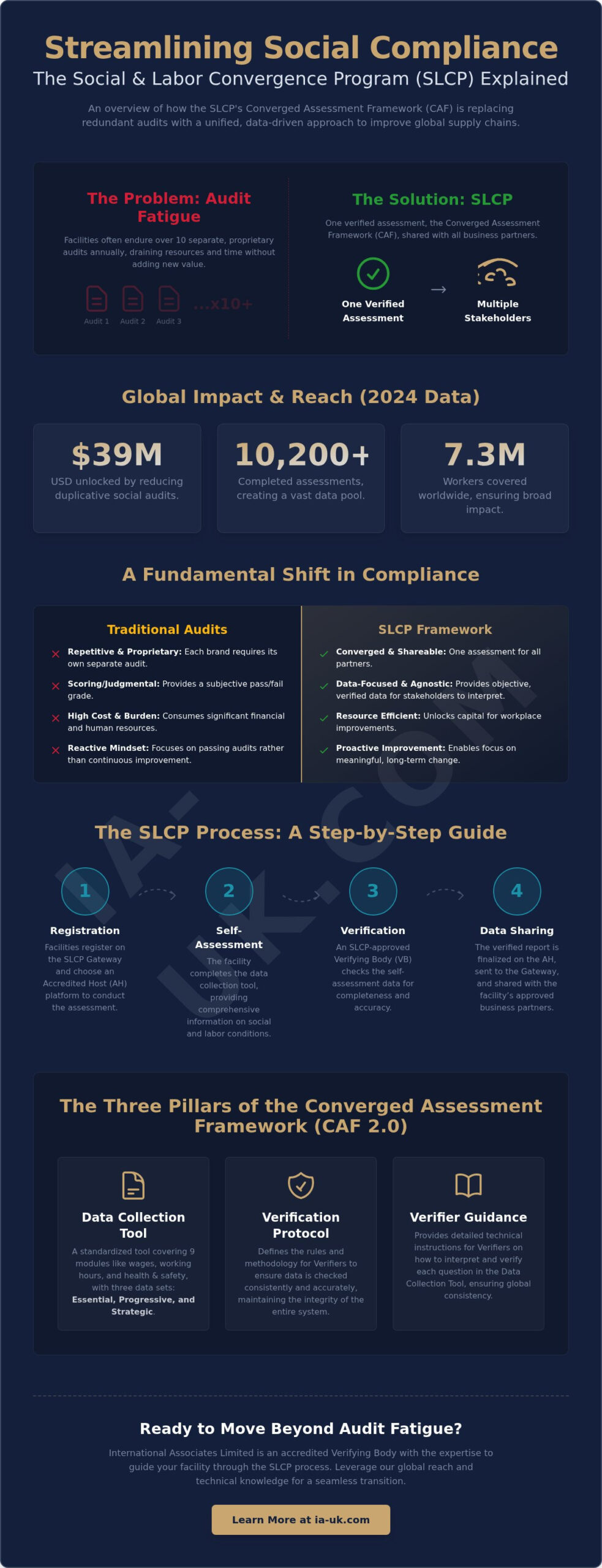
In 2024, an estimated $39 million USD was unlocked across global supply chains by reducing the burden of duplicative social audits. This significant figure represents a fundamental shift in how manufacturers and brands approach workplace compliance. Most facility managers are familiar with the exhausting cycle of redundant assessments that drain financial resources and staff time without providing new insights. The Social & Labor Convergence Program, or slcp, addresses this systemic inefficiency by offering a standardized, verified data set that replaces the need for multiple proprietary audits.
Adopting a collaborative data model allows for a more methodical and professional approach to regulatory adherence. This article explains how the slcp Converged Assessment Framework (CAF) streamlines your compliance requirements by generating credible, verified data that serves multiple business partners simultaneously. We will examine the technical requirements of the CAF 2.0 update, provide guidance on whether this framework aligns with your specific operational needs, and outline the precise process for distributing your verified data through the central Gateway. By the end of this guide, you’ll understand how to leverage this ecosystem to redirect your resources from constant monitoring to meaningful workplace improvements.
Key Takeaways
- Understand how the slcp ecosystem facilitates the transition from redundant proprietary audits to a unified, multi-stakeholder data-sharing model.
- Identify the technical components of the Converged Assessment Framework (CAF) 2.0 and the role of the Verification Protocol in maintaining rigorous data standards.
- Distinguish between the objective “Data” model and traditional “Scoring” audits to align your compliance strategy with emerging global due diligence requirements.
- Learn the methodical sequence for registration, self-assessment, and data distribution through the SLCP Gateway and authorized Accredited Hosts.
- Evaluate the role of an accredited Verifying Body in providing the specialized technical expertise and global reach necessary for credible social accountability verification.
What is SLCP? Defining the Social & Labor Convergence Program
The Social & Labor Convergence Program (SLCP) operates as a multi-stakeholder, non-profit initiative designed to harmonize social and labor data collection across global supply chains. Established in 2015, the program brings together diverse industry actors, including manufacturers, retailers, and brands, to create a single, credible assessment system. By 2024, the scale of the program reached over 10,200 completed assessments, covering an estimated 7.3 million workers worldwide. It’s critical to understand that slcp is not a certification body. Unlike traditional social accountability standards that provide a pass or fail grade, this program provides a verified data set that stakeholders can use to make their own informed compliance decisions. With operations spanning over 50 countries by 2026, the program provides the global reliability needed for modern corporate compliance.
The Problem: Understanding Audit Fatigue
Manufacturing facilities frequently endure a redundant cycle of social compliance monitoring. It’s common for a single site to host more than ten separate audits annually, as each brand partner often demands its own proprietary assessment. This duplication creates a massive administrative burden and carries high financial costs for the facility. Resources that could be spent on safety equipment or worker training are instead consumed by the logistics of constant inspection. In 2024, the industry unlocked an estimated $39 million USD by reducing these duplicative efforts. This shift allows facilities to move away from a reactive compliance mindset. The program’s adoption is also expanding beyond its origins; in 2024, 16% of facilities were from non-apparel sectors like home textiles and hard goods, representing a significant move toward cross-industry transparency.
The Solution: A Converged Assessment Framework (CAF)
The primary mechanism for this industry shift is the Converged Assessment Framework (CAF). The CAF provides a unified methodology that allows a facility to undergo one assessment and share the resulting data with all its customers. This “one assessment for all” approach ensures that data is consistent, high-quality, and easily accessible through a centralized digital gateway. The CAF is an agnostic tool that measures rather than judges compliance. By providing this objective foundation, the framework enables brands and regulators to evaluate facility performance based on a single source of truth. It effectively bridges the gap between complex global regulations and the businesses that must adhere to them, ensuring that slcp data remains a cornerstone of ethical supply chain management.
The Three Pillars of the Converged Assessment Framework (CAF)
As of April 2026, the Social & Labor Convergence Program transitioned fully to CAF 2.0. This updated version serves as the definitive standard for social and labor data collection. It’s mandatory for all assessments opened after the May 31, 2026, migration deadline. The framework’s integrity rests on three interdependent pillars: the Data Collection Tool, the Verification Protocol, and the Verifier Guidance. Together, these components ensure that slcp data is both granular and reliable for global stakeholders. By providing a standardized set of technical instructions, the Verifier Guidance ensures that an assessment conducted in one region remains consistent with those performed elsewhere, maintaining the program’s reputation for global reliability.
The Data Collection Tool: What is Measured?
The tool is structured into nine essential modules that provide a comprehensive view of a facility’s social and labor conditions. These modules cover critical areas such as recruitment and hiring, wages and benefits, working hours, and health and safety. Data within the tool is categorized into three distinct sets:
- Essential: Focuses on foundational data and legal compliance.
- Progressive: Tracks performance levels that go beyond basic legal requirements.
- Strategic: Evaluates advanced management systems and best practices.
This hierarchical structure allows the tool to adapt to various facility sizes and industry sectors. Whether a site is a Tier 2 component supplier or a major Tier 1 garment factory, the tool captures relevant information without imposing unnecessary administrative complexity. It’s an objective instrument designed to reflect the actual conditions on the factory floor.
Verification Protocol: Ensuring Credible Data
Self-assessment alone isn’t sufficient for high-stakes corporate compliance. The Verification Protocol mandates an on-site visit by an approved Verifier to confirm the accuracy of the self-reported data. These professionals must be affiliated with an accredited Verifier Body and are required to be registered with the Association of Professional Social Compliance Auditors (APSCA). To maintain the highest standards of independence and data integrity, the program employs rigorous mechanisms like “shadowing” and “duplicate verification.” These procedures act as a safeguard against fraud and ensure that the final data set is beyond reproach. By verifying the accuracy of the self-reported information, the process transforms a simple questionnaire into a robust, shareable asset. If your facility is preparing for this transition, selecting an experienced accredited Verifying Body ensures your data meets these rigorous global expectations.
SLCP vs. Traditional Audits: Choosing the Right Path
Traditional social compliance often relies on a “Scoring” model, where a facility receives a grade or a certificate based on a specific brand’s proprietary protocol. While this provides a clear result, it often leads to audit fatigue when multiple brands require their own unique assessments. In contrast, the slcp follows a “Data” model. This approach moves away from subjective scoring in favor of providing a granular, verified data set that stakeholders can interpret according to their own internal standards. By 2026, many global brands have transitioned away from proprietary protocols, recognizing that a shared data ecosystem is more efficient and provides deeper supply chain visibility.
Facilities often find value in maintaining a SA8000 certification alongside their participation in the program. While the Social & Labor Convergence Program provides the verified data needed for broad transparency, SA8000 remains the gold standard for demonstrating a robust management system. This dual approach ensures that a facility isn’t only transparent but also systematically committed to international labor standards. It creates a comprehensive profile that satisfies both the need for shared data and the requirement for high-level management system certification.
Certification vs. Verification: The Critical Difference
The most significant distinction lies in the final output. Traditional audits offer a “pass” or “fail” status. The slcp provides verification, not certification. This means no certificate is issued; instead, a verified data set is uploaded to the Gateway. This raw data is invaluable for ESG reporting, as it allows brands to perform their own due diligence and value judgments. It shifts the responsibility of compliance from the auditor back to the brand, fostering a more collaborative relationship between buyers and suppliers. Brands use this verified data to determine if a facility meets their specific code of conduct, rather than relying on a generic third-party grade.
Integration with Global Standards
Modern supply chain management requires technical interoperability. The data generated through this framework integrates seamlessly with other industry tools. For example, there is a strong synergy between Higg FDM and the converged assessment, allowing facilities to manage both social and environmental data within a single digital ecosystem. This integration reduces the administrative burden on facility staff, who can focus on operational excellence rather than data entry across multiple platforms.
This data-centric approach also aligns with the technical requirements of the UN Guiding Principles and OECD guidelines. For a broader perspective on how these assessments fit into the wider regulatory landscape, refer to our guide on Social Accountability Audits: The Definitive Global Guide for 2026. By utilizing a converged framework, facilities can meet the data requirements of multiple international standards without the need for redundant inspections.
How the SLCP Process Works: From Self-Assessment to Sharing
The transition to a converged data model requires a disciplined adherence to a specific procedural workflow. This five-stage cycle ensures that the information generated is both technically accurate and legally defensible for international stakeholders. By following this methodical sequence, facilities can effectively replace a dozen proprietary audits with a single verified data set. The efficiency of this model is evidenced by 2024 data, which shows that the average slcp assessment was shared 2.96 times, significantly reducing the administrative load on manufacturing sites.
The journey begins with registration on the central Gateway, followed by the selection of an Accredited Host platform to manage the data. Facilities then complete a comprehensive self-assessment using the Data Collection Tool. It’s recommended that management teams consult a social accountability checklist to ensure all internal documentation is prepared before the verification phase begins. Once the self-assessment is finalized, an approved Verifying Body conducts an on-site visit to validate the data. After the verifier uploads their findings, the facility reviews the report on the Gateway, where it becomes a verified asset ready for distribution to multiple brands and retailers simultaneously.
Understanding the SLCP Gateway and Accredited Hosts
The Gateway acts as the central repository, or “post office,” for all verified assessments. However, the actual data entry and verification occur on Accredited Host (AH) platforms. These specialized platforms, such as Worldly (which hosts the Higg FSLM) or the Fair Factories Clearinghouse (FFC), provide the interface for facilities to interact with the assessment tool. Choosing an AH is a strategic decision based on which platforms your primary buyers already use. Within these platforms, facilities maintain full control over their data privacy; permissions must be specifically granted before any brand or stakeholder can view the verified report. This ensures that while the data is shareable, it remains secure and under the facility’s ownership.
Timeline and Cost Considerations
Completing a full verification cycle in 2026 typically requires several weeks, depending on the facility’s readiness and the availability of verifiers. Factors influencing the total cost include the facility’s geographic location and the total man-days required for the on-site visit, which is determined by the size and complexity of the operation. While Verifier Bodies set their own professional fees for the site visit, the elimination of redundant audits provides a clear return on investment. For businesses seeking to streamline their compliance calendar, you can book a verified assessment with our global team to ensure your data meets the highest standards of integrity and reliability.
Implementing SLCP with International Associates
International Associates Limited operates as an accredited Verifying Body for the slcp, providing the technical oversight necessary to transform raw facility data into a verified asset. Our operational model combines a worldwide network of professional verifiers with specialized technical support from our Glasgow headquarters. This global-local duality ensures that while inspections are conducted on-site across diverse regions, the final data review maintains a consistent level of institutional weight and procedural integrity. We understand that the transition from proprietary brand audits to the Converged Assessment Framework (CAF) can be complex. Our team provides the objective guidance needed to navigate this shift without unnecessary friction.
Efficiency is a cornerstone of our service delivery. We prioritize a quick turnaround for verification reports to ensure that your data is available on the Gateway as soon as possible. This speed doesn’t compromise our rigorous commitment to accuracy; rather, it’s supported by a methodical approach to information delivery and a deep immersion in international labor standards. By choosing a partner with high-level expertise in both social and technical auditing, facilities can ensure their compliance data is handled with the meticulous care required for high-stakes certifications.
Why Choose International Associates Limited for Your Verification?
Our reputation is built on a foundation of trust and independence. As an impartial auditing body, International Associates Limited maintains strict regulatory adherence to ensure the credibility of every slcp verification we perform. Our advanced IT infrastructure facilitates efficient data processing, allowing for seamless integration between Accredited Host platforms and the central Gateway. Beyond social accountability, our auditors possess extensive expertise in ISO 9001 Quality Management and ISO 45001 Occupational Health and Safety. This broad service category allows us to offer integrated auditing perspectives that identify synergies between your quality, safety, and social management systems.
Next Steps: Securing Your 2026 SLCP Verification
Preparing for a 2026 verification requires a proactive approach to facility readiness. To begin the process, organisations can request a formal quote for verification services tailored to their specific size and location. Once the service is scheduled, management teams should focus on preparing internal documentation and training staff for the on-site verification visit. This preparation ensures the verifier can efficiently validate the self-assessment data without delays. By securing your verification with a globally reliable partner, you streamline your supply chain compliance and position your facility as a leader in transparent, ethical manufacturing.
Advancing Your Supply Chain Transparency in 2026
The transition toward a converged data model represents a permanent shift in global supply chain management. By adopting the slcp framework, facilities move away from the repetitive cycle of proprietary audits toward a future of shared, verified data. It’s a systematic approach that ensures social and labor information is collected once and utilized multiple times across various stakeholder platforms. This transition effectively redirects valuable resources from redundant monitoring toward meaningful workplace improvements and operational excellence.
International Associates Limited stands as a sophisticated bridge between these complex global requirements and your operational goals. As an accredited Verifying Body with a history as specialists in Social Accountability Audits since 2005, we provide the institutional reliability needed for high-stakes verification. Our expansive global network is supported by the technical expertise of our Glasgow head office, ensuring a methodical and professional assessment process. You can contact International Associates Limited for SLCP Verification Services to secure your facility’s position in a more transparent and efficient global market. We look forward to supporting your international growth through rigorous and supportive verification standards.
Frequently Asked Questions
Is SLCP a certification like SA8000?
No, the program provides a verified data set rather than a pass or fail certificate like SA8000. While a certification confirms that a facility has met a specific standard, this program focuses on the technical accuracy of self-reported data. Brands then apply their own internal criteria to this verified information to determine if a facility meets their specific code of conduct requirements.
How long is an SLCP verification valid for?
A verified assessment is valid for a period of twelve months from the date of the on-site verification. Facilities are required to undergo the assessment and verification process annually to ensure that the data remains current and reflects the actual working conditions. This yearly cycle maintains the integrity of the information shared across the Gateway and ensures that stakeholders have access to recent, credible data.
Which brands currently accept SLCP verified data?
Hundreds of global brands, retailers, and agents currently accept verified data from the program to replace their proprietary audit protocols. Because the list of signatories is extensive and growing, facilities should consult the official slcp signatory list or verify with their specific brand partners to confirm their current acceptance policies. This collaborative model is a primary reason why the average assessment was shared nearly three times in 2024.
How much does an SLCP verification cost?
The total cost is comprised of three distinct elements: the fee charged by the Verifier Body for the on-site visit, the usage fee for the Accredited Host platform, and the Gateway fee. Verifier Bodies set their own professional rates based on the location and size of the facility. Because these costs are not fixed by the program, facilities should request quotes from accredited providers to understand the total financial commitment for their specific site.
Can I use SLCP for my small manufacturing facility?
The program is designed to be inclusive of facilities of all sizes across various manufacturing sectors. The Data Collection Tool is structured to adapt to the complexity of the operation, ensuring that smaller sites aren’t overwhelmed by irrelevant requirements. In 2024, adoption continued to grow beyond Tier 1 apparel factories into Tier 2 suppliers and non-apparel sectors, demonstrating the framework’s broad applicability across the global supply chain.
What is the difference between an Accredited Host and the Gateway?
The Gateway serves as the central, permanent repository for all verified reports, while an Accredited Host (AH) is the active platform where data entry and verification occur. You must use an AH, such as Worldly or FFC, to complete the assessment. Once the verification is finalized on the AH, the report is automatically synced to the Gateway, where you can then manage sharing permissions with your business partners.
Do I need to be an APSCA member to undergo SLCP verification?
Facilities aren’t required to be members of the Association of Professional Social Compliance Auditors (APSCA) to undergo verification. However, the individual performing the on-site verification must be a registered and qualified APSCA auditor. This requirement ensures that the professional conducting the technical review has the necessary competencies and adheres to a strict code of professional conduct, which maintains the global reliability of the slcp data set.
How does SLCP handle data privacy for my facility?
The facility maintains full ownership and control over its verified data at all times. No brand or stakeholder can access your report on the Gateway unless you specifically grant them permission. This permission-based model ensures that your operational information is only shared with trusted partners. You can revoke access at any time, providing a secure environment for managing your social and labor compliance data.