

With 67% of shoppers now prioritizing ethical manufacturing when selecting clothing brands, the pressure on your facility to demonstrate verifiable social compliance has never been higher. Securing a wrap certification for apparel factories is no longer just an operational checkbox; it’s a strategic necessity for those aiming to secure contracts with high-tier global brands. You’ve likely felt the strain of managing overlapping audit requests from different buyers, each with their own technical requirements and associated costs. It’s frustrating to maintain multiple certifications that essentially verify the same standards while fearing that a minor technical non-conformity could jeopardize a major partnership.
This guide simplifies that complexity, helping you determine which framework offers the most efficient path to global recognition and buyer trust in 2026. We’ll analyze the April 2026 WRAP standards alongside SEDEX and the new SA8000:2026 transition. By comparing registration structures, audit methodologies, and industry acceptance, we provide the clarity needed to streamline your compliance processes. This analysis ensures your facility chooses the most authoritative audit to support international growth and operational stability in a demanding regulatory landscape.
Key Takeaways
- Understand why wrap certification for apparel factories has transitioned from a voluntary standard to a mandatory requirement for global market access in 2026.
- Compare the technical frameworks of WRAP, SEDEX, and SA8000 to determine which certification aligns most effectively with your specific buyer mandates.
- Identify the most frequent audit non-conformities, particularly regarding overtime compensation and Principle 1, to ensure a successful first-time verification.
- Learn how to utilize the April 2026 Edition pre-audit self-assessment to identify and rectify technical gaps before the arrival of a formal monitoring firm.
- Leverage a global network of independent auditors to achieve a universally recognized standard that reduces the financial burden of maintaining multiple redundant certifications.
The Strategic Importance of WRAP Certification for Apparel Factories in 2026
The Worldwide Responsible Accredited Production (WRAP) program serves as the world’s largest factory-based certification specifically designed for the sewn products industry. This specialized framework covers apparel, footwear, textiles, and luggage. While social compliance was once viewed as a voluntary initiative for brand differentiation, it’s transitioned into a mandatory requirement for market entry in 2026. Global sourcing dynamics have shifted significantly, and facility owners must adapt to remain viable. The 2025 USFIA Fashion Industry Benchmarking Study indicates that 60% of large apparel companies now source from ten or more countries. This diversification forces facilities in emerging markets to adopt a wrap certification for apparel factories to remain competitive and visible to high-tier buyers who demand standardized, independent proof of compliance.
The 2026 Regulatory Landscape for Global Sourcing
The regulatory environment has evolved from simple checklist inspections to integrated ESG reporting. Legislation such as the European Union’s Corporate Sustainability Due Diligence Directive (CSDDD) now mandates that brands provide verified data on their entire supply chain. Tier 1 global brands require granular evidence of ethical production to avoid significant financial penalties associated with non-compliance. Consequently, social accountability audits now intersect directly with environmental and governance reporting. Within this framework, a wrap certification for apparel factories provides a structured methodology for mitigating modern slavery risks through independent, third-party verification of labor practices across all production units.
Why Apparel Brands Prioritize WRAP Over Generic Audits
Generic social audits often fail to address the specific technical challenges inherent in garment manufacturing, such as piece-rate compensation and seasonal overtime fluctuations. WRAP remains a specialist standard that focuses exclusively on the factory floor, providing a level of depth that broad-spectrum audits lack. Major global retailers recognize this certification, which effectively reduces audit fatigue by allowing a single, rigorous assessment to satisfy multiple buyer requirements. This streamlined approach is essential in 2026 as facilities face increased pressure to provide transparency without the high cost of maintaining redundant certificates. By integrating these standards, facilities can align with broader social accountability audits to demonstrate a comprehensive commitment to international labor rights. This specialization ensures that technical non-conformities are identified and remediated through an industry-specific lens, fostering long-term stability and buyer confidence.
The 12 WRAP Principles: A Framework for Ethical Manufacturing
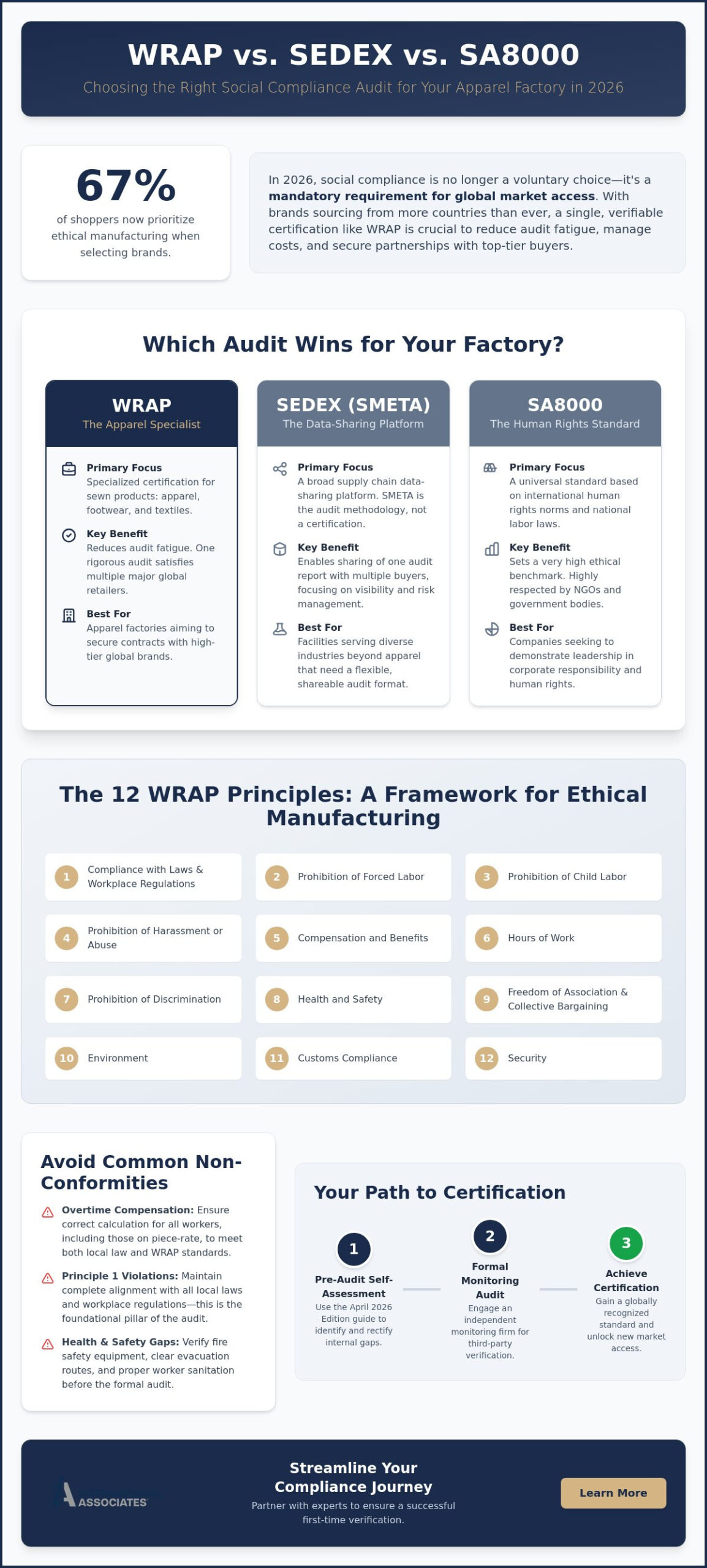
The 12 Principles establish the rigorous operational criteria for any facility pursuing a wrap certification for apparel factories. These principles encompass the entire production lifecycle, starting from the fundamental prohibition of forced labor and extending to sophisticated requirements for customs compliance. Principle 1 acts as the primary pillar, necessitating absolute adherence to local laws and workplace regulations. This legal alignment ensures that the certification process respects the specific statutory requirements of the factory’s host jurisdiction while maintaining international parity. It prevents the application of abstract standards that might conflict with local employment contracts or regional industrial mandates.
Technical infrastructure remains a core focus under Principle 8, which mandates stringent Health and Safety standards. This principle covers fire safety, building integrity, and worker sanitation, which are often high-risk areas in garment manufacturing. Differentiating itself from broader frameworks, WRAP includes Principles 11 and 12, covering Customs Compliance and Security. These principles are vital for facilities exporting to the US and EU, as they provide verification that the supply chain is secure against illegal transshipment and unauthorized access. This level of technical specificity is supported by academic research on labor standards, which highlights how sector-specific audits offer superior risk mitigation compared to generic social assessments.
Platinum, Gold, and Silver: Understanding Certification Levels
Facilities achieve certification at three distinct levels based on their audit performance and history. Silver certification is valid for six months and is granted to facilities that demonstrate substantial compliance but possess minor non-conformities in policies or procedures. Gold certification is the standard one-year award for facilities that satisfy all 12 principles during their audit. Platinum certification, valid for two years, is reserved for mature facilities that have successfully maintained Gold status for three consecutive years without any major non-conformities, reflecting a highly disciplined management system.
Mandatory Compliance Areas for Sewn Products
Certain principles represent zero-tolerance zones where any failure results in immediate audit failure. The prohibition of child and forced labor is absolute and requires no further negotiation. Principles 5 and 6, which govern compensation, benefits, and working hours, require meticulous record-keeping and evidence of legal overtime payments to ensure workers are treated fairly. Principle 10 (Environment) is increasingly scrutinized in 2026, with auditors focusing specifically on textile chemical management and wastewater treatment protocols to ensure the factory’s ecological footprint meets international standards. Facilities seeking to strengthen their environmental evidence trail may also benefit from understanding how to prepare for a Higg FEM audit, as the documentation standards required for FEM 4.0 verification closely mirror the environmental compliance evidence expected under this principle. If your facility requires an initial gap analysis against these principles, scheduling professional social accountability audits can identify non-conformities before the formal certification process begins.
WRAP vs. SEDEX (SMETA) vs. SA8000: Which Audit Wins for Your Factory?
Selecting the optimal social compliance framework requires an objective analysis of your facility’s target markets and primary buyer mandates. While several options exist, the wrap certification for apparel factories remains the definitive specialist standard for the sewn products industry. In contrast, SEDEX (utilizing the SMETA methodology) serves as a broad supply chain tool applicable across various sectors, from agriculture to electronics. SA8000 represents a high-level management system standard, often aligned with ISO principles, designed for facilities seeking a deeply embedded culture of social accountability. Your choice should depend on whether you require an industry-specific “passport” for garment exports or a generic reporting tool for diversified buyers.
Integrating these frameworks with existing management systems like ISO 9001 or ISO 14001 can significantly enhance operational efficiency. A wrap certification for apparel factories often complements these quality and environmental standards by providing the specialized labor oversight that generic ISO audits lack. The WRAP CEO testimony on ethical manufacturing underscores the importance of this industry-focused approach in ensuring that factory-level inspections are both rigorous and relevant to the garment trade. This specialization helps reduce long-term costs by minimizing the need for multiple, overlapping audits from different clients. Facilities operating across multiple product categories, such as those supplying both apparel and jewelry accessories, may also benefit from understanding how sector-specific standards like the RJC certification requirements for jewelers apply similar risk-based compliance principles to their respective supply chains.
WRAP vs. SMETA (SEDEX): The Apparel Sourcing Debate
The fundamental difference between these two systems lies in the output. WRAP is a certification program that issues a formal certificate (Silver, Gold, or Platinum) upon successful verification. SEDEX is a membership platform where factories upload a SMETA audit report for buyers to review. No “certificate” is issued by SEDEX; it is a data-sharing exercise. Consequently, US-based apparel brands frequently mandate WRAP because of its clear certification status, whereas UK and EU retailers often prefer the visibility offered by the SEDEX platform. For a more technical breakdown of these methodologies, consult our SLCP vs SMETA vs SA8000 comparison.
Market Access: When to Choose SA8000 Over WRAP
SA8000 is often the preferred choice for mature facilities that already possess robust management systems. It requires a higher level of institutional commitment, focusing on systemic change rather than just checklist compliance. While WRAP is highly effective for the apparel niche, SA8000 provides a universally recognized management framework that appeals to high-end European brands and institutional investors. Facilities should evaluate their internal readiness before pursuing this standard. If your management system is still developing, starting with WRAP provides a structured path toward ethical excellence. Detailed requirements for this transition are outlined in our SA8000 Social Accountability Audit Guide.
Preparation Guide: Avoiding Common Non-Conformities in WRAP Audits
Achieving a wrap certification for apparel factories requires more than a passive commitment to ethical standards; it demands a rigorous, evidence-based preparation strategy. The most effective method for ensuring success is the execution of a comprehensive internal audit before the formal certification body arrives on-site. This preliminary assessment allows management to identify and remediate technical gaps in a controlled environment. Inconsistencies in working hour records and overtime compensation remain the most frequent causes of audit failure. Facilities must ensure that time-tracking systems are synchronized with payroll disbursements, providing a transparent and verifiable trail for auditors to follow.
Workforce preparation is equally critical. During the audit, independent and confidential interviews are conducted with workers selected at random. Management must ensure that employees feel secure and understand that their honest participation is a protected component of the certification process. Simultaneously, physical infrastructure must meet international safety benchmarks. By utilizing the April 2026 Edition of the WRAP Condensed Pre-Audit Self-Assessment, facilities can better align with the specific requirements of a wrap certification for apparel factories. This includes maintaining unobstructed fire exits, providing appropriate Personal Protective Equipment (PPE) for specific tasks, and ensuring all machinery is equipped with functional safety guards.
Documentation Checklist for Apparel Facilities
Effective record management is the foundation of a successful audit. Facilities should maintain a centralized repository of the following documents to ensure a smooth verification process:
- Payroll and Employment: Accurate wage sheets, social security contributions, and age verification documents to prevent child labor.
- Environmental Compliance: Valid permits, chemical inventory lists, and waste management logs to satisfy Principle 10.
- Safety Records: Documented fire drill certifications and training logs for first aid and hazardous material handling.
Managing the On-Site Audit Process
The formal audit typically involves a facility walkthrough, document review, and worker interviews. Auditors look for physical evidence of compliance that matches the provided documentation. If non-conformities are identified, the facility enters the Corrective Action Plan (CAP) phase. This structured process requires the factory to provide evidence of remediation within a specified timeframe. International Associates leverages its regulatory compliance expertise to help facilities navigate these requirements efficiently, ensuring that every technical finding is addressed with a sustainable, long-term solution. To verify your facility’s readiness and minimize the risk of failure, you can contact our team for a professional social accountability audit.
Partnering with International Associates for WRAP Certification
International Associates provides the institutional weight and technical precision required to secure a wrap certification for apparel factories. Our operational model combines centralized UK-based oversight with a sophisticated network of international offices. This structure ensures that every inspection is conducted with the same level of rigorous impartiality, regardless of the facility’s geographic location. By maintaining a central administrative base in Glasgow, we provide a stable point of contact for global brands while deploying specialized regional auditors who understand local industrial contexts. This approach creates an atmosphere of security for businesses seeking to navigate complex regulatory landscapes.
We prioritize efficiency through advanced IT infrastructure, enabling quick report turnaround times and secure data management. This technological edge reduces the administrative burden on factory management, allowing for a more focused assessment process. Our commitment to independence means that our verifications are authoritative and trusted by high-tier apparel retailers. We don’t just provide a certificate; we act as a guardian of standards, ensuring that your compliance data is robust enough to withstand the scrutiny of international regulatory bodies. This earned confidence allows our clients to focus on their international growth while we handle the complexities of verification.
Global Reliability, Local Expertise
Our Glasgow head office serves as the strategic hub for regional auditing teams operating throughout Asia and the Middle East. This global-local duality is essential for facilities that require a certification body capable of handling complex, high-stakes inspections across diverse legal landscapes. Independent assurance is a foundational pillar of brand identity for global stakeholders, and our presence provides the necessary proof of competence. For facilities seeking to streamline their operations, we offer integrated audit solutions that align your social compliance with broader Management System Certification. This holistic approach ensures that quality, environmental, and social standards are managed through a single, methodical framework.
Start Your Compliance Journey Today
Initiating the process for a wrap certification for apparel factories begins with a formal request for an initial assessment. Our team evaluates your facility’s current status and provides a clear roadmap for the certification cycle. Beyond the initial award, we provide ongoing support through annual surveillance and recertification audits to ensure sustained adherence to the 12 Principles. This structured approach builds procedural integrity and long-term stability for your factory. If you’re ready to attract high-tier global brands and secure your market position, contact our team for a professional consultation on social accountability audits. We act as the steady hand that helps you meet complex global regulations without unnecessary friction or ambiguity.
Future-Proofing Your Facility Through Independent Verification
The global sourcing landscape in 2026 demands a shift from generic compliance to industry-specific excellence. Securing a wrap certification for apparel factories ensures your facility meets the specialized technical and ethical requirements mandated by high-tier global retailers. We’ve analyzed how this framework provides a definitive passport to international markets, particularly when compared to broader tools like SEDEX or management-focused standards like SA8000. By prioritizing meticulous documentation and addressing common non-conformities in working hours and safety, your facility establishes a foundation of procedural integrity and buyer trust.
International Associates acts as your steady partner in this complex regulatory environment. From our UK-based Glasgow Head Office, we coordinate a global network of accredited social auditors who are recognized specialists in apparel and textile compliance. Our independent verification processes provide the authoritative proof of competence required to navigate the 2026 supply chain with confidence. We’re committed to helping your business achieve its international growth objectives through rigorous and ethical auditing. Secure your factory’s global market access with WRAP certification from International Associates. Your commitment to these standards today defines your operational stability for years to come.
Frequently Asked Questions
How long does it take to get WRAP certification for an apparel factory?
The process typically requires six weeks to six months, depending on the facility’s initial level of compliance and the time needed to remediate non-conformities. Facilities must first register and complete a self-assessment before an accredited monitoring firm conducts the on-site audit. The final certification decision is issued by WRAP after reviewing the audit report and verifying that all technical requirements are satisfied.
What is the difference between WRAP Gold and Platinum certification?
Gold certification is the standard one-year award for facilities that demonstrate full compliance with the 12 Principles during their audit. Platinum certification is a two-year award reserved for mature facilities that have successfully maintained Gold status for three consecutive years. This higher designation reflects a sustained commitment to ethical manufacturing and a management system that consistently operates without major non-conformities.
Can a factory transfer its WRAP certification to a different auditing body?
A facility can choose any WRAP-accredited monitoring firm to conduct its audit for each certification cycle. While the certificate is issued to the facility itself, the choice of auditing body can be changed before the start of a new audit process. This flexibility allows factory owners to select partners that offer the best regional expertise or integrated management system solutions for their specific needs.
Is WRAP certification mandatory for selling apparel in the United States?
While not a legal requirement from the United States government, a wrap certification for apparel factories is commercially mandatory for many high-tier US retailers. Most major brands require independent verification of social compliance as a condition of their sourcing agreements. This certification serves as a primary tool for satisfying private sector due diligence requirements and mitigating high-stakes supply chain risks.
How much does a WRAP audit cost for a medium-sized factory?
The total investment consists of a registration fee paid to WRAP and a separate audit fee paid to the accredited monitoring firm. Registration fees are structured based on worker count, ranging from $650 for facilities with 100 or fewer workers to $1,550 for those with over 1,001 employees. Audit fees vary based on the duration of the inspection and the geographic location of the apparel facility.
What happens if a factory fails a WRAP audit principle?
If a facility fails to meet a specific principle, it must implement a Corrective Action Plan (CAP) to remediate the finding within a specified timeframe. For minor non-conformities, a follow-up audit or desk review may be required to verify the improvements. However, zero-tolerance violations such as forced labor or child labor result in the immediate denial or revocation of the certification without opportunity for immediate remediation.
How often do WRAP surveillance audits occur?
Surveillance audits occur unannounced at any time during the validity period of the certificate to ensure continuous adherence to the 12 Principles. While Gold and Silver certificates require annual or semi-annual renewal, WRAP reserves the right to conduct random spot checks. These unannounced visits are essential for maintaining the integrity of the certification and ensuring that standards don’t lapse between formal audit cycles.
Does WRAP certification cover environmental sustainability?
Principle 10 specifically addresses environmental compliance, requiring facilities to adhere to local laws and international standards regarding waste management and chemical handling. This principle ensures that the wrap certification for apparel factories covers essential ecological safeguards alongside social accountability. It increasingly focuses on textile-specific impacts, such as wastewater treatment and the safe disposal of hazardous substances used in dyeing and finishing processes.